The de Broglie wall and the fluid shortcut
The resolution requirement
A wave solver must resolve the local de Broglie wavelength $\lambda_{\rm dB}=\hbar/(mv)$, whose oscillation frequency scales with the local velocity. Unlike an N-body code, whose resolution can degrade gracefully in voids, the wave carries phase information that must be resolved wherever the velocity is high — i.e. in and around every halo.
The cost explosion
The number of grid cells to follow a box of size $L$ scales as
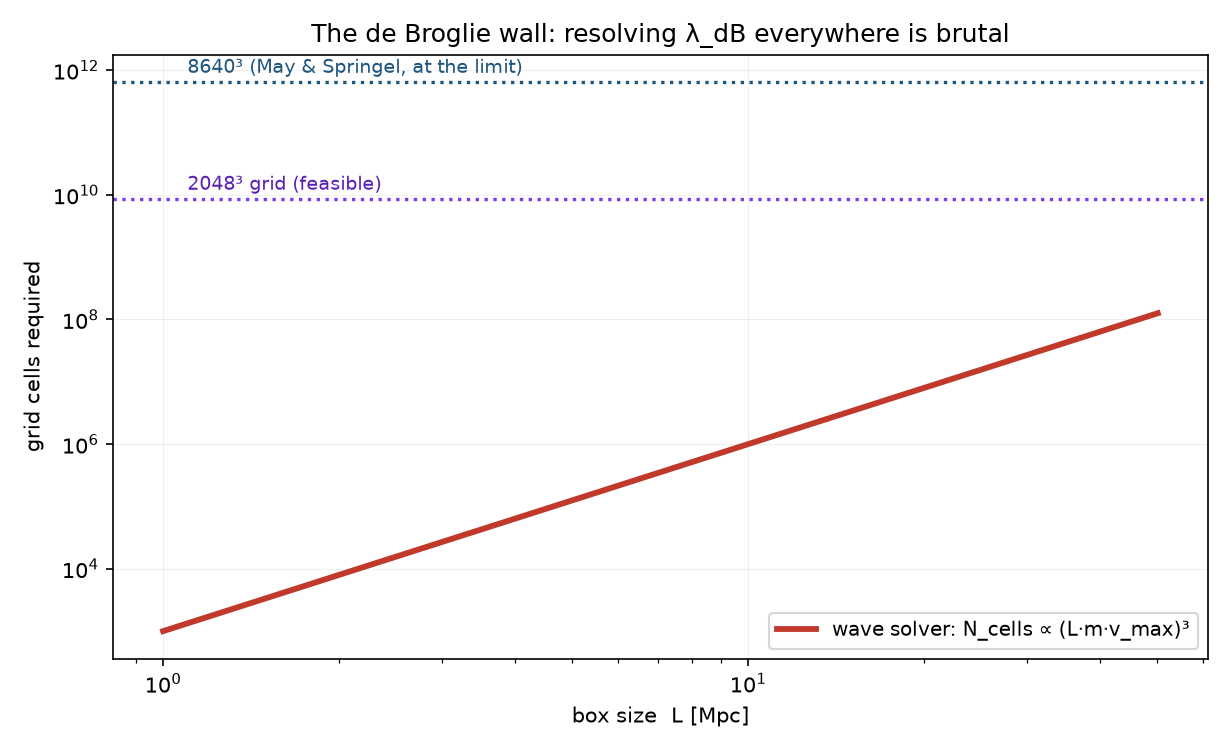
$$N_{\rm cells}\propto\left(\frac{L\,m\,v_{\max}}{\hbar}\right)^3 ,$$rising steeply with both box size and the largest velocity (hence halo mass). Resolving small waves and simulating a fair volume pull in opposite directions — and it is this tension, not raw floating-point cost, that has bounded the field (figure).
Count the cells a wave solver needs:
- Resolution requirement: $\Delta x\lesssim\lambda_{\rm dB}/2=\pi\hbar/(m\,v_{\max})$ — resolve the fastest waves.
- Cells per dimension: $N_{1D}=L/\Delta x\sim L\,m\,v_{\max}/(\pi\hbar)$.
- In 3D: $N_{\rm cells}=N_{1D}^3\propto\left(\dfrac{L\,m\,v_{\max}}{\hbar}\right)^3$.
- Worse still: $v_{\max}\propto\sqrt{M_h}$ grows with the largest halo, so at fixed resolution the cost climbs faster than $L^3$.
Doubling the box more than octuples the cost, and a heavier boson makes it worse. This cubic-plus wall — not raw speed — is why converged wave cosmology tops out near $\sim10$ Mpc boxes.
The current record is May & Springel's $8640^3$-effective 10 Mpc/h boxes. Our GAMER 20 Mpc zoom hit the MAX_PATCH memory ceiling at $z\approx11$–$12$: as halos deepened, the granule field demanded refinement everywhere, and the patch count exploded past the GPU memory. We broke the single-GPU limit with an 8×H100 MPI run (11M→22M patches) but the wall is fundamental, not a bug.
The Madelung/fluid shortcut
One escape: solve the Madelung fluid equations (Topic 3.5) with a quantum-pressure force added to smoothed-particle hydrodynamics (e.g. AX-GADGET). This reaches large volumes at N-body cost — but discards interference, granules, and the genuine soliton ground state. It captures the smoothed potential well, but not the granular quantities that depend on resolving $\lambda_{\rm dB}$.
What converges cheaply, what doesn't
The SP→Vlasov correspondence (Topic 4.5) is the guide: smoothed, potential-level quantities (large-scale density, the mass function's high-mass end) converge relatively cheaply, while granular quantities (core masses, granule amplitudes, heating rates) demand the de Broglie scale be genuinely resolved. Knowing which is which is essential to trusting a wave simulation.
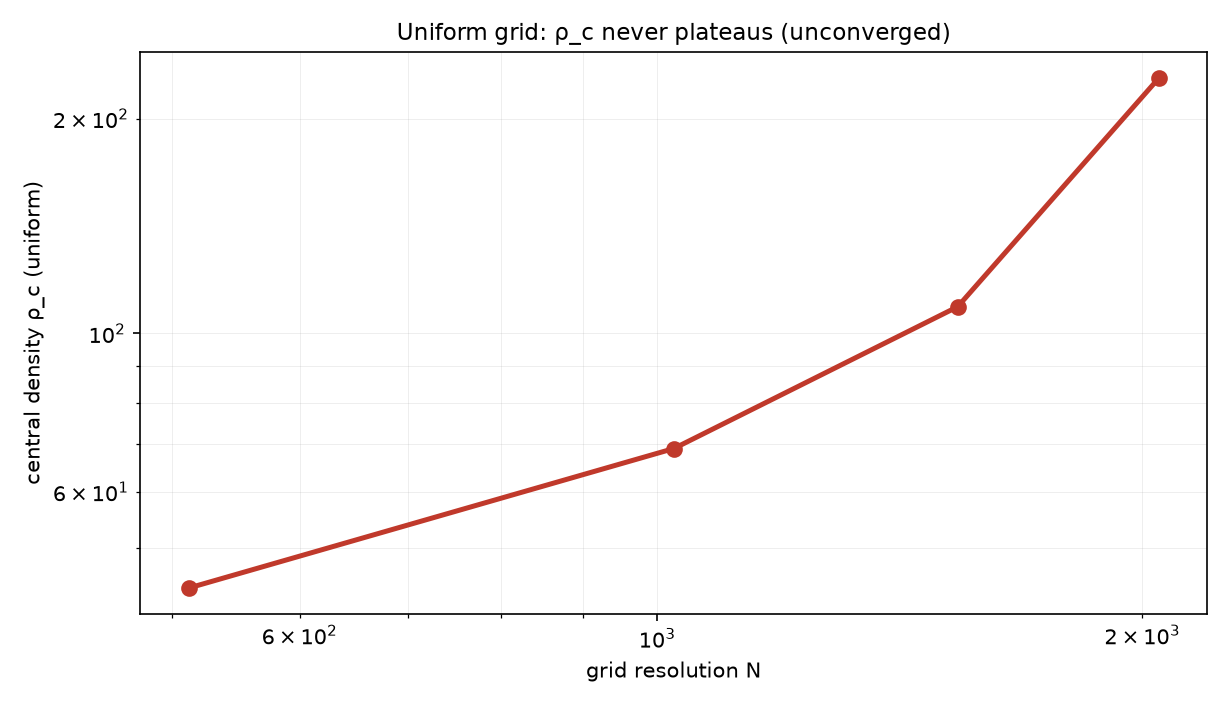
This wall is why our GAMER 20 Mpc zoom couldn't settle $\beta$ (it walled at $z\approx11$–$12$), forcing the core–halo headline onto JAXiON's soliton-fit. Breaking it (the 8×H100 MPI run) yielded $M_{\min}$ and delayed collapse. It also frames why quantum-computing methods (Topic 11.1) are of interest — they attack the same phase-space cost.
- Hui, Ostriker, Tremaine & Witten (2017), Phys. Rev. D 95, 043541 (arXiv:1610.08297).
- May & Springel (2021, 2023), MNRAS 506, 2603 & 524, 4256.
- Nori & Baldi (2018), AX-GADGET, MNRAS 478, 3935 (arXiv:1801.08144).