The SP → Vlasov–Poisson correspondence (the classical limit)
Two descriptions of gravitating matter
Cold dark matter is a collisionless gas obeying the Vlasov–Poisson equations for the phase-space distribution $f(\mathbf x,\mathbf p,t)$. Fuzzy dark matter is a wave obeying Schrödinger–Poisson. These look completely different — a distribution function versus a complex field — yet they describe the same gravitating matter in overlapping regimes.
The Husimi bridge
The link is a phase-space smoothing (the Husimi/Wigner transform) that turns the wavefunction into an effective distribution function on scales coarser than the de Broglie wavelength. Mocz et al. (2018) proved that as $\hbar/m\to0$ the SP dynamics converges to Vlasov–Poisson: the gravitational potential of the wave approaches the classical collisionless answer.
Agreement on large scales
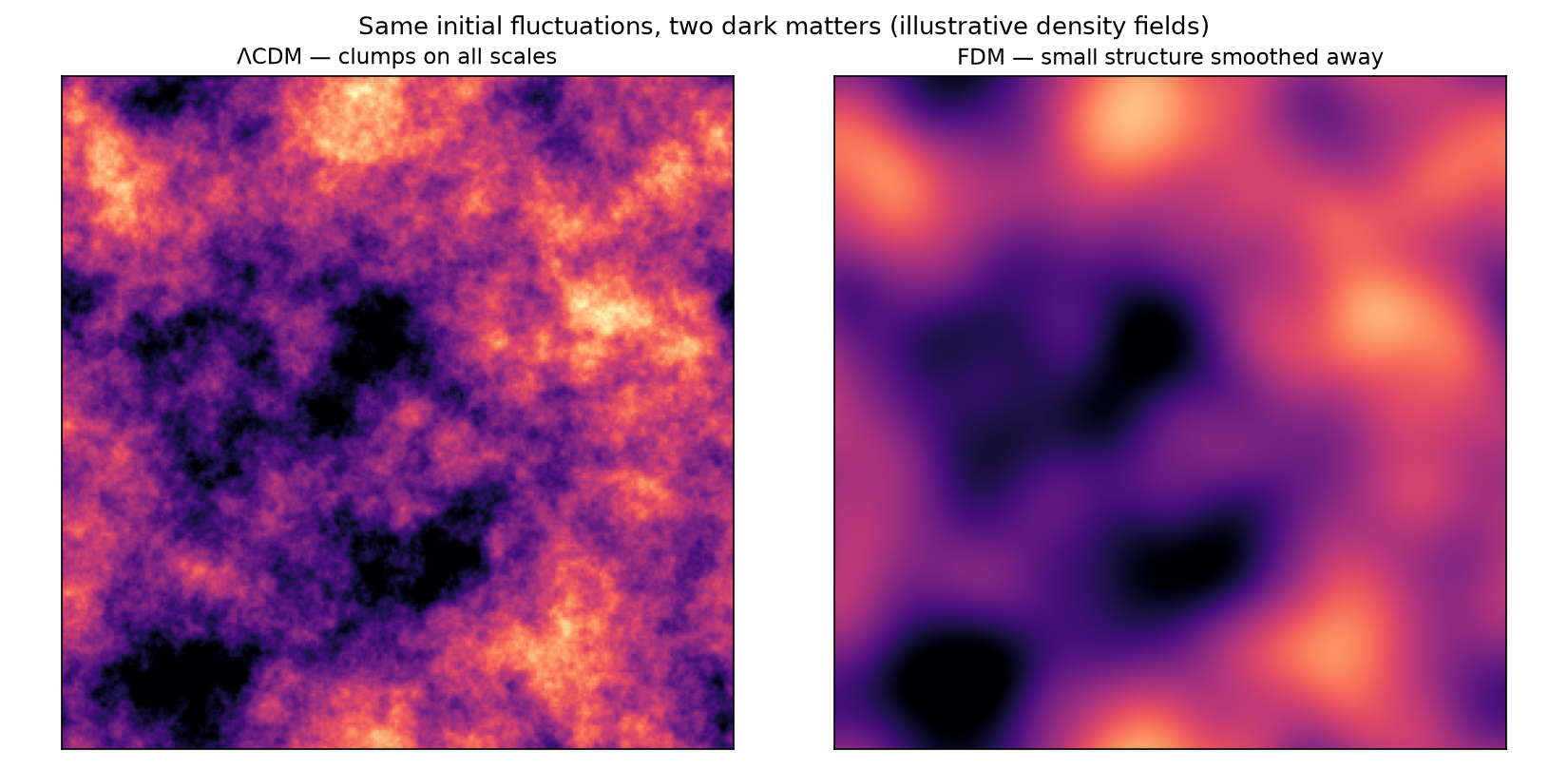
This is why FDM and CDM give the same cosmic web, the same big halos, the same large-scale power spectrum (figure). Above the de Broglie scale the wave's granular texture averages out and it behaves as a classical collisionless fluid. The correspondence guarantees the agreement — it is not a coincidence.
Where they must differ
The correspondence also pinpoints the differences: they live precisely where $\hbar/m$ cannot be neglected — on scales near and below the de Broglie wavelength. There the wave retains order-unity interference fringes and quantum pressure at all resolutions, producing the soliton core and the small-scale cutoff. Smoothed quantities (potentials, large-scale density) converge cheaply; granular quantities (core masses, granule amplitudes) demand that the de Broglie scale be genuinely resolved.
The classical Vlasov problem is so costly ($O(n_{\rm gr}^6)$ memory for a 6-D phase space) that Miyamoto et al. (2024) proposed a quantum algorithm to solve it. Because FDM's classical limit is this Vlasov dynamics, quantum-computational methods for phase-space cosmology are a long-horizon route to the same physics — the adjacent frontier catalogued in our literature survey (§24.6).
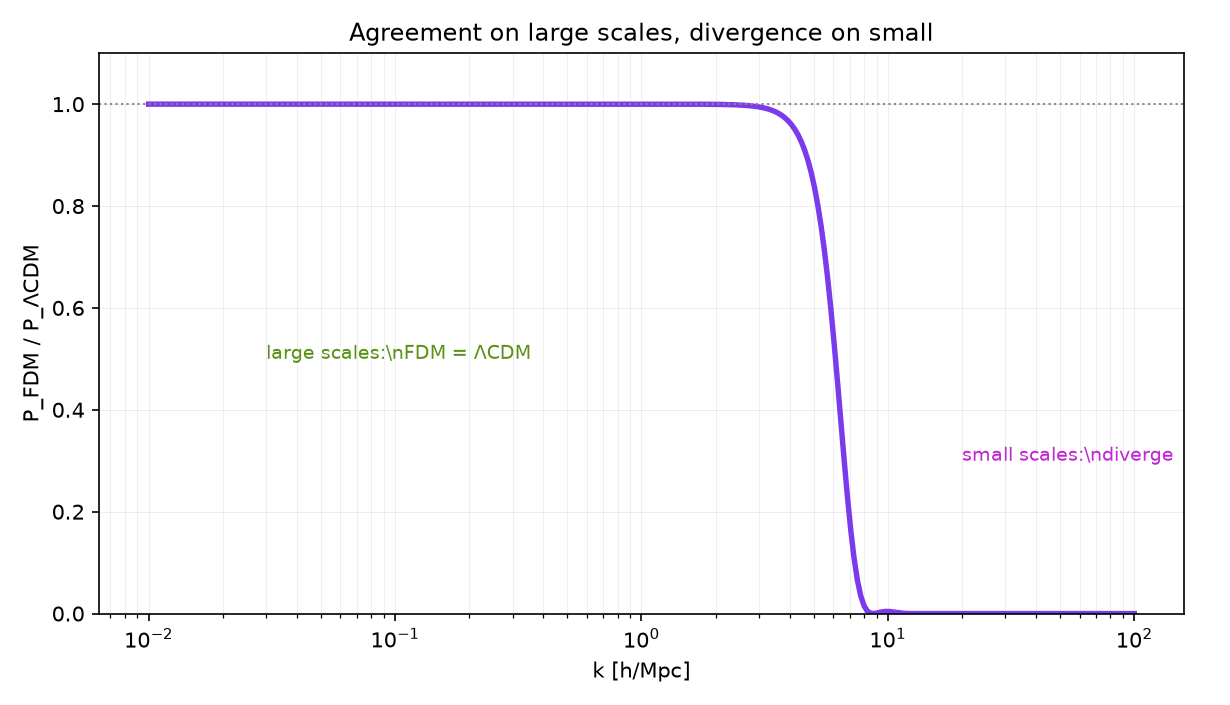
This correspondence is the logical backbone of the whole comparison: it is why GADGET-4 (a Vlasov/N-body CDM code) is a valid control for our wave codes, and why our figures show FDM and CDM identical at high mass and divergent below the cutoff. It also frames the practical challenge (Topic 9.5): smoothed quantities converge easily, granular ones do not.
- Mocz et al. (2018), SP–VP correspondence, Phys. Rev. D 97, 083519 (arXiv:1801.03507).
- Widrow & Kaiser (1993), Using the Schrödinger equation to simulate CDM, ApJ 416, L71.
- Miyamoto et al. (2024), Quantum algorithm for the Vlasov simulation, Phys. Rev. Research 6, 013200 (arXiv:2310.01832).