The FDM halo: soliton core + NFW envelope
The composite profile
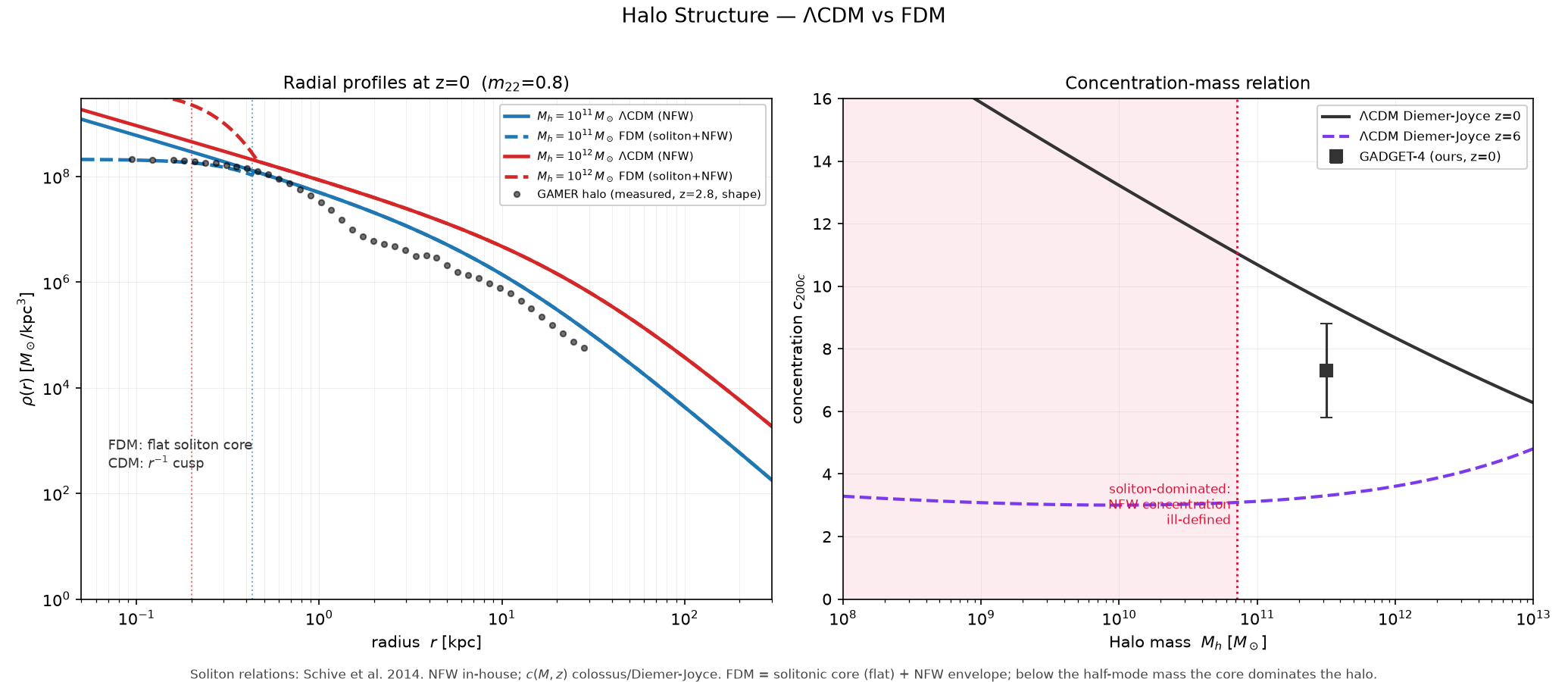
The spherically-averaged FDM density follows the flat Schive soliton (Topic 5.2) inside a transition radius of a few $r_c$, then matches onto an NFW envelope outside (figure). Concretely we build it as the soliton core replacing the cusp, joined continuously to the NFW form where the two cross — a ‘core + envelope’ model with one extra parameter (the core mass) beyond NFW.
Where the theories agree and differ
Outside a few core radii the FDM and CDM profiles are identical — the soliton is a central modification only. The difference is confined to the inner kiloparsec, where FDM is flat and CDM diverges. This is why FDM passes all the large-scale tests that $\Lambda$CDM passes, and is only distinguishable in halo centres.
Building it for Task 2
The core radius scales as $r_c\propto m^{-1}(M_h/10^9)^{-1/3}$ (at fixed $z$), so at $z=0$ for $m_{22}=0.8$: a $10^{11}\,M_\odot$ halo has $r_c\approx0.43$ kpc, a $10^{12}$ halo $r_c\approx0.20$ kpc. The core shrinks as the halo grows — so the departure from NFW is largest in low-mass halos, exactly where it is observationally accessible. Our Task-2 profile figure plots this at $z=0$ where the soliton clearly dominates the centre.
Combine the core–halo relation with the definition of the fraction:
- Core–halo relation: $M_c\propto M_h^{1/3}$ (Topic 8.5).
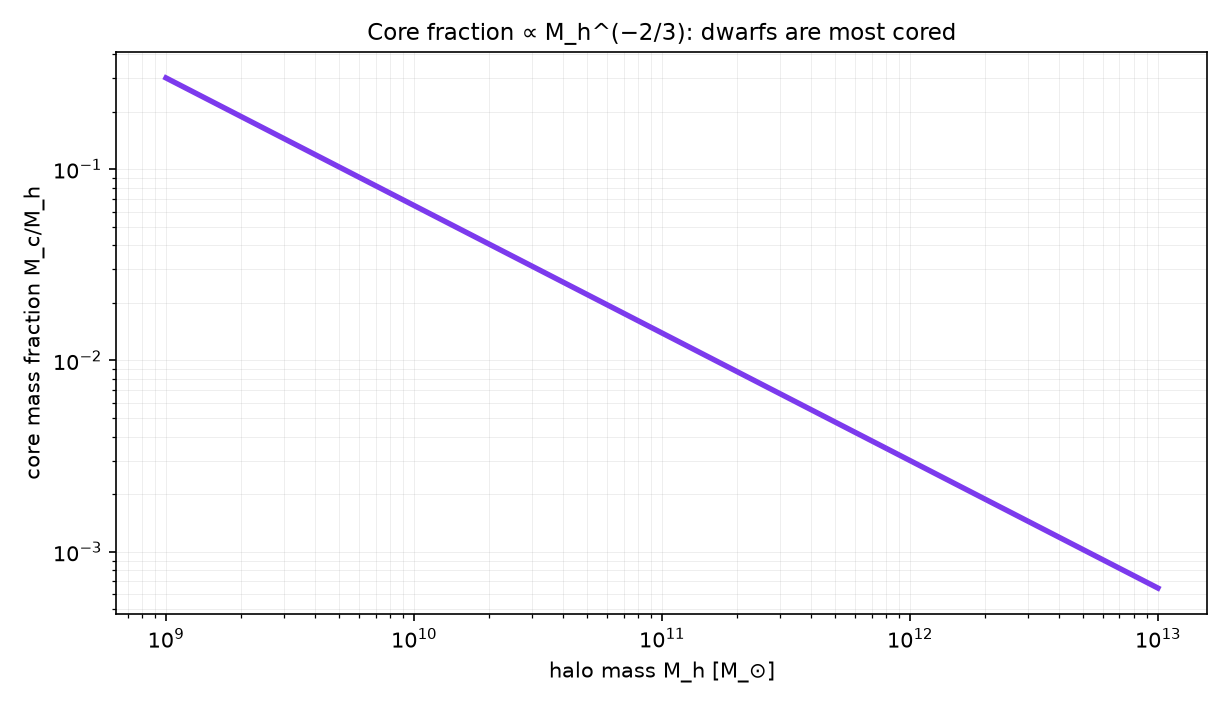
- Core fraction: $f_c\equiv M_c/M_h\propto M_h^{1/3}/M_h=M_h^{-2/3}$.
- So a $10^3\times$ heavier halo has a core fraction $10^{-2}$ as large: $(10^3)^{-2/3}=10^{-2}$.
Numerically: a $10^{9}\,M_\odot$ dwarf can be tens-of-percent core by mass, while a $10^{12}\,M_\odot$ galaxy is $\lesssim0.1\%$ core. This steep decline is why FDM's cored signature is a dwarf-galaxy phenomenon — and why the dwarf cores of Topic 10.1 are the sharpest test.
Resolving both pieces
A simulation must resolve two very different scales at once: the sub-kpc soliton and the tens-of-kpc envelope. This is the crux of the de Broglie resolution wall (Topic 9.5). Our GAMER adaptive mesh resolves the core (up to $\sim22$ cells across $r_c$) while capturing the envelope, and a measured GAMER profile traces the cored shape.
This composite profile is precisely what our Task-2 figure shows: NFW cusp vs soliton-core+NFW, with a real GAMER halo overlaid to confirm the cored shape and our GADGET-4 point anchoring the CDM $c(M)$. The core size comes from the core–halo relation (next), which we measure at $\beta\approx\tfrac13$.
- Schive, Chiueh & Broadhurst (2014), Nature Physics 10, 496 (arXiv:1406.6586).
- Mocz et al. (2017), MNRAS 471, 4559 (arXiv:1705.05845).
- Chan, Schive et al. (2022), MNRAS 511, 943.