The uncertainty principle and quantum pressure
Heisenberg's trade-off
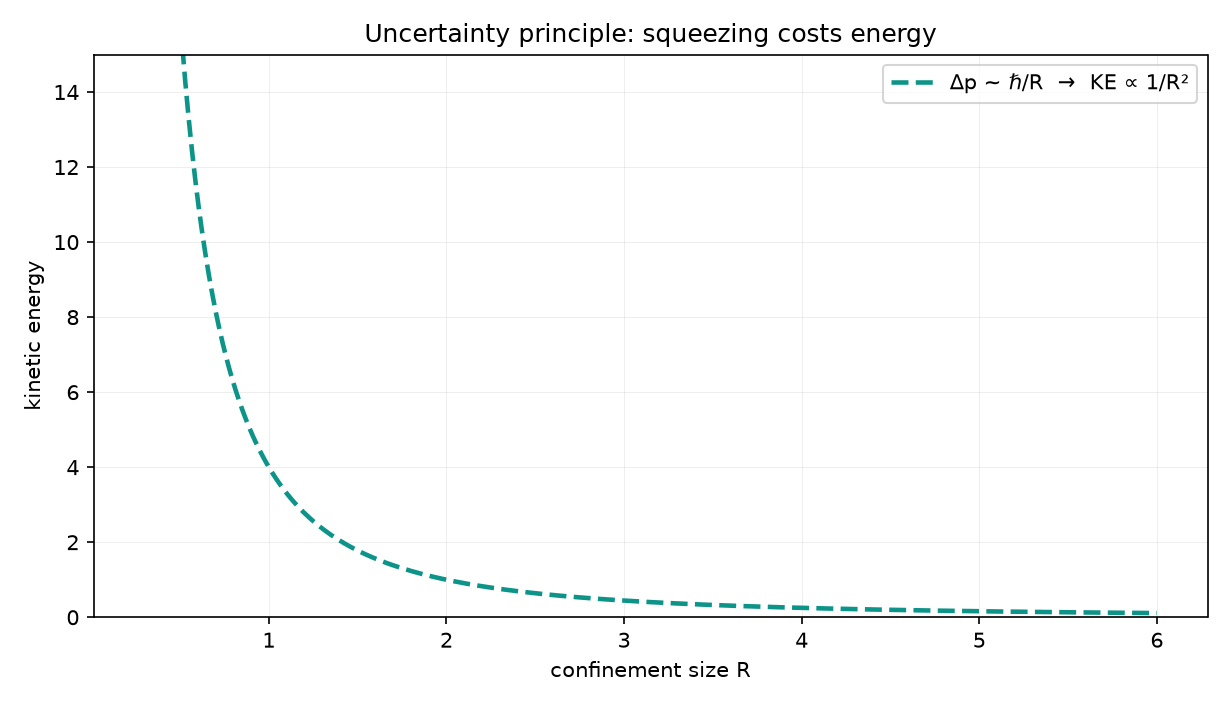
The uncertainty principle $\Delta x\,\Delta p\gtrsim\hbar/2$ says that localizing a wave to size $R$ forces a momentum spread $\Delta p\gtrsim\hbar/R$, hence a kinetic energy per unit mass $\sim(\Delta p)^2/2m^2\sim\hbar^2/2m^2R^2$. Squeeze the wave and this energy shoots up — the wave pushes back.
Quantum pressure
In the fluid picture (Topic 3.5) this appears as an extra force, the gradient of the quantum pressure term
$$Q=-\frac{\hbar^2}{2m^2}\frac{\nabla^2\sqrt{\rho}}{\sqrt{\rho}} .$$It has no thermal or collisional origin — it is pure wave mechanics — but it acts like a pressure that opposes gravitational compression, and it is the single new ingredient distinguishing fuzzy from cold dark matter.
Balancing gravity: a core of finite size
Consider a self-gravitating blob of mass $M$ and size $R$. Its energy per unit mass is the sum of the quantum (kinetic) term and the gravitational term,
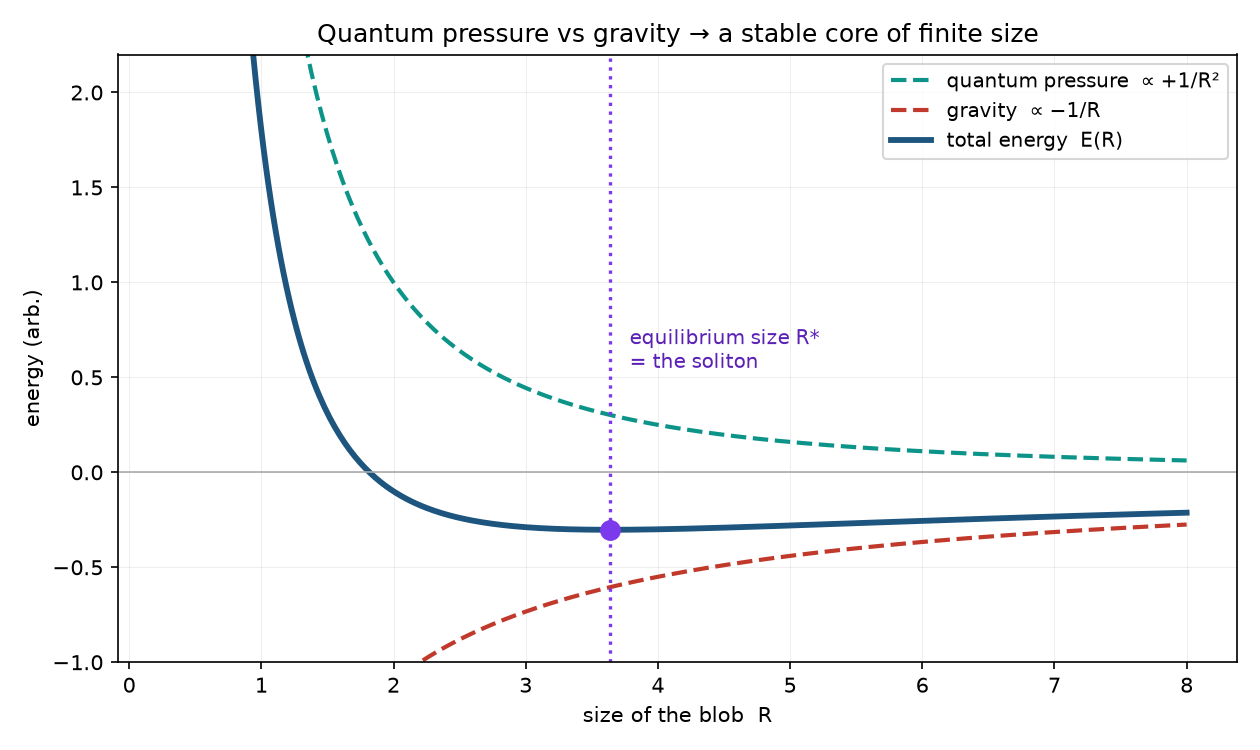
$$E(R)\sim\underbrace{\frac{\hbar^2}{2m^2R^2}}_{\text{quantum, }+1/R^2}-\underbrace{\frac{GM}{R}}_{\text{gravity, }-1/R}.$$Gravity wants $R\to0$; quantum pressure forbids it. The competition (figure) has a minimum at a finite radius $R_\ast$ — a stable, cored configuration. That configuration is the soliton.
Minimizing $E(R)$ ($dE/dR=0$) gives $R_\ast\sim\hbar^2/(Gm^2M)$. For a core mass $M\sim10^{8}\,M_\odot=2\times10^{38}$ kg and $m=1.8\times10^{-58}$ kg:
$$R_\ast\sim\frac{(1.05\times10^{-34})^2}{(6.67\times10^{-11})(1.8\times10^{-58})^2(2\times10^{38})}\approx2.6\times10^{19}\ {\rm m}\approx0.8\ {\rm kpc}.$$A back-of-envelope balance predicts a $\sim$kiloparsec core — and reproduces the inverse relation $R_\ast\propto1/(m^2M)$ that the exact Schive soliton obeys (Topic 5.2). The full solver just sharpens the coefficient.
Take the energy per unit mass and find its minimum:
- $E(R)=\dfrac{\hbar^2}{2m^2R^2}-\dfrac{GM}{R}$ (quantum $+1/R^2$, gravity $-1/R$).
- Set $\dfrac{dE}{dR}=-\dfrac{\hbar^2}{m^2R^3}+\dfrac{GM}{R^2}=0$.
- Solve: $\dfrac{GM}{R^2}=\dfrac{\hbar^2}{m^2R^3}\Rightarrow R_\ast=\dfrac{\hbar^2}{Gm^2M}$.
- Check it is a minimum: $E(R_\ast)=-\dfrac{G^2m^2M^2}{2\hbar^2}<0$ — a genuine bound state.
The result $R_\ast\propto1/(m^2M)$ is the exact scaling of the Schive soliton (Topic 5.2): heavier boson or heavier core $\Rightarrow$ smaller radius. The variational estimate captures the physics; the numerical solve fixes the $O(1)$ coefficient.
The two consequences
The same quantum pressure that cores the centre also forbids structure below a minimum mass (nothing smaller than the Jeans scale can hold together). One mechanism, two signatures: cored halos and a small-halo cutoff — the whole of Tasks 1 and 2.
This heuristic is the physical heart of the campaign. Our JAXiON imaginary-time solver finds the exact $R_\ast$ (the Schive profile, reproduced to $<1\%$), and the $R_\ast\propto1/(m^2M)$ scaling derived above is exactly the $M_c\,r_c=$ const relation we use in Task 2. The minimum-mass consequence is the $M_{\min}\approx3\times10^8\,M_\odot$ our GAMER runs measure.
- Hui, Ostriker, Tremaine & Witten (2017), Phys. Rev. D 95, 043541 (arXiv:1610.08297).
- Chavanis (2011), Mass–radius relation of Newtonian self-gravitating BECs, Phys. Rev. D 84, 043531.
- Schive, Chiueh & Broadhurst (2014), Nature Physics 10, 496 (arXiv:1406.6586).