Quantum algorithms for cosmological simulation
The classical bottleneck
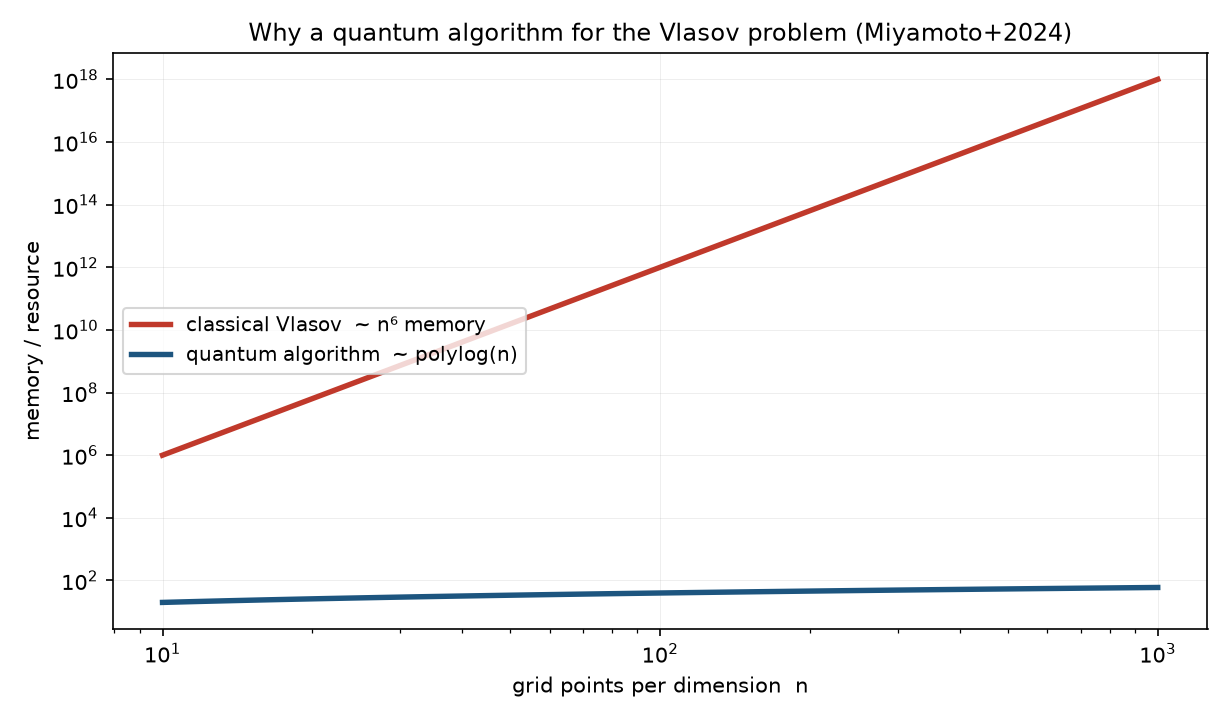
The Vlasov equation governs the phase-space distribution of collisionless matter (and, in the classical limit, of FDM — Topic 4.5). Solving it on a grid means storing a function of six phase-space coordinates: gridding each with $n_{\rm gr}$ points costs $O(n_{\rm gr}^6)$ memory (figure). This is brutal — even modest resolution exhausts the largest classical machines.
The quantum idea
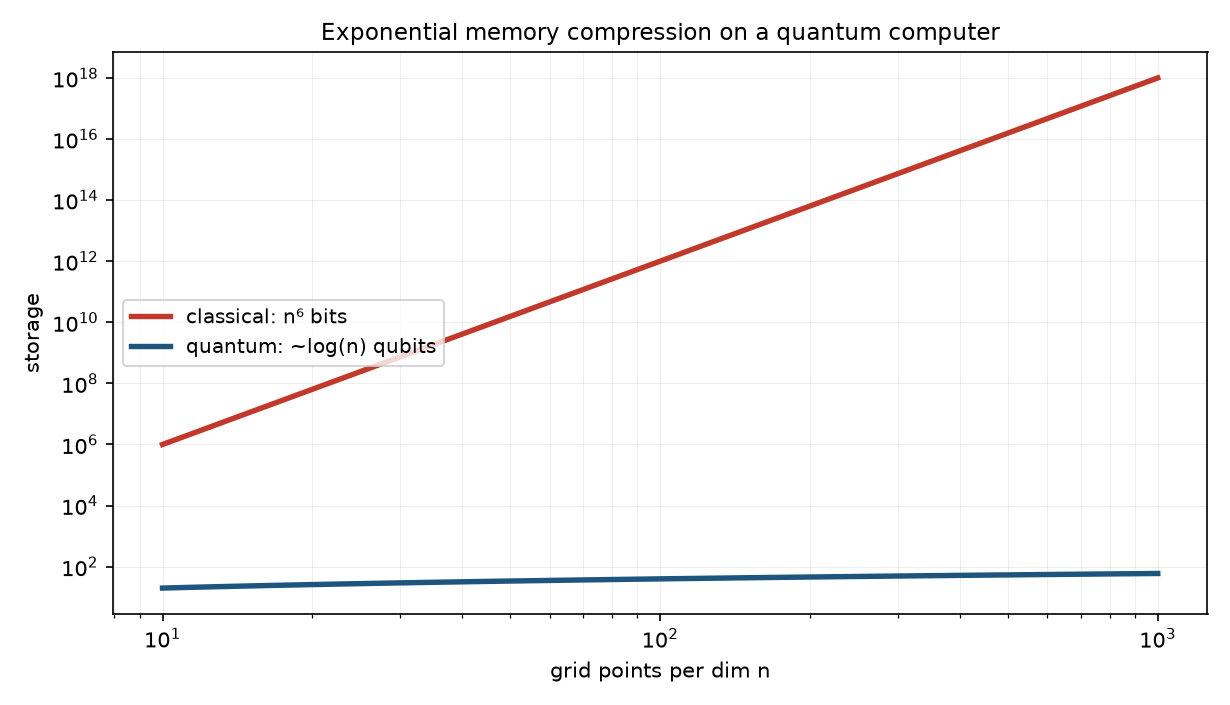
Miyamoto et al. (2024) propose a quantum algorithm for exactly this problem in the massive-neutrino sector of structure formation. By linearizing the Vlasov equation (neglecting weak self-gravity) and casting the evolution as a Hamiltonian simulation, they show the phase-space PDE could be advanced with exponentially smaller memory — encoding the $n_{\rm gr}^6$ grid in $O(\log)$ qubits.
The connection to FDM
FDM's classical limit is the Vlasov dynamics (the SP→Vlasov correspondence, Topic 4.5). So a quantum algorithm for the cosmological Vlasov problem is a long-horizon route to the same phase-space physics that defines fuzzy dark matter. It is a proof of principle, not a running simulation, and it targets neutrinos rather than the wave field — but it marks the entry of quantum computing into structure-formation cosmology.
Where it stands
This is early-stage and requires fault-tolerant quantum hardware that does not yet exist. We catalogue it as an adjacent frontier (in our literature survey, §24.6): a possible future tool for the de-Broglie-wall problem (Topic 9.5) that presently bounds the whole field.
This is one of the two frontier papers Sandro flagged (Miyamoto et al. 2024, catalogued in our literature survey §24.6 and Papers tab). It connects to the campaign through the SP→Vlasov correspondence (Topic 4.5) and offers a long-horizon route past the de Broglie wall (Topic 9.5).
- Miyamoto et al. (2024), Quantum algorithm for the Vlasov simulation, Phys. Rev. Research 6, 013200 (arXiv:2310.01832).
- Mocz et al. (2018), Phys. Rev. D 97, 083519 (arXiv:1801.03507).
- Costa et al. (2019), Quantum algorithm for the wave equation, Phys. Rev. A 99, 012323.