Cold dark matter and its small-scale problems
A triumph with cracks
$\Lambda$CDM reproduces the CMB, the large-scale galaxy distribution, cluster abundances, and lensing to remarkable precision. The tensions all live on small scales — precisely where the nature of the dark-matter particle should matter most, and precisely where fuzzy dark matter predicts departures.
The cusp–core problem
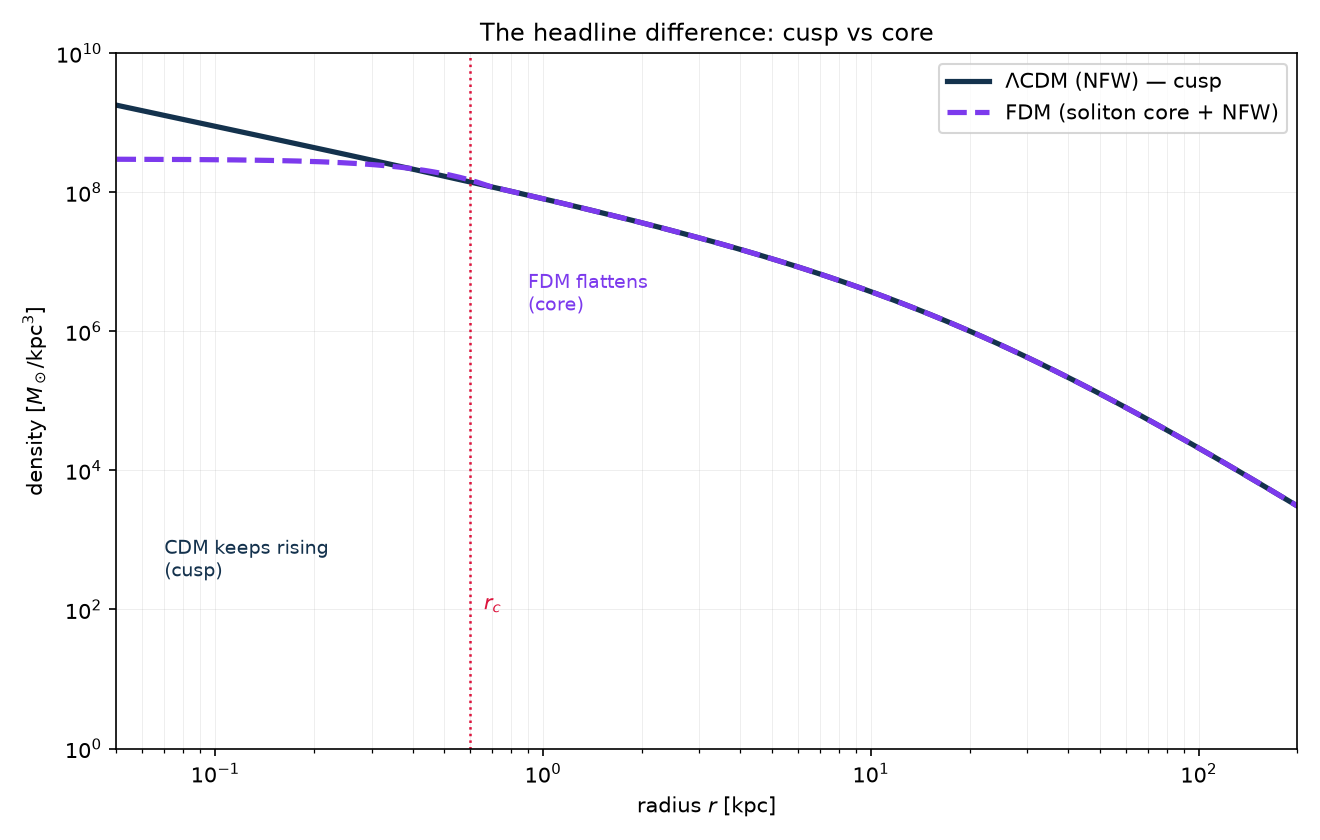
Simulations of pure cold dark matter produce halos with a central density cusp ($\rho\propto r^{-1}$, the NFW form, Topic 8.1). Yet the rotation curves and stellar kinematics of many dwarf galaxies prefer flat central cores of roughly constant density. The figure contrasts the two. This mismatch — cusp predicted, core observed — is the longest-standing small-scale tension.
Missing satellites and too-big-to-fail
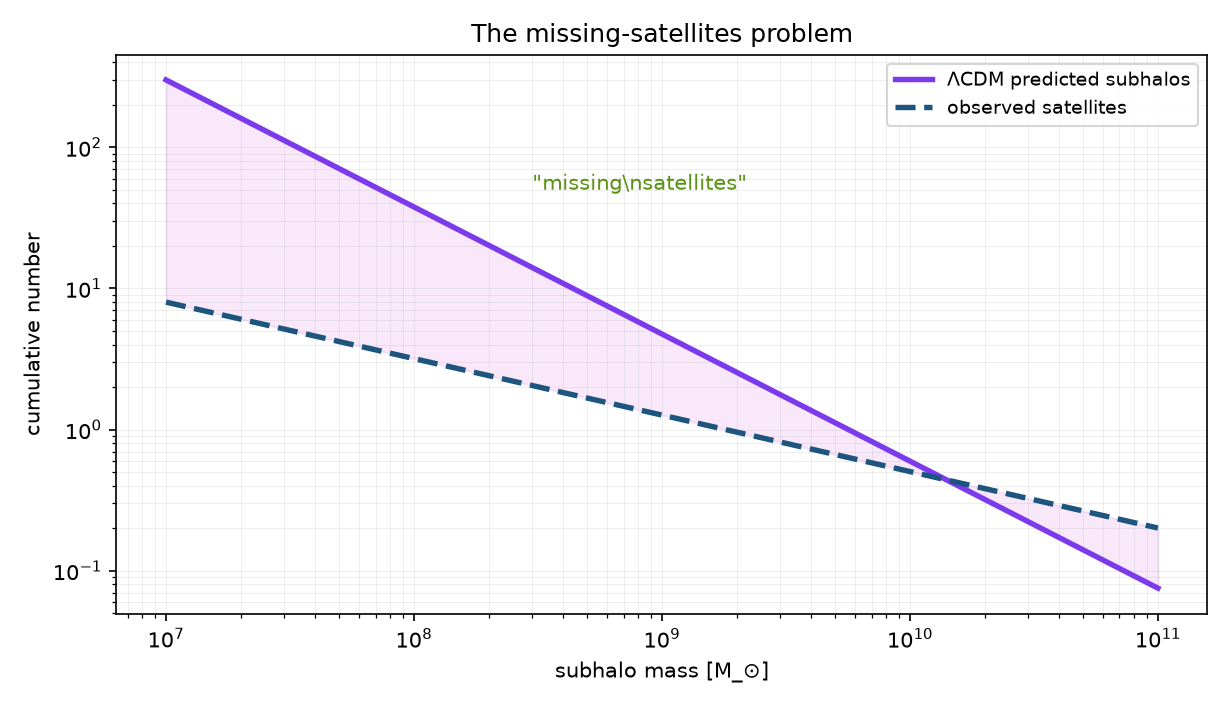
Cold dark matter predicts a teeming population of low-mass subhalos — many more than the observed satellite galaxies of the Milky Way (the missing-satellites problem) — and predicts the most massive subhalos to be denser than the brightest observed dwarfs seem to allow (too-big-to-fail). Both point to a deficit or softening of structure at low mass.
Baryons, or new physics?
These tensions may be resolved by baryonic astrophysics — supernova feedback can flatten cusps, and reionization can suppress small-galaxy formation. Or they may signal that dark matter is not perfectly cold. Fuzzy dark matter is the second route: its quantum pressure naturally produces cores (the soliton) and naturally suppresses low-mass halos (the cutoff), addressing all three tensions with a single parameter, the boson mass.
Why does CDM generically cusp as $\rho\propto r^{-1}$, and why can only new physics stop it?
- Collisionless collapse conserves phase-space density (Liouville's theorem); the coarse-grained maximum can only decrease.
- Self-similar infall onto a seed gives a power-law inner profile $\rho\propto r^{-\gamma}$, with $\gamma$ set by the fluctuation spectrum.
- For CDM's near-scale-invariant spectrum, simulations converge on $\gamma\to1$ inward — the NFW cusp; the density formally diverges though the enclosed mass $\propto r^{2}$ stays finite.
- FDM caps the phase-space density via Heisenberg ($\Delta x\,\Delta p\gtrsim\hbar$): $\rho$ cannot exceed the soliton's central value, so the cusp is replaced by a flat core.
The cusp is a robust outcome of purely collisionless physics; breaking it requires a genuinely new ingredient — quantum pressure — which is exactly what FDM supplies.
Milky Way satellites inhabit halos of $\sim10^{8}$–$10^{10}\,M_\odot$. For our fiducial boson ($m_{22}=0.8$) the half-mode mass is $M_{1/2}\approx5\times10^{10}\,M_\odot$ — right at the top of that range. FDM therefore strongly suppresses exactly the mass scale where the satellites are "missing", which is why the small-halo cutoff is such a sensitive test of the boson mass.
Why does the cusp/core distinction couple to the number of observed satellites? Through central density and tides:
- A cuspy NFW subhalo has a high central density, so it survives tidal stripping by the host and stays detectable.
- A cored subhalo (FDM) has lower central density $\rho_c$; its tidal radius $r_t\sim R\,(\rho_c/\rho_{\rm host})^{1/3}$ shrinks as $\rho_c$ falls.
- Lower $\rho_c\Rightarrow$ smaller $r_t\Rightarrow$ more mass stripped $\Rightarrow$ more subhalos disrupted below detectability.
So FDM thins the satellites twice over: fewer form below $M_{1/2}$, and those that do are cored, hence more easily destroyed — both pushing toward the observed, smaller count.
Our campaign delivers both FDM answers directly: resolved solitonic cores (GAMER, JAXiON) that replace the CDM cusp, and a mass function suppressed below $M_{1/2}$ (Task 1). The catch — quantified in Topic 10.4 — is that the light boson which fixes dwarf cores is disfavoured by the Lyman-$\alpha$ forest, our 8.7$\sigma$ tension.
- de Blok (2010), The core–cusp problem, Adv. Astron. 2010, 789293.
- Bullock & Boylan-Kolchin (2017), Small-scale challenges to $\Lambda$CDM, ARA&A 55, 343 (arXiv:1707.04256).
- Hui, Ostriker, Tremaine & Witten (2017), Ultralight scalars as cosmological dark matter, Phys. Rev. D 95, 043541.