The self-gravitating ground state
Bound states of the SP system
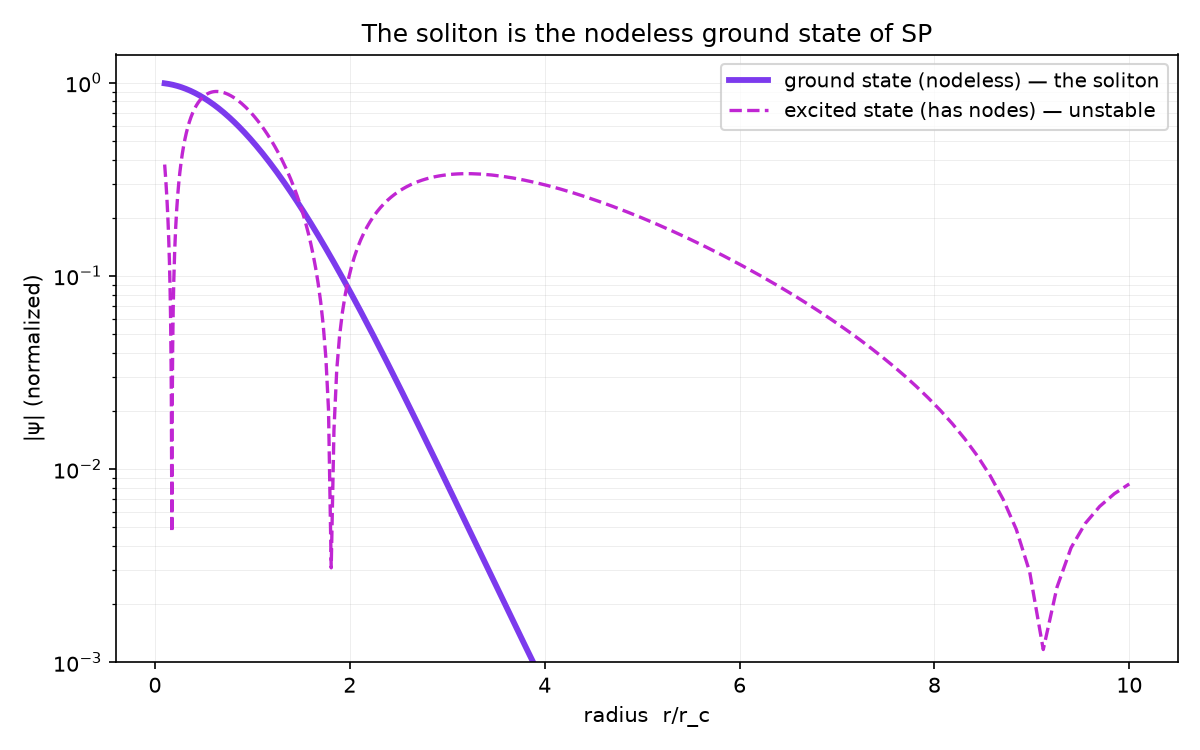
The Schrödinger–Poisson system (Topic 4.2) admits stationary bound states $\psi=e^{-i\gamma t/\hbar}\phi(r)$, where the wave's spreading is exactly halted by its own gravity. As in the hydrogen atom there is a discrete ladder of such states, labelled by the number of radial nodes: a nodeless ground state and excited states with one, two, ... nodes.
The ground state is the soliton
The ground state — nodeless, lowest energy — is the soliton (figure). Excited states exist mathematically but are unstable: perturbations drain them toward the ground state, shedding mass to infinity. So the only long-lived self-bound object is the nodeless soliton, which is why it, and not some excited configuration, sits at the centre of every halo.
Existence and uniqueness
For a given central density (or equivalently a given mass, via the scaling symmetry of Topic 4.3) the nodeless solution is unique. Its existence follows from the energy functional having a genuine minimum: quantum pressure diverges as the state is compressed ($+1/R^2$) while gravity is only $-1/R$, so the total energy is bounded below and attained at finite size (Topic 3.3). There is exactly one soliton per mass.
Relaxation to the ground state
Any self-gravitating clump of fuzzy dark matter that is not a soliton will radiate and relax toward one, a process called gravitational cooling: the wave ejects excess energy as outgoing ripples and settles into the nodeless ground state, wrapped in a fluctuating halo. This is why simulations starting from arbitrary initial conditions reliably grow solitonic cores.
Our GAMER cosmological runs start from Gaussian random-field initial conditions — nothing like a soliton. Yet by $z=19$ every resolved halo hosts a nodeless soliton core obeying the Schive profile. Gravitational cooling is the reason: the ground state is the attractor, so cores form generically, not by fine-tuning. This is the mechanism behind "a soliton in every halo."
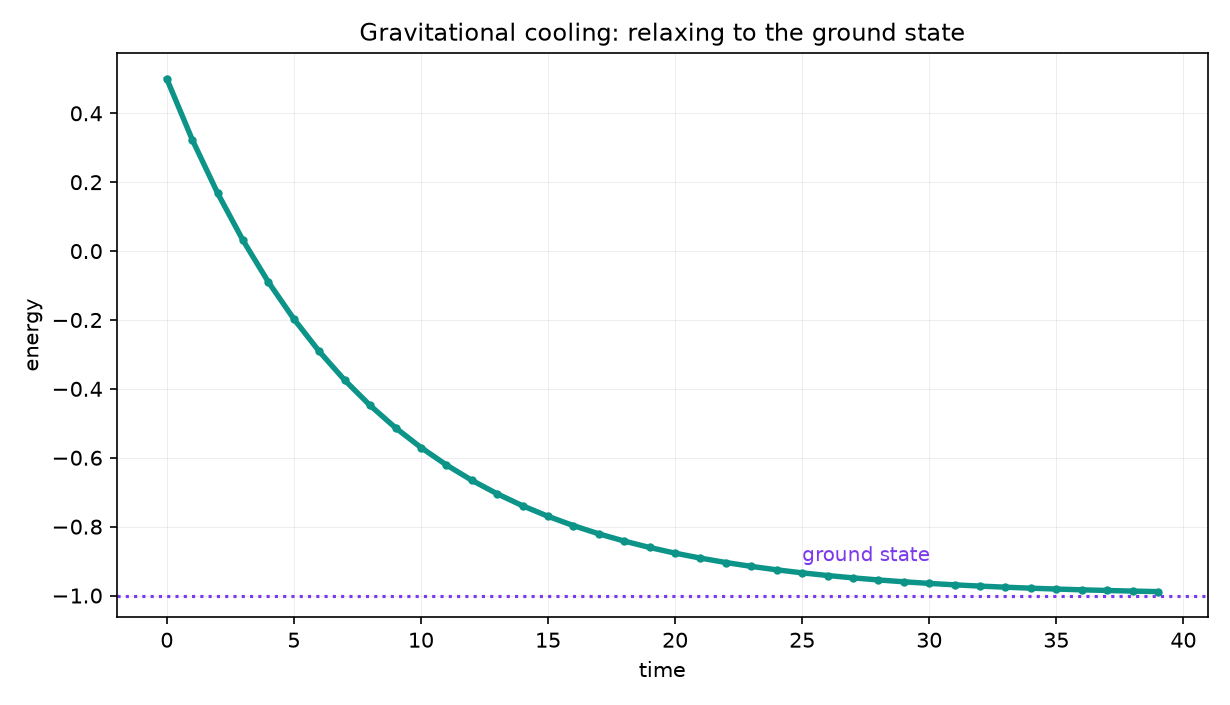
Gravitational cooling toward the unique ground state is why our GAMER and JAXiON runs grow solitonic cores from generic cosmological initial conditions — the basis of the ‘core in every resolved halo’ result and of the cross-code soliton agreement (JXE-F9).
- Seidel & Suen (1994), Formation of solitonic stars by gravitational cooling, Phys. Rev. Lett. 72, 2516.
- Schive, Chiueh & Broadhurst (2014), Nature Physics 10, 496 (arXiv:1406.6586).
- Guzmán & Ureña-López (2006), Gravitational cooling of self-gravitating BECs, ApJ 645, 814.