Wavefunction, the Schrödinger equation & probability current
The wavefunction
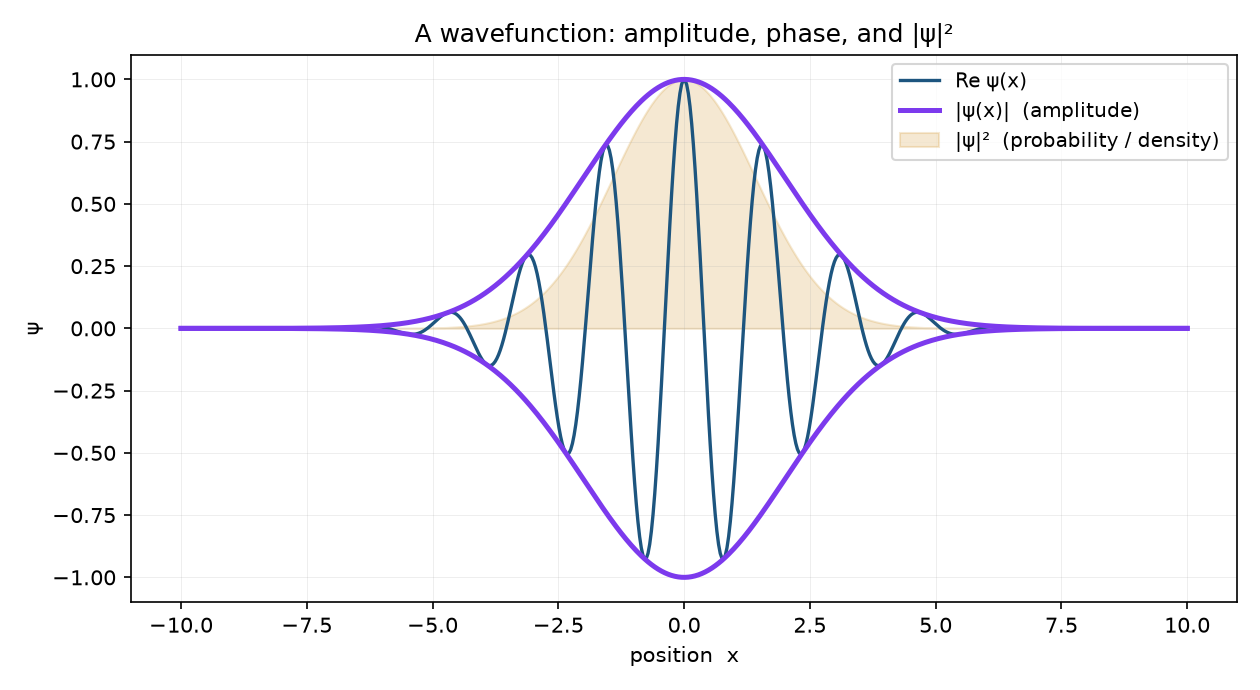
A quantum state is described by a complex field $\psi(\mathbf x,t)=|\psi|\,e^{iS/\hbar}$ carrying an amplitude $|\psi|$ and a phase $S$. The measurable is $|\psi|^2$ — a probability density for one particle, but for fuzzy dark matter the mass density itself, $\rho=m|\psi|^2$. The figure shows the two pieces: a rapidly oscillating real part under a smooth $|\psi|$ envelope.
The Schrödinger equation
Time evolution obeys
$$i\hbar\,\frac{\partial\psi}{\partial t}=-\frac{\hbar^2}{2m}\nabla^2\psi+V\psi .$$The first term on the right is kinetic (it spreads the wave), the second is a potential. For fuzzy dark matter $V$ is the gravitational potential the wave itself sources — closing the loop into the Schrödinger–Poisson system of Topic 4.
Probability — and mass — current
Conservation of $|\psi|^2$ takes the form of a continuity equation, $\partial_t|\psi|^2+\nabla\!\cdot\mathbf J=0$, with the current
$$\mathbf J=\frac{\hbar}{m}\,\mathrm{Im}(\psi^*\nabla\psi)=|\psi|^2\,\frac{\nabla S}{m}.$$Reading $\rho=m|\psi|^2$ and $\mathbf v=\nabla S/m$, this is exactly mass conservation $\partial_t\rho+\nabla\!\cdot(\rho\mathbf v)=0$: the phase gradient is the flow velocity. That reinterpretation (Madelung, Topic 3.5) is what lets us think of the wave as a peculiar fluid.
Show that $|\psi|^2$ is conserved with current $\mathbf J$:
- Write Schrödinger's equation and its complex conjugate: $i\hbar\dot\psi=-\tfrac{\hbar^2}{2m}\nabla^2\psi+V\psi$ and $-i\hbar\dot\psi^*=-\tfrac{\hbar^2}{2m}\nabla^2\psi^*+V\psi^*$.
- Form $\psi^*\times$(first) $-\psi\times$(second). The $V$ terms cancel (real potential).
- Left side: $i\hbar(\psi^*\dot\psi+\psi\dot\psi^*)=i\hbar\,\partial_t|\psi|^2$.
- Right side: $-\tfrac{\hbar^2}{2m}(\psi^*\nabla^2\psi-\psi\nabla^2\psi^*)=-\tfrac{\hbar^2}{2m}\nabla\!\cdot(\psi^*\nabla\psi-\psi\nabla\psi^*)$.
- Divide by $i\hbar$: $\partial_t|\psi|^2+\nabla\!\cdot\!\underbrace{\tfrac{\hbar}{m}\mathrm{Im}(\psi^*\nabla\psi)}_{\mathbf J}=0$.
The cancellation of the $V$ terms is why probability (and, for FDM, mass) is conserved regardless of the potential — including self-gravity.
From one particle to a field
The crucial shift for dark matter: $\psi$ is not the probability amplitude of a single particle but a classical field describing an enormous coherent condensate. Occupation numbers are astronomical, so quantum fluctuations are negligible and $\psi$ evolves as a deterministic classical field — which is exactly why it can be put on a grid and simulated.
A mode of wavelength $\sim1$ kpc has $k=1/(3.1\times10^{19}\,{\rm m})$. Its velocity is $v=\hbar k/m$; for $m=10^{-22}\,{\rm eV}=1.8\times10^{-58}$ kg,
$$v=\frac{(1.05\times10^{-34})(3.2\times10^{-20})}{1.8\times10^{-58}}\approx1.9\times10^{4}\ {\rm m\,s^{-1}}\approx19\ {\rm km\,s^{-1}}.$$Kiloparsec-scale waves move at galactic speeds — coincidence that is really the whole point (Topic 2.5): the de Broglie scale lands on galaxies.
Reduce the relativistic field to the non-relativistic wave:
- Write $\phi=\dfrac{\hbar}{\sqrt{2m}}\big(\psi e^{-imc^2t/\hbar}+\text{c.c.}\big)$ and substitute into $\ddot\phi+3H\dot\phi-\tfrac{\nabla^2}{a^2}\phi+\tfrac{m^2c^2}{\hbar^2}\phi=0$.
- Compute $\ddot\phi$: the $e^{-imc^2t/\hbar}$ carrier gives terms $\propto(mc^2/\hbar)^2\psi$, $\propto(mc^2/\hbar)\dot\psi$, and $\ddot\psi$.
- The $(mc^2/\hbar)^2\psi$ term exactly cancels the mass term $\tfrac{m^2c^2}{\hbar^2}\phi$ — the whole point of factoring out the carrier.
- Keep the leading surviving term $-2i\tfrac{mc^2}{\hbar}\dot\psi\,e^{-imc^2t/\hbar}$; drop $\ddot\psi$ (slowly varying: $|\ddot\psi|\ll\tfrac{mc^2}{\hbar}|\dot\psi|$).
- What remains, after adding the gravitational potential, is $i\hbar\dot\psi=-\tfrac{\hbar^2}{2ma^2}\nabla^2\psi+m\Phi\psi$ — the Schrödinger equation.
The dropped $\ddot\psi$ is the $O(v^2/c^2)\sim10^{-7}$ relativistic correction — negligible for galaxies, which is why the reduction is exact for our purposes.
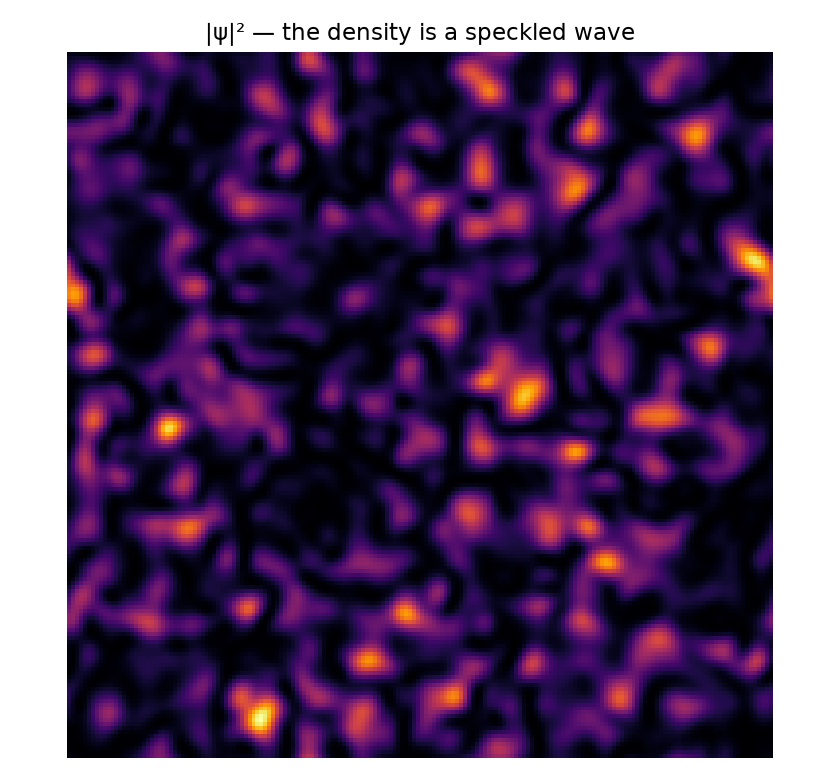
Both of our wave codes evolve precisely this equation: JAXiON with a spectral split-step integrator, GAMER with a finite-difference adaptive mesh. The gravitational $V$ makes it Schrödinger–Poisson (Topic 4), and the current $\mathbf J$ above is what our analyses use to define the FDM velocity field.
- Griffiths, Introduction to Quantum Mechanics — the wavefunction and current.
- Hui, Ostriker, Tremaine & Witten (2017), Phys. Rev. D 95, 043541 (arXiv:1610.08297).