Free particles, wave packets & dispersion
Plane waves and the dispersion relation
The free Schrödinger equation ($V=0$) is solved by plane waves $\psi\propto e^{i(\mathbf k\cdot\mathbf x-\omega t)}$ with
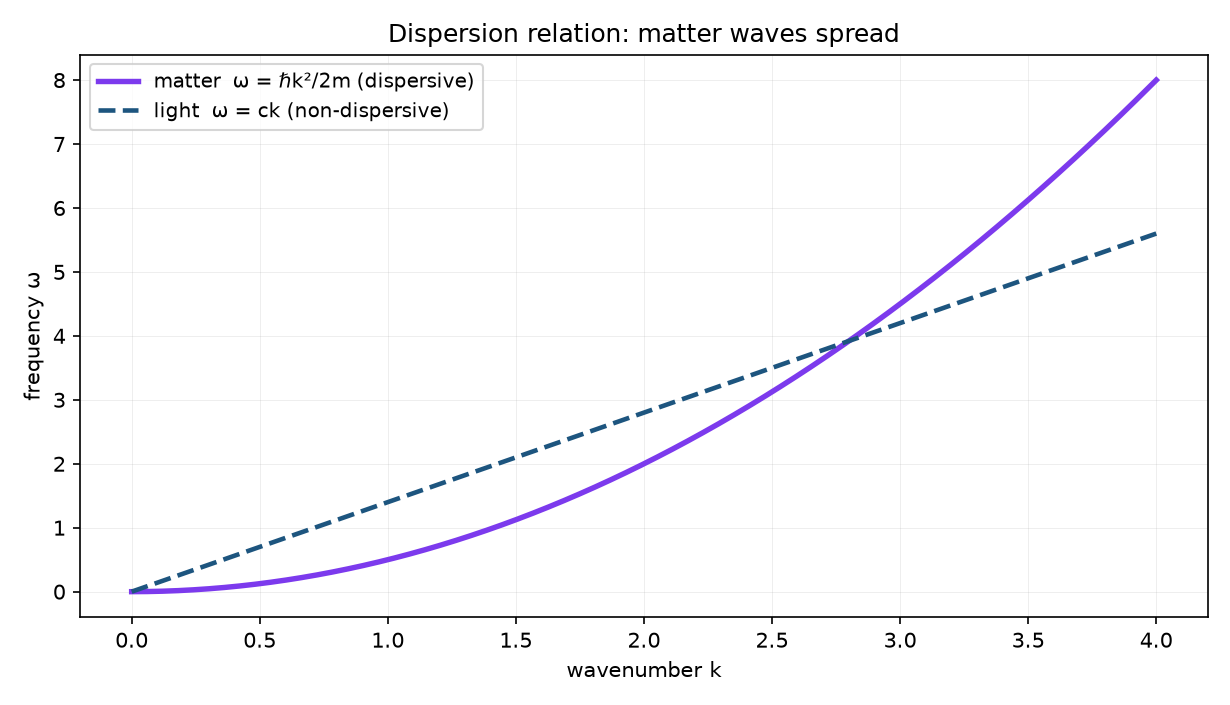
$$\omega=\frac{\hbar k^2}{2m},\qquad E=\hbar\omega=\frac{\hbar^2k^2}{2m},\qquad \mathbf p=\hbar\mathbf k.$$The quadratic $\omega(k)$ — unlike light's linear $\omega=ck$ — is what makes matter waves disperse.
Wave packets and group velocity
A localized lump is a superposition of plane waves. Its envelope travels at the group velocity $v_g=d\omega/dk=\hbar k/m$, while the internal ripples move at the phase velocity. The de Broglie relation $\lambda=2\pi/k=h/p$ ties the wavelength to the momentum.
Dispersion: packets spread
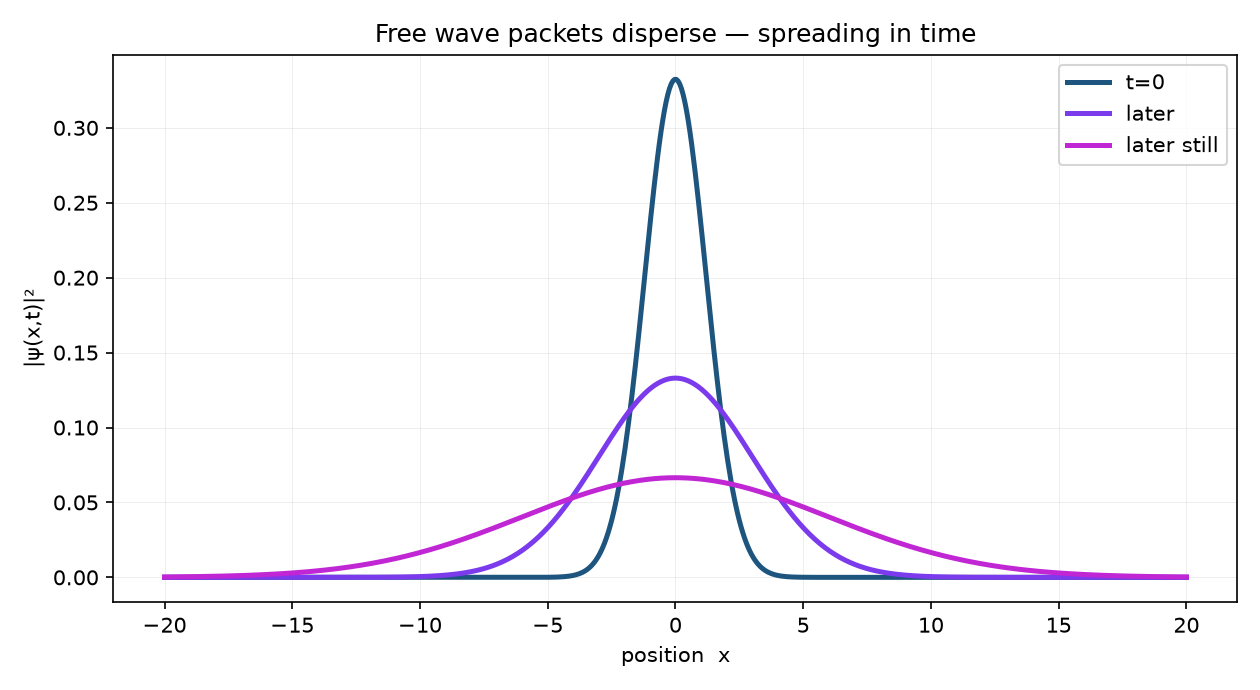
Because each component $k$ moves at its own speed, a packet inevitably broadens (figure). A packet of width $\sigma$ spreads on a timescale $\tau\sim m\sigma^2/\hbar$. On atomic scales this is femtoseconds; on galactic scales, for an ultralight boson, it is astronomical — and that is the crux.
For $m=1.8\times10^{-58}$ kg and $\sigma=1$ kpc $=3.1\times10^{19}$ m,
$$\tau\sim\frac{m\sigma^2}{\hbar}=\frac{(1.8\times10^{-58})(9.5\times10^{38})}{1.05\times10^{-34}}\approx1.6\times10^{15}\ {\rm s}\approx50\ {\rm Myr}.$$That is comparable to the orbital time in a dwarf galaxy — so quantum dispersion competes with gravity on kpc scales. On megaparsec scales $\tau$ is far longer than the age of the Universe, so the wave behaves classically. Quantum effects are dynamically important on galaxy scales and negligible above — exactly the FDM story.
Why this matters for FDM
The interplay of dispersion (spreading) and self-gravity (pulling in) is what gives fuzzy dark matter its structure: gravity wins in the centre, forming the stable soliton (Topic 3.3, 5), while interference of the still-dispersing waves paints the granular halo. The coherence length of that texture is the de Broglie wavelength.
This dispersion–gravity balance is what our simulations resolve: JAXiON's spectral solver evolves it exactly, and we measure the granule/interference scale against the de Broglie wavelength (the $\lambda_{\rm pat}/\lambda_{\rm dB}$ tests). The $\sim50$ Myr scale above is why the de-Broglie resolution requirement is so punishing (Topic 9.5).
- Griffiths, Introduction to Quantum Mechanics — wave-packet dispersion.
- Mocz et al. (2017), Galaxy formation with BECDM, MNRAS 471, 4559 (arXiv:1705.05845).