Bose–Einstein condensates & the Gross–Pitaevskii equation
A macroscopic quantum state
At low temperature and high density, identical bosons pile into the same lowest-energy state — a Bose–Einstein condensate — whose entire many-body physics collapses onto a single complex field $\psi(\mathbf x,t)$, the condensate wavefunction. Ultralight dark matter is the extreme case: bosons of mass $\sim10^{-22}$ eV at cosmic densities have enormous phase-space occupancy, forming a condensate that spans the Universe.
The Gross–Pitaevskii equation
A condensate evolves by the Gross–Pitaevskii (GP) equation — the Schrödinger equation plus a self-interaction term:
$$i\hbar\frac{\partial\psi}{\partial t}=-\frac{\hbar^2}{2m}\nabla^2\psi+V\psi+g|\psi|^2\psi.$$In a laboratory BEC $V$ is the trap and $g$ encodes short-range contact interactions. For the simplest fuzzy dark matter the contact term is negligible ($g\approx0$) and the dominant "interaction" is gravity: $V$ is the potential the condensate itself sources through Poisson's equation. Dropping $g$ and closing the loop with gravity turns GP into the Schrödinger–Poisson system (Topic 4) — the equations all our wave codes solve.
Why FDM is a classical field
Although born of quantum mechanics, the FDM field behaves classically, because its mode occupation numbers are astronomical.
The number of bosons within a de Broglie volume is $N\sim(\rho/m)\,\lambda_{\rm dB}^3$. At a galactic density $\rho\sim0.1\,M_\odot\,{\rm pc^{-3}}\approx7\times10^{-21}\,{\rm kg\,m^{-3}}$, with $m=1.8\times10^{-58}$ kg and $\lambda_{\rm dB}\sim1$ kpc:
$$N\sim\frac{7\times10^{-21}}{1.8\times10^{-58}}\times(3.1\times10^{19})^3\approx10^{96}.$$With $\sim10^{96}$ quanta per mode, quantum fluctuations are utterly negligible and $\psi$ is a deterministic classical field — which is precisely why we can lay it on a grid and integrate it.
Track the energy of the oscillating field after release ($H So an oscillating scalar field is cold dark matter cosmologically, even though it is a wave: the fast oscillation averages to zero pressure, leaving only the $a^{-3}$ dilution of matter.
Solitons in the GP/SP system
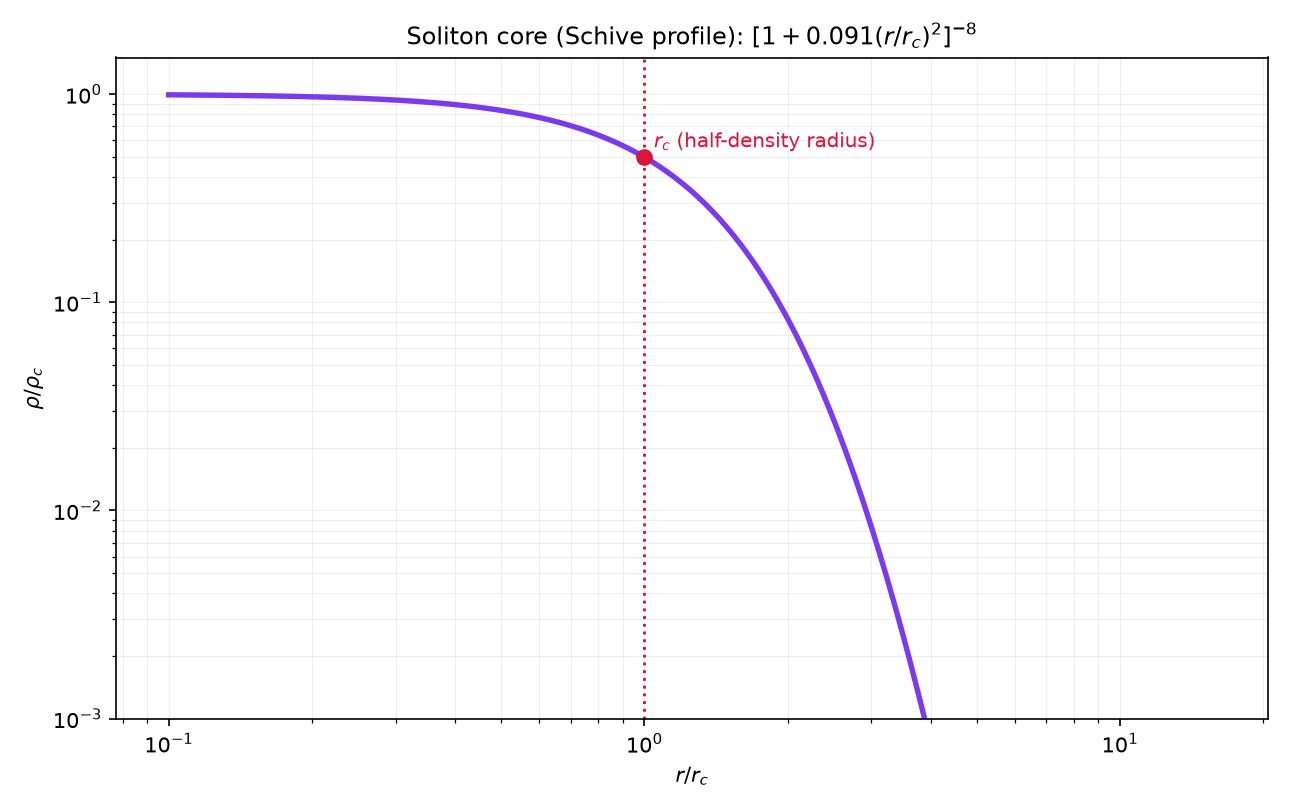
Every self-bound BEC has a ground state — a soliton (figure) — where the kinetic (quantum-pressure) energy balances the confining potential. In the laboratory that balance is contact repulsion vs the trap; in fuzzy dark matter it is quantum pressure vs self-gravity. The FDM soliton (Topic 5) is nothing but the gravitational GP ground state.
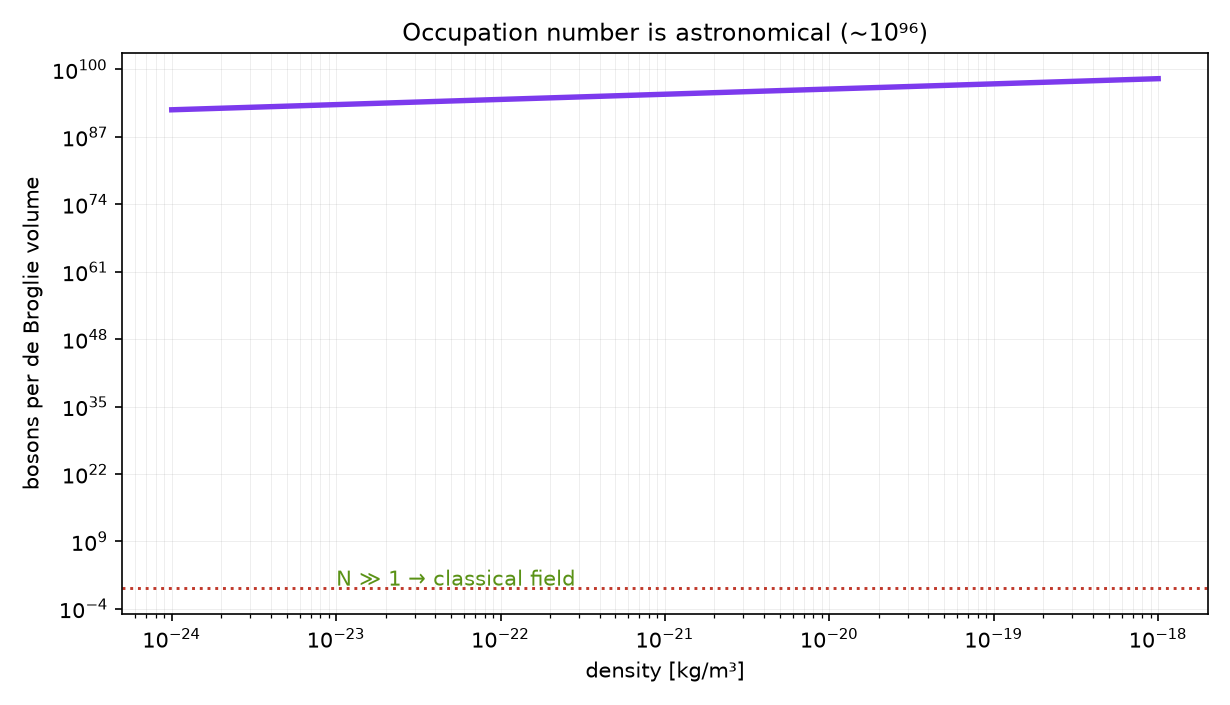
This is the conceptual license for the whole program: fuzzy dark matter is a self-gravitating BEC, so we evolve the Gross–Pitaevskii/Schrödinger–Poisson field (JAXiON, GAMER) rather than particles. The $N\sim10^{96}$ occupancy is why treating $\psi$ as a classical field is exact for our purposes.
- Pethick & Smith, Bose–Einstein Condensation in Dilute Gases — the GP equation.
- Hui, Ostriker, Tremaine & Witten (2017), Phys. Rev. D 95, 043541 (arXiv:1610.08297).
- Mocz et al. (2017), MNRAS 471, 4559 (arXiv:1705.05845).