A soliton inside a halo: core + granular envelope
Two regions, one wavefunction
The full halo is a single wavefunction $\psi$ with two regimes. In the centre it settles into the coherent, stationary soliton core. Outside, the same field is a superposition of many modes whose interference produces a fluctuating, granular density — the halo envelope. There is no seam: the two are limits of one continuous $\psi$.
The core–envelope profile
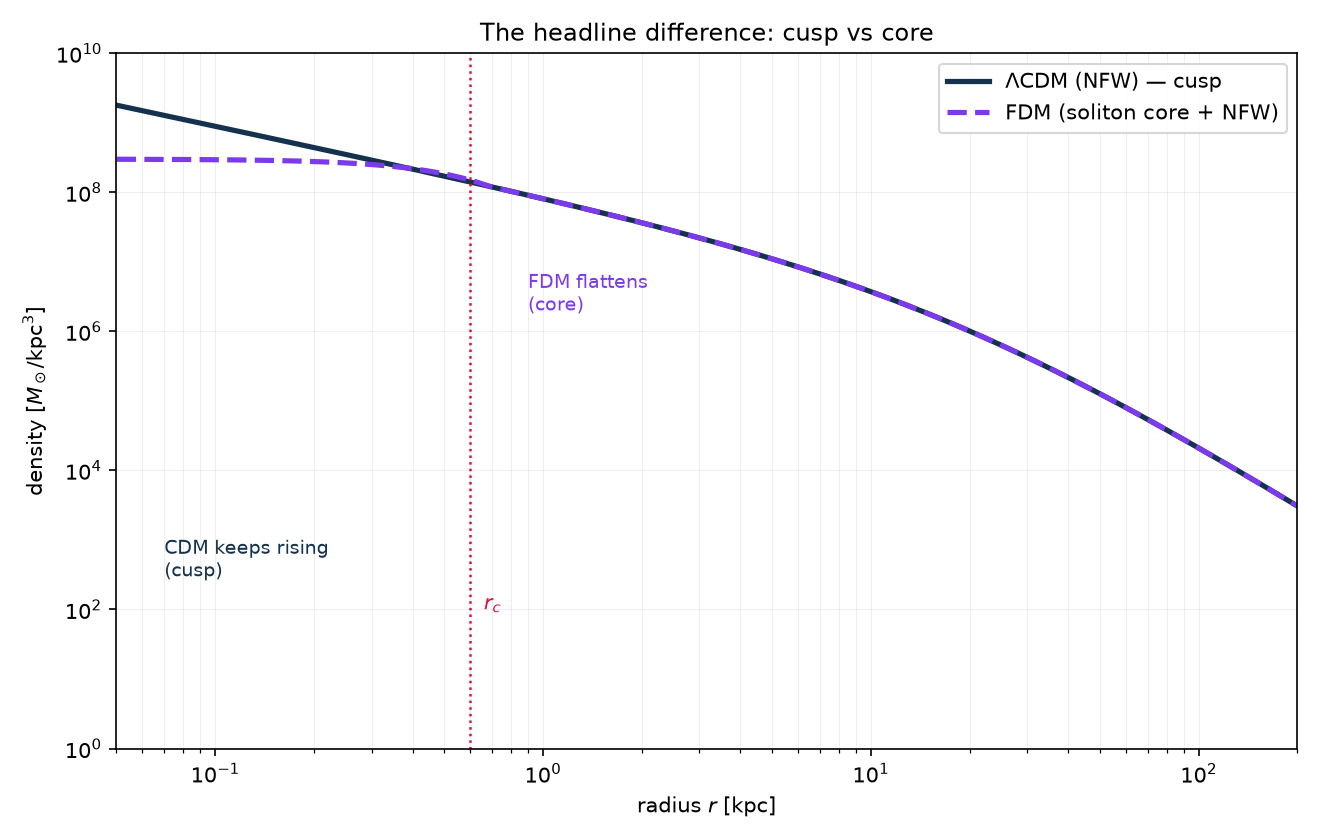
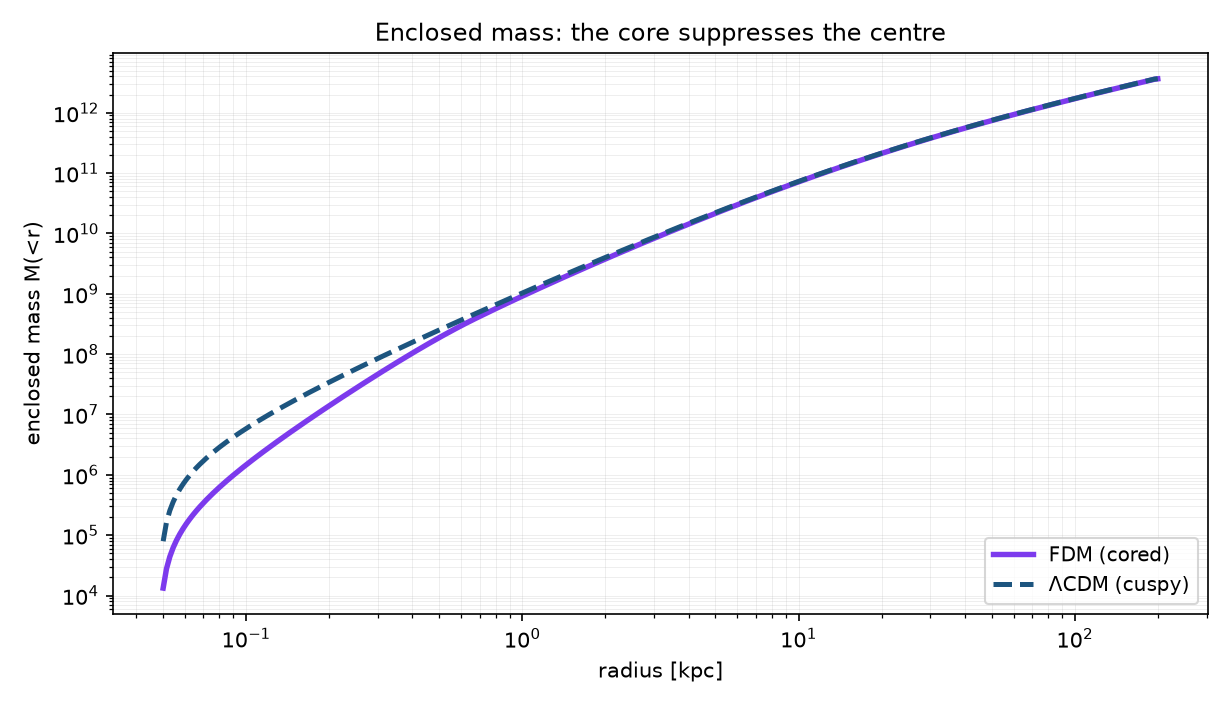
The spherically-averaged density follows the flat Schive soliton inside a transition radius of a few $r_c$, then matches onto an NFW-like envelope ($\rho\propto r^{-3}$ in the outskirts) — the same profile a cold-dark-matter halo would have (figure). The soliton replaces the CDM cusp; beyond a few core radii the two theories agree, because gravity dominates and quantum pressure is negligible there.
Granules and the de Broglie texture
The envelope is not smooth: interference produces order-unity density granules of size $\sim\lambda_{\rm dB}$, forming and dissolving on the dispersion timescale (Topic 3.2). These granules gravitationally scatter orbits (dynamical heating) and are a distinctive, if subtle, FDM signature. Their coherence length is a direct probe of the de Broglie wavelength.
The core mass is set by the halo
How big is the central soliton? Not free — it is tied to the host halo by the core–halo relation $M_c\propto M_h^{1/3}$ (Topic 8.5). A more massive halo grows a more massive (hence smaller, denser) core. This link between the halo's global mass and its inner soliton is the campaign's headline measurement.
With $M_c\propto M_h^{1/3}$, the core mass fraction $M_c/M_h\propto M_h^{-2/3}$ falls with halo mass. For our runs a $\sim10^{8}\,M_\odot$ dwarf has a core that is a large fraction of the halo, while a $10^{12}\,M_\odot$ galaxy has a tiny central soliton. This is why FDM's cored signature is strongest in dwarfs — the same galaxies at the heart of the core–cusp and mass-tension debates.
This core + envelope structure is Task 2 of the campaign. GAMER resolves both pieces (soliton core + $r^{-3}$ envelope, GM-F12); JAXiON validates the granular/interference texture against the de Broglie scale; and the core–halo relation tying $M_c$ to $M_h$ is our $\beta=0.30\pm0.03$ result.
- Schive, Chiueh & Broadhurst (2014), Nature Physics 10, 496 (arXiv:1406.6586).
- Mocz et al. (2017), MNRAS 471, 4559 (arXiv:1705.05845).
- Chan, Schive et al. (2022), Core–halo mass relation scatter, MNRAS 511, 943.