The FDM mass function: suppression below the cutoff
Putting it together
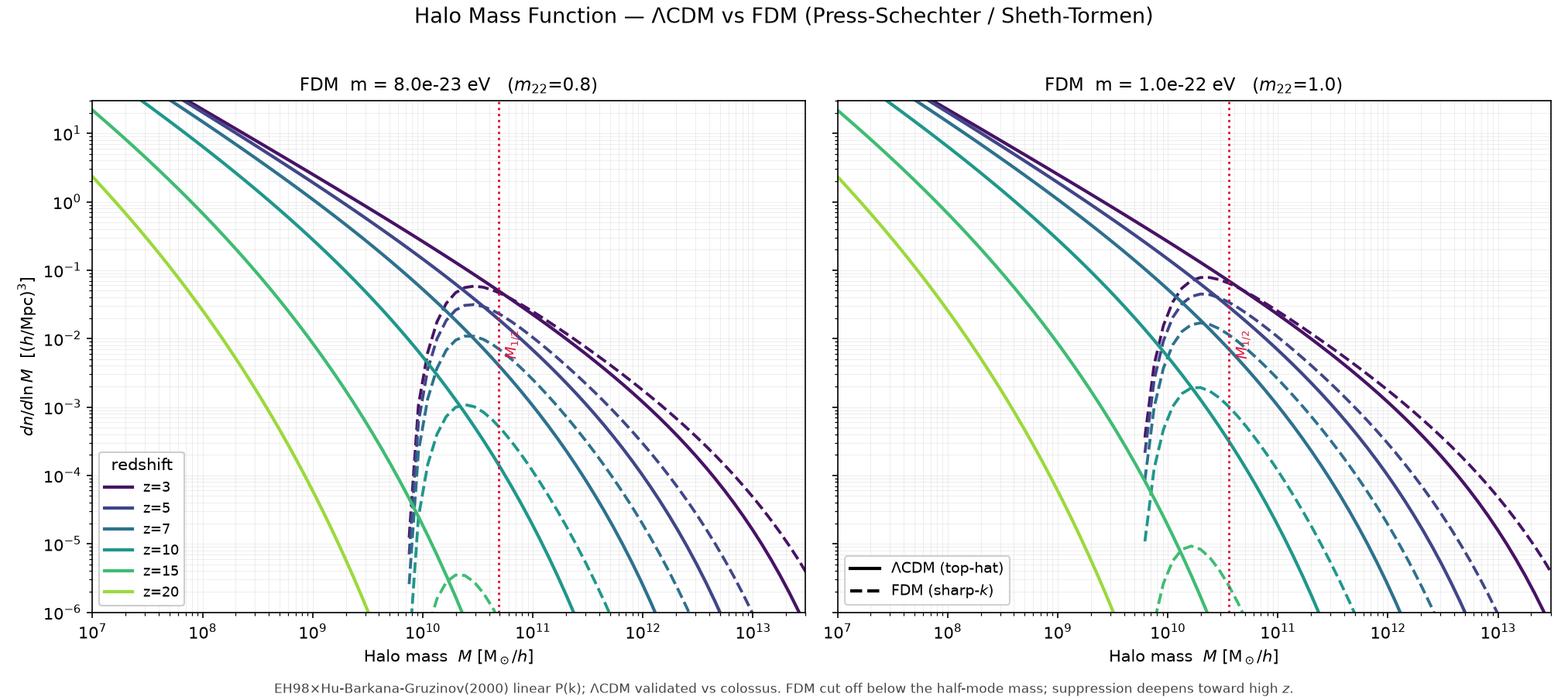
The FDM mass function is the same $dn/d\ln M=(\bar\rho/M)f(\sigma)|d\ln\sigma/d\ln M|$ as CDM, with one change: $\sigma(M)$ is computed from the FDM power spectrum (CDM transfer $\times$ HBG cutoff, §6.3) using a sharp-k window (§6.4). Because $\sigma(M)$ flattens below the cutoff, the Gaussian tail above $\delta_c$ collapses and the abundance plummets (figure).
Reading the figure
Above the half-mode mass, FDM and $\Lambda$CDM are indistinguishable — the same big halos form. Below $M_{1/2}$, the FDM curve turns over and drops steeply: small halos are dramatically rarer, and the deficit deepens toward high redshift (the mass function is even more suppressed early, when small halos would otherwise dominate).
The characteristic scales
For our two fiducial masses the pipeline gives:
| Boson mass | Half-mode mass $M_{1/2}$ [$M_\odot/h$] | $k_{1/2}$ [$h$/Mpc] |
|---|---|---|
| $m=8\times10^{-23}$ eV ($m_{22}=0.8$) | $4.85\times10^{10}$ | 6.14 |
| $m=1\times10^{-22}$ eV ($m_{22}=1.0$) | $3.61\times10^{10}$ | 6.77 |
Consistent with our GAMER runs at $m_{22}=0.8$: a minimum halo mass $M_{\min}\approx3\times10^{8}\,M_\odot$ and delayed first collapse ($z_{\rm ff}\approx15.7$ vs $z\approx50$ for CDM).
A caveat, stated honestly
The result is semi-analytic Press–Schechter (the method named), not counted from our boxes — our zoom volumes hold too few halos for HMF statistics. The sharp-k constant ($c\approx2.5$) and the transfer's node-truncation shift the cutoff mass by tens of percent, not its existence or scaling. And it is validated: axionCAMB (§6.5) confirms it to $\sim$1–15%.
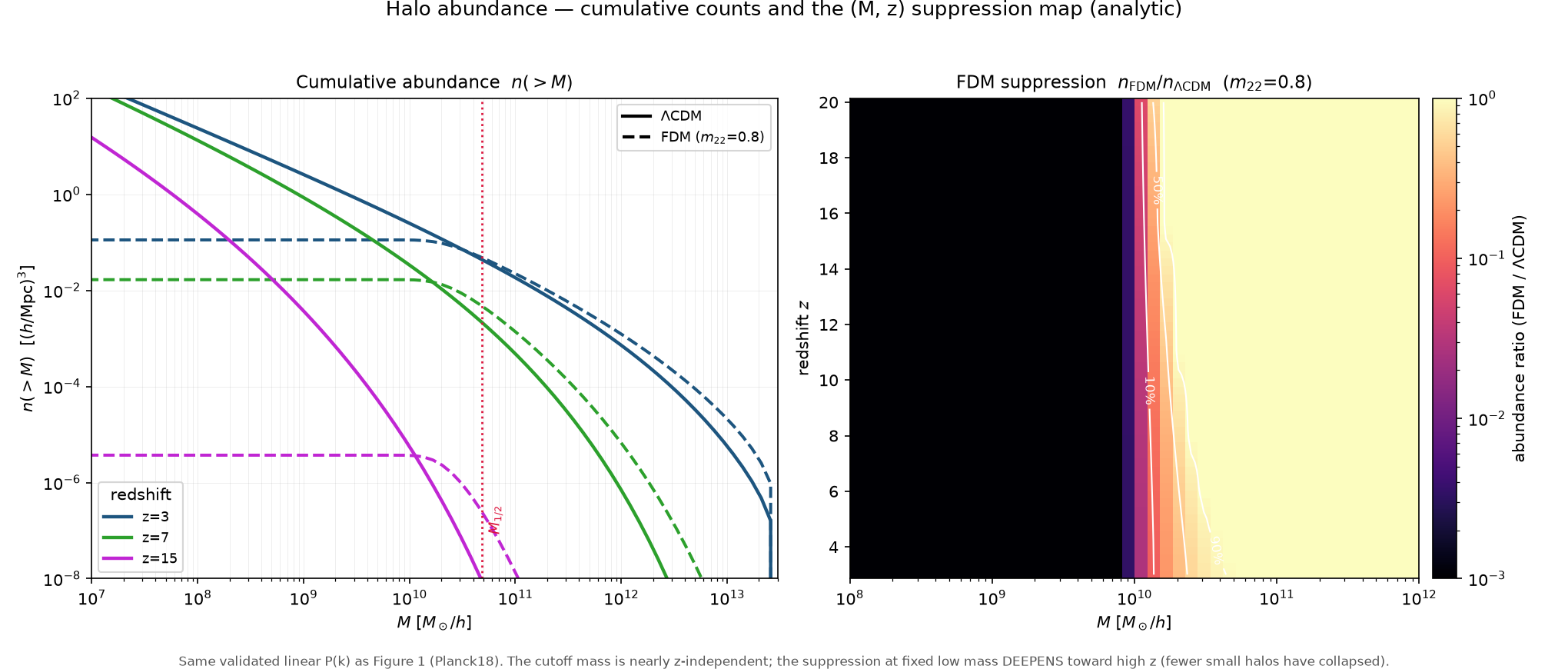
This is Task 1 — the direct answer to Sandro's first question. The curves come from our validated pipeline (colossus-checked to 0.1%), and our own GADGET-4 and GAMER simulation points overlay them (Topic 7.2, Fig 7-2b): CDM on the curve, FDM suppressed.
- Kulkarni & Ostriker (2022), What is the halo mass function in FDM? (arXiv:2011.02116).
- May & Springel (2023), The halo mass function… with FDM, MNRAS 524, 4256 (arXiv:2209.14886).
- Hu, Barkana & Gruzinov (2000), Phys. Rev. Lett. 85, 1158.