Analog gravity: cold-atom simulation
The analogy
A laboratory BEC is governed by the Gross–Pitaevskii equation (Topic 3.4) — the same nonlinear-Schrödinger physics that describes self-gravitating scalar-field dark matter on galactic scales. Solitons, interference, coherent nonlinear evolution: all appear in both. This makes cold atoms a candidate analog in which wave-dark-matter phenomenology could be probed in a lab rather than inferred from astrophysics.
Simulating the early universe
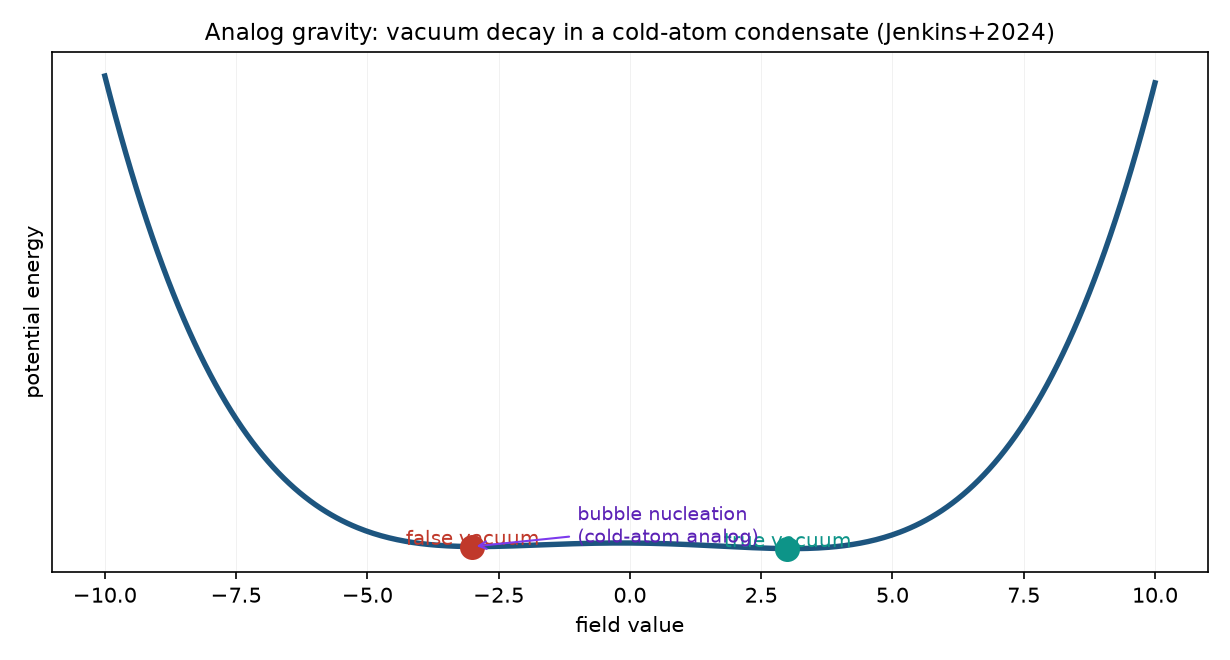
Jenkins et al. (2024) — the second frontier paper Sandro flagged — advance this programme by studying vacuum decay: false-vacuum bubble nucleation (figure), a relativistic early-universe process, realized in an ultracold potassium-41 condensate. They extend earlier classical treatments to include the quantum fluctuations of the analog vacuum, and show its fluctuation spectrum matches the relativistic field-theory result.
Vacuum decay is a strongly non-perturbative, quantum process that is notoriously hard to simulate classically or observe cosmologically. A tabletop cold-atom system that reproduces its physics — bubble nucleation rates, fluctuation spectra — offers an experimental handle on scalar-field dynamics that FDM shares. It is empirical access to physics otherwise reachable only through simulation.
Relevance to fuzzy dark matter
The condensate physics is the same self-gravitating (or self-interacting) scalar-field dynamics FDM invokes. While Jenkins et al. target early-universe phase transitions rather than dark matter directly, the platform is among the few settings where wave-dark-matter phenomenology — solitons, coherence, nonlinear waves — might be studied experimentally.
Where it stands
Like the quantum-algorithm frontier, this is early and not FDM-specific. We catalogue it (survey §24.6) as an adjacent method whose maturation would enlarge a toolbox the wave problem is starved of — experimental, rather than computational, reach.
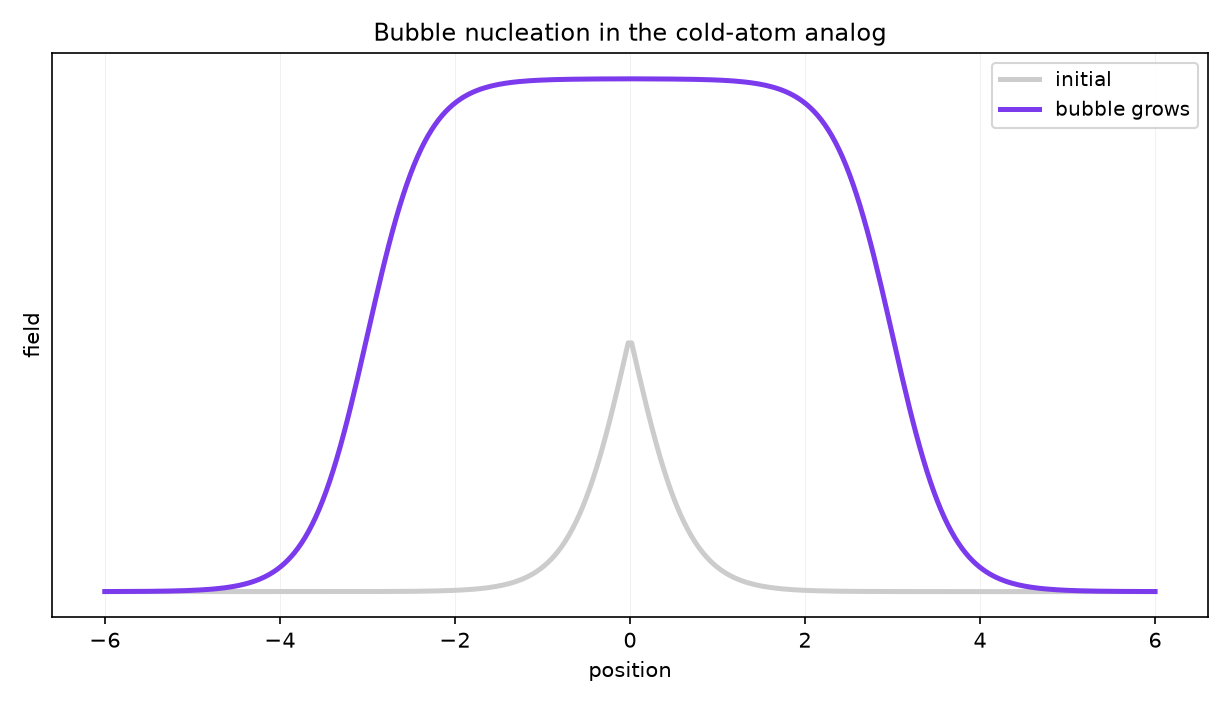
This is the second frontier paper Sandro flagged (Jenkins et al. 2024, in our survey §24.6 and Papers tab). It connects through the shared Gross–Pitaevskii/nonlinear-Schrödinger physics (Topic 3.4) — cold atoms as a possible laboratory analog of the wave dynamics our codes simulate.
- Jenkins et al. (2024), Analog vacuum decay from vacuum initial conditions, Phys. Rev. D 109, 023506 (arXiv:2307.02549).
- Fialko et al. (2015), Fate of the false vacuum: cold-atom analog, EPL 110, 56001.
- Pethick & Smith, Bose–Einstein Condensation in Dilute Gases.