The FDM cutoff: Hu–Barkana–Gruzinov & the half-mode
The HBG transfer function
Hu, Barkana & Gruzinov (2000) derived the FDM suppression by solving the coupled field–gravity perturbation equations. Their fitting form for the FDM-to-CDM transfer ratio is
$$T_{\rm FDM}(k)=\frac{\cos x^3}{1+x^8},\qquad x=1.61\,m_{22}^{1/18}\,\frac{k}{k_{J,\rm eq}},\quad k_{J,\rm eq}=9\,m_{22}^{1/2}\ {\rm Mpc^{-1}} .$$It is $\approx1$ on large scales and falls steeply beyond the Jeans scale, with an oscillatory tail (which, for abundance counts, we truncate at the first node — see Task 1).
The half-mode scale
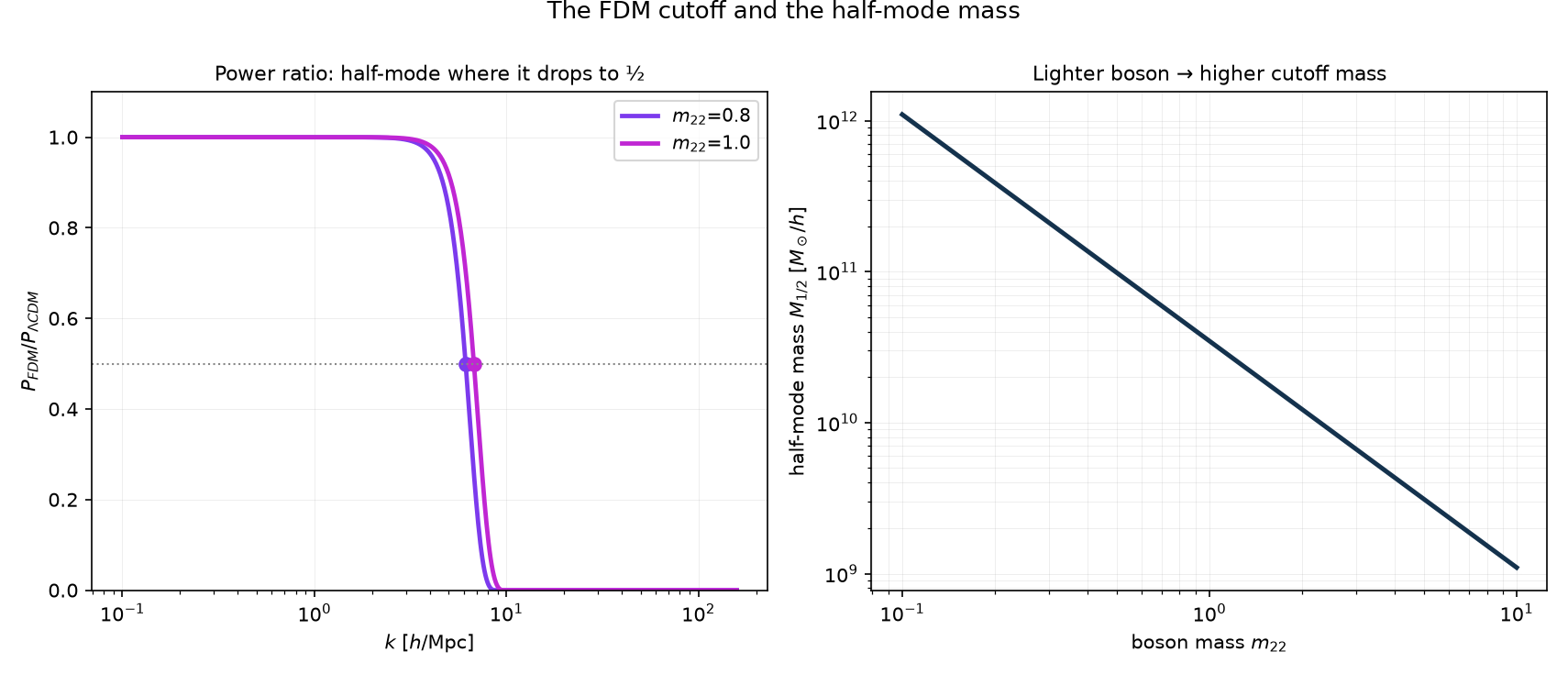
A convenient marker is the half-mode: the wavenumber $k_{1/2}$ where $T_{\rm FDM}^2=\tfrac12$. Converting that length to an enclosed mass gives the half-mode mass $M_{1/2}$ — the scale below which suppression sets in (figure).
For $m_{22}=0.8$ our pipeline gives $k_{1/2}\approx6.1\ h/$Mpc and $M_{1/2}\approx4.9\times10^{10}\,M_\odot/h$; for $m_{22}=1.0$, $k_{1/2}\approx6.8\ h/$Mpc and $M_{1/2}\approx3.6\times10^{10}$. The cutoff mass scales roughly as $M_{1/2}\propto m^{-4/3}$: a lighter boson pushes the cutoff to higher mass, suppressing more of the halo population — which is exactly why counting small halos constrains $m$.
Trace the half-mode mass back to the boson mass:
- The Jeans-equality wavenumber scales as $k_{1/2}\propto m^{1/2}$ (from $k_J\propto\sqrt m$, Topic 4.4).
- A wavenumber encloses a mass $M\propto\bar\rho\,\lambda^3\propto k^{-3}$ (since $\lambda\propto1/k$).
- Therefore $M_{1/2}\propto k_{1/2}^{-3}\propto (m^{1/2})^{-3}=m^{-3/2}$ at fixed epoch.
- Including the mild $m^{1/18}$ factor in the HBG variable $x$ softens this to the empirical $M_{1/2}\propto m^{-4/3}$.
The steep inverse scaling is why a factor-2 change in the boson mass moves the cutoff mass by $\sim2.5\times$ — making the small-halo abundance a sharp lever on $m$.
One number sets the small-scale story
Everything small-scale flows from $m$: the cutoff wavenumber, the half-mode mass, the minimum halo mass, and (via the soliton) the core size. Measure any of these and you pin the boson mass — the logic behind both our Tasks and the observational tension of Topic 10.
Validity
The HBG formula is a fit to linear perturbation theory and is accurate at the few-percent level; our implementation matches the original half-modes to $\le0.1\%$, and Topic 6.5 confirms the whole approach against a Boltzmann code.
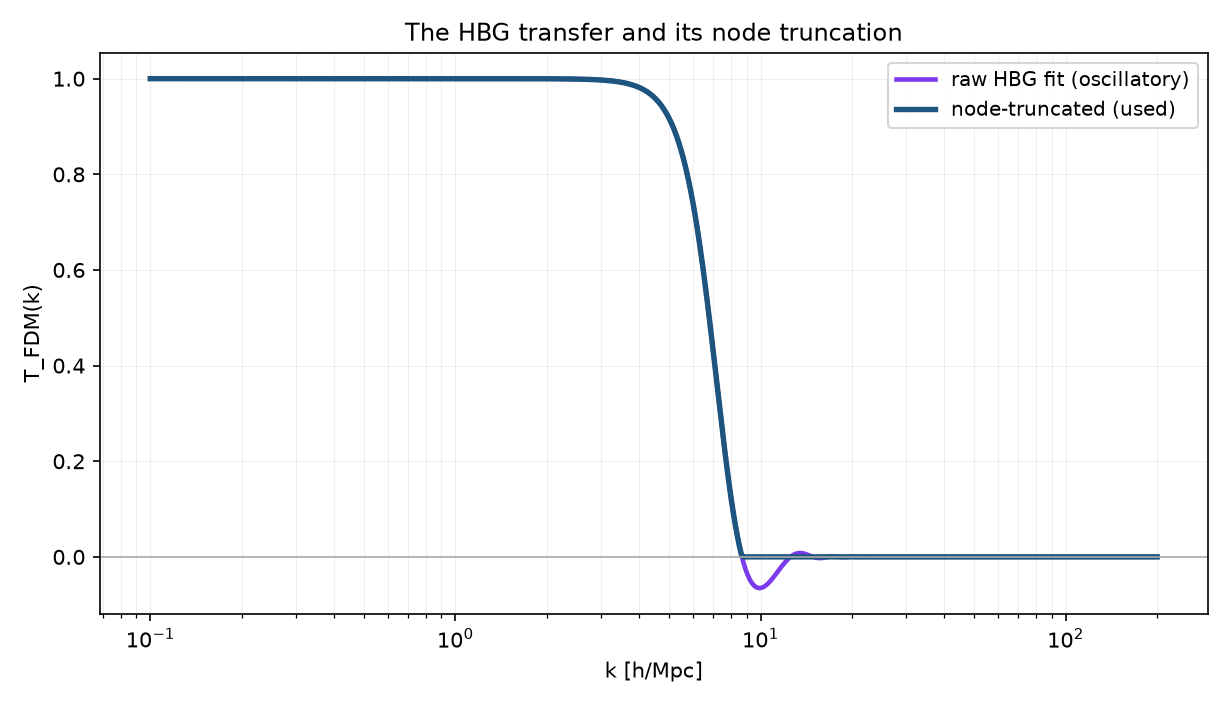
This is the exact cutoff we impose in Task 1 — the crimson line in our mass-function figures at $M_{1/2}\approx5\times10^{10}\,M_\odot/h$. Our in-house cosmology_pk.py implements this HBG form (validated $\le0.1\%$), and the $M_{1/2}$ values above are what our GAMER $M_{\min}$ and delayed-collapse results confirm.
- Hu, Barkana & Gruzinov (2000), Cold and fuzzy dark matter, Phys. Rev. Lett. 85, 1158 (arXiv:astro-ph/0003365).
- Marsh (2016), Phys. Rep. 643, 1 (arXiv:1510.07633).
- Kulkarni & Ostriker (2022), What is the halo mass function in FDM? (arXiv:2011.02116).