The M⁴ scaling and the one-parameter soliton family
From symmetry to a scaling law
The SP scaling symmetry (Topic 4.3) says lengths scale as $\lambda^{-1}$ and densities as $\lambda^4$, so the combination
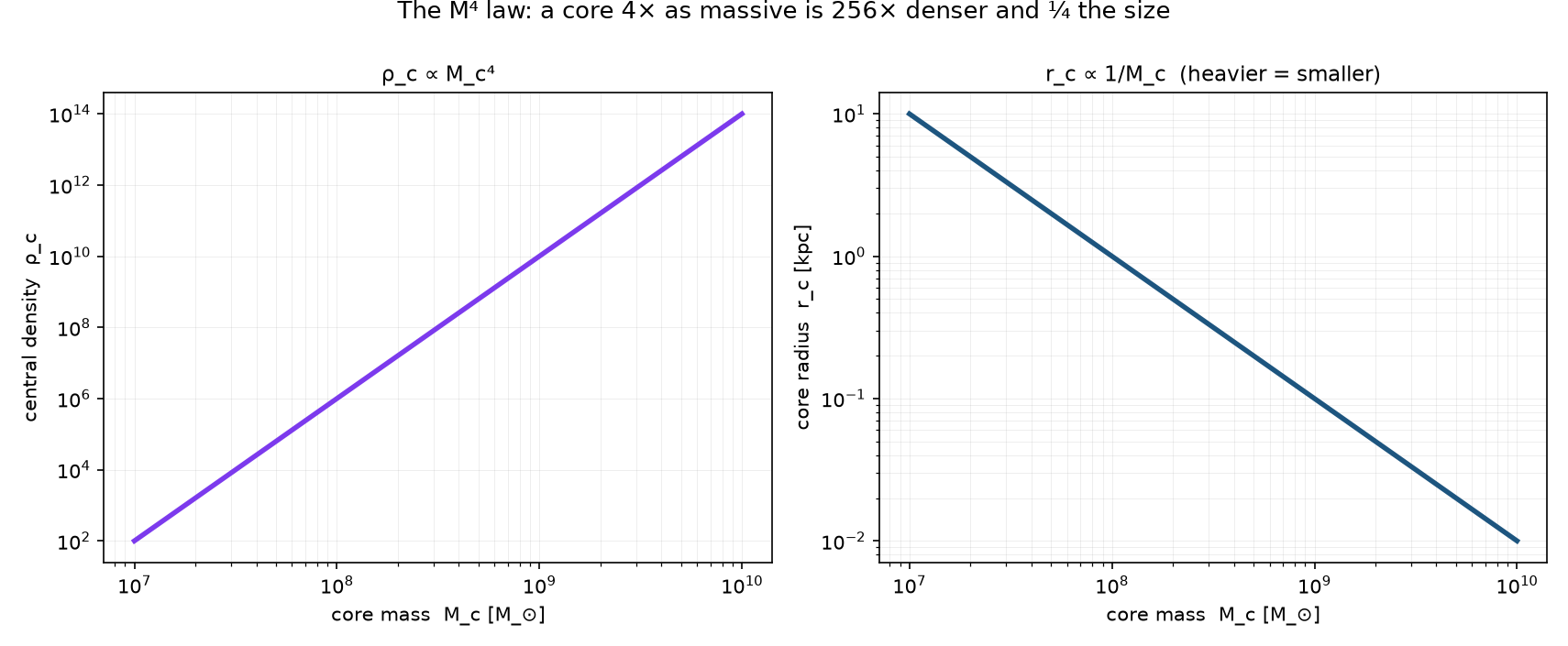
$$\rho_c\,r_c^4=\text{const}$$is invariant across the whole soliton family. Since the core mass is $M_c\propto\rho_c r_c^3$, eliminating $\rho_c$ gives $M_c\propto r_c^{-1}$ and $\rho_c\propto M_c^{4}$ — the $M^4$ law (figure).
What it means physically
A more massive core is smaller and much denser: double $M_c$ and the radius halves while the central density rises 16-fold. Restoring the boson mass, $r_c\propto1/(m^2 M_c)$, so a heavier boson also shrinks the core. Everything about a soliton's appearance is fixed by one number (its mass) and the constant $m$.
Using $M_c\,r_c\simeq\dfrac{5.5\times10^{7}(1+z)}{m_{22}^2}\,M_\odot\,{\rm kpc}$ at $z=0$ with $m_{22}=0.8$: a soliton of $M_c=10^{9}\,M_\odot$ has
$$r_c=\frac{5.5\times10^{7}}{0.8^2\times10^{9}}\approx0.086\ {\rm kpc}\approx86\ {\rm pc}.$$A billion-solar-mass core just tens of parsecs across — dense and compact, exactly as the $M^4$ law demands.
Why it is a powerful test
The $M^4$ law needs only the correct ground-state shape — it is independent of cosmology, box size, or halo environment. A simulation that finds the right soliton at any single mass must reproduce it at every mass. That makes $\rho_c r_c^4=$ const a clean, falsifiable benchmark, decoupled from the messier questions of halo assembly.
Chain the scaling invariant with the mass integral:
- Invariant (Topic 4.3): $\rho_c\,r_c^4=K$ (a constant fixed by $\hbar/m$).
- Core mass: $M_c=4\pi\cdot0.9220\,\rho_c r_c^3$.
- From (1), $\rho_c=K/r_c^4$; substitute into (2): $M_c\propto (K/r_c^4)\,r_c^3=K/r_c$, so $\boxed{r_c\propto 1/M_c}$.
- Then $\rho_c=K/r_c^4\propto M_c^4$ — the $M^4$ law.
So doubling $M_c$ halves $r_c$ and raises $\rho_c$ by $2^4=16$: a heavier core is smaller and dramatically denser, all forced by the single invariant $K$.
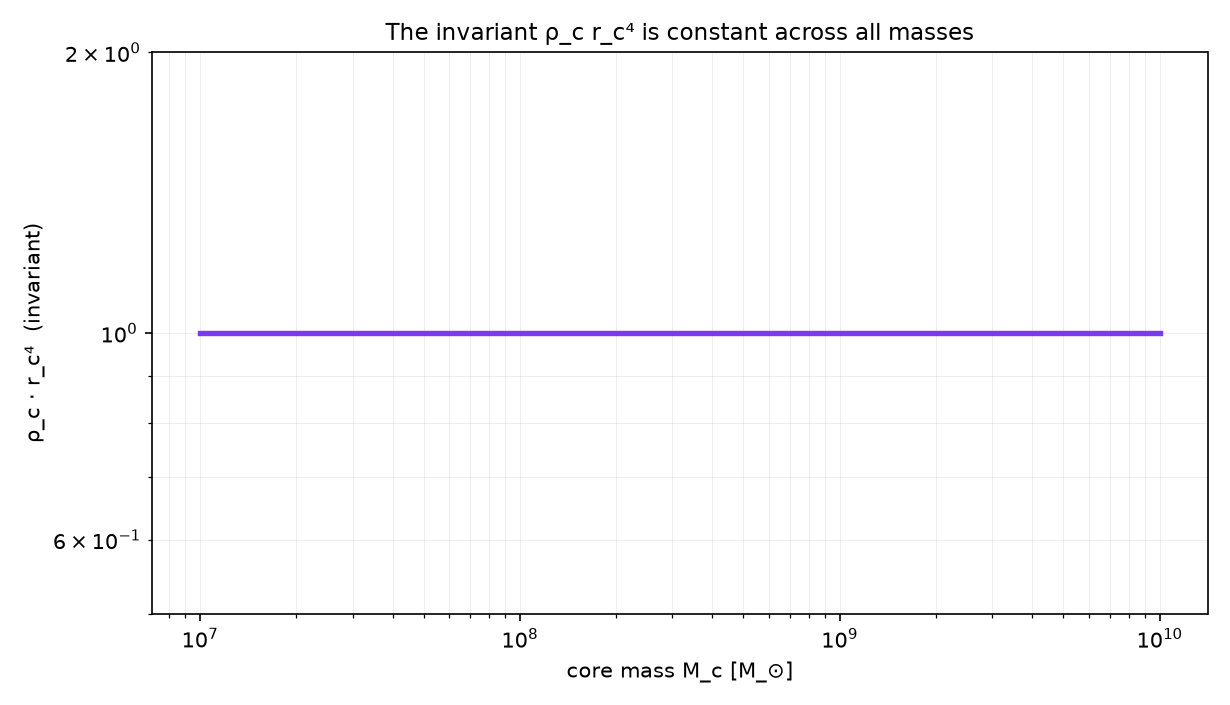
Our JAXiON solver reproduces the $M^4$ law exactly — $\rho_c\propto r_c^{-4}$ and $\rho_c r_c^4$ constant to five significant figures (JXE-F5) — and GAMER's independent cores obey $\rho_c\propto r_c^{-3.95}$ (JXE-F9). This scaling is what lets one validated solver speak for cores of every mass across the campaign.
- Schive, Chiueh & Broadhurst (2014), Nature Physics 10, 496 (arXiv:1406.6586).
- Chavanis (2011), Phys. Rev. D 84, 043531.
- Mocz et al. (2017), MNRAS 471, 4559 (arXiv:1705.05845).