Dwarf-galaxy cores: a light-boson signal
Why dwarfs are the laboratory
Dwarf spheroidal galaxies are the most dark-matter-dominated systems known: little gas, few stars, mass-to-light ratios in the hundreds. That makes them clean probes of the dark-matter profile — with negligible baryonic feedback to muddy the interpretation (Topic 8.3). And they are small, so the kpc-scale soliton is a large fraction of the halo (Topic 5.4).
Cores prefer a light boson
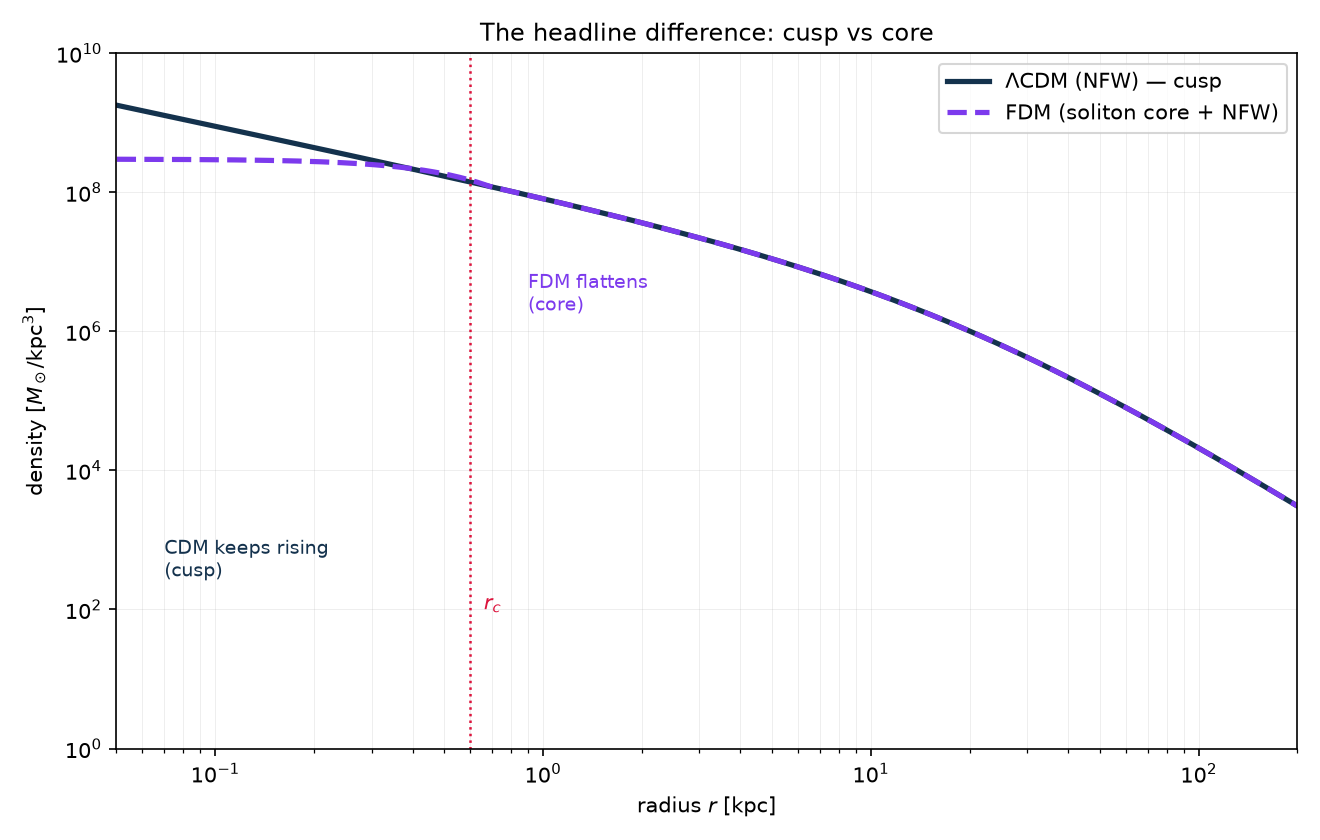
Stellar kinematics of several dwarfs favour flat central cores rather than NFW cusps (figure). In FDM the core radius is set by the soliton, $r_c\propto1/(m\,\sqrt{M})$, so a larger observed core implies a lighter boson. Fitting dwarf cores gives an upper bound on the mass.
Matching the observed $\sim$kpc cores of classical dwarfs (e.g. Fornax) with the soliton relation yields boson masses around $m_{22}\sim1$, with dwarf-core analyses giving an upper bound $m_{22}\lesssim1$ (95%). This is the value that makes FDM attractive — it naturally solves the core–cusp problem at the mass that fits the dwarfs.
The Rc–σ relation
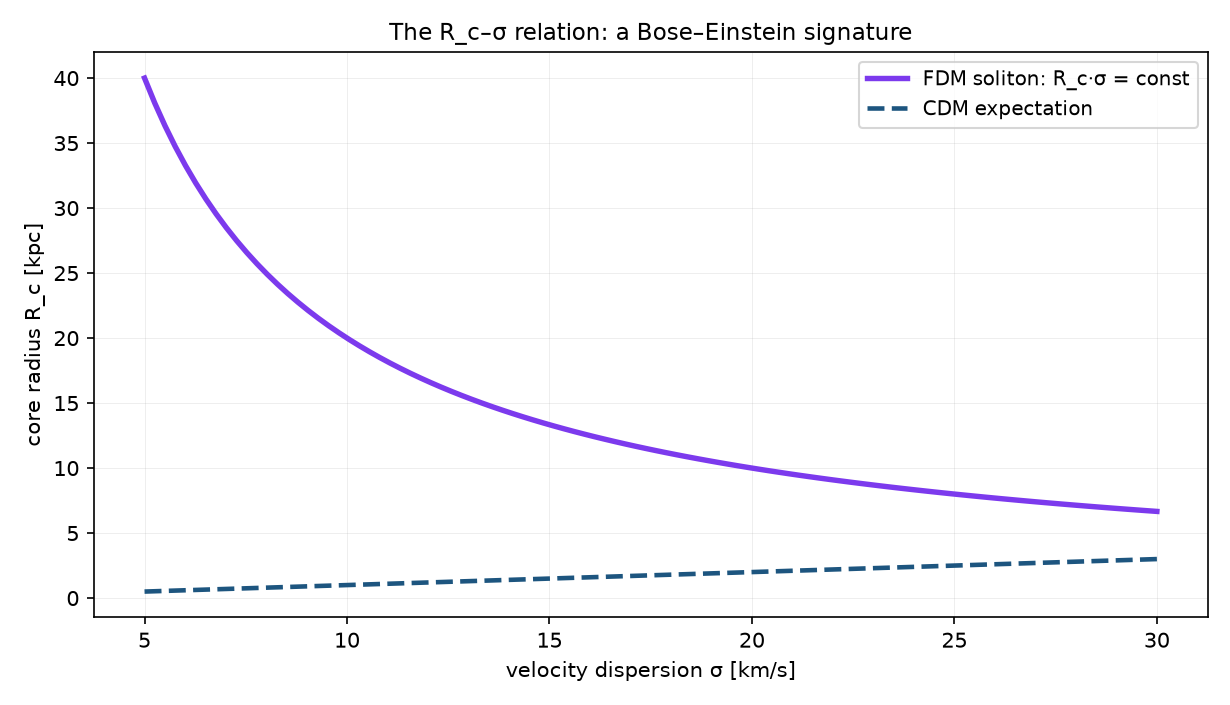
A striking piece of evidence: across dwarfs, the core radius scales inversely with velocity dispersion, $R_c\,\sigma\approx$ const — exactly the signature of a Bose–Einstein soliton ground state, and opposite to the CDM expectation. Some analyses even find two populations preferring two distinct boson masses, hinting at a multi-field axiverse (Topic 2.4).
The catch
The dwarf signal points to a light boson — but, as the next article shows, the Lyman-α forest points the opposite way. That disagreement is the mass tension (Topic 10.4), the central open problem for single-field FDM.
The dwarf-core bound ($m_{22}\lesssim1$) is one arm of our 8.7$\sigma$ mass tension (Topic 10.4). It rests on the soliton physics of Topic 5 and the core–halo relation of Topic 8.5 — both of which our JAXiON and GAMER runs measure directly.
- Schive, Chiueh & Broadhurst (2014), Nature Physics 10, 496 (arXiv:1406.6586).
- Marsh & Pop (2015), Constraining FDM with dwarf cores, MNRAS 451, 2479 (arXiv:1502.03456).
- Pozo, Broadhurst, Smoot et al. (2024), Dwarf galaxies united by dark bosons (arXiv:2302.00181).