Excursion set and Sheth–Tormen
The cloud-in-cloud problem
Press–Schechter counts regions above threshold on each smoothing scale independently, which double-counts (a small halo may sit inside a larger collapsed region) and forces the ad-hoc factor of 2. The excursion-set formalism (Bond et al. 1991) fixes this by tracking $\delta$ as a random walk versus smoothing scale, and asking when the walk first crosses the barrier. The factor of 2 emerges naturally.
Ellipsoidal collapse
Real peaks are not spheres. Sheth & Tormen (1999) let regions collapse as triaxial ellipsoids, which collapse along their shortest axis first and need a higher effective threshold when rarer. This moving barrier $\delta_c(\sigma)$ yields the Sheth–Tormen multiplicity function,
$$f_{\rm ST}(\sigma)=A\sqrt{\frac{2a}{\pi}}\left[1+\left(\frac{\sigma^2}{a\delta_c^2}\right)^{p}\right]\frac{\delta_c}{\sigma}\,e^{-a\delta_c^2/2\sigma^2},$$with $A=0.322,\ a=0.707,\ p=0.3$ calibrated to N-body simulations.
What changes
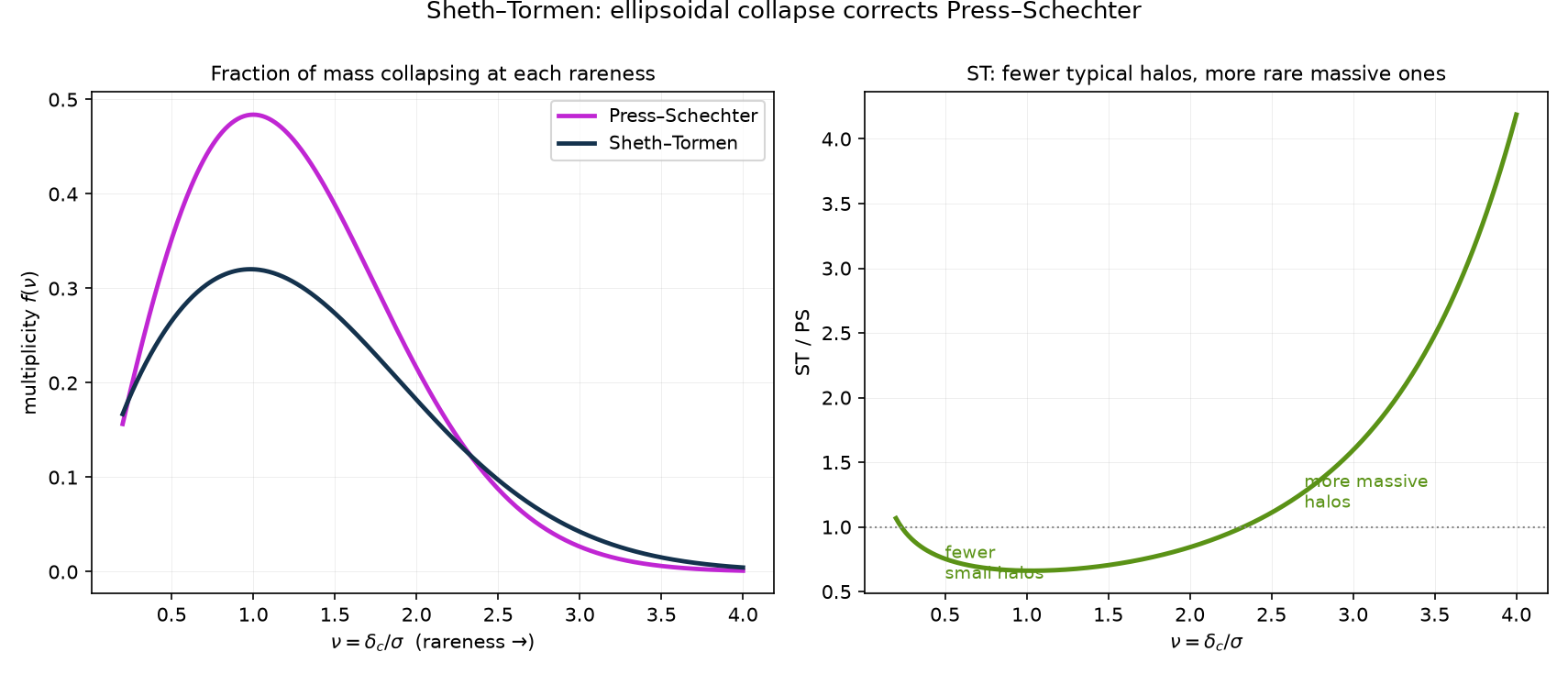
Relative to Press–Schechter, Sheth–Tormen predicts fewer typical halos and more rare massive ones (figure) — exactly the direction simulations require. It has been the default analytic mass function for two decades and is what our pipeline uses.
Ellipsoidal collapse makes the threshold depend on rarity. Sketch of the argument:
- A triaxial region collapses along its shortest axis first; full collapse needs a higher overdensity than a sphere, by an amount that grows for less-massive (more common) peaks.
- Parametrize the barrier as $B(\sigma)=\sqrt a\,\delta_c\left[1+b\,(\sigma^2/a\delta_c^2)^p\right]$ — rising toward small $\sigma$ (rare, massive) and low $\sigma$ regimes reversed.
- First-crossing of this moving barrier by the excursion-set walk yields $f_{\rm ST}(\sigma)=A\sqrt{\tfrac{2a}{\pi}}\big[1+(\sigma^2/a\delta_c^2)^p\big]\tfrac{\delta_c}{\sigma}e^{-a\delta_c^2/2\sigma^2}$.
- The constants $a=0.707,\ p=0.3,\ A=0.322$ are fit to N-body simulations; setting $a=1,p=0$ recovers Press–Schechter.
The factor $a<1$ lowers the effective threshold, shifting halos from typical to rare masses — exactly the correction the figure shows.
Evaluating the Sheth–Tormen mass function on our linear $P(k)$ reproduces the standard colossus library to 0.1% at $z=3$–$7$ (5% at $z=15$), and matches our GADGET-4 control ($N=91{,}058$ FOF halos, sim/ST median $1.07$ at $z=6$). Same machinery, same $\delta_c$ — only $f(\sigma)$ is upgraded.
Carries over to FDM unchanged
Crucially, all the FDM physics lives in $\sigma(M)$, so the Sheth–Tormen multiplicity applies to fuzzy dark matter without modification — we simply feed it the cutoff $\sigma(M)$ from the HBG transfer (with a sharp-k window).
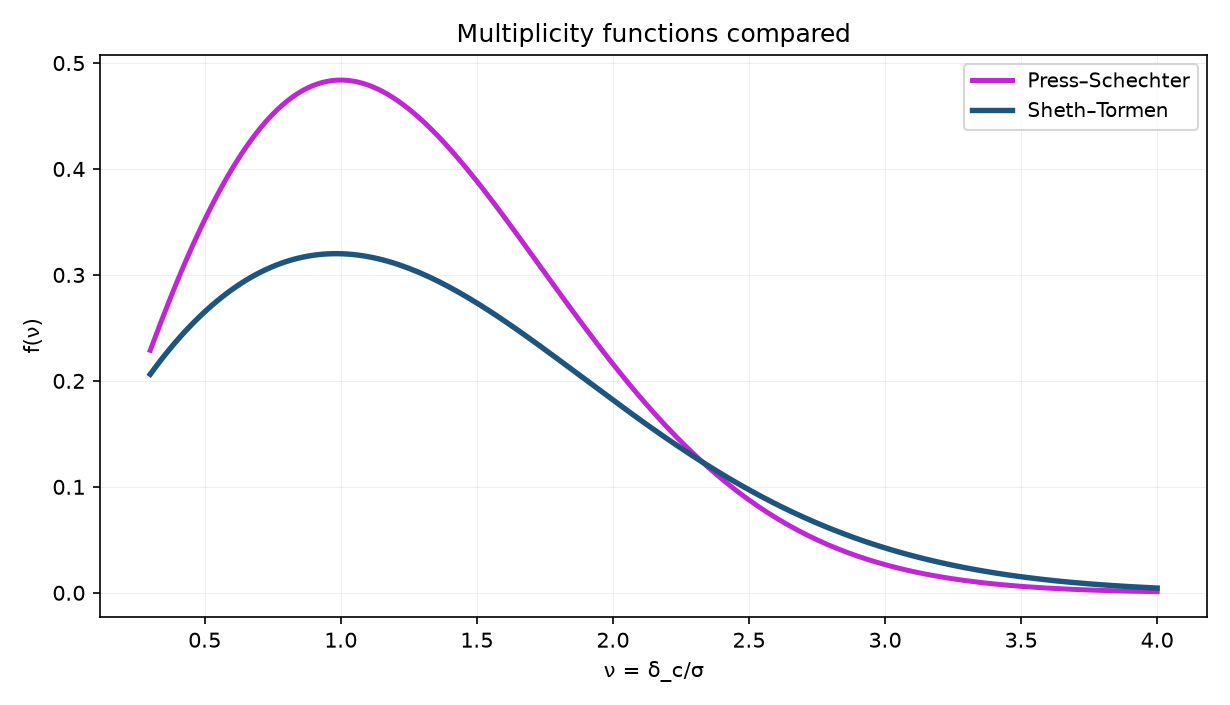
Sheth–Tormen is the exact multiplicity behind every mass function in the campaign; it is why our $\Lambda$CDM baseline matches colossus to 0.1% and our GADGET-4 control at $z=6$. For FDM we feed it the cutoff $\sigma(M)$ (§6.3–6.4), giving the suppressed curves of Task 1.
- Bond, Cole, Efstathiou & Kaiser (1991), Excursion set mass functions, ApJ 379, 440.
- Sheth & Tormen (1999), MNRAS 308, 119 (arXiv:astro-ph/9901122).
- Tinker et al. (2008), Toward a halo mass function for precision cosmology, ApJ 688, 709 (arXiv:0803.2706).