The quantum Jeans scale and instability
Linearizing Schrödinger–Poisson
Perturb a uniform background, $\rho=\bar\rho(1+\delta)$, and linearize the SP (or equivalently the Madelung, Topic 3.5) equations. Each Fourier mode obeys
$$\ddot\delta_k+2H\dot\delta_k+\left[\left(\frac{\hbar k^2}{2ma^2}\right)^2-\frac{4\pi G\bar\rho}{a^3}\right]\delta_k=0 .$$The bracket is the battleground: the $k^4$ quantum-pressure term versus the constant self-gravity term.
Growth vs oscillation
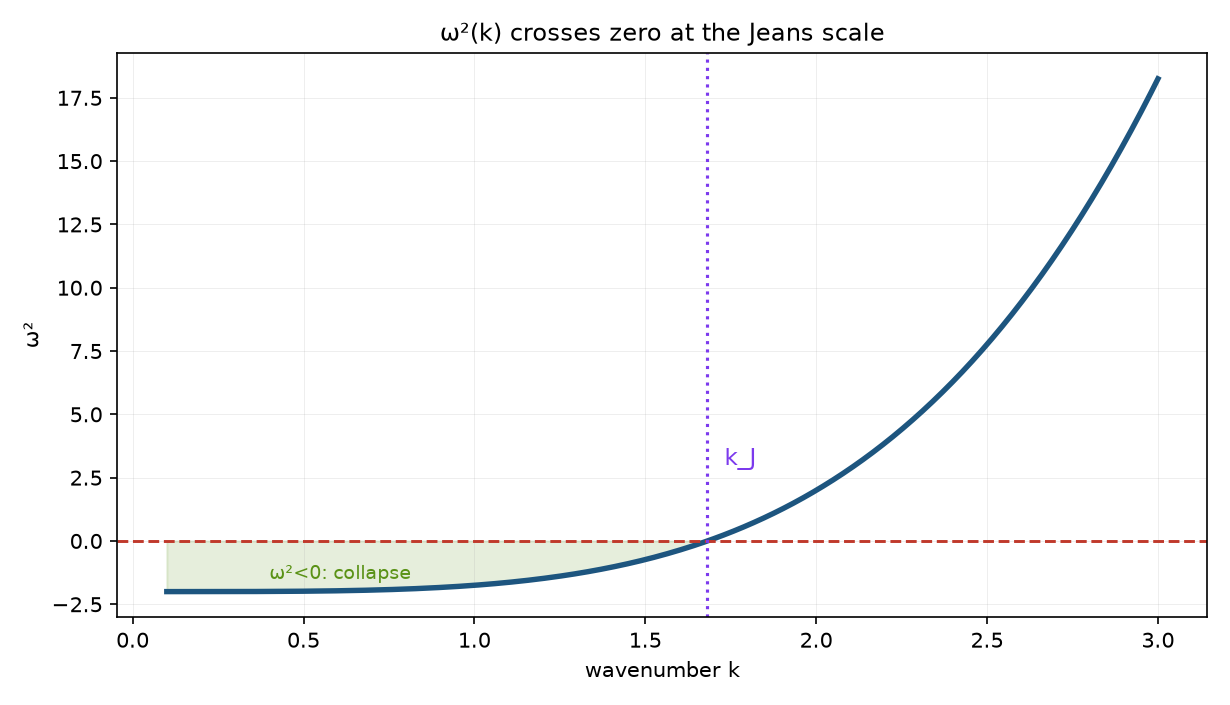
When the bracket is negative (small $k$, large scales) the mode is unstable and grows — ordinary gravitational collapse. When it is positive (large $k$, small scales) the mode oscillates instead of growing: quantum pressure has stabilized it. The crossover defines the quantum Jeans wavenumber,
$$k_J=\left(\frac{16\pi G\bar\rho\,m^2}{\hbar^2}\right)^{1/4}a^{1/4}.$$A smallest structure
Modes with $k>k_J$ never collapse, so fuzzy dark matter cannot form structure below the Jeans length $\lambda_J=2\pi/k_J$. This is the sharp difference from cold dark matter, which has no such floor. The figure shows how a heavier boson pushes $k_J$ to smaller scales (a smaller minimum halo).
The mass enclosed in a Jeans wavelength, $M_J\sim\tfrac{4}{3}\pi\bar\rho(\lambda_J/2)^3$, evaluated for $m_{22}=0.8$ at the relevant epoch, gives $M_J\sim10^{8}\,M_\odot$ — matching the $M_{\min}\approx3\times10^{8}\,M_\odot$ that our GAMER runs measure. The boson mass, through $k_J\propto\sqrt{m}$, directly sets the smallest galaxy that can exist.
Where does the $k^4$ term come from? Perturb the Madelung fluid about a uniform background:
- Linearized continuity + Euler (with quantum pressure) give $\ddot\delta_k+2H\dot\delta_k=\left(4\pi G\bar\rho-\dfrac{\hbar^2 k^4}{4m^2a^4}\right)\delta_k$.
- Gravity ($+4\pi G\bar\rho$) is scale-independent as in CDM; the quantum term ($-\hbar^2k^4/4m^2a^4$) is new and steep in $k$.
- The $k^4$ arises because quantum pressure $Q\propto\nabla^2\sqrt\rho/\sqrt\rho$ gives a force $\propto k^3$, and Euler's divergence adds one more power of $k$.
- Growth stops where the bracket vanishes: $4\pi G\bar\rho=\dfrac{\hbar^2 k_J^4}{4m^2a^4}$, so $k_J\propto(G\bar\rho)^{1/4}(m/\hbar)^{1/2}a$.
Below $k_J$ the bracket is positive (CDM-like growth); above it, negative (oscillation). This quartic scale-dependence — absent in CDM — is the mathematical origin of the cutoff.
From instability to the cutoff
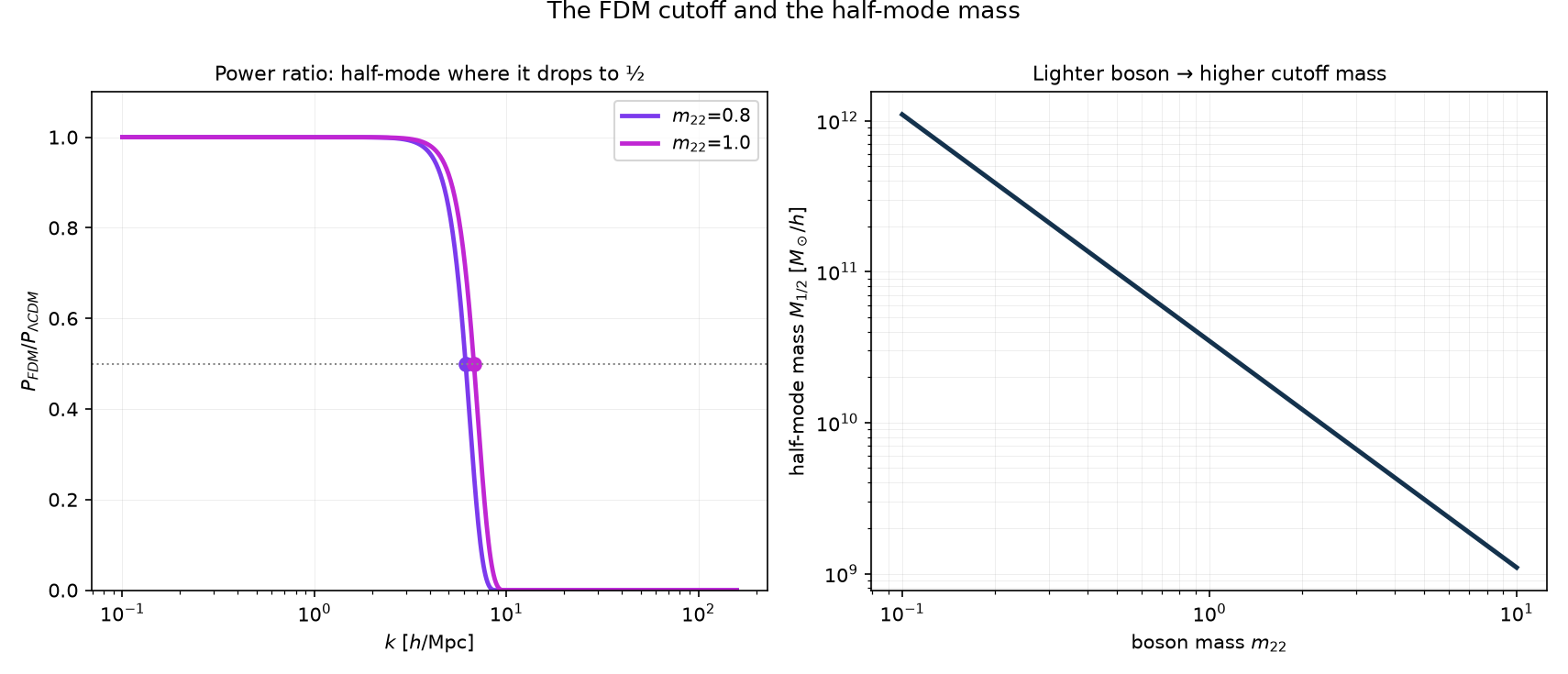
Because sub-Jeans modes oscillate rather than grow, the FDM linear power spectrum is suppressed below $\lambda_J$ relative to CDM — the cutoff computed analytically as the Hu–Barkana–Gruzinov transfer (Topic 6.3) and imposed in our mass functions (Task 1).
The quantum Jeans scale is the physical origin of everything in Task 1: the power-spectrum cutoff, the half-mode mass $M_{1/2}\approx5\times10^{10}\,M_\odot/h$, and the minimum halo mass $M_{\min}\approx3\times10^{8}\,M_\odot$ our GAMER runs recover — plus the delayed first collapse ($z_{\rm ff}\approx15.7$), since sub-Jeans seeds simply never grow.
- Hu, Barkana & Gruzinov (2000), Phys. Rev. Lett. 85, 1158 (arXiv:astro-ph/0003365).
- Marsh (2016), Phys. Rep. 643, 1 (arXiv:1510.07633).
- Hui, Ostriker, Tremaine & Witten (2017), Phys. Rev. D 95, 043541 (arXiv:1610.08297).