The evidence for dark matter
Galaxy rotation curves
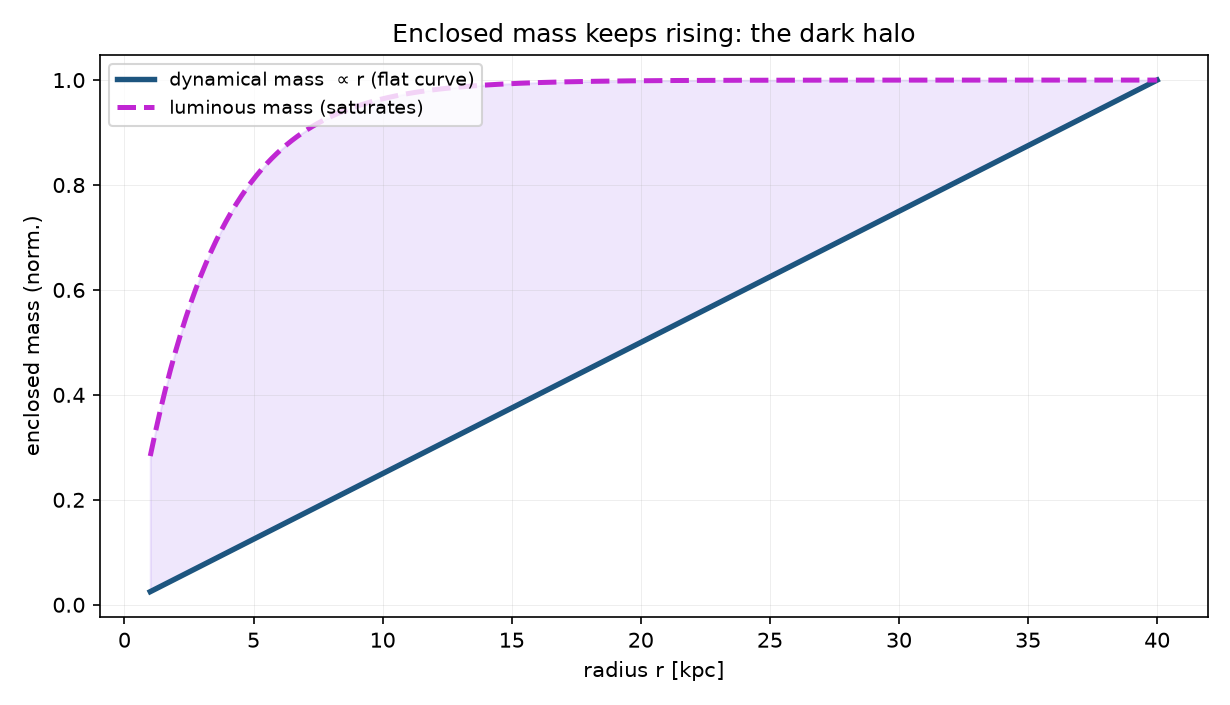
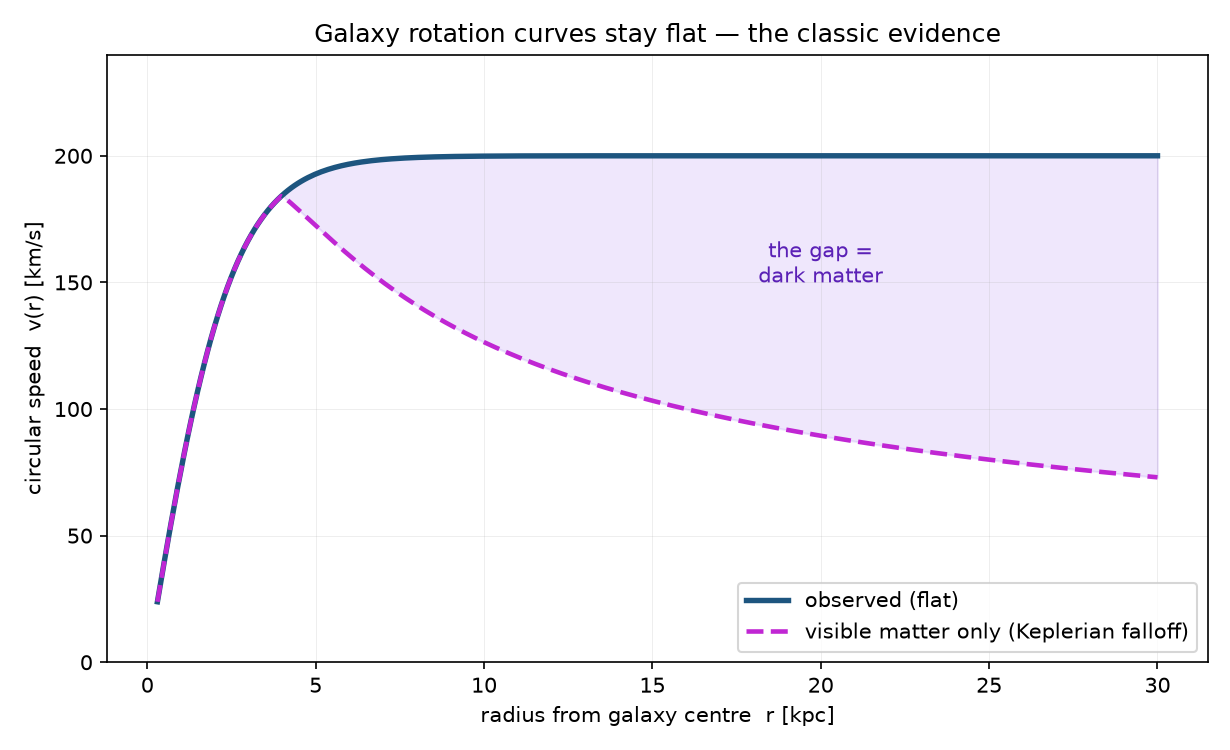
The cleanest evidence is kinematic. If a galaxy's mass followed its light, the circular speed beyond the luminous disk would fall as $v\propto r^{-1/2}$ (Keplerian). Instead, measured rotation curves stay flat out to large radii (figure) — which requires the enclosed mass to keep growing, $M( For a circular orbit, $v^2=GM( several times the stellar mass — and it keeps rising with $r$. The missing mass is dark. Ask what density profile produces a flat rotation curve $v(r)=$ const: A flat rotation curve is thus the signature of an extended $\rho\propto r^{-2}$ dark halo enveloping the visible disk — far larger than the light. Zwicky (1933) applied the virial theorem to the Coma cluster and found the galaxies move far too fast to be bound by their visible mass — the first hint of dark matter, on the largest scales. Modern cluster dynamics and X-ray gas temperatures confirm a large dark component. Light bends around mass regardless of whether it shines. Weak and strong lensing map cluster mass directly, and in the Bullet Cluster the lensing mass is spatially offset from the X-ray gas (most of the baryons) — showing the dominant mass is collisionless and dark, not the gas. The most precise measurement is cosmological. The heights of the acoustic peaks in the CMB power spectrum require about five times more matter than baryons — a non-baryonic component that does not couple to photons. The same $\Omega_c$ then correctly predicts the growth of large-scale structure. Independent probes converge on $\Omega_c\approx0.26$. That $\sim$5:1 dark-to-baryon ratio is the $\Omega_c\approx0.26$ we put into every simulation. What none of this evidence tells us is what the dark matter is — cold particles or an ultralight wave. Distinguishing those on the galactic scales where they differ is the entire point of this program.
Clusters and the virial discrepancy
Gravitational lensing
The CMB and large-scale structure