Scaling symmetry and dimensionless units
The SP scaling symmetry
If $\{\psi(\mathbf x,t),\Phi(\mathbf x,t)\}$ solves SP, then for any $\lambda>0$ so does the rescaled set
$$\psi\to\lambda^2\psi(\lambda\mathbf x,\lambda^2 t),\quad \Phi\to\lambda^2\Phi(\lambda\mathbf x,\lambda^2 t),\quad \{\mathbf x,t,\rho,M\}\to\{\lambda^{-1}\mathbf x,\lambda^{-2}t,\lambda^4\rho,\lambda M\}.$$Lengths shrink as $\lambda^{-1}$, densities grow as $\lambda^4$, and masses grow as $\lambda$.
One soliton, all masses
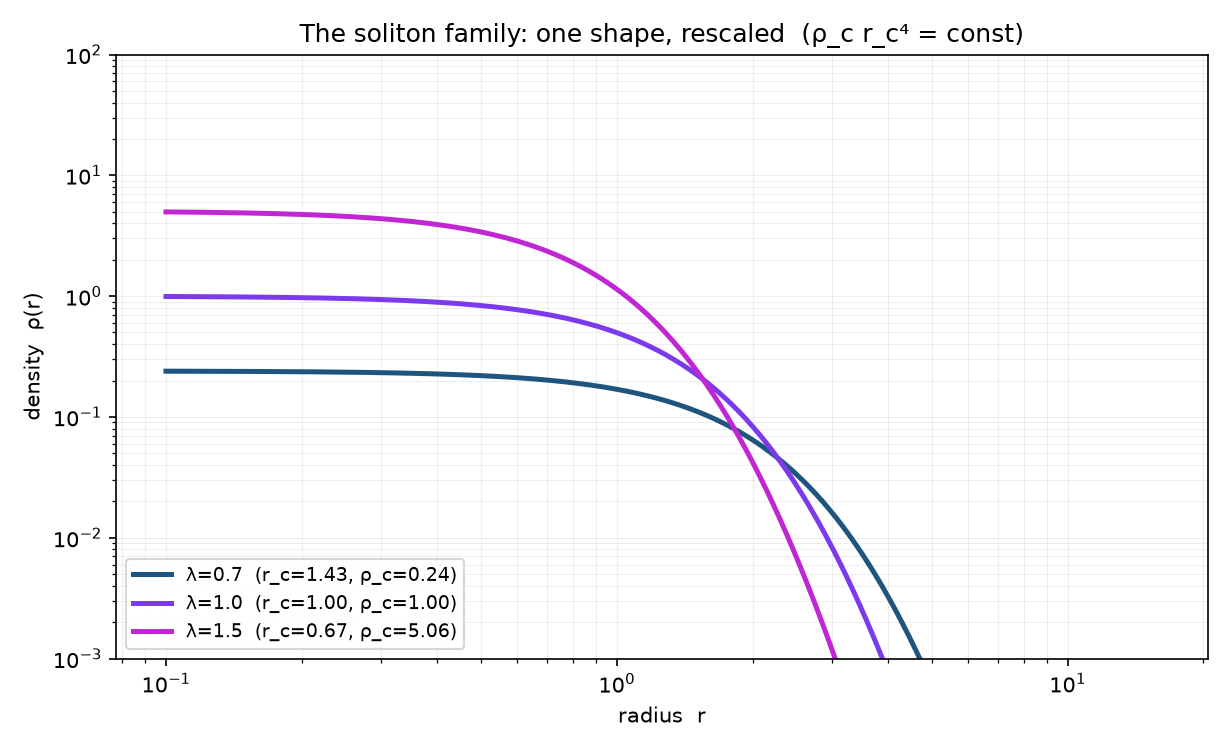
The immediate payoff: compute the ground state once and every other soliton is a rescaling of it (figure). The invariant combinations are
$$\rho_c\,r_c^4=\text{const},\qquad M_c\,r_c=\text{const}\times\frac{1}{m^2},$$which are exactly the $M^4$ law and the core–halo scaling of Topic 5.2. A heavier core is smaller and denser, in a fixed ratio set by this symmetry.
Dimensionless units
The symmetry means SP has no intrinsic scale beyond $\hbar/m$ and $G$, so simulations are run in dimensionless code units and rescaled to physical values afterward. This is what lets one modest box speak to a wide range of halo masses, and it is why our solver's validation (reproducing the Schive profile) transfers to every mass without re-running.
Suppose the code finds a ground state with $\rho_c=1,\ r_c=1$ in code units. To model a soliton of physical core radius $r_c=0.5$ kpc we need $\lambda=1/0.5=2$, giving $\rho_c\to\lambda^4=16$ and $M_c\to\lambda=2$ (in the corresponding code-to-physical conversion). One solve, infinitely many cores — the numerical economy the whole soliton program relies on.
Show the rescaled fields solve the same equations:
- Propose $\tilde\psi(\mathbf x,t)=\lambda^2\psi(\lambda\mathbf x,\lambda^2 t)$, $\tilde\Phi=\lambda^2\Phi(\lambda\mathbf x,\lambda^2 t)$.
- Derivatives: $\partial_t\tilde\psi=\lambda^4(\partial_t\psi)$, $\nabla^2\tilde\psi=\lambda^4(\nabla^2\psi)$, $\tilde\Phi\tilde\psi=\lambda^4(\Phi\psi)$.
- Every term in $i\hbar\partial_t\psi=-\tfrac{\hbar^2}{2m}\nabla^2\psi+m\Phi\psi$ scales as $\lambda^4$ — so it holds for the tilded fields too.
- Poisson: $\nabla^2\tilde\Phi=\lambda^4\nabla^2\Phi=4\pi Gm|\tilde\psi|^2$ ✓ (since $|\tilde\psi|^2=\lambda^4|\psi|^2$).
Both equations are invariant. Reading the exponents: $\rho=m|\psi|^2\propto\lambda^4$, length $\propto\lambda^{-1}$, so $\rho_c r_c^4$ is invariant — the $M^4$ law drops straight out of the symmetry.
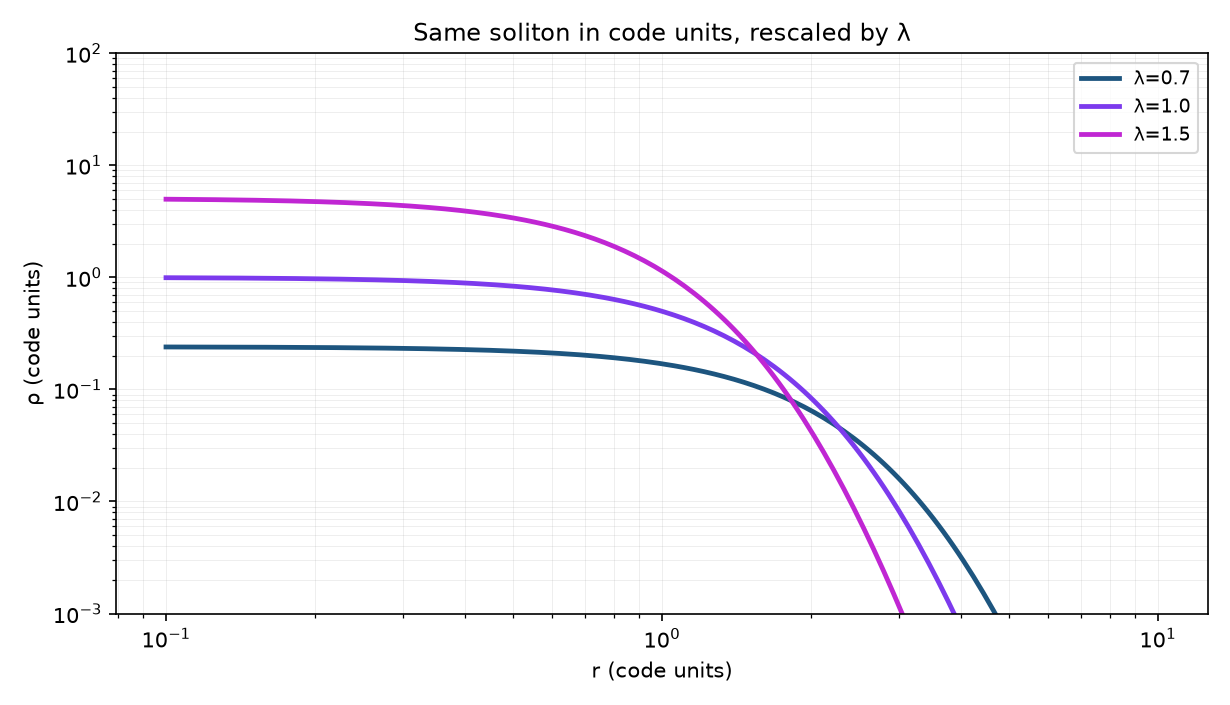
This symmetry is why our JAXiON solver only has to reproduce the Schive profile once (JXE-F5) to validate cores of all masses, and why GAMER's three z=19 cores of different masses fall on one curve (JXE-F9): they are the same soliton, rescaled. It also underlies the $M_c r_c=$ const relation used throughout Task 2.
- Schive, Chiueh & Broadhurst (2014), Nature Physics 10, 496 (arXiv:1406.6586).
- Mocz et al. (2017), MNRAS 471, 4559 (arXiv:1705.05845).
- Chavanis (2011), Phys. Rev. D 84, 043531.