The candidate map: WIMPs, warm, axion, fuzzy
One name, many candidates
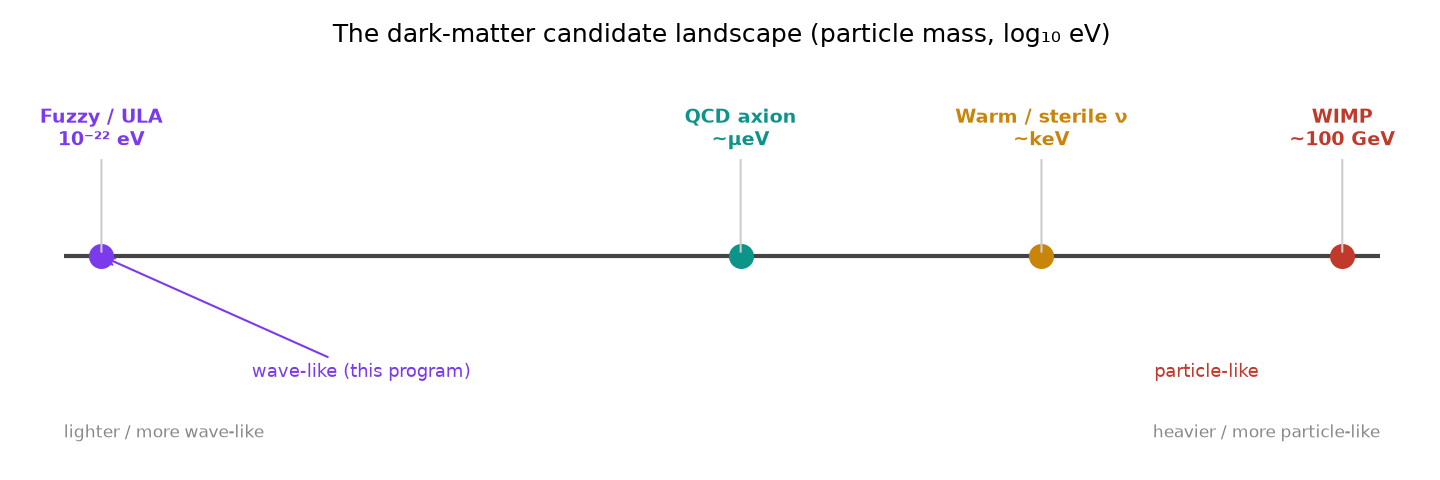
All the evidence of Topic 2.1 constrains dark matter's gravity, not its identity. That leaves a vast candidate landscape (figure), from ultralight bosons at $10^{-22}$ eV to WIMPs near $100$ GeV — and beyond, to macroscopic primordial black holes. Each corner makes different small-scale predictions.
The mass landscape
- WIMPs ($\sim100$ GeV) — the long-favoured thermal relic; heavy, cold, clumps on all scales.
- Sterile neutrinos / warm dark matter ($\sim$keV) — fast enough to free-stream out of small halos, giving a cutoff.
- QCD axion ($\sim\mu$eV) — a well-motivated light boson, but still effectively cold cosmologically.
- Fuzzy / ultralight axion ($\sim10^{-22}$ eV) — so light its wave nature is macroscopic. This program's subject.
Particle-like vs wave-like
The dividing line is the de Broglie wavelength. When $\lambda_{\rm dB}=\hbar/(mv)$ is microscopic, dark matter is a gas of particles; when it is astrophysical, dark matter is a coherent wave and must be treated with the Schrödinger–Poisson equations (Topic 4).
Take $m=10^{-22}\,{\rm eV}/c^2=1.8\times10^{-58}$ kg moving at a dwarf-galaxy speed $v\sim10\ \mathrm{km\,s^{-1}}$:
$$\lambda_{\rm dB}=\frac{\hbar}{mv}=\frac{1.05\times10^{-34}}{(1.8\times10^{-58})(10^{4})}\approx6\times10^{19}\ {\rm m}\approx2\ {\rm kpc}.$$The wavelength is kiloparsecs — the size of a galaxy's core. That is exactly why fuzzy dark matter reshapes galaxies while leaving large scales untouched.
Why $\lambda_{\rm dB}$ lands on galaxies for $m\sim10^{-22}$ eV is not luck — it follows from the scaling:
- $\lambda_{\rm dB}=\dfrac{\hbar}{mv}$, and in a virialized halo $v\sim\sqrt{GM_h/R}$ is set by the halo, not the boson.
- So at fixed halo velocity, $\lambda_{\rm dB}\propto 1/m$ — a lighter boson has a proportionally larger wavelength.
- Requiring $\lambda_{\rm dB}\sim$ kpc at dwarf velocities $v\sim10\ {\rm km\,s^{-1}}$ solves for $m\sim\hbar/(v\cdot{\rm kpc})\sim10^{-22}$ eV.
Turned around: the observed $\sim$kpc cores of dwarf galaxies select a boson mass of $\sim10^{-22}$ eV. The "fuzzy" scale is an empirical target, not a coincidence.
Why fuzzy is testable — and where it sits with warm
Warm dark matter also cuts off small-scale power (by free-streaming), so FDM and WDM share a family resemblance in the mass function; they differ in the halo interior, where only FDM builds a solitonic core. The macroscopic de Broglie scale makes fuzzy dark matter uniquely testable on galactic scales — the regime our three codes target.
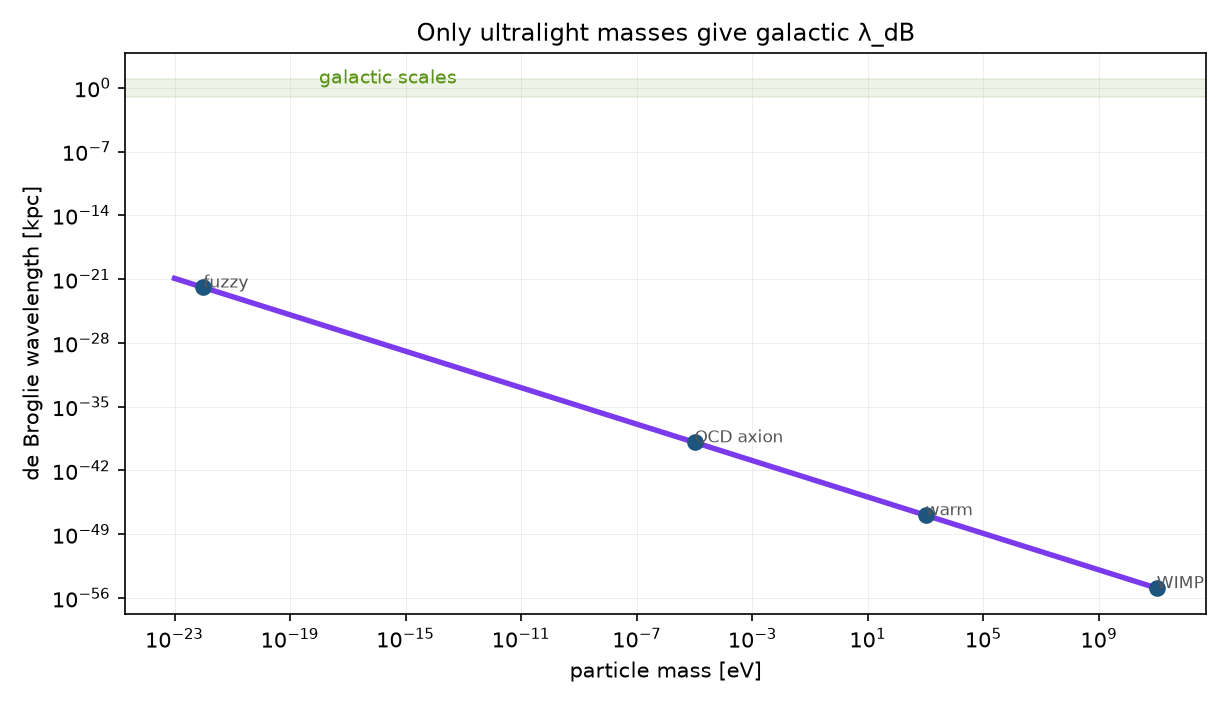
Our entire program tests the wave-like corner at $m\sim10^{-22}$ eV. The $\sim$kpc de Broglie scale computed above is what puts the FDM cutoff at $M_{1/2}\sim10^{10}\,M_\odot$ and sizes the solitonic cores we resolve — the two observables Tasks 1 and 2 measure.
- Hui, Ostriker, Tremaine & Witten (2017), Ultralight scalars as cosmological dark matter, Phys. Rev. D 95, 043541 (arXiv:1610.08297).
- Marsh (2016), Axion Cosmology, Phys. Rep. 643, 1 (arXiv:1510.07633).
- Ferreira (2021), Ultra-light dark matter, A&A Rev. 29, 7 (arXiv:2005.03254).