The Lyman-α forest: a heavy-boson bound
What the forest is
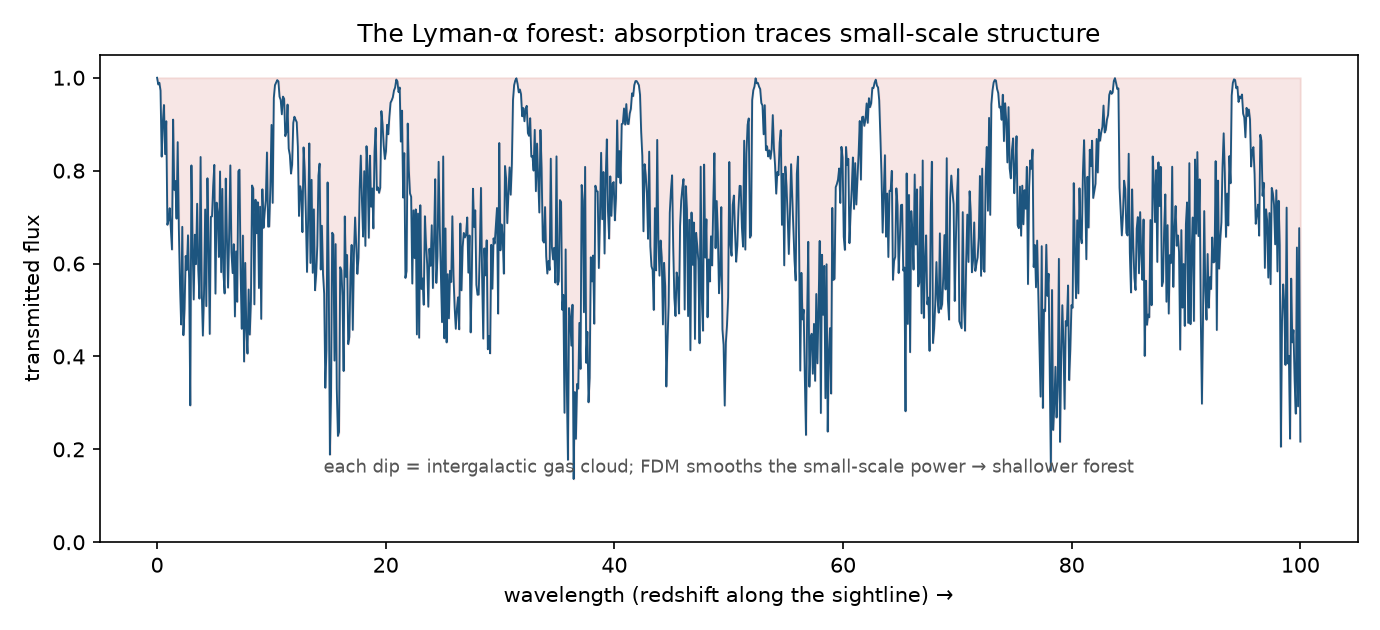
Light from a distant quasar passes through intervening hydrogen, which absorbs at the Lyman-$\alpha$ wavelength. Because the gas is at many redshifts along the sightline, the spectrum shows a dense series of absorption dips — the Lyman-$\alpha$ forest (figure). The statistics of those dips trace the density fluctuations of the gas, and hence of the dark matter, on small scales at $z\sim2$–$5$.
A probe of small-scale power
The forest measures the matter power spectrum on exactly the scales where FDM cuts off — $k\sim1$–$10\ h/$Mpc. Fuzzy dark matter would smooth the forest: erasing small-scale power makes the absorption shallower and less structured than observed. The data show plenty of small-scale structure, so a strong FDM cutoff is excluded.
Fitting the observed flux power spectrum requires the FDM cutoff to sit at higher $k$ than the light-boson value allows, giving a lower bound $m_{22}\gtrsim20$ (2$\sigma$; some analyses push to $m_{22}\gtrsim100$). At such masses the soliton is far too small to core a dwarf — so the very feature that motivated FDM becomes dynamically irrelevant.
Systematics
The forest bound depends on modelling the gas temperature and reionization history, which are degenerate with the FDM cutoff — so the exact number is debated. But the qualitative conclusion (the forest wants a heavy boson) is robust across analyses.
The collision
Dwarfs want $m_{22}\lesssim1$; the forest wants $m_{22}\gtrsim20$. These allowed regions do not overlap. Quantifying that disagreement is the mass tension (Topic 10.4).
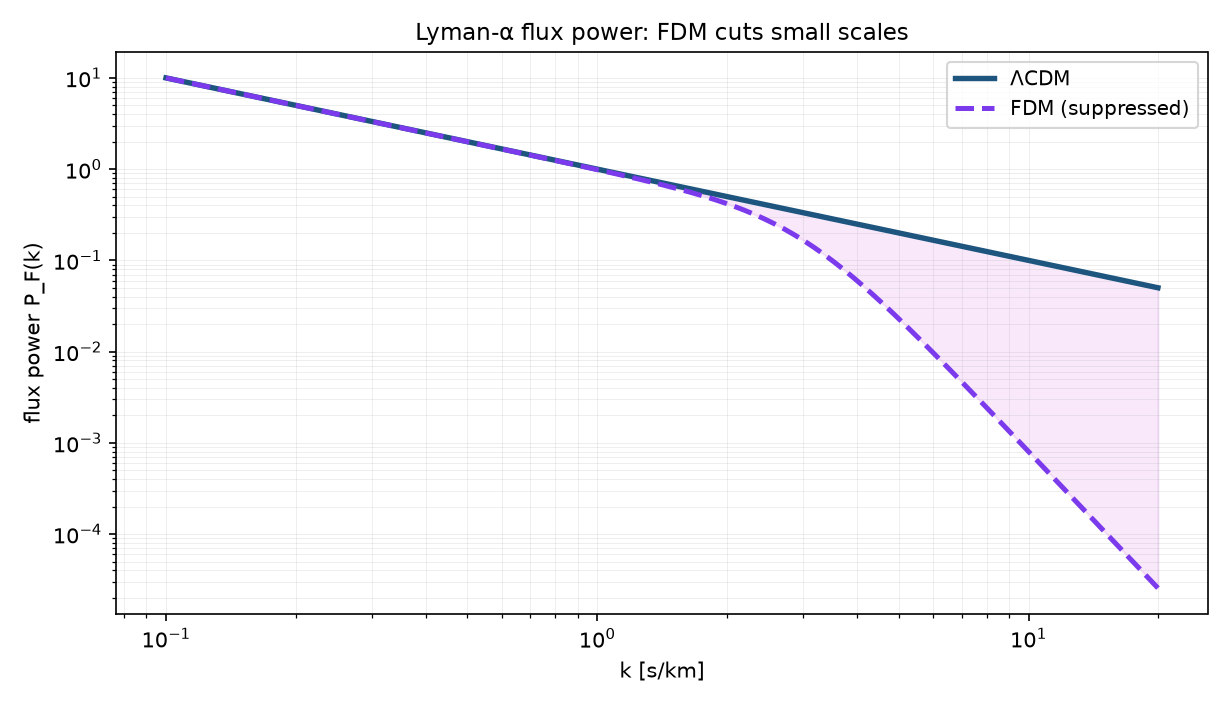
The Lyman-α bound ($m_{22}\gtrsim20$) is the other arm of our 8.7$\sigma$ tension (Topic 10.4). It probes exactly the small-scale $P(k)$ cutoff we compute in Task 1 (Topic 6.3) — the same physics, read from observation rather than simulation.
- Iršič et al. (2017), First constraints on FDM from Lyman-α, Phys. Rev. Lett. 119, 031302 (arXiv:1703.04683).
- Rogers & Peiris (2021), Strong bound on ULA DM, Phys. Rev. Lett. 126, 071302 (arXiv:2007.12705).
- Armengaud et al. (2017), MNRAS 471, 4606 (arXiv:1703.09126).