Substructure, satellites & stellar streams
Counting the smallest halos
Fuzzy dark matter's defining prediction is a deficit of low-mass halos below the half-mode mass (Topic 7.4). Several observations count those halos, directly or by their gravitational effects, and so bound the cutoff — and the boson mass.
Satellite galaxies
The number of satellite galaxies orbiting the Milky Way counts luminous subhalos. FDM suppresses low-mass subhalos, so too strong a cutoff would leave too few satellites. The observed (and increasingly complete) satellite census sets a lower bound on $m$.
Lensing and stellar streams
Two elegant dynamical probes reach dark, starless subhalos: strong-lensing flux-ratio anomalies and gravitational imaging detect subhalo perturbations to lensed images, while cold stellar streams (tidal debris of disrupted clusters) develop gaps and wiggles when a dark subhalo passes through. Both measure the substructure abundance — the cleanest handle on the cutoff, since it needs no luminous tracer.
Each of these — satellites, lensing, streams — finds enough low-mass structure to require $m_{22}\gtrsim$ several to tens. Like the forest, they push the boson mass up, reinforcing the tension with the dwarf cores. They probe the same cutoff, from a different observable.
Complementarity
These probes are powerful precisely because they are independent: dwarfs probe halo interiors, the forest and substructure probe halo abundance. That they pull in opposite directions on the boson mass is what makes the tension serious rather than a single-probe systematic.
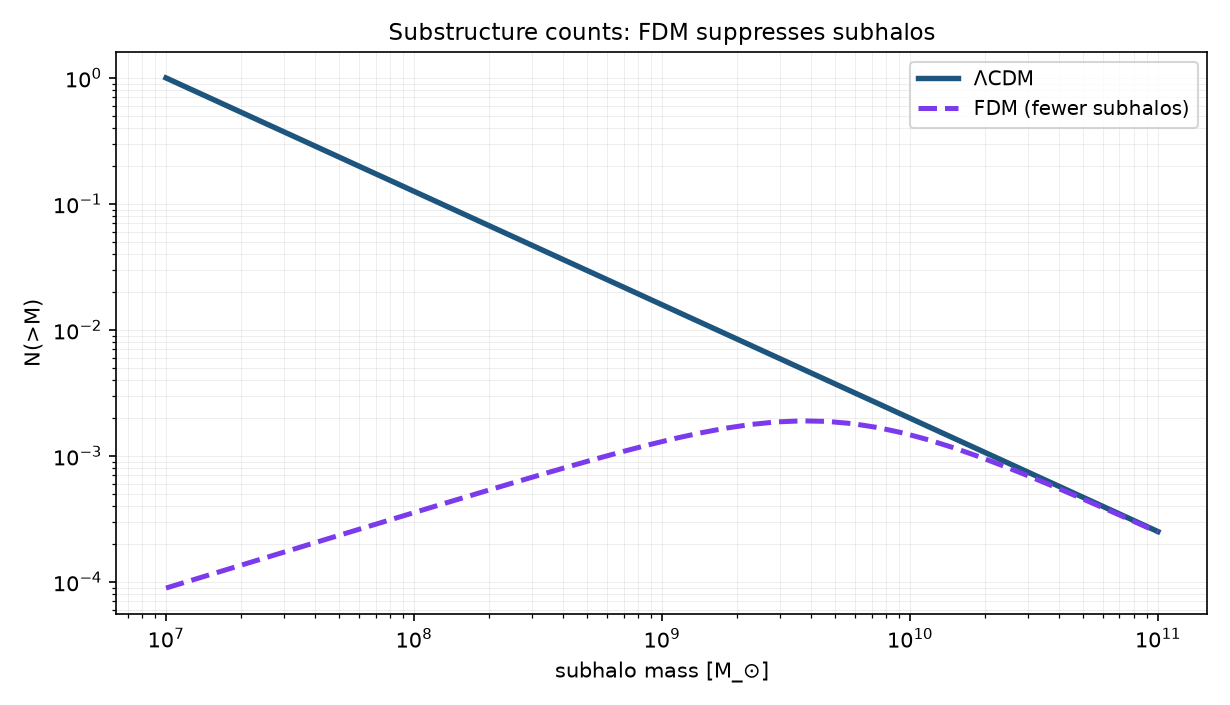
These abundance probes measure the same low-mass cutoff our Task 1 predicts ($M_{1/2}$, the delayed collapse). They mostly reinforce the heavy-boson side of the 8.7$\sigma$ tension (Topic 10.4), against the light-boson dwarf cores of Topic 10.1.
- Nadler et al. (2021), Milky Way satellite constraints on FDM, Phys. Rev. Lett. 126, 091101 (arXiv:2008.00022).
- Schutz (2020), Subhalo mass function and ultralight DM, Phys. Rev. D 101, 123026 (arXiv:2001.05503).
- Banik et al. (2021), Stream constraints on DM substructure, JCAP 10, 043.