The ΛCDM concordance model and its parameters
Six numbers run the Universe
The base $\Lambda$CDM model — a spatially flat universe of cold dark matter plus a cosmological constant — is fixed by six parameters. In the Planck basis:
| Parameter | Symbol | Planck 2018 | Controls |
|---|---|---|---|
| Baryon density | $\Omega_b h^2$ | 0.0224 | ordinary matter |
| Cold DM density | $\Omega_c h^2$ | 0.120 | dark matter |
| Hubble parameter | $h$ | 0.677 | expansion rate, distances |
| Fluctuation amplitude | $\sigma_8$ (or $A_s$) | 0.811 | how much structure |
| Spectral tilt | $n_s$ | 0.965 | large- vs small-scale power |
| Optical depth | $\tau$ | 0.054 | reionization |
Everything else — the age, distances, the growth of structure — is derived from these.
Planck reports $\Omega_b h^2$ and $\Omega_c h^2$ rather than $\Omega_b,\Omega_c$ directly. The reason:
- The physical mass density today is $\rho_{i,0}=\Omega_i\,\rho_{\rm crit}=\Omega_i\,\dfrac{3H_0^2}{8\pi G}$.
- But $H_0=100\,h\ \mathrm{km\,s^{-1}Mpc^{-1}}$, so $\rho_{\rm crit}\propto H_0^2\propto h^2$.
- Hence $\rho_{i,0}\propto\Omega_i h^2$ — the combination $\Omega_i h^2$, not $\Omega_i$ alone, is the actual physical density.
The CMB acoustic physics measures physical densities (photon–baryon ratios, the sound horizon), so $\Omega_b h^2$ and $\Omega_c h^2$ are what it constrains most directly. To recover $\Omega_m=(\Omega_bh^2+\Omega_ch^2)/h^2=(0.0224+0.120)/0.677^2\approx0.31$.
The energy budget today
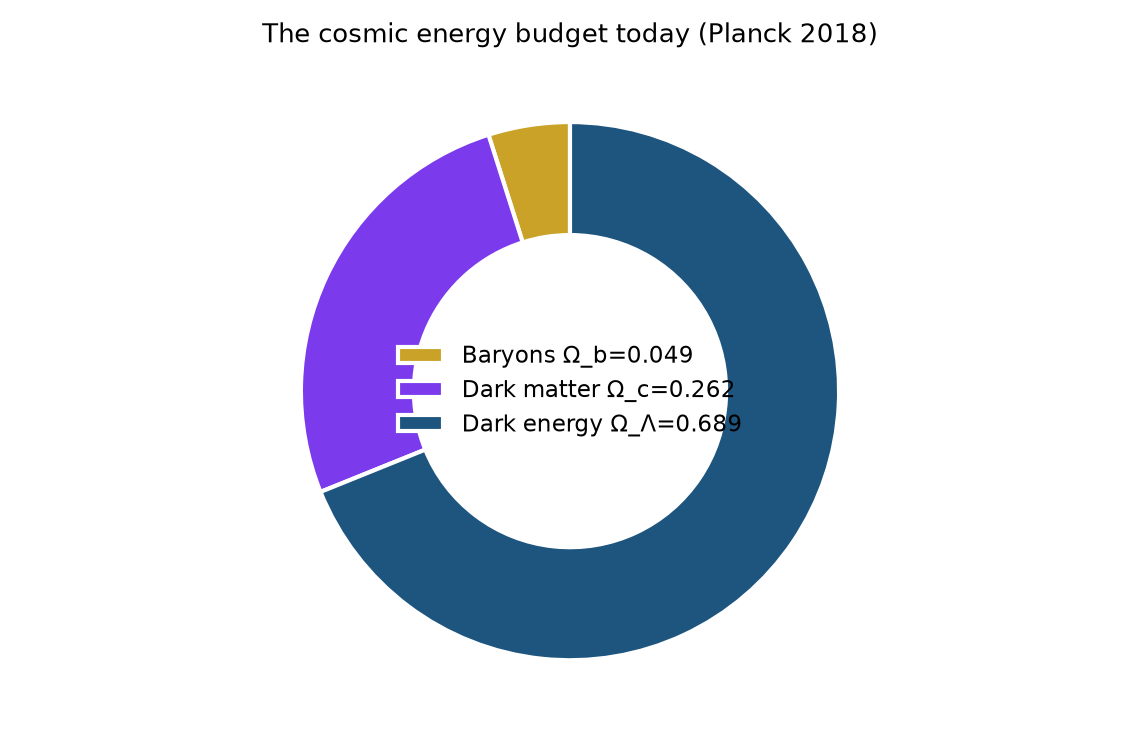
Rolling the densities to the present gives the budget in the figure: matter $\Omega_m\approx0.31$ (ordinary baryons $\Omega_b\approx0.049$ plus dark matter $\Omega_c\approx0.262$) and dark energy $\Omega_\Lambda\approx0.69$, summing to flat. Dark matter outweighs ordinary matter more than five to one — and it is what that dark matter is (cold, or fuzzy) that this whole program probes.
What each parameter controls
- $\Omega_m$ sets how strongly gravity assembles structure and when deceleration ended.
- $\sigma_8$ scales the entire power spectrum — it is how much structure there is.
- $n_s\approx0.965$ tilts the primordial spectrum ($n_s=1$ would be perfectly scale-invariant).
- $h$ sets the expansion rate and hence all cosmic distances and times.
From parameters to a density
The critical density today is $\rho_{\rm crit,0}=2.775\times10^{11}\,h^2\ M_\odot\,{\rm Mpc}^{-3}$. With $h=0.677$,
$$\rho_{\rm crit,0}=2.775\times10^{11}\times0.677^2\approx1.27\times10^{11}\ M_\odot\,{\rm Mpc}^{-3},$$and the mean matter density is $\bar\rho_m=\Omega_m\,\rho_{\rm crit,0}\approx0.311\times1.27\times10^{11}=3.96\times10^{10}\ M_\odot\,{\rm Mpc}^{-3}$. This single number is the $\bar\rho$ prefactor in every halo mass function $dn/d\ln M=(\bar\rho/M)f(\sigma)|d\ln\sigma/d\ln M|$ we compute — the parameters here are not abstract, they set the normalization of our results.
How we know them
The six numbers are pinned by the cosmic microwave background (Planck measures the acoustic-peak pattern to sub-percent precision), reinforced by baryon acoustic oscillations in galaxy surveys and Type Ia supernovae. That three independent probes converge on the same values is the ‘concordance’ the model is named for.
Our adopted cosmology
For all analytic results we adopt Planck-2018: $\Omega_m=0.311,\ \Omega_b=0.049,\ h=0.677,\ n_s=0.967,\ \sigma_8=0.811$. Our simulation boxes used a close variant ($\Omega_m=0.284,\ h=0.696$); the $\sim1\%$ difference is negligible for the FDM-vs-CDM contrast and is flagged wherever a figure overlays theory and simulation.
These are the exact numbers behind our Task-1 mass functions: the $\bar\rho_m$ computed above sets the amplitude, $\sigma_8$ fixes the normalization, and our $\Lambda$CDM baseline reproduces the standard colossus library to 0.1%. Fuzzy dark matter changes only the small-scale end; this six-parameter model is the shared backbone against which the FDM cutoff is measured.
- Planck Collaboration (2020), Planck 2018 results VI, A&A 641, A6 (arXiv:1807.06209).
- Dodelson & Schmidt (2020), Modern Cosmology, 2nd ed.