Initial conditions: from P(k) to particles
The goal: a random realization
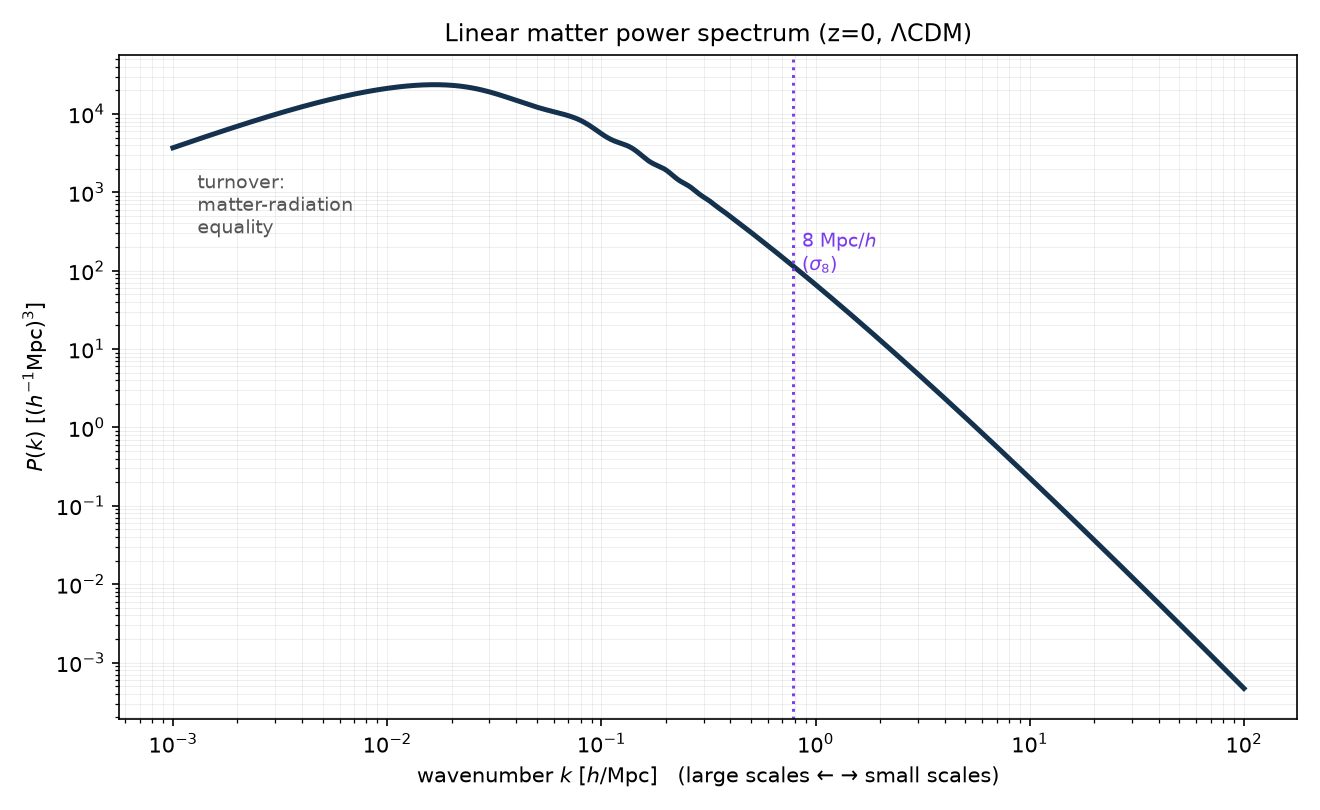
A simulation needs a specific density field at its start redshift that (statistically) has the right power spectrum $P(k)$. The standard method: draw a Gaussian random field with the target $P(k)$, then displace a uniform particle grid according to it.
The Zel'dovich approximation
Particles are displaced from a uniform lattice by the Zel'dovich approximation: $\mathbf x=\mathbf q+D(z)\,\nabla\psi(\mathbf q)$, where $\psi$ is a potential drawn from $P(k)$ and $D(z)$ is the growth factor. This linear displacement is accurate at high redshift, where fluctuations are small — which is why we start at $z=127$.
Imprinting the FDM cutoff
To isolate the FDM effect cleanly, we generate a CDM realization and an FDM realization from the same random phases, differing only by the transfer function: the FDM field multiplies $P(k)$ by the Hu–Barkana–Gruzinov cutoff. This gives a phase-matched twin pair. Our GADGET-4 FDM-IC run does exactly this — CDM dynamics on FDM-suppressed initial conditions — and finds ~7× fewer halos at $z=6$, with the cutoff imprinted from the start.
Two kinds of FDM initial conditions
There is a subtlety: the FDM cutoff can be put in the initial conditions only (then evolved with any solver) or it can arise dynamically from quantum pressure during the run. May & Springel (2023) showed both contribute — the initial-condition cutoff plus ongoing wave dynamics — with dynamics adding extra suppression at the lowest masses. A full wave simulation captures both; an N-body run on FDM ICs captures only the first.
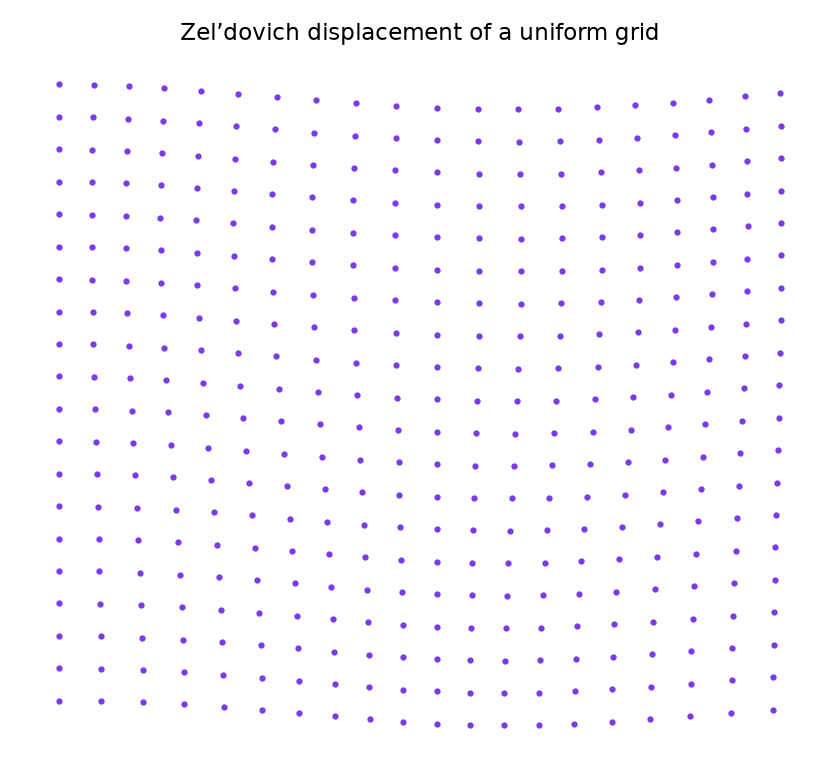
Our FDM-IC experiment (GADGET-4) is exactly this twin construction — same phases, CDM vs FDM-suppressed $P(k)$ — reproducing the May & Springel decomposition: an initial-condition cutoff (~7× fewer halos at $z=6$) plus, in the full wave runs, additional dynamical suppression. All three codes start from $z=127$ Zel'dovich ICs.
- Zel'dovich (1970), Gravitational instability, A&A 5, 84.
- May & Springel (2023), MNRAS 524, 4256 (arXiv:2209.14886).
- Crocce, Pueblas & Scoccimarro (2006), 2LPT initial conditions, MNRAS 373, 369.