The Friedmann universe: scale factor, redshift & the cosmic budget
An expanding space
On large scales the Universe is homogeneous and isotropic, and the only geometry consistent with that symmetry is the Friedmann–Lemaître–Robertson–Walker metric, in which every cosmic distance scales with a single time-dependent number, the scale factor $a(t)$ (normalized to $a=1$ today). A galaxy at fixed comoving coordinate $\mathbf x$ sits at physical distance $\mathbf r=a(t)\,\mathbf x$; as $a$ grows, space stretches and galaxies recede. Our simulation boxes are quoted in comoving units precisely so that this uniform stretching is divided out and only genuine clustering remains.
Light stretches with space. A photon emitted at scale factor $a$ is observed today with
$$1+z=\frac{\lambda_{\rm obs}}{\lambda_{\rm emit}}=\frac{1}{a},$$so redshift $z$ is a direct label for epoch: $z=0$ is now, and $z=127$ (our starting redshift) is when the Universe was $1/128$ of its present size.
The Friedmann equation
General relativity applied to this metric gives the Friedmann equation, relating the expansion rate $H\equiv\dot a/a$ to the energy content:
$$H^2=\left(\frac{\dot a}{a}\right)^2=\frac{8\pi G}{3}\rho-\frac{kc^2}{a^2}+\frac{\Lambda c^2}{3}.$$Writing each component as a fraction of the critical density $\rho_{\rm crit}=3H_0^2/8\pi G$ turns this into the form we actually integrate to evolve a simulation:
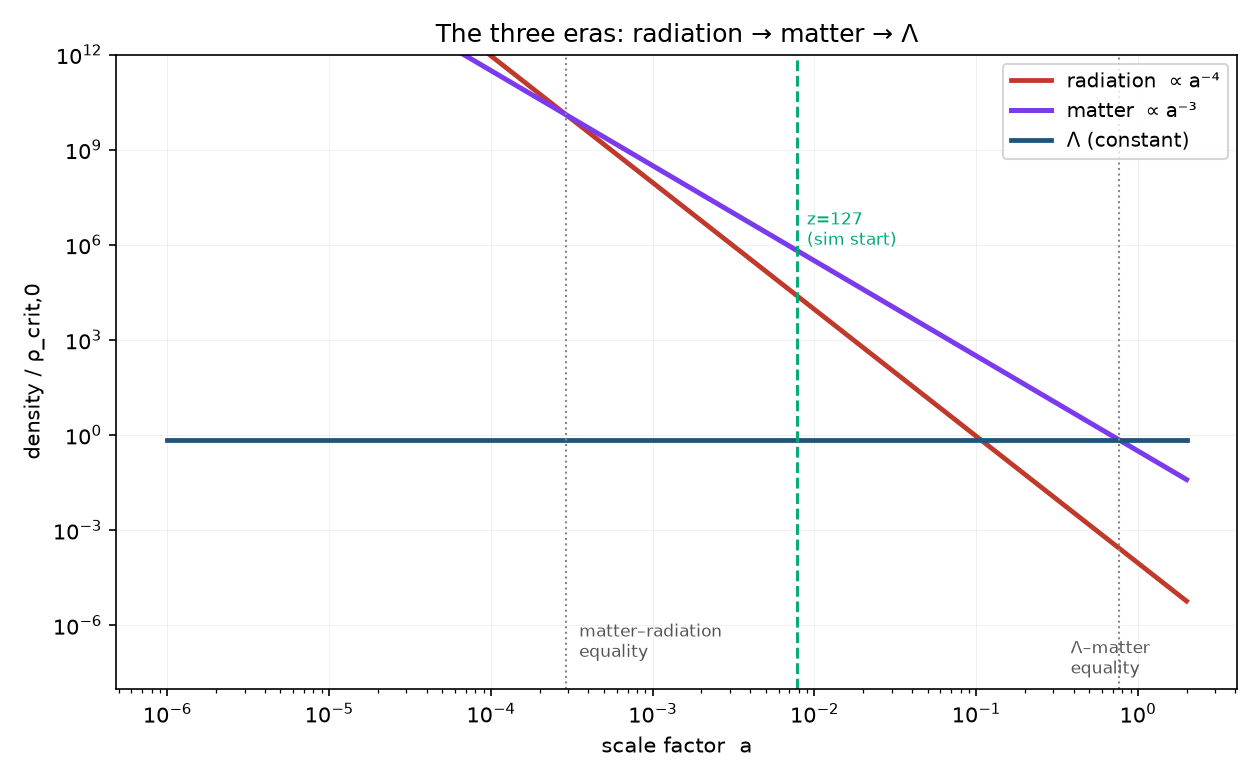
$$H^2(a)=H_0^2\Big[\Omega_r a^{-4}+\Omega_m a^{-3}+\Omega_k a^{-2}+\Omega_\Lambda\Big].$$Each term dilutes differently as the box expands: radiation as $a^{-4}$ (it redshifts and dilutes), matter as $a^{-3}$ (pure dilution), curvature as $a^{-2}$, and the cosmological constant not at all.
Start from the Friedmann equation with $\rho=\sum_i\rho_i$. Evaluate it today ($a=1$, $H=H_0$) for a flat universe ($k=0$):
- Define the critical density as the density that makes the universe flat: $\rho_{\rm crit}\equiv\dfrac{3H_0^2}{8\pi G}$.
- Define each density parameter as a fraction of it: $\Omega_i\equiv\rho_{i,0}/\rho_{\rm crit}$.
- Each species dilutes with its own power: $\rho_i(a)=\rho_{i,0}\,a^{-n_i}$ with $n=4$ (radiation), $3$ (matter), $0$ ($\Lambda$).
- Divide the Friedmann equation by $H_0^2$: $\dfrac{H^2}{H_0^2}=\dfrac{8\pi G}{3H_0^2}\sum_i\rho_{i,0}a^{-n_i}=\sum_i\Omega_i\,a^{-n_i}$.
which is exactly the workhorse form above. Setting $a=1$ forces $\sum_i\Omega_i=1$ for a flat universe — the closure relation Planck confirms.
The three eras
Because the terms scale differently, one always dominates, and the Universe passes through three eras (figure). Radiation dominated until matter–radiation equality at $a_{\rm eq}=\Omega_r/\Omega_m\approx3\times10^{-4}$ ($z\approx3400$); matter dominated the long middle epoch when cosmic structure actually grew; and dark energy took over near $a\approx(\Omega_m/\Omega_\Lambda)^{1/3}\approx0.75$ ($z\approx0.3$). Our runs start at $z=127$ ($a\approx0.008$) — safely in the matter era, long after equality — which is why the initial conditions need only matter and can be laid down with linear theory.
Redshift as a clock and a ruler
Since $a$ maps one-to-one to time through the Friedmann equation, redshift doubles as a cosmic clock (via $dt=da/aH$) and a ruler (comoving distance $\chi=\int c\,dz/H$). These conversions are what turn a raw simulation snapshot into something comparable with an observation at a given redshift.
With $\Omega_m=0.311,\ \Omega_\Lambda=0.689$ (flat, radiation negligible), the dimensionless rate is $E(z)=\sqrt{\Omega_m(1+z)^3+\Omega_\Lambda}$. At $z=6$:
$$E(6)=\sqrt{0.311\cdot7^3+0.689}=\sqrt{107.4}\approx10.4,$$so the Universe expanded $\sim\!10\times$ faster then than today, and it was only $\sim\!0.9$ Gyr old. At our start, $z=127$, the scale factor is $a=1/128\approx0.0078$ — the box begins when the Universe was $1/128$ of its present size.
Why this matters for structure
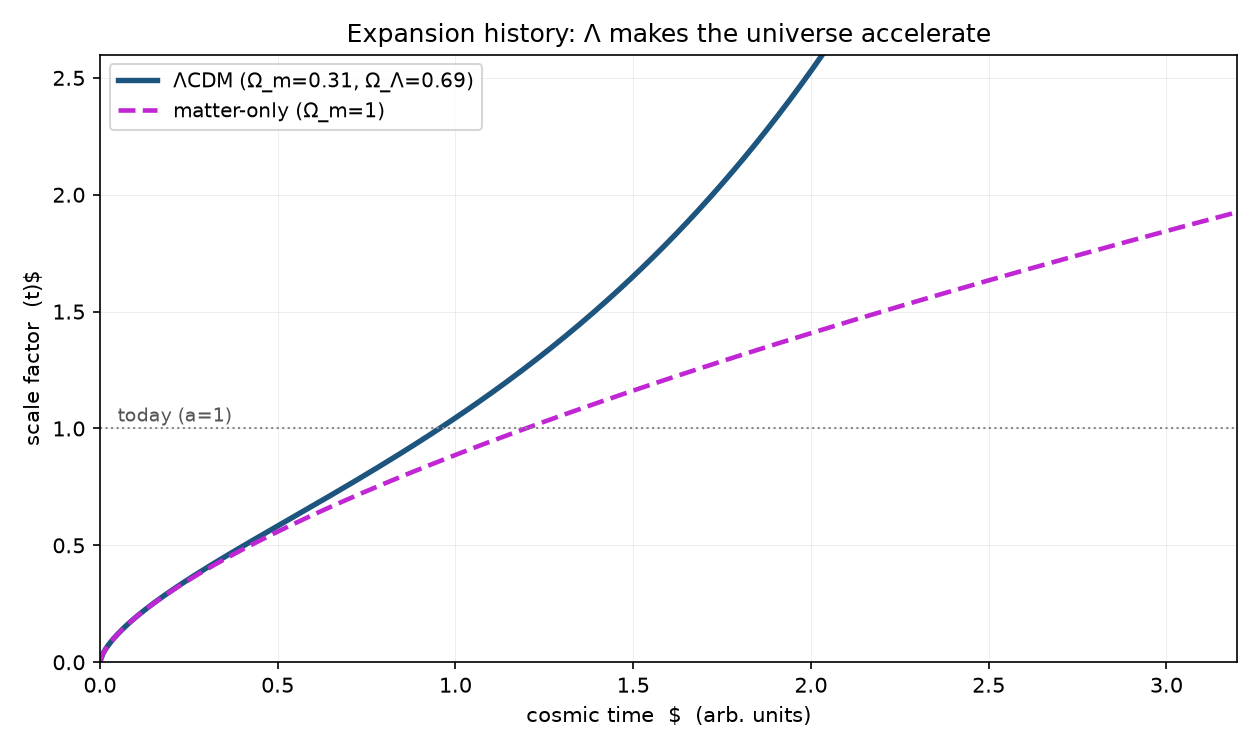
Structure grows only while matter dominates: gravity pulls overdense regions together, while the background expansion (the ‘Hubble drag’ of Topic 1.3) fights it. During matter domination the two nearly balance and overdensities grow steadily; once $\Lambda$ takes over, growth freezes. The halo population is therefore largely in place by low redshift, and to capture that history our FDM boxes must run from very early times — hence $z=127\to0$.
All three codes — GAMER, JAXiON, GADGET-4 — evolve on exactly this Planck-2018 $\Lambda$CDM background from $z=127$. The growth of the initial fluctuations into halos, and how fuzzy dark matter delays that growth (we measure first collapse at $z_{\rm ff}\approx15.7$ vs $z\approx50$ for CDM), is timed against this expansion history.
- Planck Collaboration (2020), Planck 2018 results VI. Cosmological parameters, A&A 641, A6 (arXiv:1807.06209).
- Dodelson & Schmidt (2020), Modern Cosmology, 2nd ed.
- Peebles (1980), The Large-Scale Structure of the Universe.