The core–halo relation (β≈⅓) and its debate
The relation
Simulations reveal a tight link between the central soliton mass and the host halo mass,
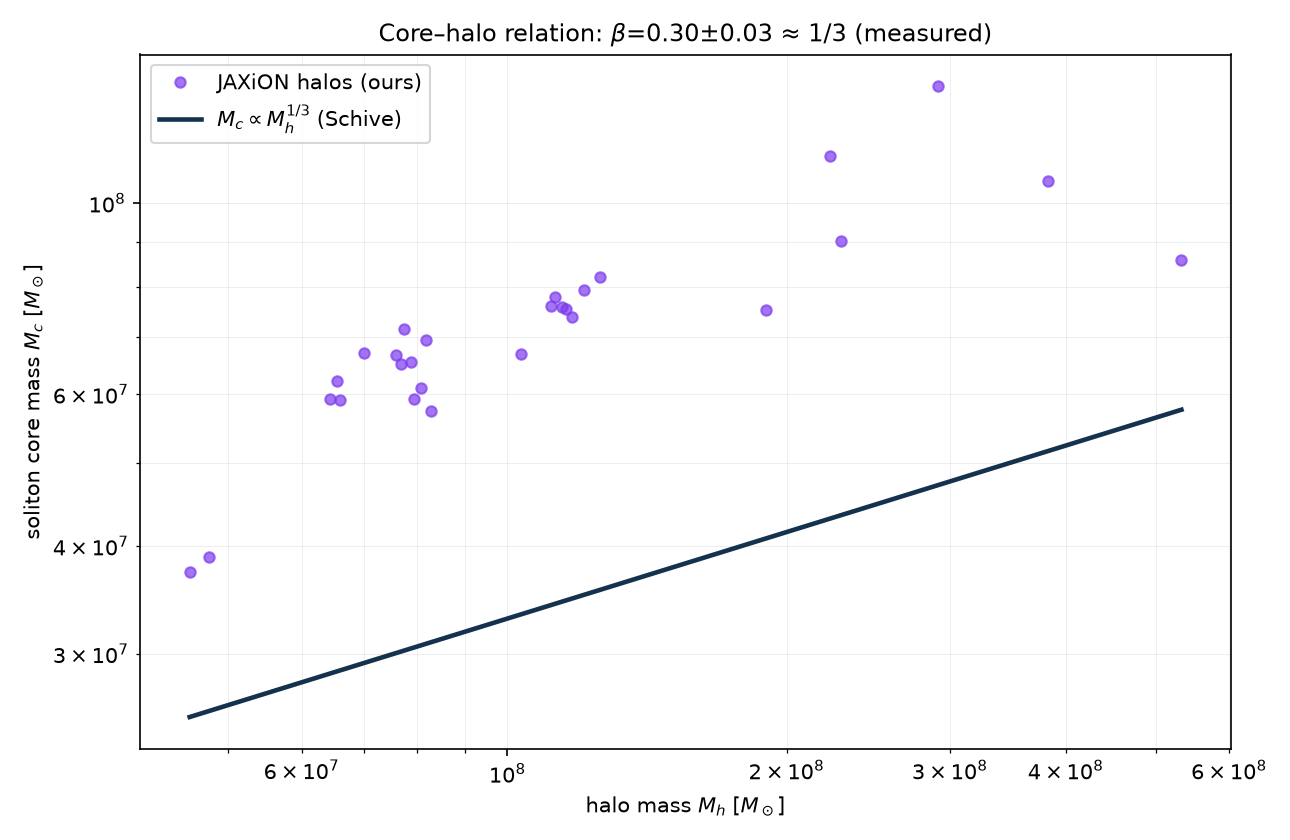
$$M_c\propto M_h^{\beta},\qquad \beta\approx\tfrac13 ,$$so bigger halos host bigger cores — but the core mass fraction $M_c/M_h\propto M_h^{-2/3}$ falls with mass (figure). Schive et al. (2014) argued the $\tfrac13$ power follows from matching the soliton's specific energy to the halo's.
Match the specific energy (energy per mass) of the soliton to that of its host halo:
- Soliton specific energy $|E_c|/M_c\propto GM_c/r_c\propto G M_c\cdot(m^2 M_c)=Gm^2M_c^2$ (using $r_c\propto1/m^2M_c$).
- Halo specific energy (virial) $|E_h|/M_h\propto GM_h/r_h\propto (GM_h)^{2/3}(G\bar\rho)^{1/3}$ at fixed collapse overdensity.
- Assume the soliton virializes in equilibrium with the halo: $|E_c|/M_c\sim|E_h|/M_h$.
- Then $m^2M_c^2\propto M_h^{2/3}$, so $M_c\propto m^{-1}M_h^{1/3}$ — the core–halo relation with $\beta=\tfrac13$.
The $\tfrac13$ is thus the signature of a soliton in energetic equilibrium with its halo. Our measured $\beta=0.30\pm0.03$ tests exactly this equilibrium assumption.
Why it is disputed
The relation is central because it converts a halo mass into an observable core, but its exact slope and (especially) its scatter are contested. Different codes, resolutions, and halo-finding choices give somewhat different $\beta$ and a range of scatter — and that scatter propagates directly into boson-mass constraints (Topic 10). It is a debate the field is organized around.
Our measurement
Fitting solitons across dozens of JAXiON halos gives $\beta=0.30\pm0.03$ — consistent with $\tfrac13$ (soliton-fit, bias-checked with a Monte-Carlo of the fit). Our GAMER 2 Mpc box gives $\beta=0.035\pm0.13$ — inconclusive, because the box is too small (consistent with zero). The two must never be conflated: $0.30$ is the defensible JAXiON value; $0.035$ is the box-limited GAMER one. Honest blind science means reporting both and trusting only the first.
The resolution wall
The cleanest test — GAMER's 20 Mpc cosmological zoom — hit the memory wall at $z\approx11$–$12$ before it could settle $\beta$, so the headline defaults to JAXiON's soliton-fit ($0.30\pm0.03$). Nailing the slope and its scatter, and propagating that into the mass constraints, is the open problem at the frontier (Topic 11).
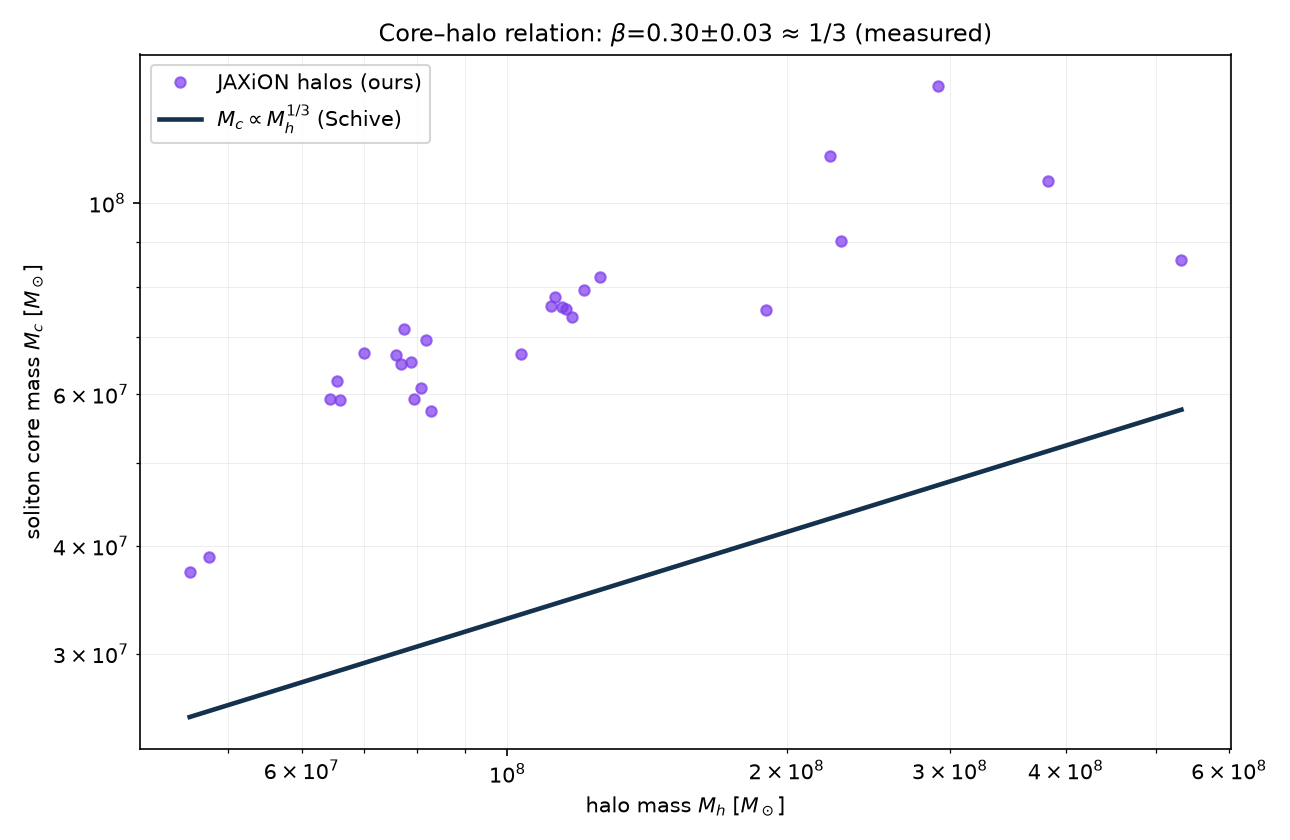
This is the campaign's headline result. Our JAXiON soliton-fit gives $\beta=0.30\pm0.03\approx\tfrac13$ (defensible, bias-checked); the GAMER 2 Mpc value ($0.035\pm0.13$) is box-limited and inconclusive. The relation sizes the cores in our Task-2 profiles, and its debated scatter (Chan+2022) feeds the boson-mass tension of Topic 10.4.
- Schive et al. (2014), Understanding the core–halo relation of FDM, Phys. Rev. Lett. 113, 261302 (arXiv:1407.7762).
- Chan, Schive et al. (2022), The diversity of core–halo relations, MNRAS 511, 943.
- Nori & Baldi (2021), Scaling relations of FDM haloes (arXiv:2007.01316).