Open problems & our contribution
What is established
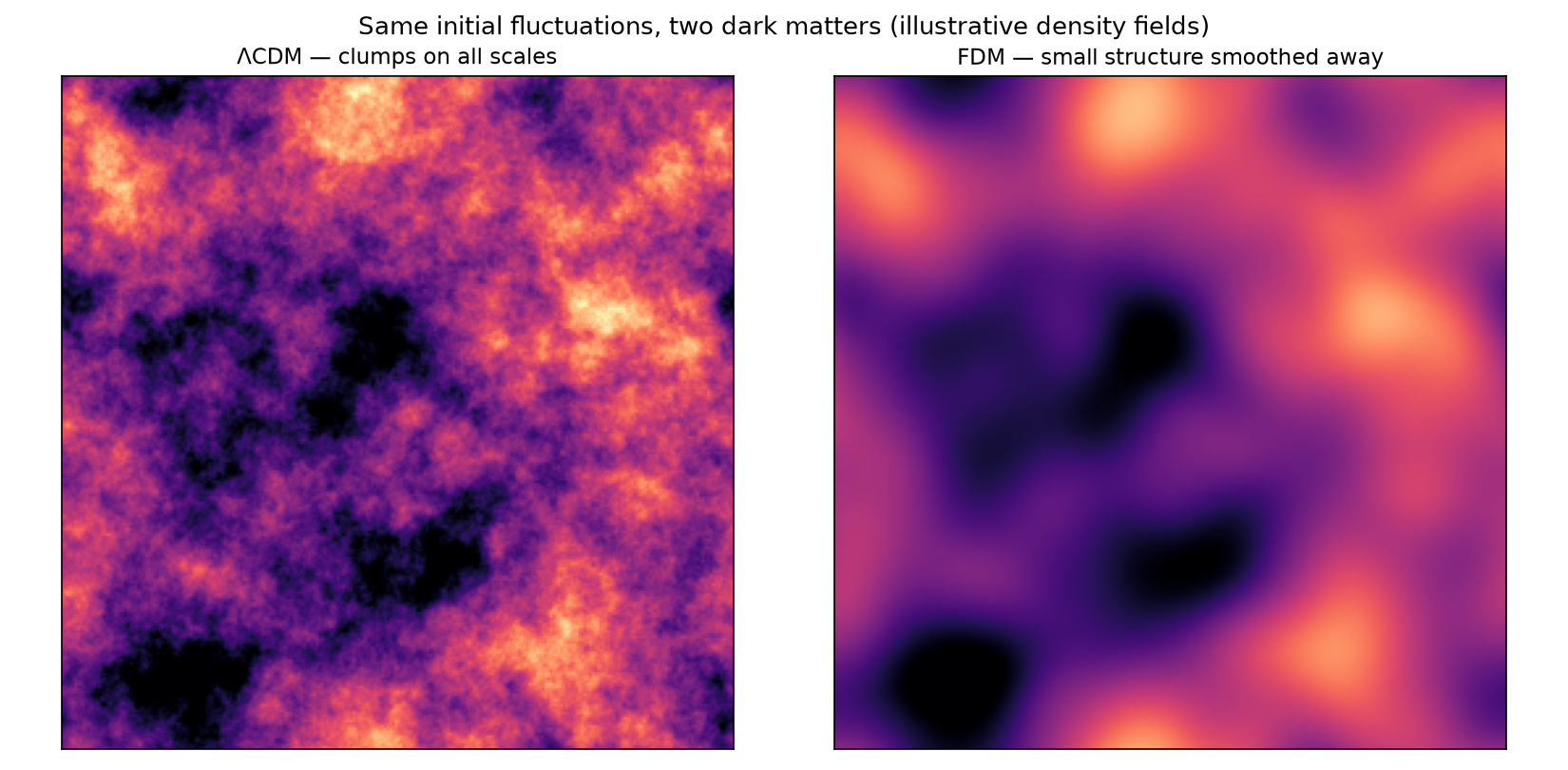
The wave framework is understood at the level of principle: the Schrödinger–Poisson system reproduces the de Broglie scale, small-scale suppression, solitonic cores, and a granular halo interior. Converged FDM halo mass functions exist (May & Springel), individual solitons can be resolved, and the core–halo relation is measured (if debated). Fuzzy dark matter is a simulatable, testable theory.
What is open
The hard questions remain: the exact slope and scatter of the core–halo relation; hydrodynamics at representative scale; the multi-field/mixed parameter space; and, above all, the mass tension — the light boson dwarfs want versus the heavy one the forest demands. These are bounded less by ideas than by two finite resources: simulation dynamic range (the de Broglie wall) and observational reach.
What our campaign contributes
Across three independent codes we: reproduced the Schive soliton to $<1\%$ and validated it cross-code (JAXiON spectral $\leftrightarrow$ GAMER AMR, JXE-F9); measured the core–halo slope $\beta=0.30\pm0.03\approx\tfrac13$; recovered the FDM mass function with our own simulation points (GADGET-4 CDM on the curve, GAMER FDM suppressed); measured $M_{\min}\approx3\times10^8\,M_\odot$ and delayed collapse ($z_{\rm ff}\approx15.7$); built the first differentiable adaptive SP solver with calibrated boson-mass inference (~5%); and quantified the mass tension at 8.7$\sigma$. Answers to Sandro's Task 1 (mass function) and Task 2 (halo structure) are the direct products.
The road ahead
The next round is set by the same two frontiers: larger, higher-resolution wave simulations to pin the core–halo scatter and settle $\beta$; hydrodynamic runs in representative volumes; and, further out, the quantum-computational (Topic 11.1) and analog-experimental (Topic 11.2) methods that could enlarge the toolbox. Progress on the theory now requires progress on both simulation and observation together.
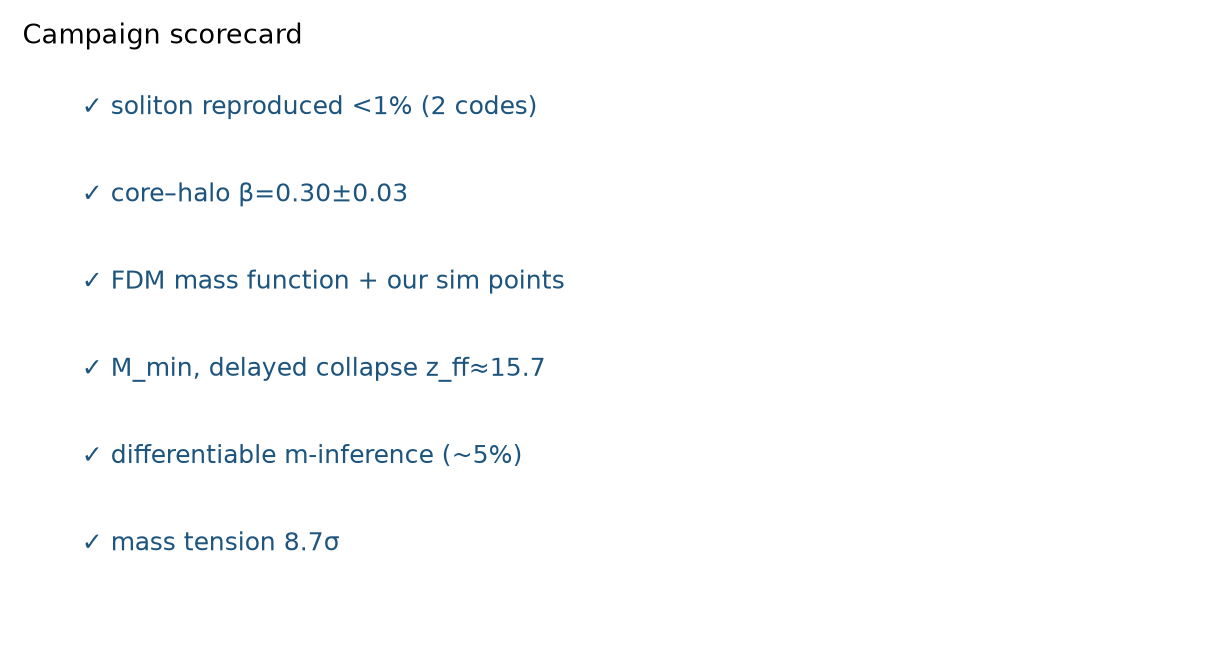
This is the whole campaign in one place: the reproduced physics (solitons, $\beta\approx\tfrac13$, the mass function, delayed collapse), the original science (differentiable inference, the 8.7$\sigma$ tension), and the open problems (core–halo scatter, hydrodynamics, the tension's resolution). Every earlier Study topic feeds this synthesis — and it is where the research this whole series explains actually lives.
- Hui, Ostriker, Tremaine & Witten (2017), Phys. Rev. D 95, 043541 (arXiv:1610.08297).
- Ferreira (2021), Ultra-light dark matter, A&A Rev. 29, 7 (arXiv:2005.03254).
- May & Springel (2021, 2023), MNRAS 506, 2603 & 524, 4256.