Why ‘fuzzy’: the de Broglie wavelength as a galactic scale
The defining length
A particle of mass $m$ moving at speed $v$ has de Broglie wavelength $\lambda_{\rm dB}=\hbar/(mv)$. For $m\sim10^{-22}$ eV at galactic velocities this is $\sim$ kiloparsecs (worked out in Topic 2.3). On scales below $\lambda_{\rm dB}$ the field cannot be localized — it behaves as a coherent wave, and small-scale structure is ‘fuzzed’ out. That is the origin of the name.
Coherence and interference
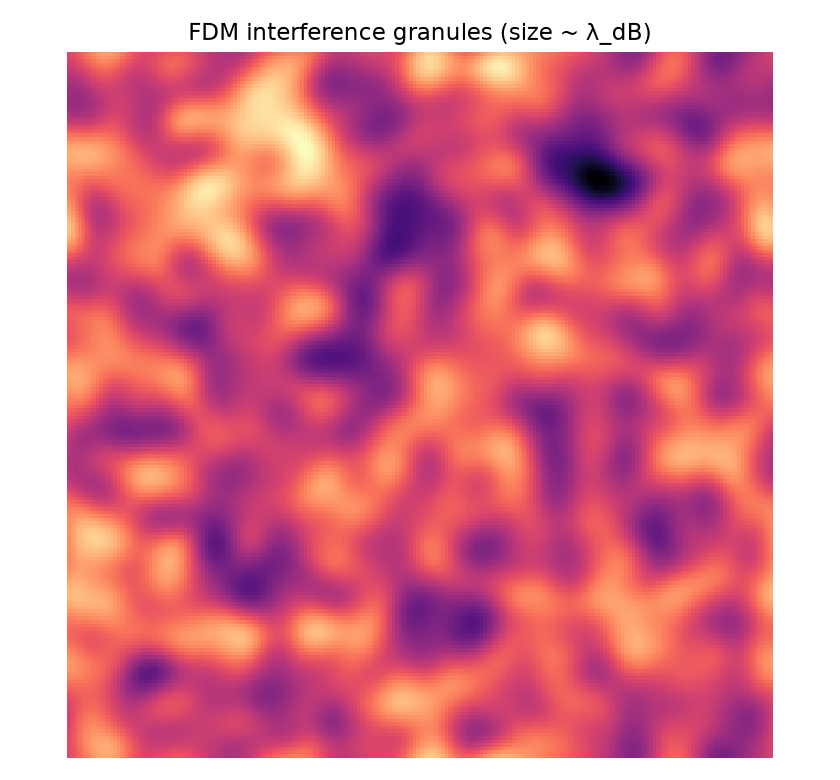
Because the dark matter is one coherent wave, a halo is not a smooth particle cloud but a field with amplitude and phase. Interference of the wave produces order-unity density granules of size $\sim\lambda_{\rm dB}$ that continually form and dissolve — a texture with no counterpart in cold dark matter, and a target for our simulations to reproduce.
Quantum pressure sets a Jeans scale
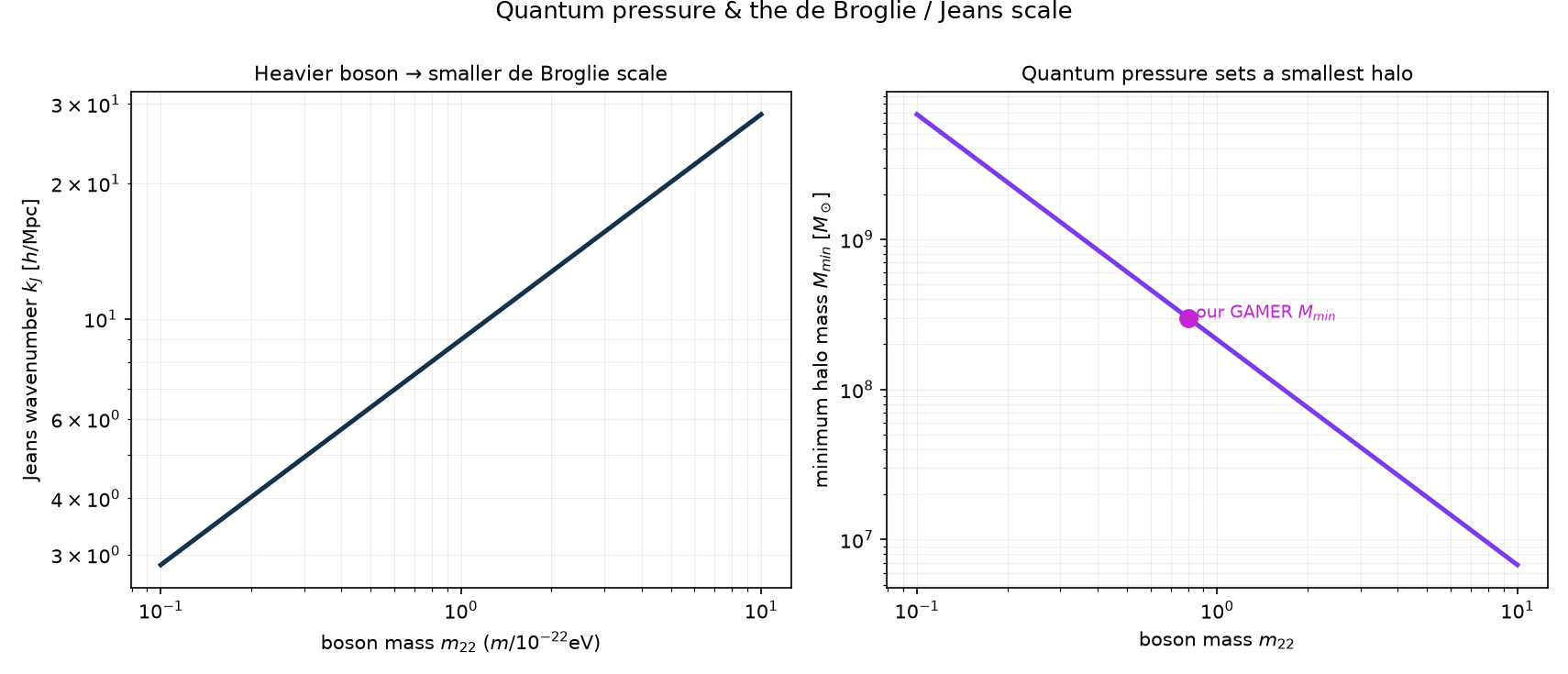
Gradients in the wave generate an effective ‘quantum pressure’ (Topic 3.3, 4.4) that resists gravitational compression below a characteristic Jeans scale. Below it, structure simply cannot collapse — imposing a smallest halo mass and cutting off the power spectrum (figure).
The comoving quantum-Jeans wavenumber at equality is $k_{J}\approx9\sqrt{m_{22}}\ {\rm Mpc^{-1}}$. For our fiducial $m_{22}=0.8$, $k_J\approx8\ {\rm Mpc^{-1}}$, i.e. a comoving wavelength $\lambda_J\sim0.8$ Mpc. The enclosed mass sets the half-mode mass $M_{1/2}\approx5\times10^{10}\,M_\odot/h$ and a minimum halo mass $M_{\min}\approx3\times10^{8}\,M_\odot$ — both of which our GAMER runs recover. A single number, $m$, fixes the whole small-scale story.
One number, two signatures
The same de Broglie scale produces both observables the campaign measures: a deficit of small halos (nothing forms below the Jeans mass) and a flat solitonic core in the halos that do form (quantum pressure balancing gravity, size $\sim\lambda_{\rm dB}$). Measure either — the low-mass cutoff or the core radius — and you constrain the boson mass.
The kpc de Broglie scale is the physical root of everything in Tasks 1 and 2: it puts the FDM cutoff at $M_{1/2}\sim10^{10}\,M_\odot$ (the mass function, Task 1) and sizes the solitonic cores we resolve (halo structure, Task 2). Our measured $M_{\min}$ and $z_{\rm ff}$ are direct consequences of this one length.
- Hu, Barkana & Gruzinov (2000), Cold and fuzzy dark matter, Phys. Rev. Lett. 85, 1158 (arXiv:astro-ph/0003365).
- Schive, Chiueh & Broadhurst (2014), Nature Physics 10, 496 (arXiv:1406.6586).
- Hui, Ostriker, Tremaine & Witten (2017), Phys. Rev. D 95, 043541 (arXiv:1610.08297).