Spherical collapse and the critical overdensity
A spherical overdensity
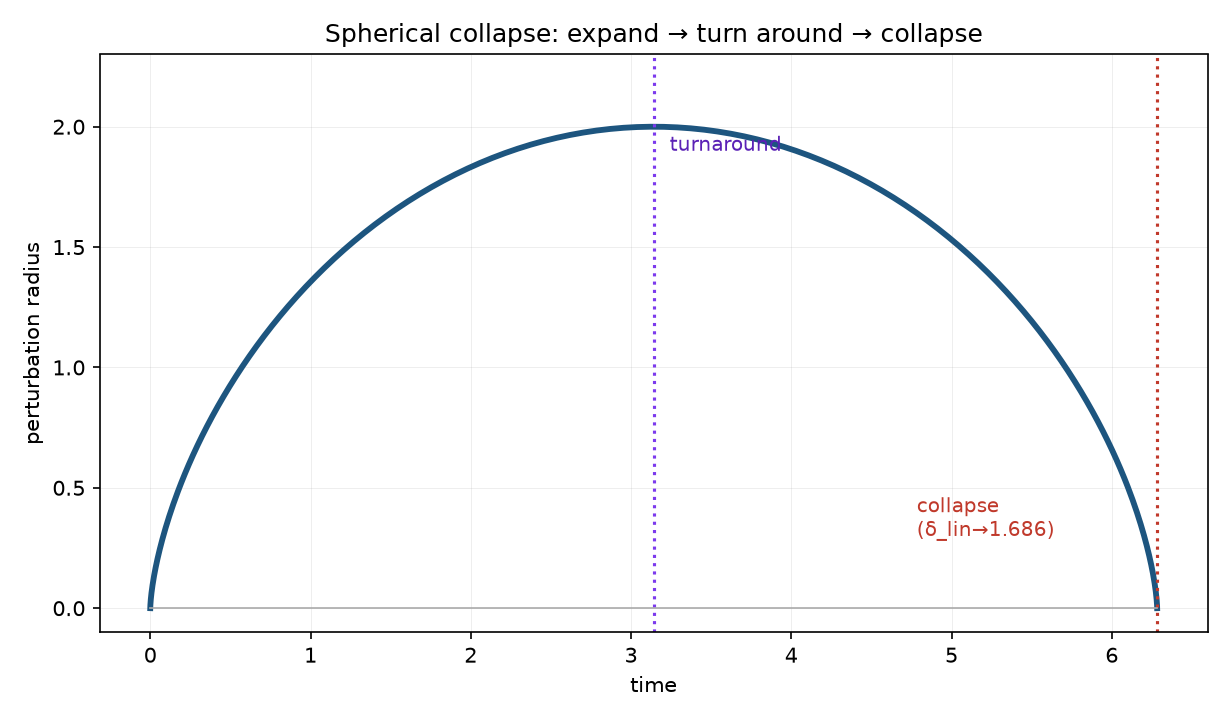
Consider a uniform sphere slightly denser than the background. By Birkhoff's theorem it evolves like its own closed sub-universe: it expands with the cosmos, but its extra self-gravity slows it, so it reaches a maximum radius (turnaround), then recollapses (figure). The denser the sphere, the sooner this happens.
Turnaround and collapse
The exact solution is a cycloid: the sphere's radius traces $r\propto(1-\cos\theta)$ against time $t\propto(\theta-\sin\theta)$. Turnaround is at $\theta=\pi$; formal collapse to a point at $\theta=2\pi$. In reality the sphere virializes at half the turnaround radius rather than collapsing to a singularity, settling into a bound halo.
The linear threshold δc
The useful trick: ask what the linearly-extrapolated overdensity would be at the moment of true collapse. Linear theory (Topic 1.3) underestimates the real growth, so this extrapolated value is a fixed number,
$$\delta_c=\frac{3}{5}\left(\frac{3\pi}{2}\right)^{2/3}\approx1.686,$$(in an Einstein–de Sitter universe; the $\Lambda$CDM value is very close). Any region whose linear overdensity exceeds $1.686$ has, in reality, already collapsed.
This lets us work entirely in linear theory: rather than following nonlinear collapse for every region, we evolve the linear density field (cheap, analytic) and simply count where it exceeds $\delta_c=1.686$. That is precisely the Press–Schechter recipe (Topic 7.2). The whole halo mass function rests on this one threshold.
Why it is (nearly) universal
Remarkably, $\delta_c$ depends only weakly on cosmology and not at all on the perturbation's size — so the same threshold applies to dwarf halos and clusters alike. This universality is what makes Press–Schechter a one-parameter-free prediction, and it carries over unchanged to fuzzy dark matter (where only $\sigma(M)$ differs).
The cycloid solution gives the threshold exactly:
- A spherical overdensity follows $r(\theta)=A(1-\cos\theta)$, $t(\theta)=B(\theta-\sin\theta)$, with $A^3=GMB^2$.
- Collapse ($r\to0$) is at $\theta=2\pi$, i.e. $t_{\rm coll}=2\pi B$.
- Meanwhile the linear theory predicts $\delta_{\rm lin}(t)=\tfrac{3}{20}(6\pi)^{2/3}(t/B)^{2/3}$ for this perturbation.
- Evaluate at $t_{\rm coll}=2\pi B$: $\delta_c=\tfrac{3}{20}(6\pi)^{2/3}(2\pi)^{2/3}=\tfrac{3}{20}(12\pi^2)^{2/3}=\tfrac{3}{5}\big(\tfrac{3\pi}{2}\big)^{2/3}\approx1.686$.
The number is pure geometry — no free parameters — which is why the same $\delta_c$ threshold works for every halo mass and both dark-matter models.
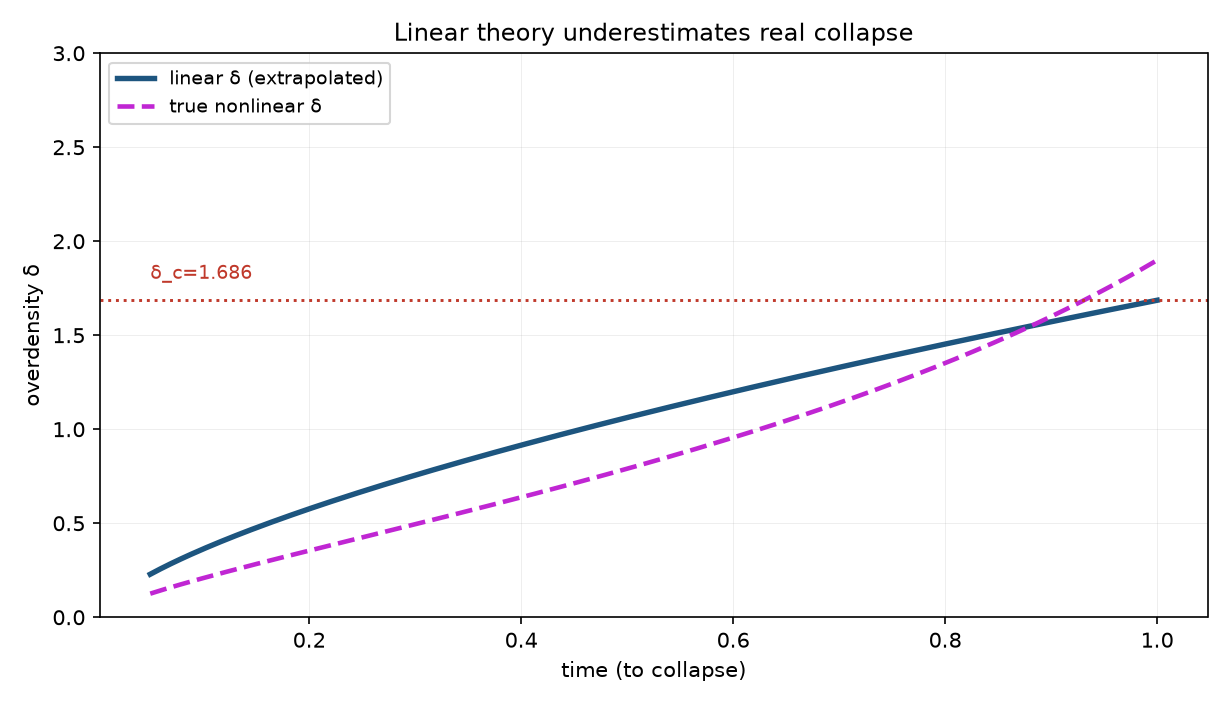
The threshold $\delta_c=1.686$ is the barrier in every mass function we compute (Task 1). Because it is the same for CDM and FDM, the entire FDM suppression comes from $\sigma(M)$ alone — the reason our FDM and $\Lambda$CDM curves share a formula and differ only in the small-scale input.
- Gunn & Gott (1972), Infall of matter into clusters, ApJ 176, 1.
- Padmanabhan (1993), Structure Formation in the Universe.
- Mo, van den Bosch & White (2010), Galaxy Formation and Evolution.