Linear perturbations and the growth of structure
Small ripples on a smooth sea
Departures from smoothness are measured by the density contrast
$$\delta(\mathbf x,t)=\frac{\rho(\mathbf x,t)-\bar\rho(t)}{\bar\rho(t)}.$$In the early Universe $|\delta|\sim10^{-5}$ — the same fluctuations seen in the CMB. While $|\delta|\ll1$ the physics is linear: each Fourier mode $\delta_{\mathbf k}$ evolves independently and the problem reduces to one ordinary differential equation per mode.
The growth equation
Mass conservation plus the Poisson equation give, for sub-horizon matter perturbations,
$$\ddot\delta+2H\dot\delta=4\pi G\bar\rho\,\delta .$$The middle term is the Hubble drag — the expansion resisting collapse; the right-hand side is self-gravity driving it. During matter domination they nearly balance and the growing solution is simply $\delta\propto a$.
In an Einstein–de Sitter (matter-only) universe, $a\propto t^{2/3}$, so $H=\dot a/a=\tfrac{2}{3t}$ and $4\pi G\bar\rho=\tfrac{3}{2}H^2=\tfrac{2}{3t^2}$. Substitute into the growth equation:
- $\ddot\delta+\dfrac{4}{3t}\dot\delta-\dfrac{2}{3t^2}\delta=0$ — an equidimensional (Euler) equation.
- Try a power law $\delta\propto t^{\,p}$: then $p(p-1)+\tfrac43 p-\tfrac23=0$, i.e. $p^2+\tfrac13 p-\tfrac23=0$.
- Roots: $p=\tfrac23$ and $p=-1$ — a growing mode and a decaying mode.
- The growing mode $\delta\propto t^{2/3}\propto a$ (since $a\propto t^{2/3}$).
So overdensities grow linearly with the scale factor during matter domination — the cornerstone that lets us scale a power spectrum between epochs by $D(a)\propto a$.
The growth factor D(a)
The growing-mode amplitude, normalized to unity today, is the linear growth factor,
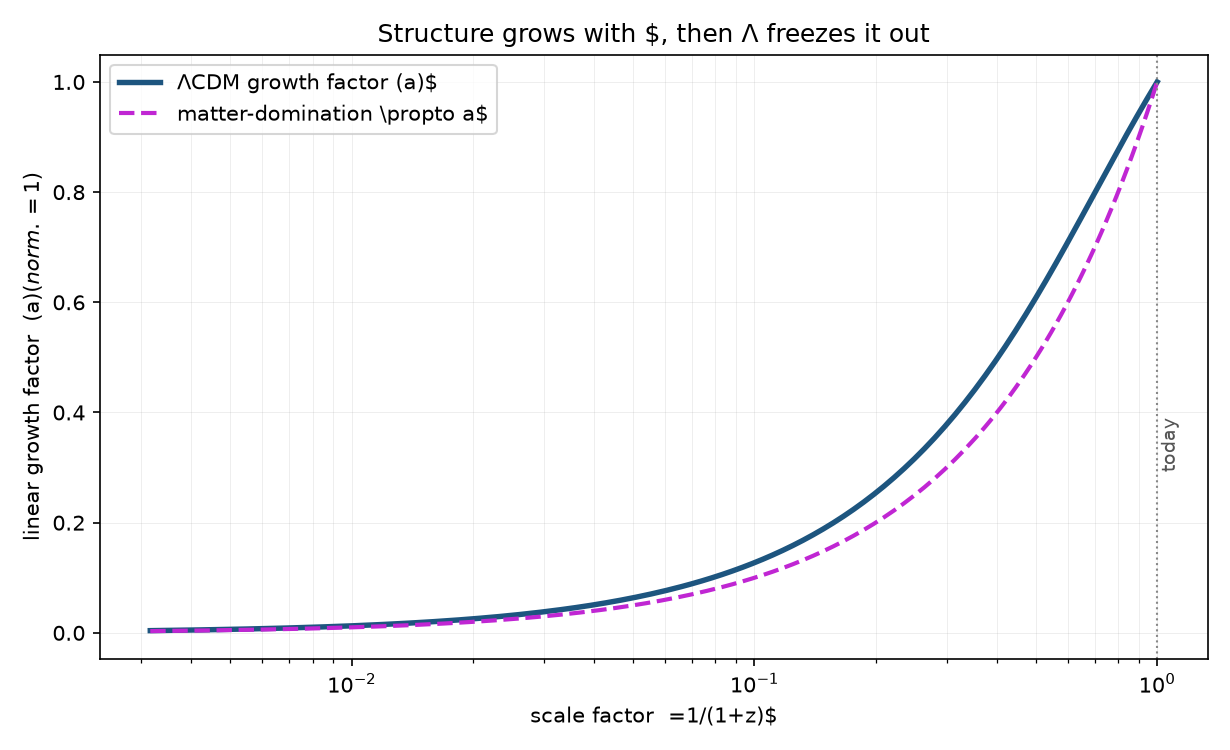
$$D(a)\propto H(a)\int_0^{a}\frac{da'}{[a'H(a')]^3}.$$In matter domination $D\propto a$; once dark energy dominates, growth slows and freezes (figure). Because $D$ is the same for every mode in $\Lambda$CDM, the shape of the power spectrum is frozen at early times and only its amplitude grows, as $D^2(a)$.
Evaluating the integral for our cosmology gives $D(z=6)/D(0)\approx0.18$: a given fluctuation was about 5–6 times smaller at $z=6$ than today. Extrapolating to our start, $z=127$, $D\approx a\approx0.008$, so the $\delta\sim10^{-5}$ CMB-level ripples were still $\sim10^{-5}$ then — comfortably linear, which is exactly why we can generate initial conditions with linear theory and trust them.
A peak's height sets its collapse time
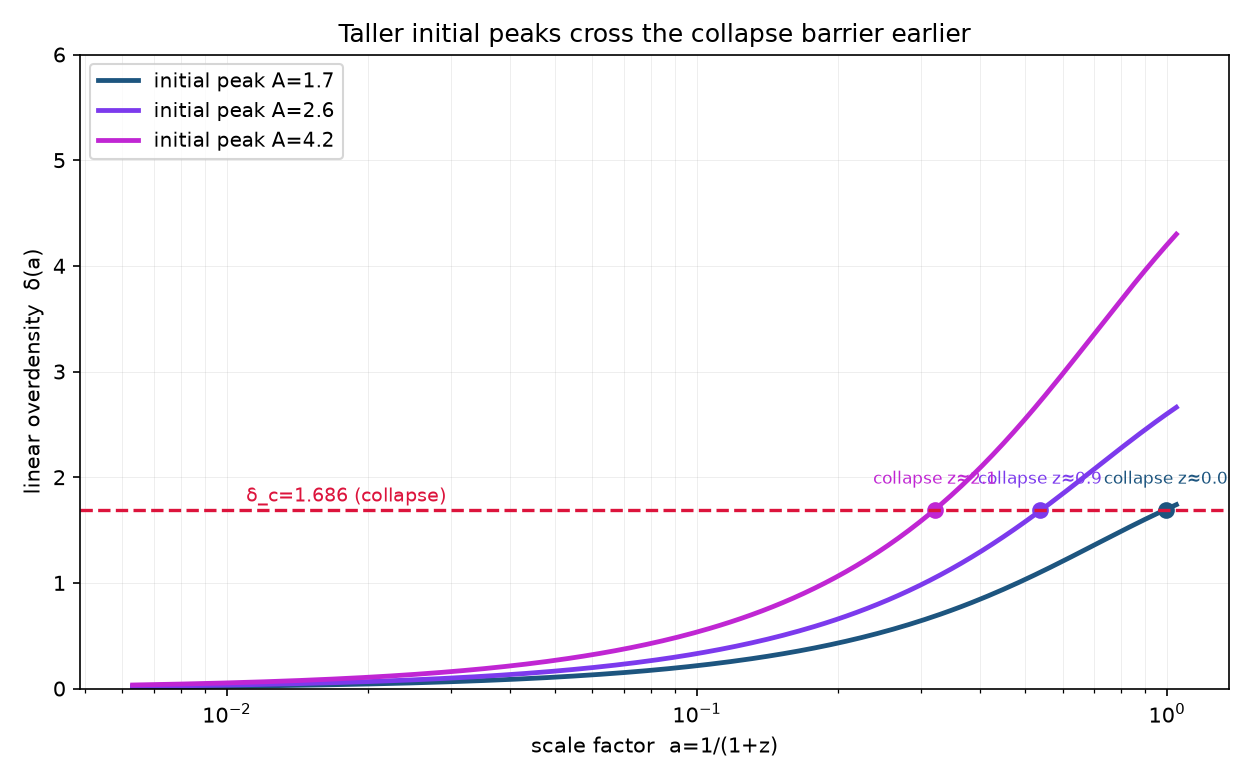
Since every mode grows by the same $D(a)$, a region with larger initial overdensity reaches the collapse threshold sooner. The figure follows three initial peaks of increasing height: the tallest crosses the critical value $\delta_c=1.686$ (Topic 7.1) first, collapsing at high redshift, while shallower peaks collapse later. This is the seed of the entire halo mass function — rare tall peaks become today's massive clusters, and they formed earliest.
Scale-independent growth — and where FDM breaks it
That all modes share one $D(a)$ is special to cold dark matter: a pressureless fluid has no preferred length, so a $1$-Mpc and a $100$-Mpc ripple grow identically. Fuzzy dark matter breaks this — its quantum pressure introduces the Jeans length (Topic 4.4), below which growth is suppressed. The scale-dependent growth this creates is, together with the initial-condition cutoff, what carves the FDM deficit of small halos.
When linear theory breaks
Linear theory holds only while $\delta\ll1$. Once a region reaches $\delta\sim1$ it decouples from the expansion, turns around, and collapses non-linearly into a bound halo. Predicting which regions cross that threshold, and how many, is the job of the Press–Schechter formalism (Topic 7), which takes this linearly-evolved field as its input.
Our simulations begin at $z=127$, deep in the linear regime, so linear theory sets the initial conditions and $D(z)$ scales the linear $P(k)$ to any epoch. The breakdown of scale-independent growth below the de-Broglie scale is precisely the FDM effect the runs are built to capture — and why FDM's first halos appear so late.
- Dodelson & Schmidt (2020), Modern Cosmology, 2nd ed., ch. 8.
- Peebles (1980), The Large-Scale Structure of the Universe.