The Schive soliton profile and its derivation
The ground-state problem
The soliton is the lowest-energy configuration of the wavefunction $\psi$ obeying the Schrödinger–Poisson (SP) equations (Topic 4). We seek a stationary state oscillating only in phase,
$$\psi(\mathbf r,t)=e^{-i\gamma t/\hbar}\,\phi(r),\qquad \phi\ \text{real, spherically symmetric},$$which turns SP into a coupled nonlinear eigenvalue problem for the profile $\phi(r)$ and potential $V(r)$:
$$\gamma\,\phi=-\frac{\hbar^2}{2m^2}\nabla^2\phi+V\phi,\qquad \nabla^2 V=4\pi G\,m\,\phi^2 .$$The nonlinearity — $V$ sourced by $\phi^2$, acting back on $\phi$ — is what makes the soliton self-bound rather than a spreading packet. There is no closed form; one solves it numerically (Topic 5.5).
Scaling symmetry: one solution generates all
SP has a scaling symmetry: if $\{\phi(r),V(r),\gamma\}$ solves it, so does $\phi\to\lambda^2\phi(\lambda r)$, $V\to\lambda^2V(\lambda r)$, $\gamma\to\lambda^2\gamma$ for any $\lambda>0$. A single computed ground state, rescaled, gives the whole one-parameter family. Since $\rho=m\phi^2$ scales as $\lambda^4$ and length as $\lambda^{-1}$,
$$\rho_c\,r_c^4=\text{const},$$the origin of the $M^4$ law.
The Schive fitting profile
Schive, Chiueh & Broadhurst (2014) found the numerical ground state is captured to $<1\%$ inside a few core radii by
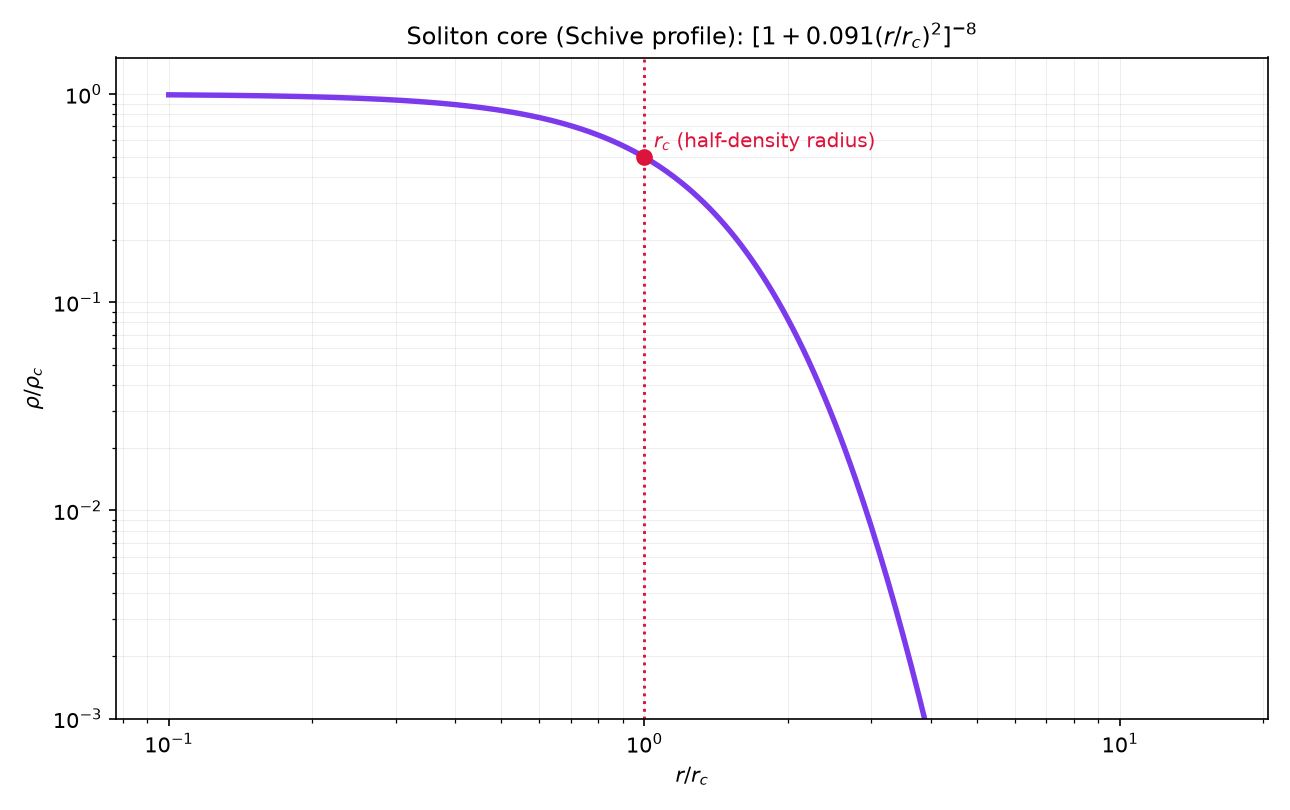
$$\rho(r)=\frac{\rho_c}{\big[1+0.091(r/r_c)^2\big]^{8}},$$with $r_c$ the radius where the density falls to half its central value. The high power (8) makes the profile flat-topped in the centre and steep ($\rho\propto r^{-16}$) outside — nothing like the $r^{-1}$ cusp of cold dark matter. The constant $0.091$ is fixed by the ground-state shape; only $\rho_c$ (or $r_c$) varies between solitons.
Mass, radius and boson mass
Integrating gives the core mass $M_c=4\pi\cdot0.9220\,\rho_c r_c^3$, and combining with the scaling symmetry yields the relations used throughout the campaign,
$$r_c\propto\frac{1}{m^2 M_c},\qquad M_c\,r_c=\frac{5.5\times10^{7}(1+z)}{m_{22}^2}\ M_\odot\,\text{kpc},$$with $m_{22}=m/10^{-22}\,$eV. A heavier boson makes smaller, denser cores; a more massive core is smaller. The figure shows the universal shape in scaled units.
Integrate the Schive profile to get $M_c$ in terms of $\rho_c$ and $r_c$:
- $M_c=\displaystyle\int_0^\infty\rho(r)\,4\pi r^2\,dr=4\pi\rho_c\int_0^\infty\frac{r^2\,dr}{[1+0.091(r/r_c)^2]^8}$.
- Substitute $u=r/r_c$: $M_c=4\pi\rho_c r_c^3\displaystyle\int_0^\infty\frac{u^2\,du}{(1+0.091u^2)^8}$.
- The dimensionless integral evaluates to $0.9220$ (a Beta-function value).
- Hence $M_c=4\pi\cdot0.9220\,\rho_c r_c^3\approx11.6\,\rho_c r_c^3$.
Because the shape is universal, this numerical coefficient is fixed once and for all — only the scale ($\rho_c$ or $r_c$) changes between solitons.
Take a Fornax-like dwarf: core mass $M_c\approx10^{8}\,M_\odot$, boson $m_{22}=0.8$, at $z=0$. From $M_c r_c=5.5\times10^{7}/m_{22}^2\ M_\odot\,$kpc:
$$r_c=\frac{5.5\times10^{7}}{0.8^2\times10^{8}}\approx0.86\ {\rm kpc},$$a kiloparsec-scale core — exactly the size that makes FDM cores observable in dwarf galaxies. The central density then follows from $M_c=11.6\,\rho_c r_c^3$: $\rho_c\approx10^{8}/(11.6\times0.86^3)\approx1.4\times10^{7}\,M_\odot\,{\rm kpc^{-3}}$, orders of magnitude above the mean — a genuinely dense, flat core.
The M⁴ law and the family
The invariant $\rho_c r_c^4=$ const is the soliton's signature: a core four times as massive is sixteen times denser and half the size. It is sharp and falsifiable, and among the cleanest things a wave simulation can test — it needs only the correct ground-state shape.
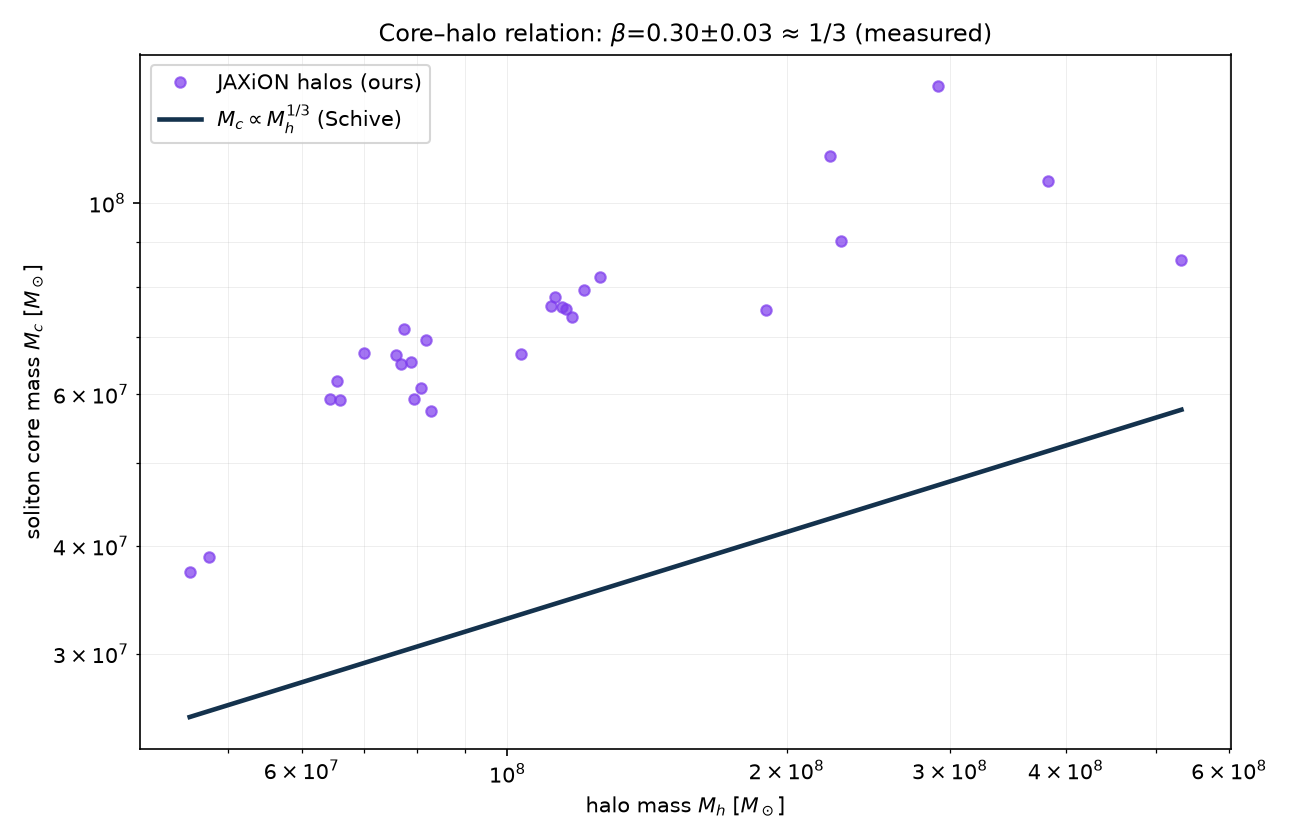
Our JAXiON imaginary-time solver reproduces this profile to $<1\%$ and the $\rho_c r_c^4$ invariant to five significant figures (JXE-F5). GAMER's adaptive-mesh cores at $z=19$, across three halo masses, land on the same family ($\rho_c\propto r_c^{-3.95}$, JXE-F9). The $r_c$ set here feeds the core–halo relation of §8.5, which our runs measure at $\beta=0.30\pm0.03\approx\tfrac13$.
- Schive, Chiueh & Broadhurst (2014), Cosmic structure as the quantum interference of a coherent dark wave, Nature Physics 10, 496 (arXiv:1406.6586).
- Marsh (2016), Axion Cosmology, Phys. Rep. 643, 1 (arXiv:1510.07633).
- Chavanis (2011), Mass–radius relation of Newtonian self-gravitating BECs, Phys. Rev. D 84, 043531.