The transfer function
What the transfer function does
Inflation lays down a nearly scale-invariant primordial spectrum $P_{\rm prim}(k)\propto k^{n_s}$. Between then and now, physics reshapes it scale by scale — radiation pressure, baryon oscillations, free-streaming, quantum pressure. The transfer function $T(k)$ encodes that reshaping:
$$P(k)=A\,k^{n_s}\,T^2(k)\,D^2(a),$$normalized so $T\to1$ on large scales. Everything about the dark-matter model that matters for structure is in $T(k)$.
The CDM transfer function
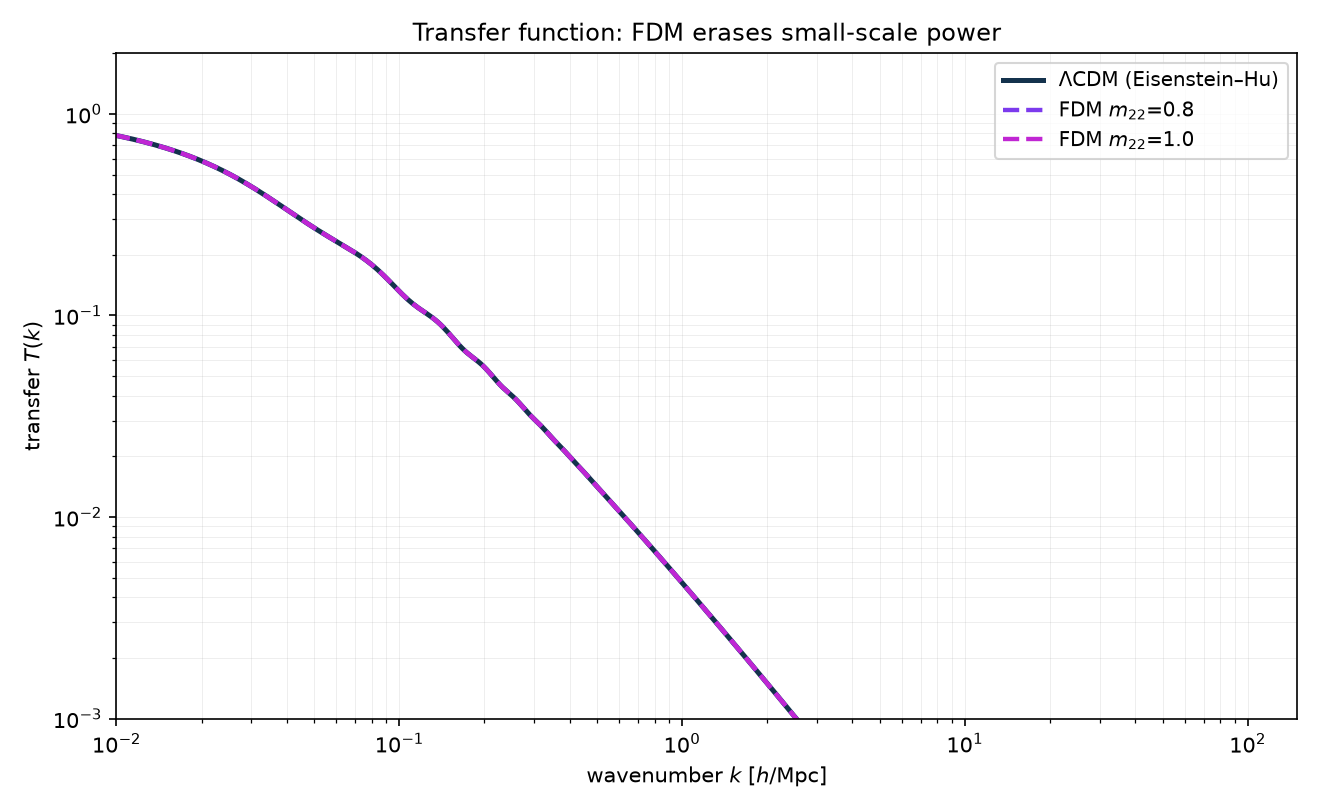
For cold dark matter we use the Eisenstein & Hu (1998) closed-form fit, which captures the turnover at matter–radiation equality and the baryon-acoustic wiggles to sub-percent accuracy. On small scales $T_{\rm CDM}\to1$: CDM preserves power everywhere (figure, solid).
The FDM transfer function
Fuzzy dark matter multiplies the CDM transfer by a suppression factor that plunges to zero beyond the quantum-Jeans scale (figure, dashed). This is the only place FDM differs from CDM in the linear mass-function calculation — it carves the small-scale cutoff directly into $P(k)$, and hence into every downstream halo count.
At $k=10\ h/$Mpc the CDM transfer is $\sim1$, but for $m_{22}=0.8$ the FDM transfer squared has fallen below $\sim0.01$ — power suppressed by more than 100$\times$. That two-orders-of-magnitude cut is what removes the small halos: with almost no power at high $k$, $\sigma(M)$ flattens and the mass function collapses below the half-mode mass.
Fitting formula vs first principles
These transfer functions are analytic approximations, but excellent ones. The next article (Topic 6.3) derives the FDM form (Hu–Barkana–Gruzinov), and Topic 6.5 shows we cross-checked it against a full Boltzmann solve (axionCAMB), confirming it to $\sim$few percent.
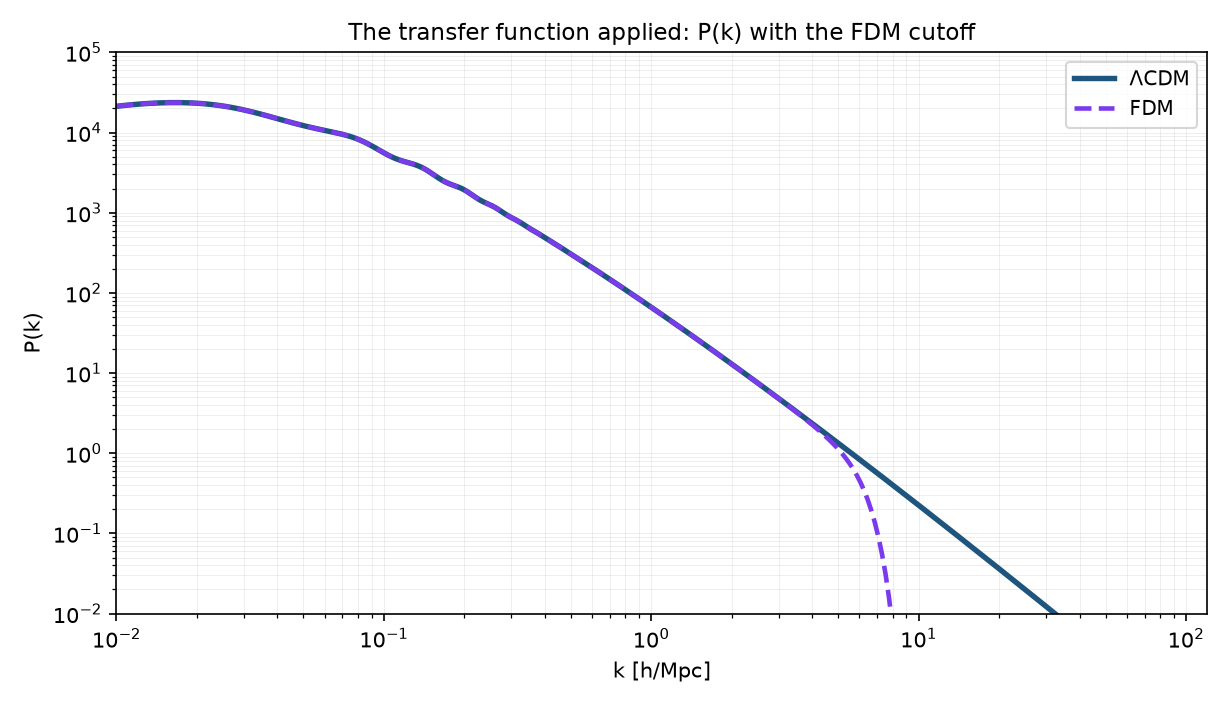
The product Eisenstein–Hu $\times$ Hu–Barkana–Gruzinov is our linear input for Task 1 (our in-house cosmology_pk.py, validated to $\le0.1\%$ against Hu+2000). The FDM factor is what makes the dashed curves in our mass-function figures peel away from $\Lambda$CDM.
- Eisenstein & Hu (1998), Baryonic features in the matter transfer function, ApJ 496, 605 (arXiv:astro-ph/9709112).
- Hu, Barkana & Gruzinov (2000), Phys. Rev. Lett. 85, 1158 (arXiv:astro-ph/0003365).