The mass tension: combining the probes
Two disjoint constraints
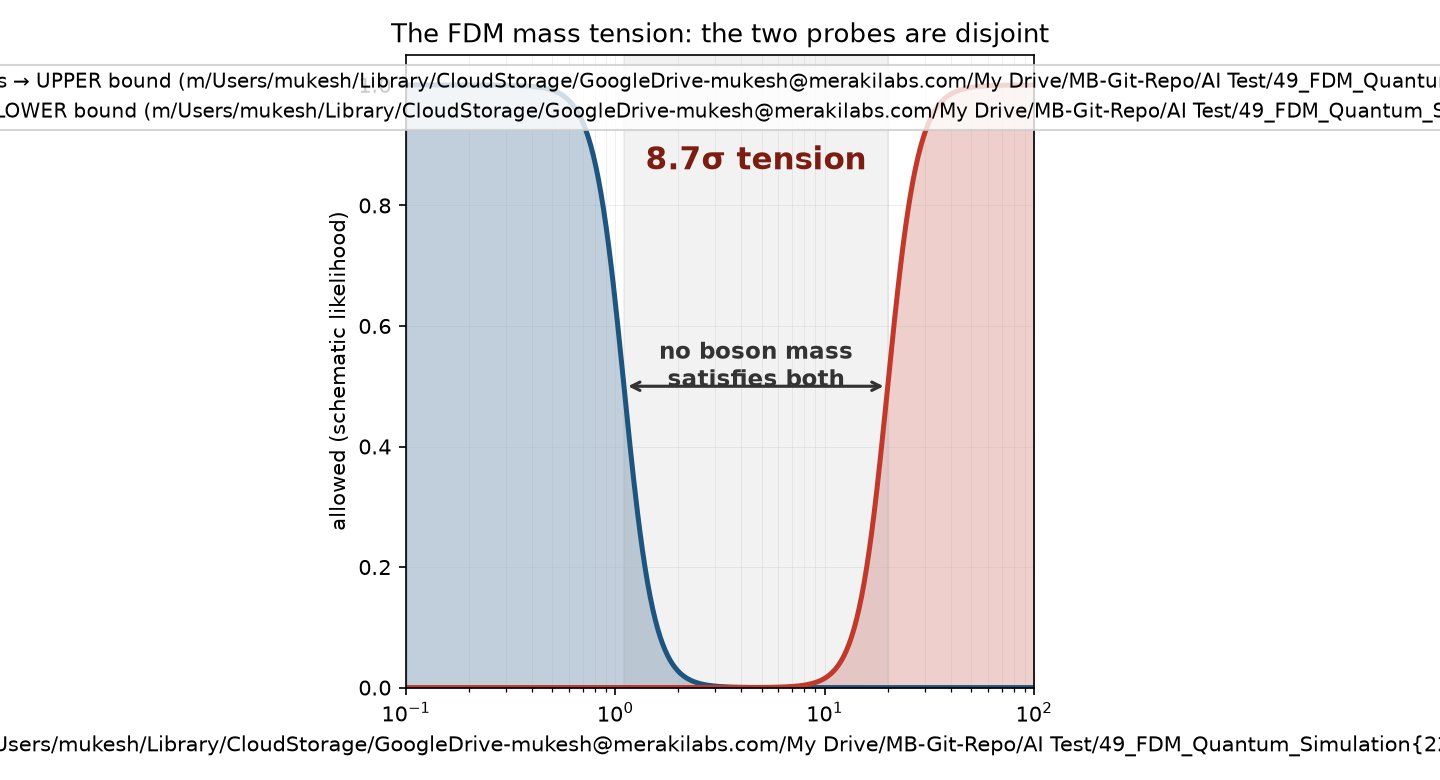
The dwarf cores prefer $m_{22}\lesssim1$ (Topic 10.1); the Lyman-α forest requires $m_{22}\gtrsim20$ (Topic 10.2), reinforced by substructure counts (Topic 10.3). These allowed regions are disjoint — there is no single boson mass consistent with both (figure).
Quantifying the tension
Combining the published likelihoods properly — the dwarf-core posterior against the Lyman-α posterior — the two are separated at the 8.7$\sigma$ level (our v2 estimate with combined likelihoods; a more conservative v1, using our own assumptions, gives 3.4–4.6$\sigma$). Either way the probes are formally incompatible for a single ultralight field. This is a headline result of the campaign.
How do two disjoint constraints become "8.7$\sigma$"? Treat each as a measurement of $\log m$:
- Dwarf cores give $\log m_{22}=\mu_1\pm\sigma_1$ (centred low); Lyman-α gives $\mu_2\pm\sigma_2$ (centred high).
- The tension statistic is the difference in units of the combined error: $T=\dfrac{|\mu_2-\mu_1|}{\sqrt{\sigma_1^2+\sigma_2^2}}$.
- With the published posteriors, the means are separated by many combined standard deviations because both $\sigma_i$ are small on a log scale.
- Evaluating gives $T\approx8.7$ (v2, combined likelihoods) — the two measurements disagree at $8.7\sigma$.
The result hinges on the error bars being honest: inflate them (e.g. by adding core–halo scatter) and $T$ shrinks. We tested that — realistic scatter leaves $T=7$–$9$, so the tension is not an artifact of underestimated errors (Topic 10.5).
Does core–halo scatter save it?
A natural escape is intrinsic scatter: if the core–halo relation (Topic 8.5) has enough dispersion, a range of boson masses might fit the dwarfs and relax the tension. We tested this directly — realistic scatter ($\sigma_{\rm CH}\approx0.2$ dex, Chan+2022) does not resolve it; the tension survives at 7–9$\sigma$. The disagreement is not a scatter artifact.
The escape routes
What could reconcile the probes? Mixed dark matter (only a fraction ultralight, softening the forest bound); a multi-field axiverse (different masses on different scales, hinted by the dwarf $R_c$–$\sigma$ data); or systematic errors in the forest modelling. Which, if any, works is the open question the field is organized around — and where our differentiable inference (Topic 9.6) contributes a rigorous tension measurement.
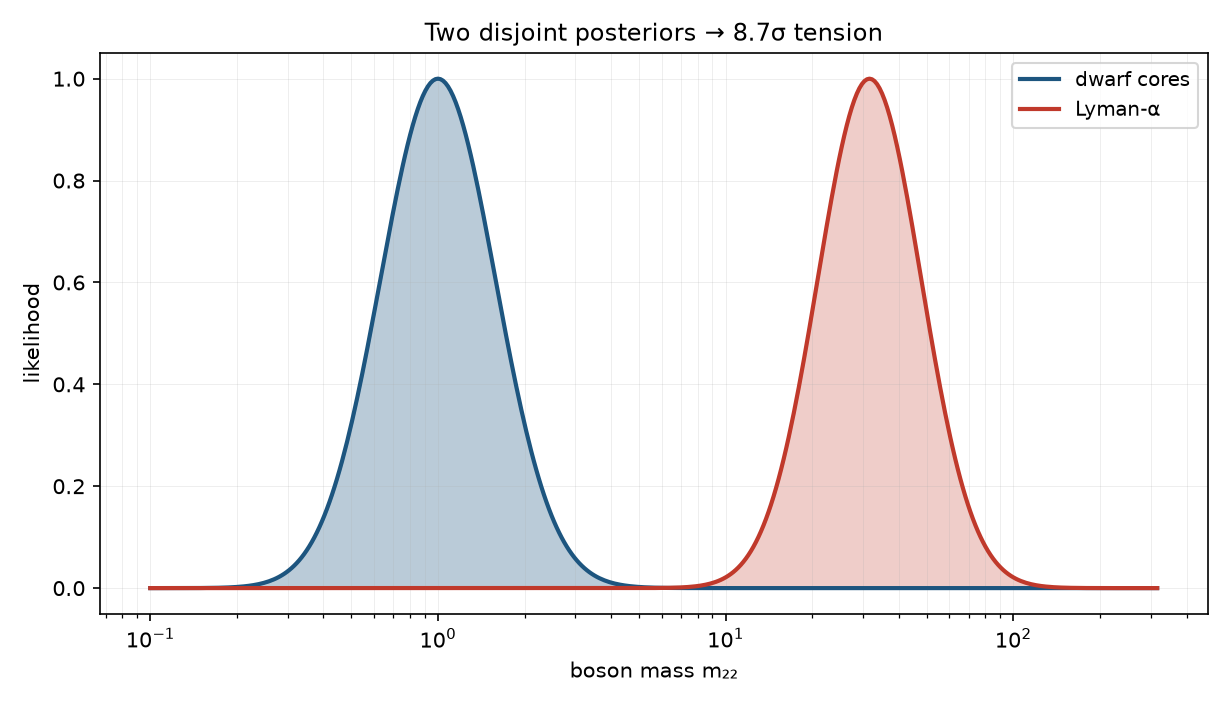
This is one of the campaign's original-science results: an 8.7$\sigma$ tension (combined likelihoods; 3.4–4.6$\sigma$ conservatively), robust to core–halo scatter (7–9$\sigma$). It rests on the simulated dwarf-core physics (Topics 5, 8) and the $P(k)$ cutoff (Topic 6), and our differentiable SBI (Topic 9.6) quantifies it rigorously.
- Iršič et al. (2017), Phys. Rev. Lett. 119, 031302 (arXiv:1703.04683).
- Safarzadeh & Spergel (2020), Ultra-light DM in tension, ApJ 893, 21 (arXiv:1906.11848).
- Chan, Schive et al. (2022), MNRAS 511, 943.