The NFW profile
A universal shape
Navarro, Frenk & White found in simulations that CDM halos of all masses follow one two-parameter density law,
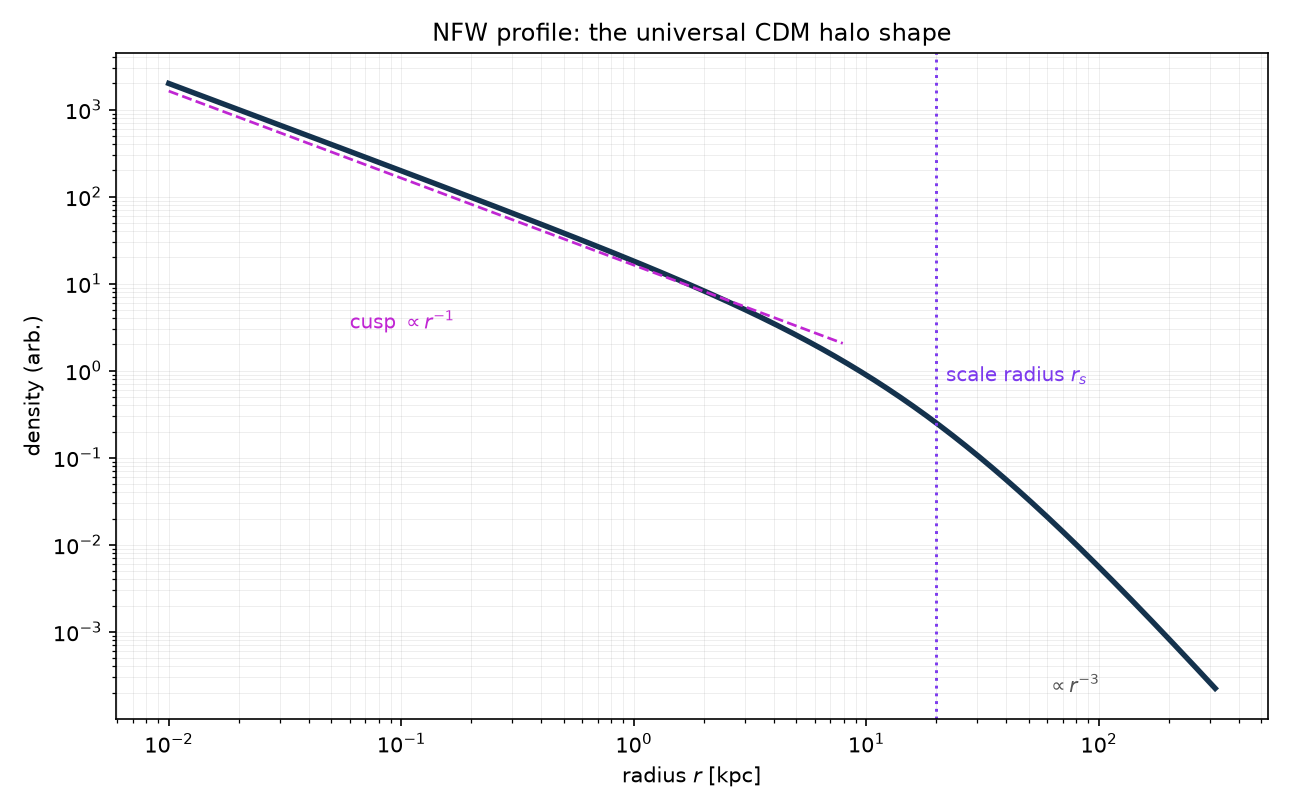
$$\rho(r)=\frac{\rho_s}{(r/r_s)(1+r/r_s)^2},$$with a scale radius $r_s$ and normalization $\rho_s$. Every cold halo, from dwarf to cluster, is described by this form (figure).
Cusp and outskirts
Two limits define it. Toward the centre $\rho\propto r^{-1}$ — a cusp that formally diverges. Far out $\rho\propto r^{-3}$. The scale radius $r_s$ marks the transition ($\rho\propto r^{-2}$ there). The diverging central density is the crucial feature: cold dark matter packs ever more mass into the centre, with nothing to stop it.
Why halos look like this
The cusp is a generic outcome of hierarchical, collisionless collapse: small halos merge into large ones, violently relaxing into this attractor. Nothing in CDM physics halts the density climb inward — which is exactly what fuzzy dark matter's quantum pressure will change.
Integrating gives the enclosed mass $M(
The FDM contrast
FDM halos share the NFW envelope in their outskirts — gravity is gravity — but replace the central cusp with a flat solitonic core (Topic 8.4). NFW is thus the yardstick for Task 2: we ask precisely where and how the FDM profile departs from it.
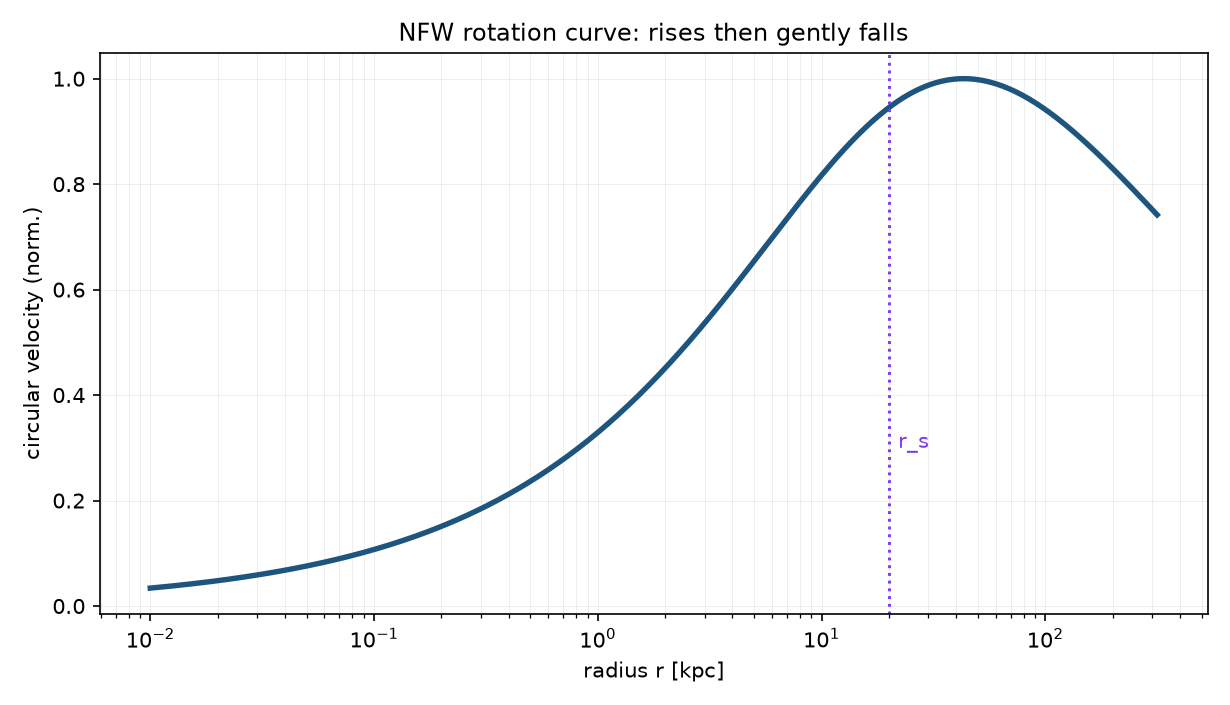
NFW is the $\Lambda$CDM baseline in Task 2 (our halo-structure figure). We build the FDM profile as a soliton core embedded in an NFW envelope, and our GADGET-4 halos follow the NFW concentration–mass relation — validating the control against which FDM's core is compared.
- Navarro, Frenk & White (1996), The structure of CDM halos, ApJ 462, 563 (arXiv:astro-ph/9508025).
- Navarro, Frenk & White (1997), ApJ 490, 493 (arXiv:astro-ph/9611107).
- Wang et al. (2020), Universal structure of DM halos, Nature 585, 39.