Cusp vs core: the observational problem
Two behaviours at r→0
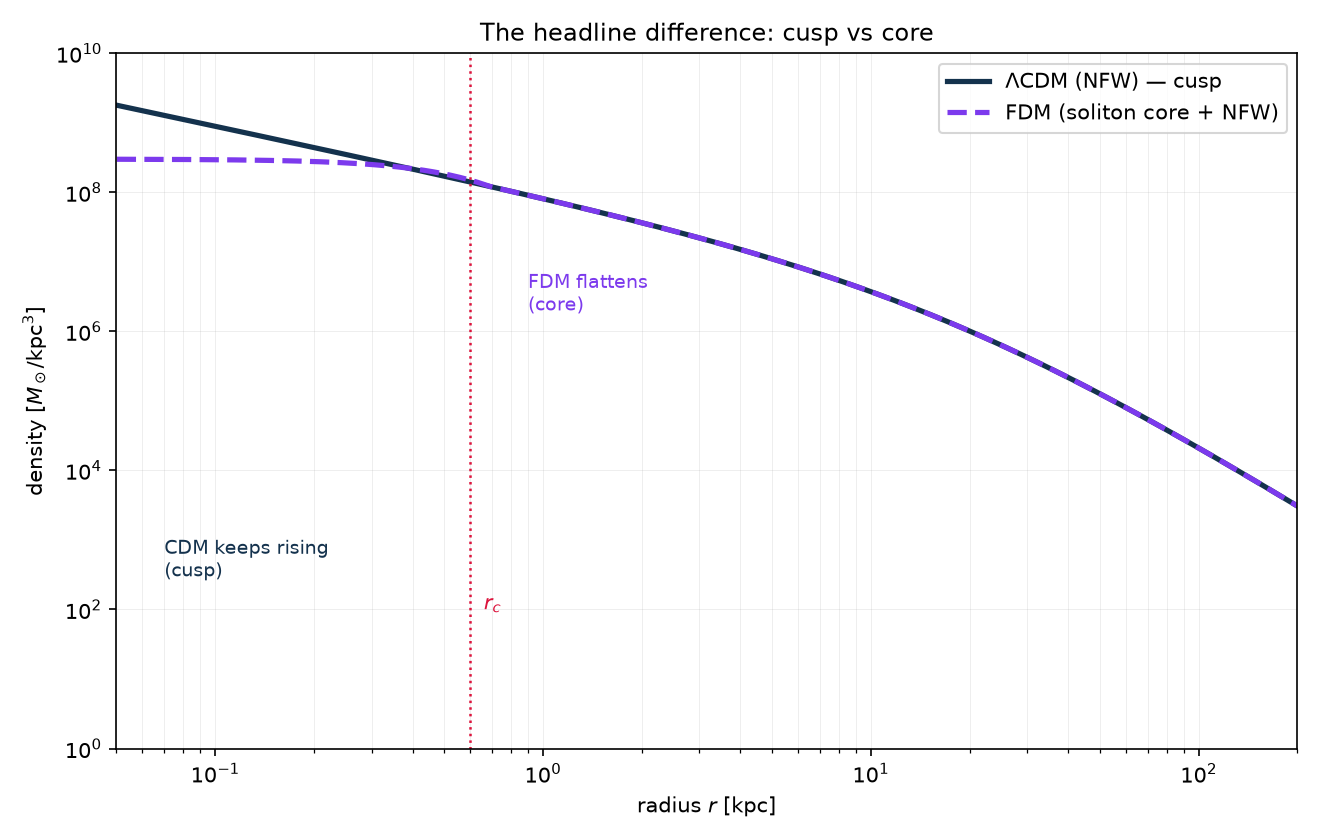
A cusp means the density keeps climbing to the centre (CDM/NFW, $\rho\propto r^{-1}$). A core means it levels off to a finite central value. The distinction is sharp and, in principle, observable in the inner rotation curves and stellar kinematics of galaxies (figure).
Why CDM cusps
Collisionless cold particles have nothing to halt their infall; hierarchical merging drives the central density up without limit. Every pure-CDM halo, at every mass, is cuspy — a robust prediction of dissipationless simulations.
Why FDM cores
Fuzzy dark matter's quantum pressure resists compression. At the centre it balances gravity and settles into a smooth, flat-topped soliton (Topic 3.3, 5): inside the core radius the density is essentially constant, and only outside a few $r_c$ does it rejoin the NFW envelope. Cores are automatic, not tuned.
The observational stakes
Many dwarf galaxies show rotation curves and stellar kinematics that prefer cored inner profiles — the long-running core–cusp problem. FDM produces cores naturally, which is part of its appeal.
The catch: supernova feedback in baryon-rich galaxies can also flatten a CDM cusp into a core, so a cored dwarf is not by itself proof of FDM. The cleanest discriminant is a dark-matter-dominated dwarf (little gas to provide feedback) that is still cored — there, only new physics like FDM's quantum pressure can explain the core. This is why the faintest dwarfs are the key battleground (Topic 10.1).
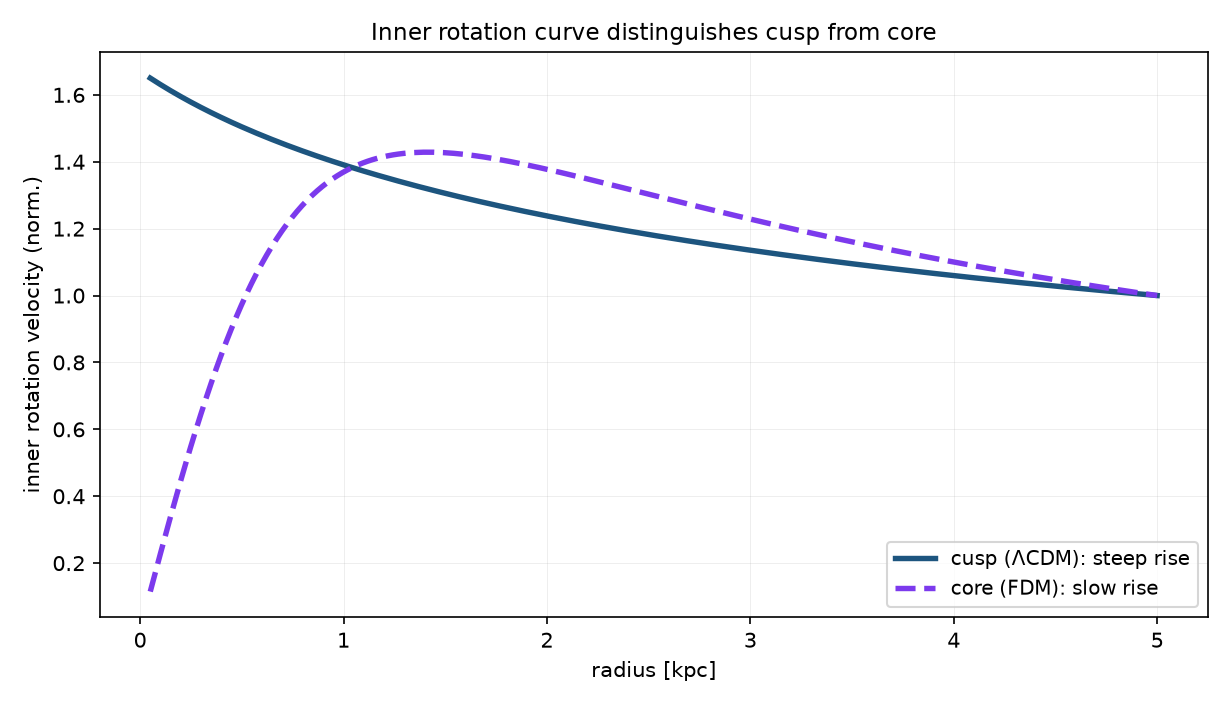
This is the headline of Task 2: FDM halos are cored, CDM halos are cusped, and the two profiles are identical only outside a few core radii. Our GAMER runs resolve the cored FDM profile directly (GM-F12), and the core–cusp discriminant motivates the whole dwarf-galaxy side of the mass tension (Topic 10).
- de Blok (2010), The core–cusp problem, Adv. Astron. 2010, 789293 (arXiv:0910.3538).
- Oh et al. (2015), High-resolution rotation curves (THINGS), AJ 149, 180.
- Hui, Ostriker, Tremaine & Witten (2017), Phys. Rev. D 95, 043541.