The concentration–mass relation
Defining concentration
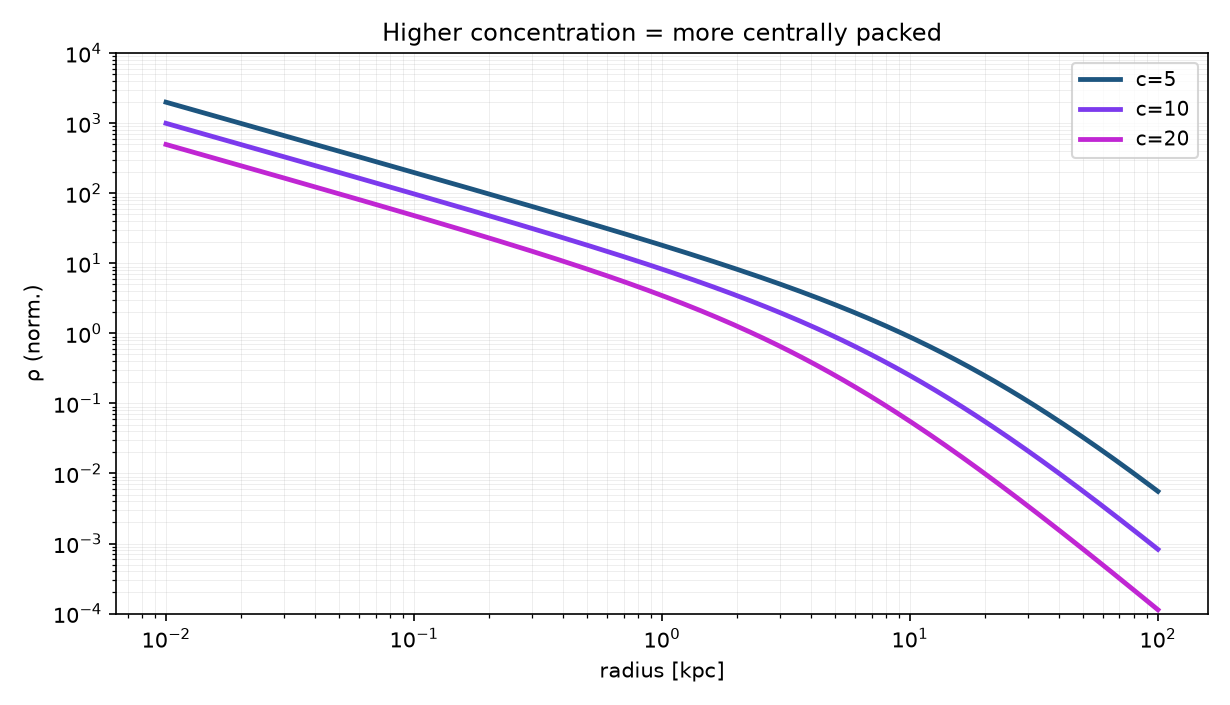
The concentration is $c=r_{\rm vir}/r_s$, the ratio of the virial radius to the NFW scale radius. High $c$ means mass is crammed into the centre; low $c$ means a diffuse halo. Together with the mass, $c$ fully specifies an NFW profile.
The trends
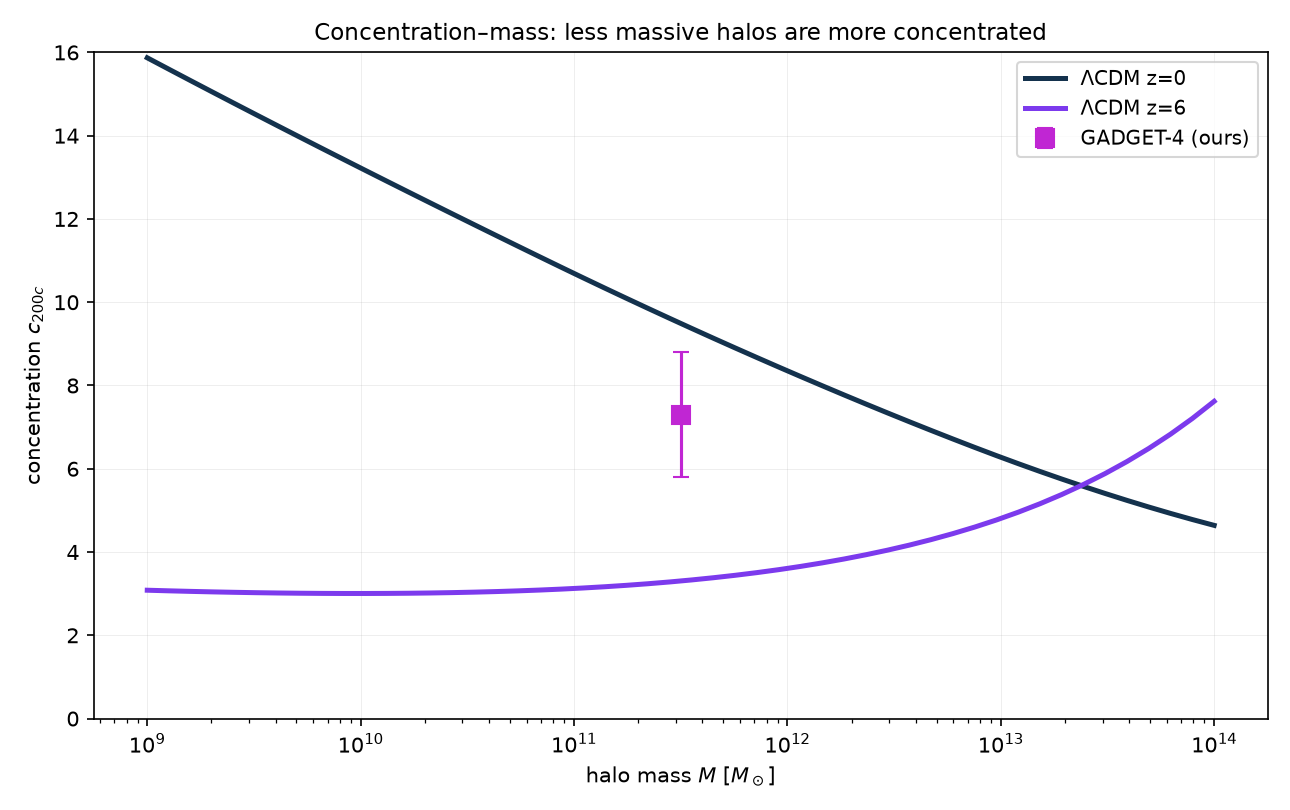
Concentration falls with halo mass — small halos are more concentrated because they collapsed earlier, when the Universe was denser — and falls with redshift at fixed mass. This $c(M,z)$ relation is well calibrated in $\Lambda$CDM (e.g. Dutton–Macciò, Diemer–Joyce) and shown in the figure.
A structural fingerprint
Because concentration encodes formation time, $c(M)$ is a sensitive probe of the growth history — and hence of the dark-matter model. Warm or fuzzy dark matter, which delays small-halo formation, generally lowers the concentration of the smallest halos relative to CDM.
Our GADGET-4 control measures $c\approx7.3$ at $M\approx3\times10^{11}\,M_\odot$ ($z=0$), sitting squarely on the standard Diemer–Joyce / Dutton–Macciò curve across 7,594 halos. That agreement validates the CDM baseline — so when we mark where FDM makes concentration ill-defined (next), it is against a trusted reference.
The FDM subtlety
Below the half-mode mass the FDM halo is dominated by its soliton core, so a single NFW concentration stops being a meaningful descriptor — the profile simply isn't NFW there. Above the cutoff, FDM and CDM concentrations converge. This is why our Task-2 $c(M)$ figure shades the soliton-dominated regime.
The $c(M)$ relation is the second half of Task 2. Our GADGET-4 measurement lands on the standard Diemer–Joyce curve (validating the CDM control), and we mark where the FDM soliton makes a single concentration ill-defined — the shaded region in our halo-structure figure.
- Dutton & Macciò (2014), Cold DM haloes… concentration, MNRAS 441, 3359 (arXiv:1402.7073).
- Diemer & Joyce (2019), An accurate physical model for c(M,z), ApJ 871, 168 (arXiv:1809.07326).
- Bullock et al. (2001), Profiles of DM haloes, MNRAS 321, 559.