Ultralight bosons: the axiverse & the misalignment mechanism
Where a 10⁻²² eV particle comes from
Ultralight scalars are not ad hoc. String-theory compactifications generically produce many axion-like fields — the ‘axiverse’ — as pseudo-Nambu–Goldstone bosons of broken shift symmetries. Their masses are exponentially sensitive to the underlying scales, so they spread across a huge, roughly logarithmic range, plausibly populating the $10^{-33}$–$10^{-10}$ eV window. A dark-matter boson near $10^{-22}$ eV is therefore a natural, not fine-tuned, possibility.
The misalignment mechanism
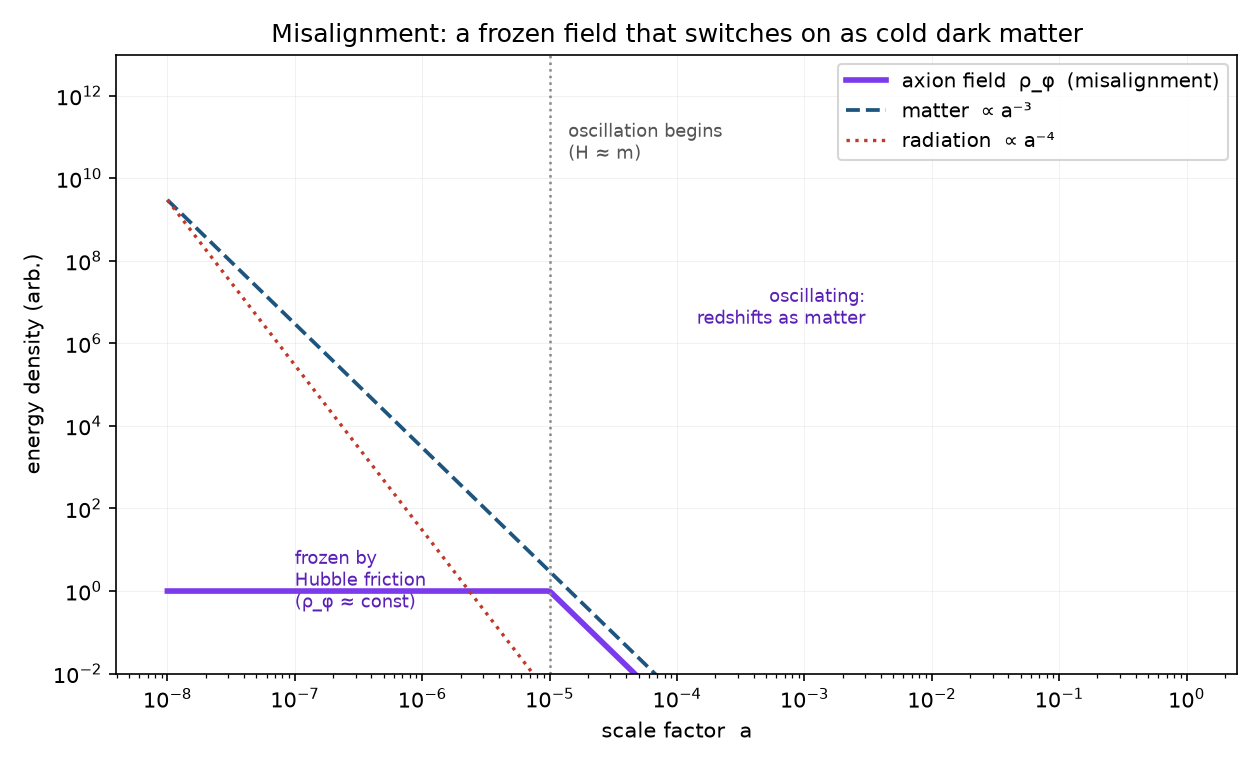
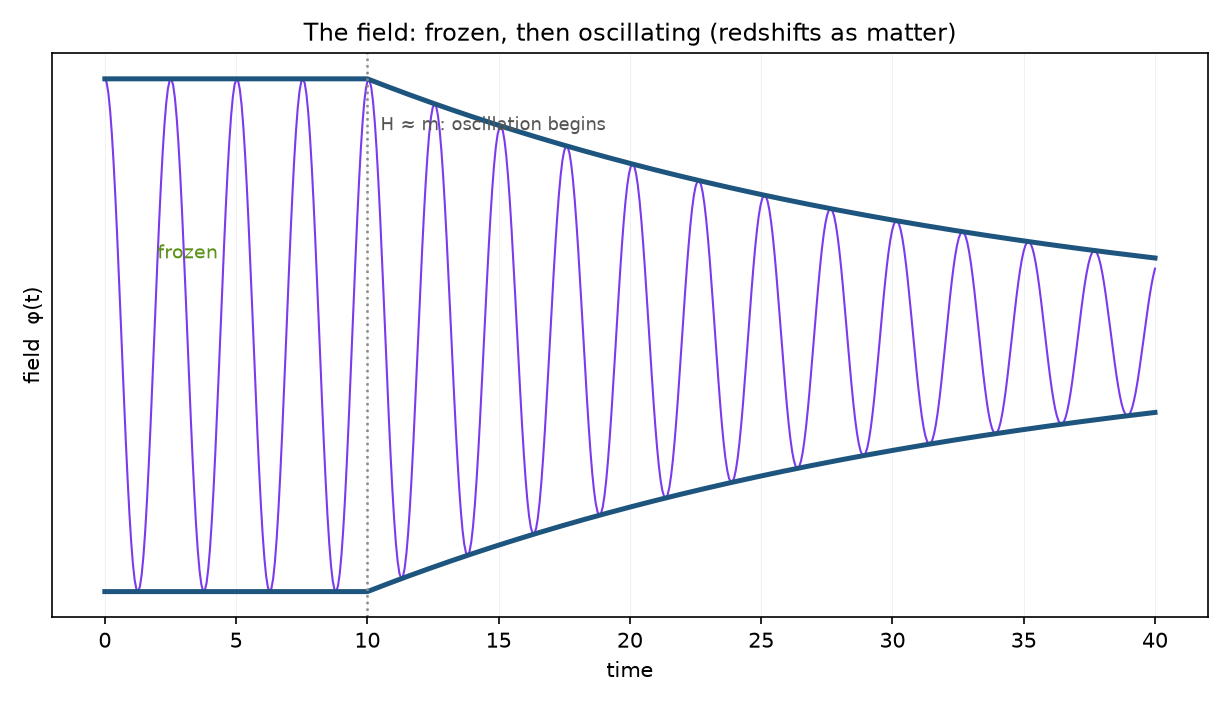
How does a light boson become dark matter? Not thermally. Instead, in the early Universe the field $\phi$ sits ‘misaligned’ at some initial value and is held there by Hubble friction: while the expansion rate exceeds the field's mass ($H>m$) the equation of motion $\ddot\phi+3H\dot\phi+m^2\phi=0$ is over-damped and $\phi$ is frozen, contributing a constant energy density $\rho_\phi\approx\tfrac12 m^2\phi^2$ (figure). When the Universe expands enough that $H$ drops to $\sim m$, the field is released, begins to oscillate, and its time-averaged energy density then redshifts exactly as pressureless matter, $\rho_\phi\propto a^{-3}$.
Why it is cold despite being light
The relic is a coherent, classical, zero-momentum field oscillation — not a gas of thermally-produced particles — so it carries essentially no random velocity. That is what makes it ‘cold’ on large scales despite the tiny mass, and why on those scales it mimics CDM.
The oscillation angular frequency is $\omega=mc^2/\hbar$. For $m=10^{-22}$ eV,
$$\omega=\frac{(10^{-22})(1.6\times10^{-19}\,{\rm J})}{1.05\times10^{-34}}\approx1.5\times10^{-7}\ {\rm s^{-1}},$$versus the present expansion rate $H_0\approx2.2\times10^{-18}\ {\rm s^{-1}}$. So $\omega/H_0\sim10^{11}$: the field completes $\sim10^{11}$ oscillations per Hubble time today — utterly fast compared to cosmic expansion, which is why its coarse-grained behaviour is that of smooth, pressureless matter.
The upshot for structure
Because the dark matter is a single coherent field with a macroscopic de Broglie wavelength (Topic 2.5), it is described not as particles but as a classical wave obeying the Schrödinger–Poisson equations (Topic 4). The axiverse also motivates the possibility of several ultralight fields of different masses — a scenario our dwarf-galaxy data even hint at (two preferred boson masses; Topic 10).
This is the justification for the whole modelling choice of the campaign: fuzzy dark matter is a classical scalar field, so we evolve the Schrödinger–Poisson system (JAXiON, GAMER) rather than N-body particles. The single parameter is the boson mass $m_{22}$; the axiverse's multi-field possibility is why we keep the mass a free parameter rather than assuming one value.
- Arvanitaki et al. (2010), String axiverse, Phys. Rev. D 81, 123530 (arXiv:0905.4720).
- Marsh (2016), Axion Cosmology, Phys. Rep. 643, 1 (arXiv:1510.07633).
- Hui, Ostriker, Tremaine & Witten (2017), Phys. Rev. D 95, 043541 (arXiv:1610.08297).