The coupled equations: wave + self-gravity
Closing the loop with Poisson
The wave moves in the gravitational potential $\Phi$; but $\Phi$ is generated by the wave's own mass density $\rho=m|\psi|^2$ through Poisson's equation. Together:
$$i\hbar\,\dot\psi=-\frac{\hbar^2}{2ma^2}\nabla^2\psi+m\Phi\psi,\qquad \nabla^2\Phi=\frac{4\pi G}{a}\big(\rho-\bar\rho\big).$$This is the Schrödinger–Poisson (SP) system. The nonlinearity — $\psi$ sources $\Phi$, which acts back on $\psi$ — is what makes it produce self-bound solitons and rich structure rather than trivial spreading.
Conserved quantities
SP conserves total mass $M=\int m|\psi|^2\,d^3x$ (from the continuity equation), total energy (kinetic + gravitational + quantum), and momentum and angular momentum. These are not decoration — they are the primary numerical diagnostics: a simulation that fails to conserve mass or energy is not to be trusted.
Solitons as stationary solutions
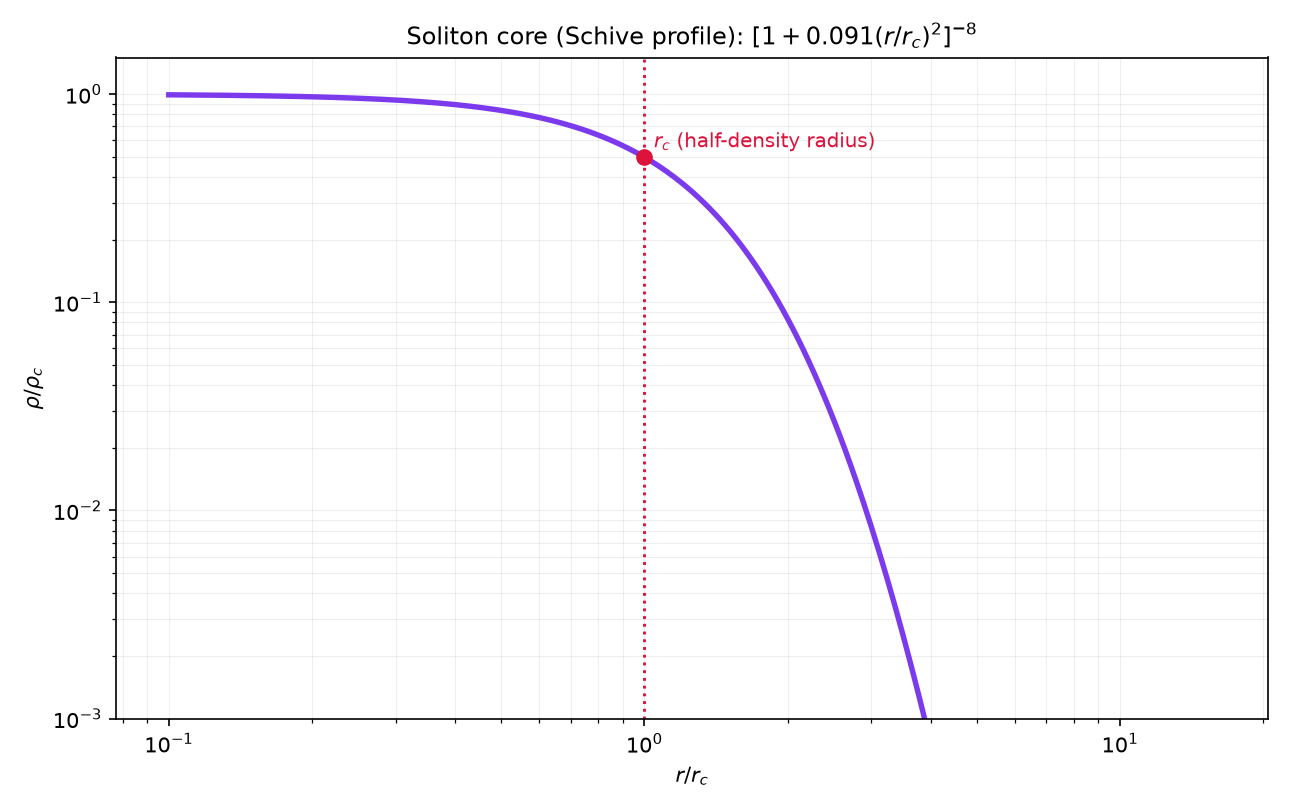
Stationary states $\psi=e^{-i\gamma t/\hbar}\phi(r)$ of SP are the solitons (figure) — the self-gravitating ground states where quantum pressure balances gravity (Topic 5). Every FDM halo settles a soliton into its centre; the surrounding halo is the time-dependent, interfering part of the same $\psi$.
Why it must be solved numerically
SP has no general closed-form solution — the nonlinear gravitational coupling defeats analytic methods except for the stationary soliton and linear perturbations. Structure formation therefore demands numerical evolution.
Our JAXiON spectral solver conserves mass to $|\Delta M/M|\sim10^{-13}$ (machine precision, from the unitary split-step) and energy to $\sim10^{-9}$ over hundreds of checkpoints. Those numbers are the licence to believe the physics: a $\rho_c$ or a core radius extracted from a run that drifted in mass would be meaningless.
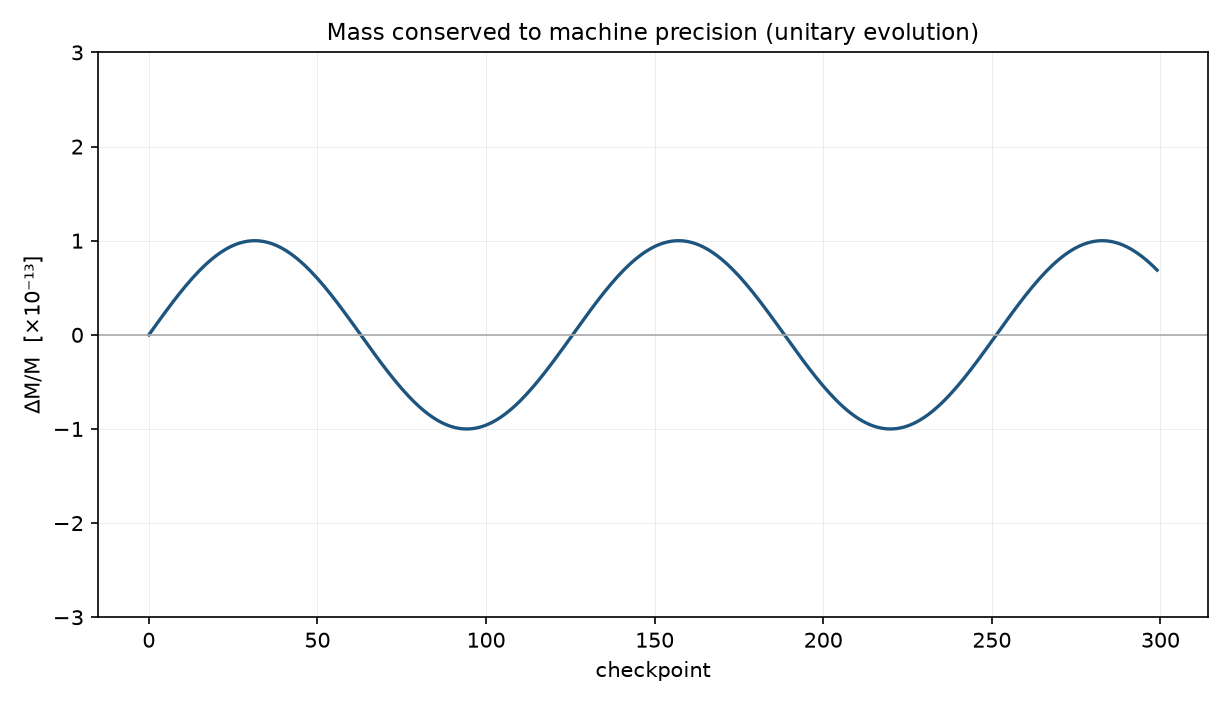
The Schrödinger–Poisson system is the campaign: JAXiON evolves it spectrally, GAMER on an adaptive mesh, and their agreement on the soliton (cross-code validation, JXE-F9) is agreement on this equation. Our conservation figures ($|\Delta M/M|\sim10^{-13}$) are the SP invariants above, measured.
- Schive, Chiueh & Broadhurst (2014), Nature Physics 10, 496 (arXiv:1406.6586).
- Mocz et al. (2017), MNRAS 471, 4559 (arXiv:1705.05845).
- Hui, Ostriker, Tremaine & Witten (2017), Phys. Rev. D 95, 043541 (arXiv:1610.08297).