Growth of perturbations and the growth factor
Recap: the growth factor
In linear theory (Topic 1.3) each cold-dark-matter mode grows by the same factor $D(a)$, so the power spectrum's amplitude scales as $P(k,a)=D^2(a)\,P(k,a_0)$ while its shape is fixed. During matter domination $D\propto a$; once $\Lambda$ dominates, growth freezes. This single function propagates a spectrum from one redshift to another.
Scale-dependent growth in FDM
Fuzzy dark matter breaks the scale-independence. Its quantum-pressure term makes the growth factor depend on wavenumber: large scales ($k
Reading P(k) at a given redshift
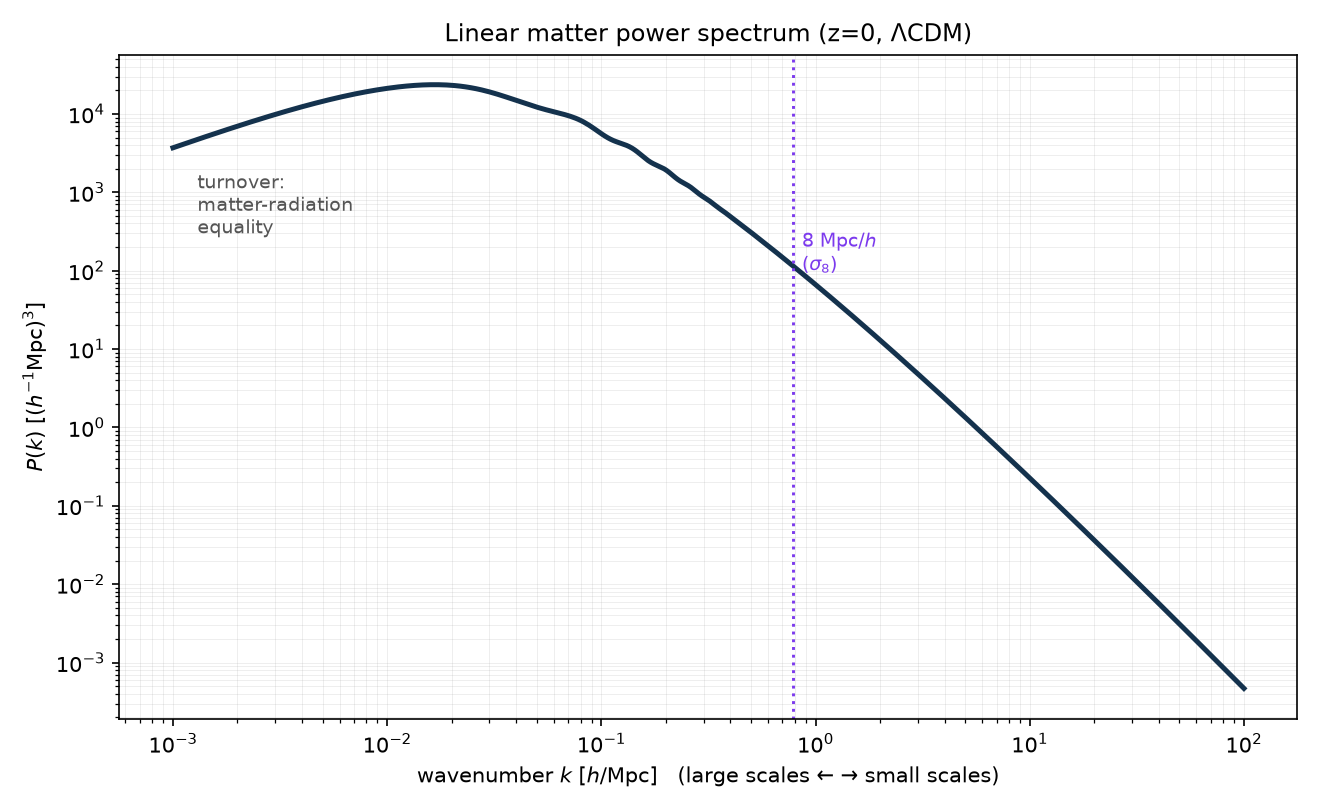
To compare with observations at redshift $z$, we scale the $z=0$ linear spectrum by $D^2(z)$ (CDM) or by the scale-dependent factor (FDM), then apply nonlinear corrections where needed. The figure shows the linear $P(k)$; growth moves its amplitude up and down without (for CDM) touching its shape.
With $D(z=6)/D(0)\approx0.18$, the linear power at $z=6$ is $D^2\approx0.032$ times its present value — fluctuations were $\sim5.6\times$ smaller in amplitude. At our start $z=127$, $D\approx a\approx0.008$, so $P\propto D^2\approx6\times10^{-5}$ of today: firmly linear, which is why we can generate initial conditions analytically and trust them.
Why the FDM difference grows with time
Because sub-Jeans modes fail to grow while super-Jeans modes do, the gap between the FDM and CDM spectra widens as structure develops. This is why the halo-abundance suppression deepens toward high redshift (our (M,z) suppression map) and why FDM's first halos form conspicuously late.
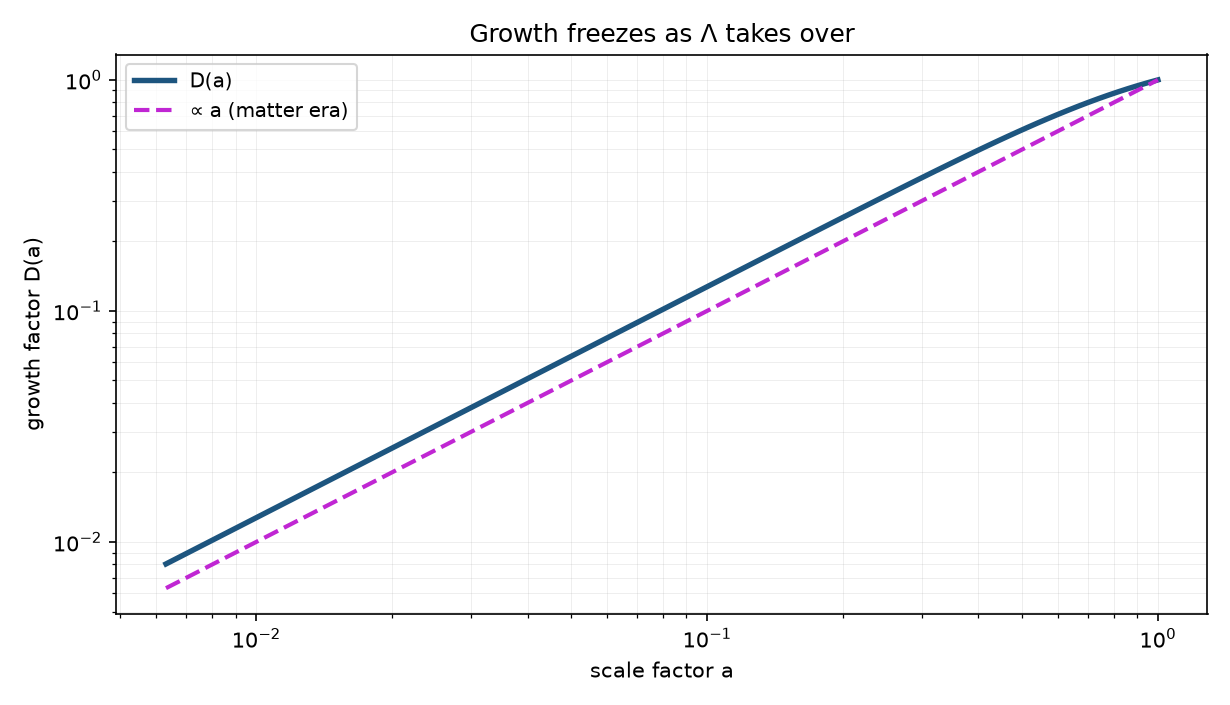
We scale our linear $P(k)$ to each simulation epoch with $D(z)$, and the growing FDM–CDM gap is exactly the deepening suppression seen in our (M,z) map and the delayed first collapse ($z_{\rm ff}\approx15.7$). GADGET-4's validated growth is the CDM reference the FDM curves peel away from.
- Dodelson & Schmidt (2020), Modern Cosmology, 2nd ed.
- Hu, Barkana & Gruzinov (2000), Phys. Rev. Lett. 85, 1158 (arXiv:astro-ph/0003365).