Measuring the HMF: halo finders (FOF vs SO)
Two definitions of a halo
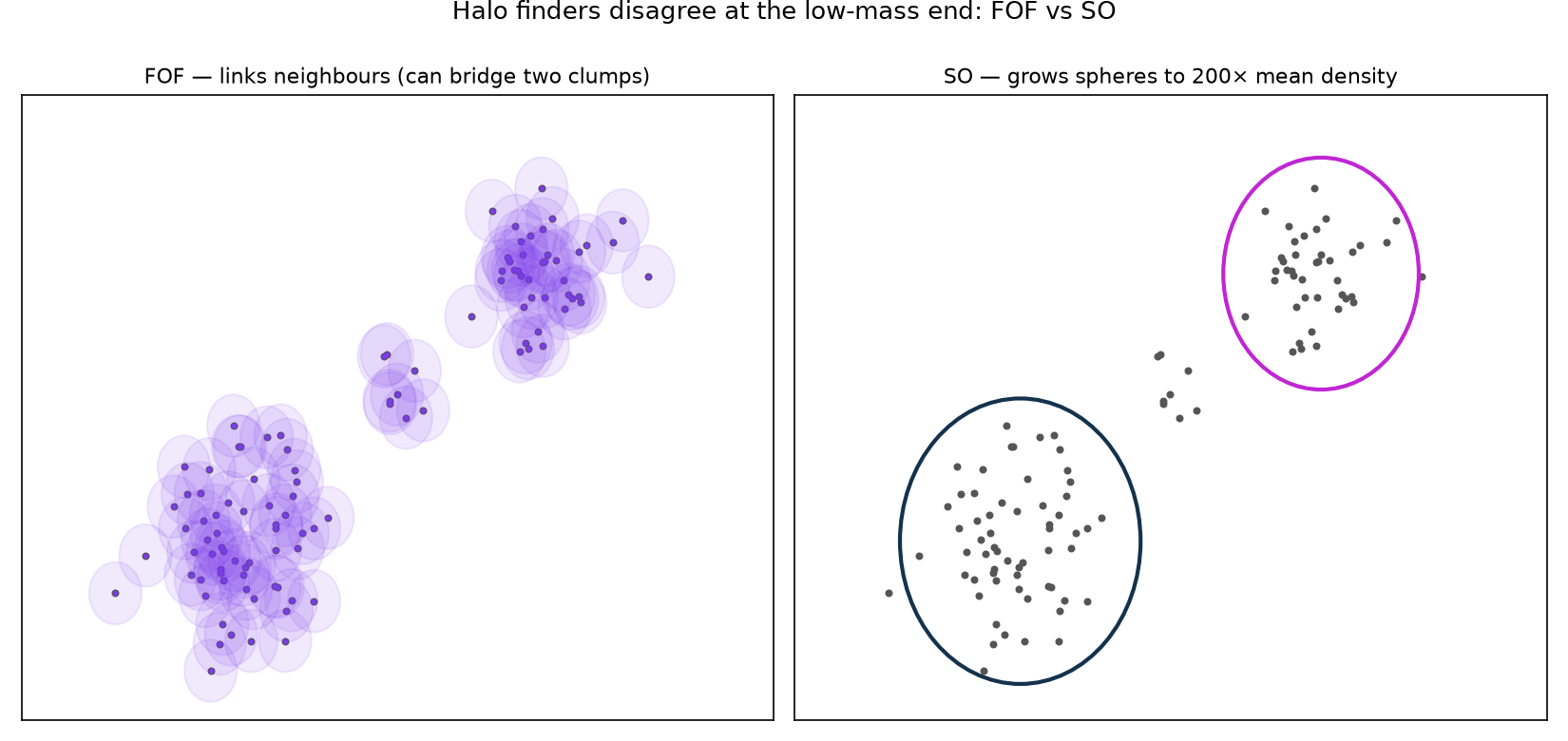
Halos are not sharply bounded, so ‘halo’ is a matter of definition. Friends-of-friends (FOF) links any two particles closer than a chosen linking length and calls each connected group a halo. Spherical overdensity (SO) grows a sphere around a density peak until the enclosed mean density drops to a threshold (e.g. $200\bar\rho$). They agree for isolated halos but diverge at the low-mass end and for bridged systems (figure).
The FDM complication
May & Springel (2023) point out that FDM halos are strung together by dense, smooth filaments — unlike the clumpier $\Lambda$CDM web — which makes halo identification genuinely harder and more finder-dependent. FOF can join two clumps linked by such a filament into one object; SO enforces a spherical boundary.
The systematic in our comparison
Our GADGET-4 control uses FOF (91,058 halos at $z=6$); our GAMER FDM census uses SO (292 halos). Comparing the two codes at the low-mass end therefore carries a finder systematic that can reach tens of percent. The honest statement — the one we make — is to compare each code against its own theory, not directly against each other, and to flag the cross-code low-mass ratio as finder-dependent.
Why this matters for blind science
Naming this systematic is part of the campaign's discipline: rather than quote a clean-looking but finder-contaminated cross-code ratio, we state the caveat and lean on the each-vs-own-theory comparison. It is the difference between an honest measurement and a misleading one.
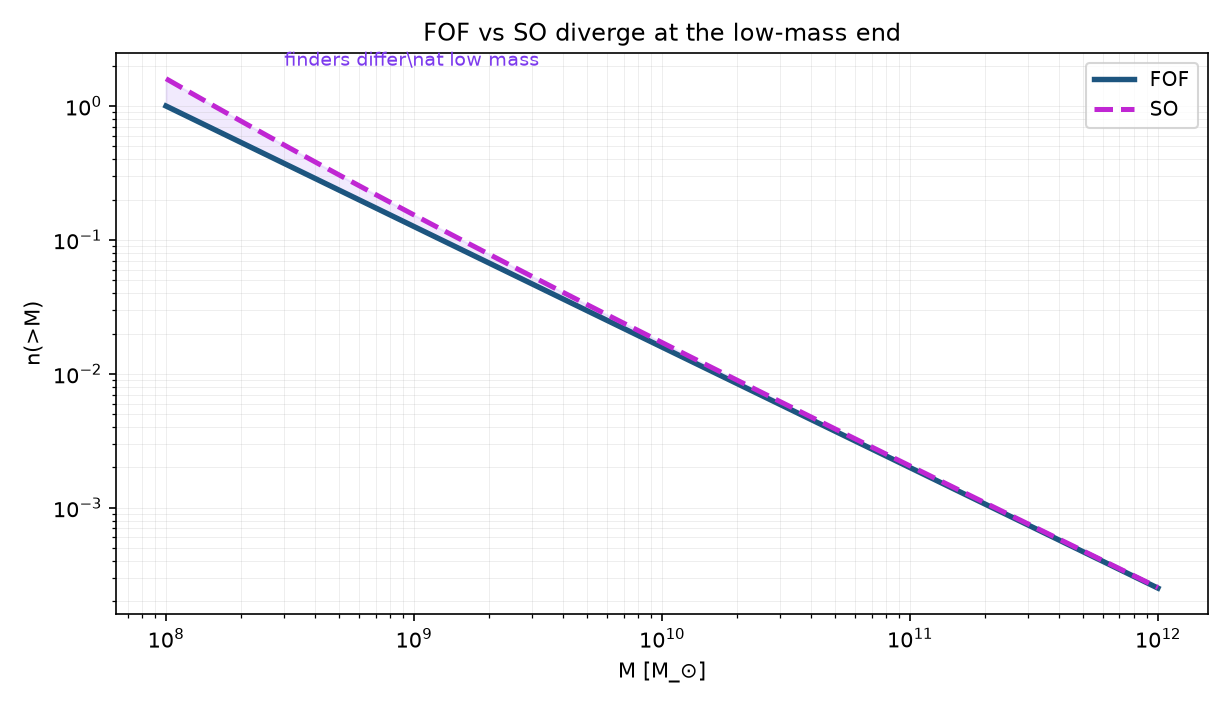
This is exactly the caveat on our sim-vs-theory figure (Topic 7.2): GADGET-4 (FOF) and GAMER (SO) are each shown against their own theory, and the ‘finder systematic’ note on that figure is this issue. It is also why the filament-linked FDM web (May & Springel) makes FDM halo-finding a live research problem.
- Davis et al. (1985), The evolution of large-scale structure (FOF), ApJ 292, 371.
- Knebe et al. (2013), Halo-finder comparison, MNRAS 435, 1618.
- May & Springel (2023), MNRAS 524, 4256 (arXiv:2209.14886).