Hydrodynamics + FDM; mixed dark matter
Adding baryons
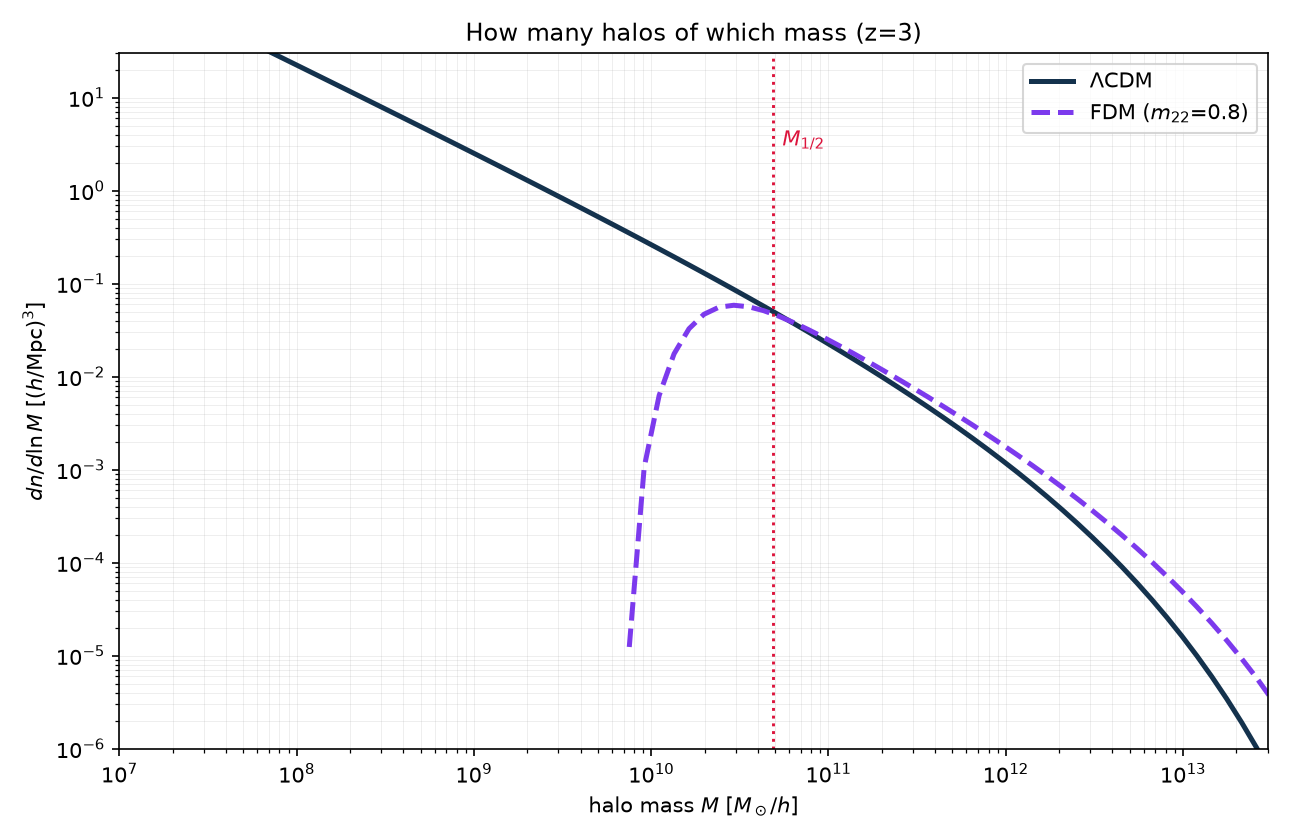
The predictions of Tasks 1 and 2 are for dark matter alone. Real galaxies form stars, whose feedback (supernovae, radiation) can reshape the inner dark-matter profile and suppress small-galaxy formation. To know whether FDM's distinctive signatures — solitonic cores, the small-halo cutoff — survive galaxy-formation physics, one must couple the wave solver to hydrodynamics.
Coupled wave + gas simulations
Pioneering runs (Mocz et al. 2019, 2020) married an AREPO moving-mesh baryonic solver to a spectral FDM component, at cosmic dawn. They found the dark-matter structure largely unaffected by feedback in their small boxes — but establishing this statistically, in representative volumes, is an open and computationally severe problem (it stacks the baryonic cost on top of the de Broglie wall, Topic 9.5).
Mixed dark matter
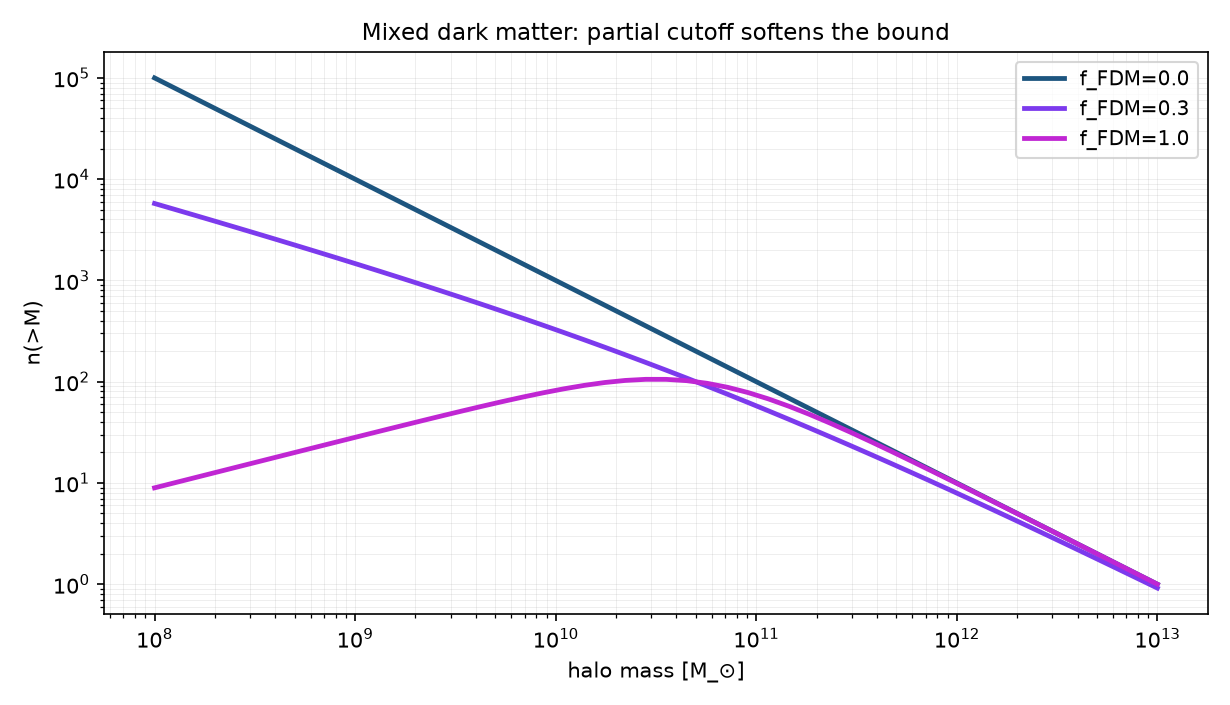
What if only a fraction $f$ of the dark matter is ultralight, the rest cold? Then the small-scale cutoff is partial, softening the Lyman-α bound (Topic 10.2) while a light boson could still core dwarfs — potentially relaxing the 8.7$\sigma$ tension (Topic 10.4). Recent emulator-based analyses of the forest constrain how large $f$ can be as a function of mass. Mixed dark matter is a leading candidate reconciliation.
Multi-field models
The axiverse (Topic 2.4) generically predicts several ultralight fields of different masses. Such multi-field models restore diversity to the core–halo relation and are hinted by the two-mass preference in dwarf data (Topic 10.1). Both mixed and multi-field scenarios are active routes to save FDM from its own tension.
These are the frontiers our campaign's results point toward: our semi-analytic stellar-mass-suppression decomposition (G6) probed the baryon side, and the mixed/multi-field routes are the escape hatches for the 8.7$\sigma$ tension (Topic 10.4) that our inference quantified. Hydrodynamics at scale is gated by the same resolution wall (Topic 9.5).
- Mocz et al. (2019, 2020), Galaxy formation with BECDM, MNRAS 1911.05746 / Phys. Rev. Lett. 123, 141301.
- Schwabe et al. (2020), Mixed FDM, MNRAS 496, 4227 (arXiv:2007.08256).
- Kobayashi et al. (2017), Lyman-α constraints on mixed FDM, Phys. Rev. D 96, 123514.