From a classical scalar field to Schrödinger–Poisson
The starting point: a scalar field
An ultralight boson is described by a real scalar field $\phi(\mathbf x,t)$ of mass $m$ obeying the Klein–Gordon equation in an expanding universe,
$$\ddot\phi+3H\dot\phi-\frac{\nabla^2}{a^2}\phi+\frac{m^2c^2}{\hbar^2}\phi=0 .$$The field oscillates at the Compton frequency $\omega=mc^2/\hbar$ (Topic 2.4). For dark matter we care about the slow, gravitationally-driven modulation of that oscillation, not the fast carrier itself.
Factoring out the fast oscillation
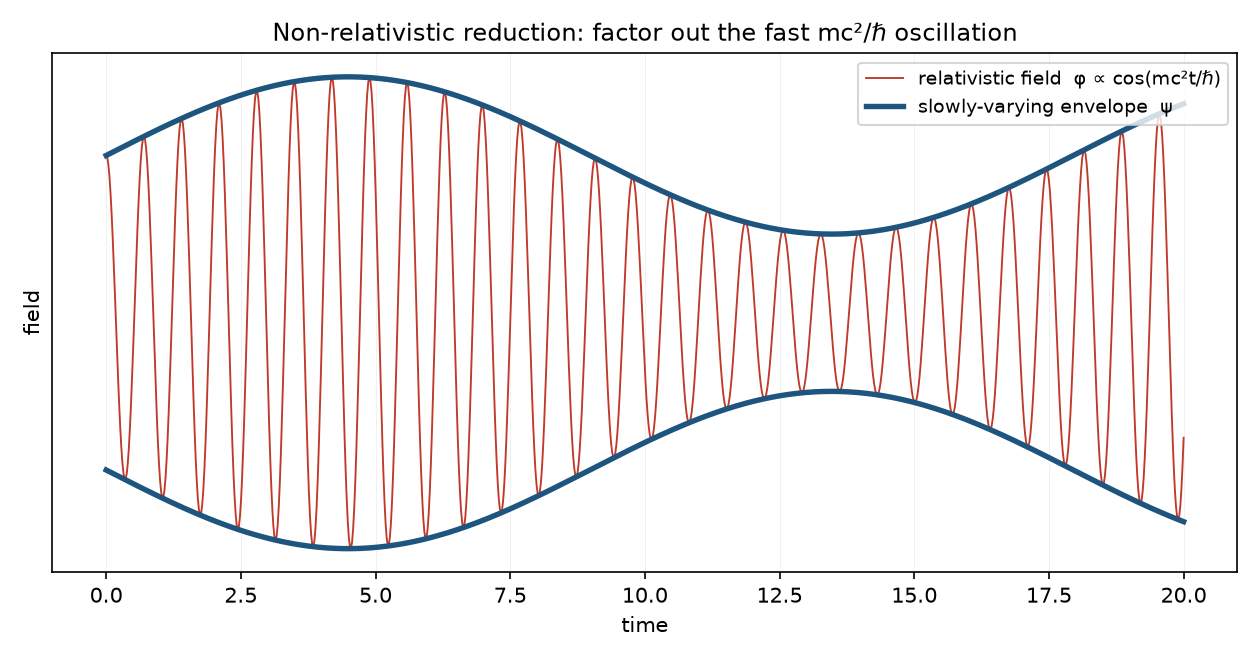
Write the field as a fast carrier times a slowly-varying complex envelope $\psi$ (figure):
$$\phi(\mathbf x,t)=\frac{\hbar}{\sqrt{2m}}\Big(\psi\,e^{-imc^2t/\hbar}+\psi^*\,e^{+imc^2t/\hbar}\Big).$$The key non-relativistic assumption is that $\psi$ changes slowly compared with the carrier: $|\dot\psi|\ll(mc^2/\hbar)|\psi|$, so we may drop $\ddot\psi$ relative to $mc^2\dot\psi/\hbar$. This separates the ~$10^{11}$-per-Hubble-time oscillation from the ~cosmological modulation.
The result: Schrödinger's equation
Substituting and keeping leading order in $1/c^2$ collapses Klein–Gordon to the (comoving) Schrödinger equation,
$$i\hbar\,\dot\psi=-\frac{\hbar^2}{2ma^2}\nabla^2\psi+m\,\Phi\,\psi,$$with $\Phi$ the Newtonian gravitational potential and $\rho=m|\psi|^2$ the dark-matter density. The relativistic field theory has become non-relativistic wave mechanics — the equation our codes actually integrate.
The approximation needs $v\ll c$. Fuzzy dark matter in galaxies moves at $v\sim100\ \mathrm{km\,s^{-1}}$, so $v/c\sim3\times10^{-4}$ and $(v/c)^2\sim10^{-7}$: relativistic corrections are one part in ten million. The Schrödinger reduction is superbly accurate for structure formation — relativistic treatment is needed only near black holes or in the very early universe.
What survives, what is dropped
The reduction keeps gravity and the wave's kinetic (quantum-pressure) term — everything relevant to halos — and discards the fast Compton oscillation and $O(v^2/c^2)$ corrections. Adding self-gravity through Poisson's equation (next section) closes the system.
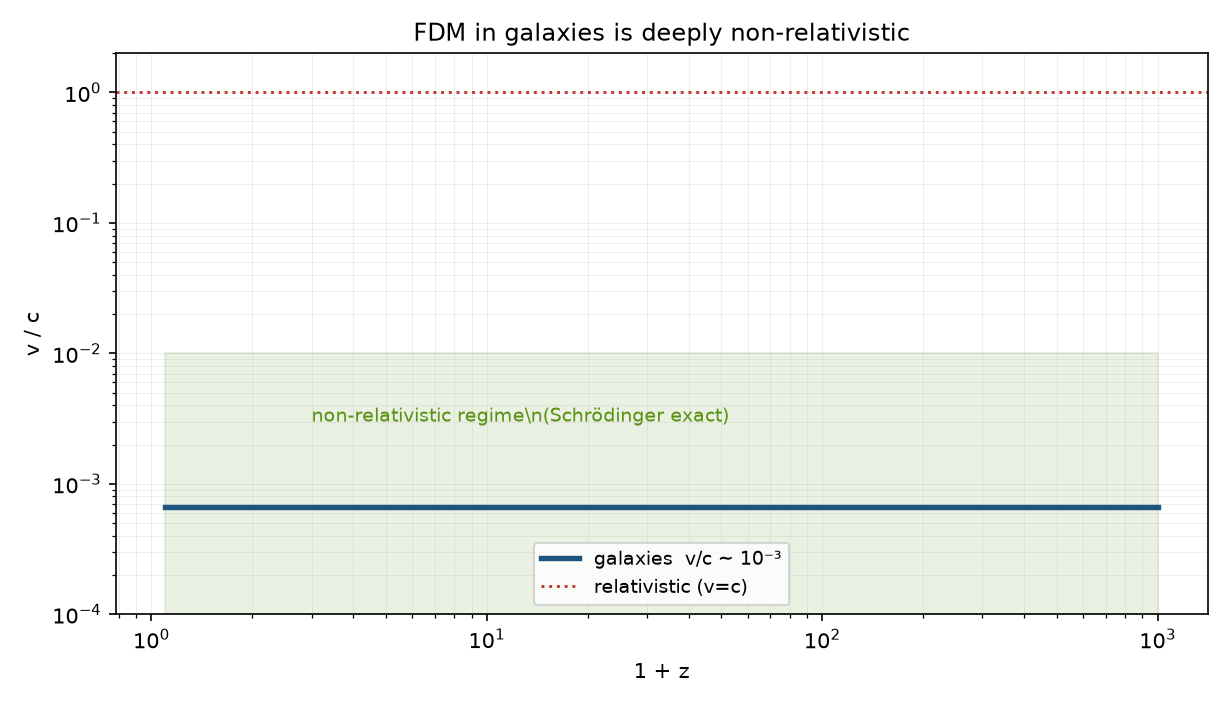
This reduction is why the campaign simulates the Schrödinger equation rather than full field theory: at galactic $v/c\sim10^{-4}$ it is exact to one part in $10^{7}$. All three of JAXiON, GAMER, and the analytic tools inherit their governing equation from this step.
- Hui, Ostriker, Tremaine & Witten (2017), Phys. Rev. D 95, 043541 (arXiv:1610.08297).
- Marsh (2016), Axion Cosmology, Phys. Rep. 643, 1 (arXiv:1510.07633).
- Ferreira (2021), Ultra-light dark matter, A&A Rev. 29, 7 (arXiv:2005.03254).