σ(M), σ₈ and window functions
Smoothing the field
The variance of the density field smoothed on scale $R$ (enclosing mass $M=\tfrac43\pi\bar\rho R^3$) is
$$\sigma^2(M)=\int_0^\infty\frac{dk}{2\pi^2}\,k^2\,P(k)\,|W(kR)|^2 .$$$\sigma(M)$ rises as $M$ falls (more small-scale power), and the halo mass function depends on it through $f(\sigma)$ and $d\ln\sigma/d\ln M$ (Topic 7.2). Normalized at $R=8\,h^{-1}$Mpc it defines $\sigma_8$.
The standard choice: real-space top-hat
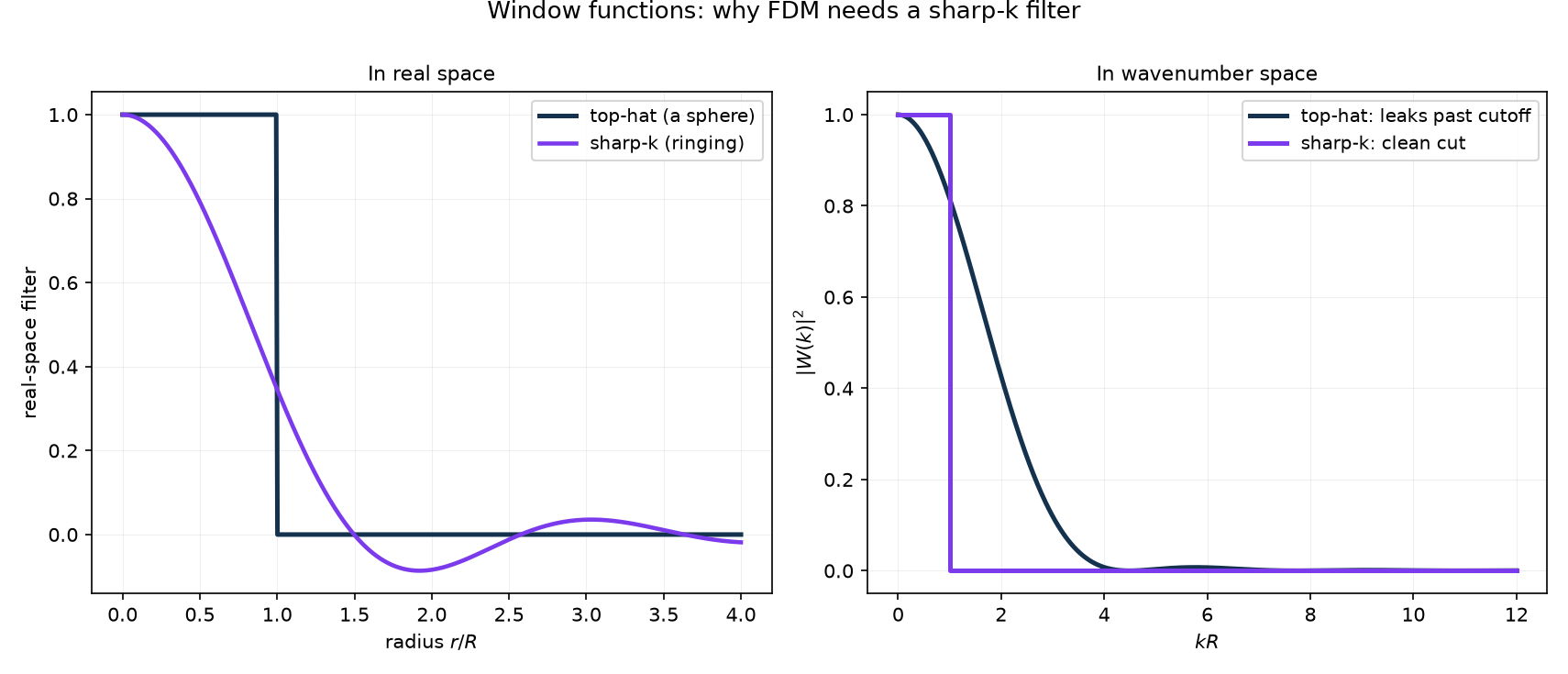
For cold dark matter the natural filter is a real-space top-hat sphere. In Fourier space it is $W(kR)=3[\sin(kR)-kR\cos(kR)]/(kR)^3$, which oscillates and has broad tails. For CDM, with power at all scales, this is fine — and the Sheth–Tormen constants are calibrated to it.
Why FDM needs a sharp-k window
FDM has essentially no power below the cutoff. But a top-hat's tails still reach past the cutoff and pick up the (removed) small-scale power, manufacturing spurious halos that should not exist. The fix is a sharp-k filter — a hard step in wavenumber, $W=1$ for $k<1/R$ and $0$ beyond — which counts exactly the surviving modes and nothing more (figure). It is mandatory for any truncated spectrum.
A sharp-k filter introduces one calibration constant relating the cut wavenumber to a mass, $M=\tfrac43\pi\bar\rho(c\,R)^3$ with $c\approx2.5$ (Benson+2013). Using it shifts the cutoff mass by tens of percent — not its existence or scaling. Using a top-hat instead would invent a whole population of sub-cutoff FDM halos: a qualitative error, not a small one. This is why our Task-1 pipeline uses top-hat for $\Lambda$CDM but sharp-k for FDM.
Consistency
The window choice is the one subtlety that separates a correct FDM mass function from a wrong one. It is standard in the FDM literature (Kulkarni & Ostriker 2020 use the same sharp-k approach), and it is why our FDM curves cut off cleanly rather than tailing into spurious small halos.
Compare what each window integrates when $P(k)$ is truncated at $k_{\rm cut}$:
- $\sigma^2(M)=\displaystyle\int\frac{k^2dk}{2\pi^2}P(k)|W(kR)|^2$; for FDM, $P(k)\to0$ for $k>k_{\rm cut}$.
- Sharp-k: $W=1$ for $k<1/R$, else $0$. For $M$ below the cutoff, $1/R>k_{\rm cut}$, so the integral sees no power — $\sigma$ flattens. Correct.
- Top-hat: $|W(kR)|^2$ has tails $\propto(kR)^{-4}$ reaching to all $k$. It integrates the CDM-like power at $k
- So the top-hat keeps $\sigma(M)$ rising below the cutoff — predicting halos where FDM allows none.
The window's $k$-space support is the whole issue: only sharp-k respects the truncation, which is why it is mandatory for FDM (and warm DM).
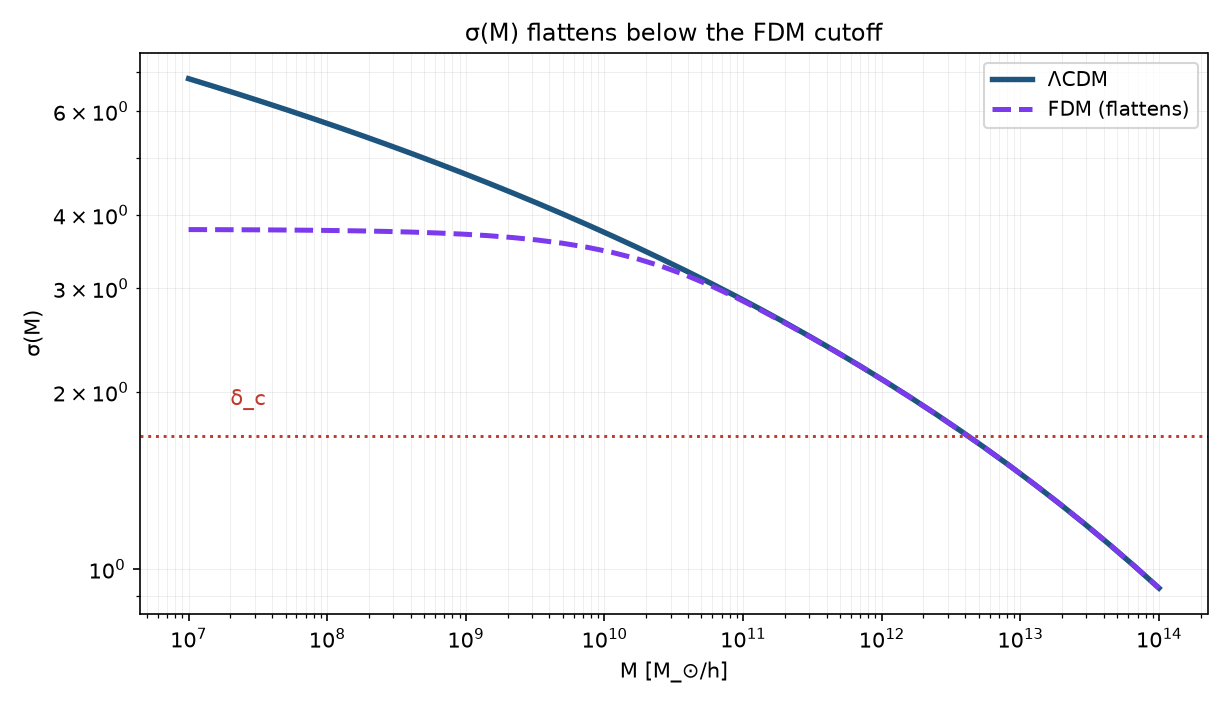
This is exactly why our note states ‘FDM uses a sharp-k window (mandatory)’: $\Lambda$CDM keeps the standard top-hat, FDM the sharp-k. The constant $c\approx2.5$ shifts $M_{1/2}$ by tens of percent (a caveat we state), but the wrong window would fabricate halos the cutoff forbids.
- Benson et al. (2013), Dark matter halo mass functions with sharp-k filter, MNRAS 428, 1774.
- Kulkarni & Ostriker (2022), arXiv:2011.02116.
- Sheth & Tormen (1999), MNRAS 308, 119 (arXiv:astro-ph/9901122).