Press–Schechter: the barrier-crossing argument
The core idea
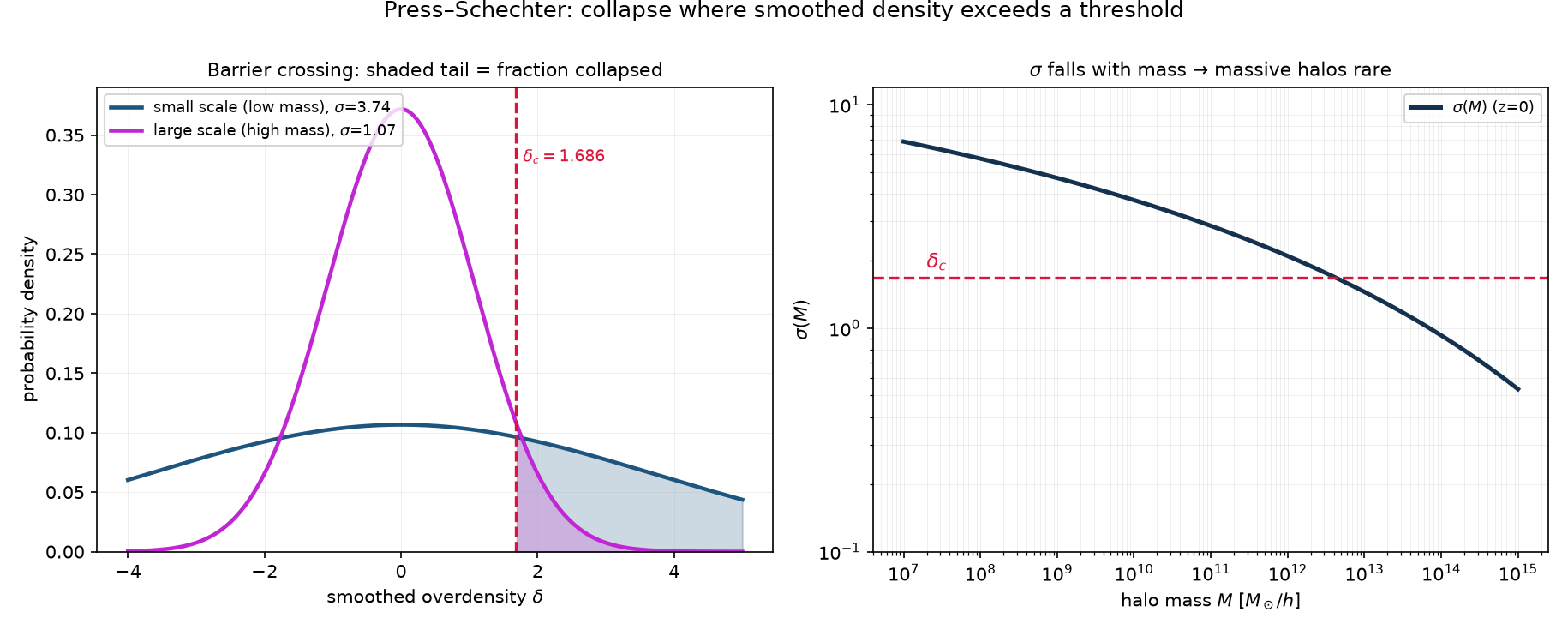
The early density field is Gaussian. Press & Schechter proposed that a region collapses into a bound halo if, smoothed on the scale enclosing mass $M$, its overdensity $\delta$ exceeds a critical threshold $\delta_c$. The mass fraction in halos above $M$ is then the probability of exceeding that threshold — a statement about the initial statistics, not the messy nonlinear collapse.
Smoothing the field: σ(M)
Smoothing with a filter of radius $R$ (mass $M=\tfrac43\pi\bar\rho R^3$) gives a Gaussian $\delta$ of variance
$$\sigma^2(M)=\int_0^\infty\frac{dk}{2\pi^2}k^2P(k)|W(kR)|^2 .$$More small-scale power means $\sigma$ is large for small $M$ and falls as $M$ grows — the single fact that makes massive halos rare. The window $W$ matters for FDM (Topic 6.4).
The collapsed fraction
Since $\delta$ is Gaussian with variance $\sigma^2(M)$,
$$F(>M)=\int_{\delta_c}^{\infty}\frac{d\delta}{\sqrt{2\pi}\sigma}e^{-\delta^2/2\sigma^2}=\tfrac12\,\mathrm{erfc}\!\left(\frac{\delta_c}{\sqrt2\,\sigma}\right).$$Press & Schechter multiplied by 2 by hand (later justified by the excursion-set formalism, Topic 7.3).
From fraction to a mass function
Differentiating gives the number density per logarithmic mass interval,
$$\frac{dn}{d\ln M}=\frac{\bar\rho}{M}f(\sigma)\left|\frac{d\ln\sigma}{d\ln M}\right|,\qquad f_{\rm PS}(\sigma)=\sqrt{\tfrac2\pi}\,\frac{\delta_c}{\sigma}e^{-\delta_c^2/2\sigma^2}.$$The exponential makes rare massive halos scarce; the prefactor gives the abundant low-mass end. Everything cosmological enters through $\sigma(M)$, built from $P(k)$. The figure shows both ingredients.
Convert the mass fraction above threshold, $F(>M)$, into a number density:
- The mass fraction in a shell $[M,M+dM]$ is $\dfrac{dF}{dM}\,dM$; the number of halos per volume is $\dfrac{\bar\rho}{M}\dfrac{dF}{dM}\,dM$ (dividing mass fraction by mass per halo).
- With $F=\tfrac12\mathrm{erfc}(\delta_c/\sqrt2\,\sigma)$ and $\sigma=\sigma(M)$, chain-rule: $\dfrac{dF}{dM}=\dfrac{dF}{d\sigma}\dfrac{d\sigma}{dM}$.
- $\dfrac{dF}{d\sigma}=\dfrac{1}{\sqrt{2\pi}}\dfrac{\delta_c}{\sigma^2}e^{-\delta_c^2/2\sigma^2}$ (differentiating the erfc), and the ad-hoc factor 2 fixes the total.
- Collecting: $\dfrac{dn}{d\ln M}=\dfrac{\bar\rho}{M}\,f(\sigma)\left|\dfrac{d\ln\sigma}{d\ln M}\right|$ with $f_{\rm PS}=\sqrt{\tfrac2\pi}\dfrac{\delta_c}{\sigma}e^{-\delta_c^2/2\sigma^2}$.
The $|d\ln\sigma/d\ln M|$ factor is the Jacobian converting "fraction above threshold on scale $M$" into "halos per mass bin" — it is why the shape of $\sigma(M)$, not just its value, matters.
At $z=0$ a cluster of $M=10^{15}\,M_\odot$ has $\sigma(M)\approx0.5$, so $\nu=\delta_c/\sigma=1.686/0.5\approx3.4$. The exponential suppression is $e^{-\nu^2/2}=e^{-5.7}\approx3\times10^{-3}$. Compare a galaxy halo $M=10^{12}$ with $\sigma\approx1.7$, $\nu\approx1.0$, $e^{-0.5}\approx0.6$. The ratio $\sim200$ in the exponential alone is why clusters are so much rarer than galaxies — a direct read-off of $\sigma(M)$ falling with mass.
δc, and the FDM twist
The threshold $\delta_c\approx1.686$ is the linearly-extrapolated overdensity at which a spherical top-hat collapses (Topic 7.1). For FDM nothing changes except $\sigma(M)$: quantum pressure erases small-scale power, $\sigma(M)$ flattens toward low mass, the Gaussian tail above $\delta_c$ collapses, and the halo count plummets below the half-mode mass. Same formula, different $\sigma(M)$ — the entire origin of the FDM suppression.
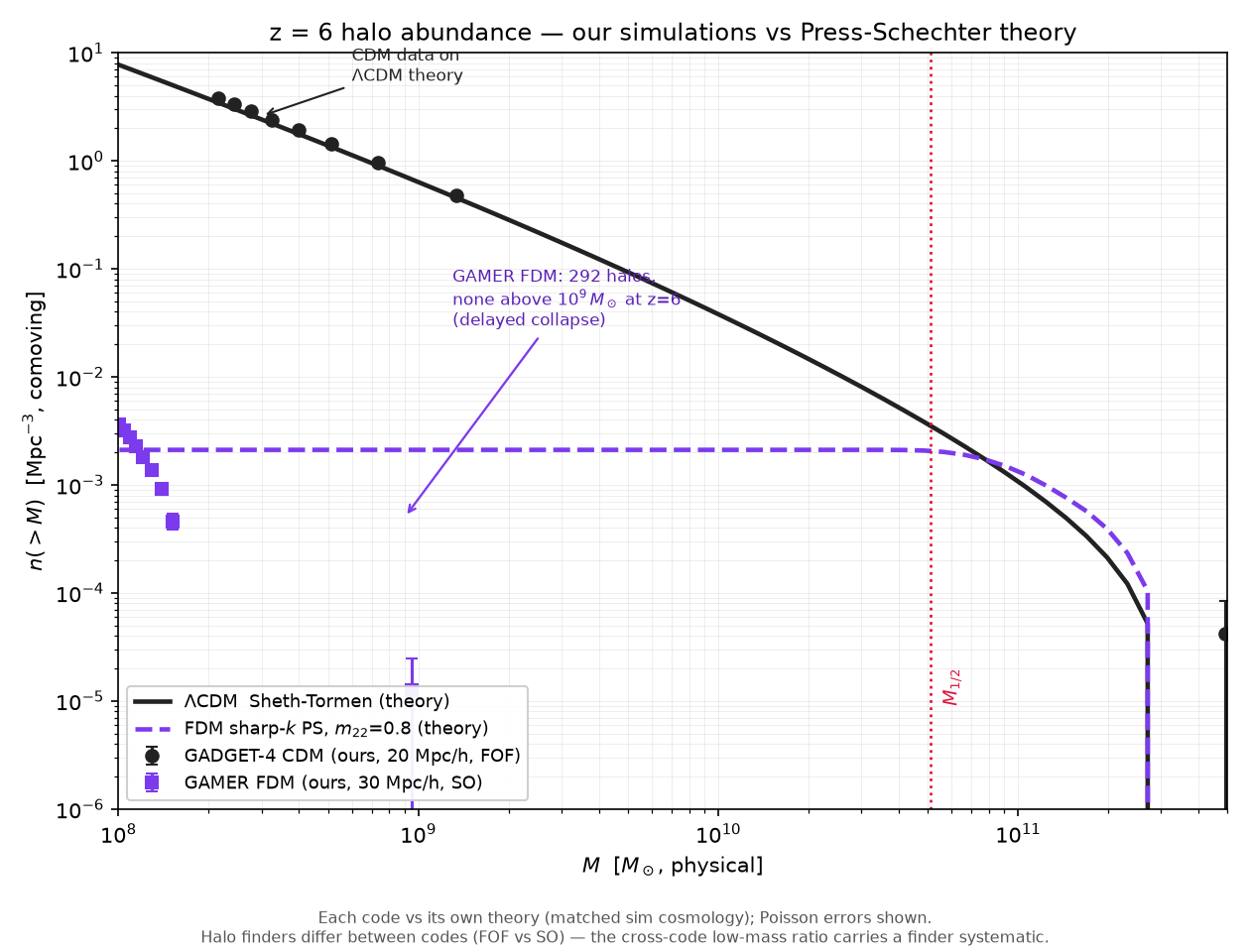
This is the method Sandro named for Task 1. Our mass functions evaluate Press–Schechter and its Sheth–Tormen refinement (§7.3) on our validated linear $P(k)$; the $\Lambda$CDM baseline matches colossus to 0.1% and our own GADGET-4 halos at $z=6$. For FDM we swap in the Hu–Barkana–Gruzinov transfer (§6.3) and a sharp-$k$ window (§6.4), and the mass function cuts off below $M_{1/2}\approx5\times10^{10}\,M_\odot/h$.
- Press & Schechter (1974), Formation of galaxies and clusters…, ApJ 187, 425.
- Bond, Cole, Efstathiou & Kaiser (1991), Excursion set mass functions, ApJ 379, 440.
- Sheth & Tormen (1999), Large-scale bias and the peak-background split, MNRAS 308, 119 (arXiv:astro-ph/9901122).