Statistical inference: likelihoods, SBI & calibration
From data to a parameter
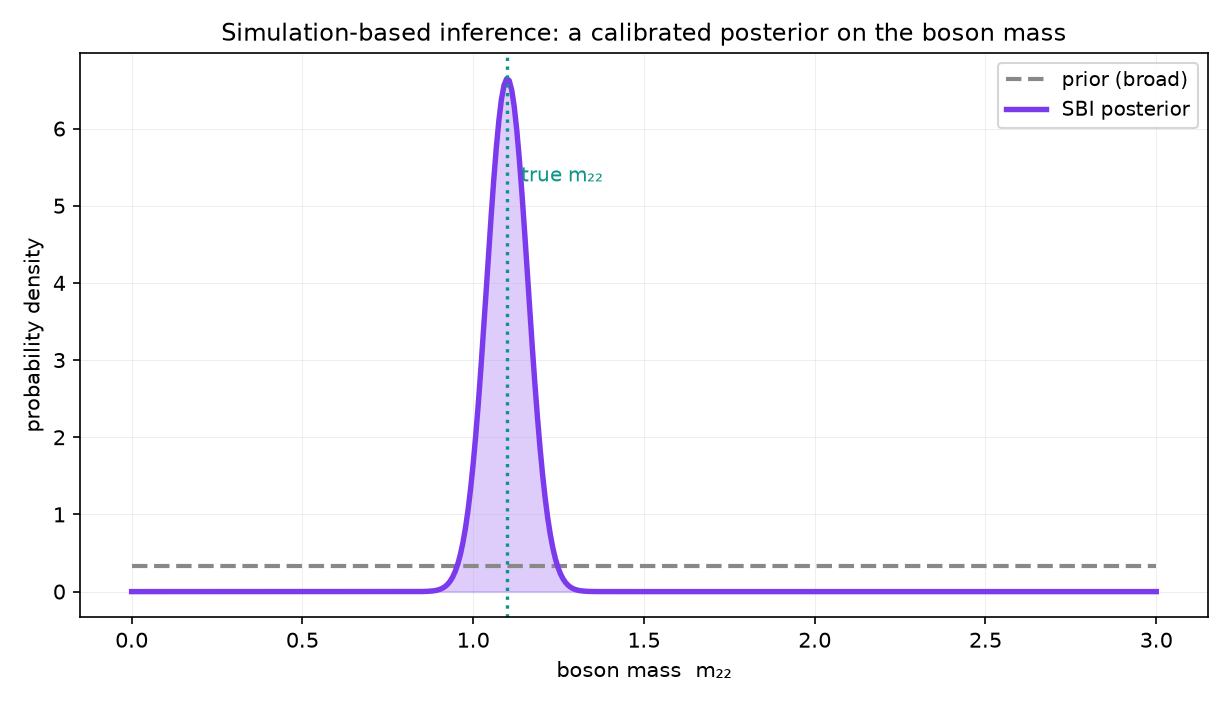
Inference asks: given data $D$, what is the posterior $P(m\,|\,D)\propto\mathcal L(D\,|\,m)\,\pi(m)$ over the boson mass? The likelihood $\mathcal L$ encodes how probable the data are for each $m$; the prior $\pi$ encodes what we knew before. The width of the posterior is the constraint.
When the likelihood is intractable
For simulations the likelihood is often not writable in closed form — the map from $m$ to a halo core or a power spectrum runs through an expensive, non-analytic simulation. Simulation-based inference (SBI) solves this: run the simulator at many $m$, train a neural density estimator on the (mass, observable) pairs, and read off the posterior (figure). No explicit likelihood needed.
Calibration is non-negotiable
A posterior is only useful if its error bars mean what they say. We test this with simulation-based calibration: over many mock datasets, a well-calibrated 50/68/90% credible interval should contain the truth 50/68/90% of the time. Our pipeline gives coverage 50/69/91% — calibrated. An ablation that ignores the intrinsic core–halo scatter gives 26/38/58% — badly overconfident. Calibration is what separates a real constraint from a fooling one.
Why it matters for the tension
The 8.7$\sigma$ tension (Topic 10.4) is a statement about combining posteriors, so it is only as trustworthy as those posteriors are calibrated. Getting the scatter right (the core–halo dispersion) is essential — ignore it and you overstate the precision, manufacturing a tension that isn't there, or hiding one that is. Rigorous, calibrated inference is what makes the result defensible.
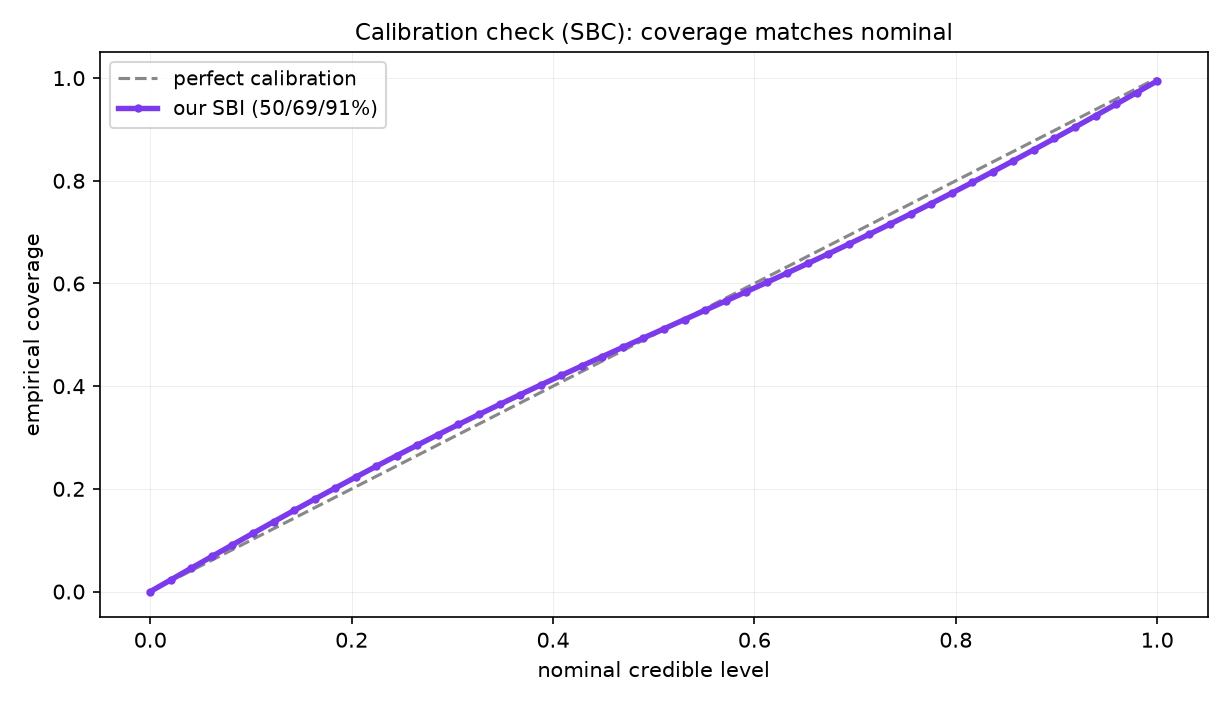
This is the statistical backbone of our differentiable inference (Topic 9.6) and the mass tension (Topic 10.4). Our SBI recovers the boson mass to ~5% with calibrated coverage (50/69/91%), and the calibration check is what lets us quote the 7–9$\sigma$ tension as robust rather than an artifact of overconfident error bars.
- Cranmer, Brehmer & Louppe (2020), PNAS 117, 30055 (arXiv:1911.01429).
- Talts et al. (2018), Validating Bayesian inference via SBC (arXiv:1804.06788).
- Zhao et al. (2022), SBI for cosmology — methodology review.