The Madelung (hydrodynamic) formulation
Rewriting the wave as a fluid
Write the wavefunction in amplitude–phase form, $\psi=\sqrt{\rho/m}\,e^{iS/\hbar}$, and substitute into the Schrödinger equation. Separating real and imaginary parts gives two real equations for the density $\rho$ and the velocity $\mathbf v\equiv\nabla S/m$:
$$\frac{\partial\rho}{\partial t}+\nabla\!\cdot(\rho\mathbf v)=0,\qquad \frac{\partial\mathbf v}{\partial t}+(\mathbf v\!\cdot\!\nabla)\mathbf v=-\nabla V-\nabla Q.$$The first is ordinary mass conservation; the second is Euler's equation for a fluid moving in the gravitational potential $V$ — with one extra force, $-\nabla Q$.
The quantum pressure term
That extra term is the quantum pressure,
$$Q=-\frac{\hbar^2}{2m^2}\frac{\nabla^2\sqrt{\rho}}{\sqrt{\rho}} .$$It is the only difference between fuzzy dark matter and a classical pressureless (cold) fluid. It has no thermal origin — it is pure wave mechanics — and it resists compression on small scales, smoothing the density field below the de Broglie length.
The classical (CDM) limit
The Madelung form makes the connection to cold dark matter transparent: as $\hbar/m\to0$ the quantum-pressure term vanishes and the equations reduce to those of a pressureless self-gravitating fluid — the fluid limit of collisionless CDM. Fuzzy dark matter is thus ‘CDM plus a small-scale quantum pressure’, which is exactly why the two agree on large scales and diverge on small (Topic 4.5).
The quantum Jeans scale
Linearizing the Madelung equations about a uniform background gives the dispersion relation for a growing/oscillating mode,
$$\omega^2=\left(\frac{\hbar k^2}{2m}\right)^2-4\pi G\rho .$$Gravity (the second term) drives collapse; quantum pressure (the first, $\propto k^4$) resists it and wins at large $k$. The crossover defines the quantum Jeans wavenumber
$$k_J=\left(\frac{16\pi G\rho\,m^2}{\hbar^2}\right)^{1/4}\propto (G\rho)^{1/4}\Big(\frac{m}{\hbar}\Big)^{1/2}.$$Only modes with $k
Find where quantum pressure balances gravity by setting $\omega^2=0$:
- The dispersion relation is $\omega^2=\left(\dfrac{\hbar k^2}{2m}\right)^2-4\pi G\rho$.
- Collapse ($\omega^2<0$) requires the gravity term to win: $\left(\dfrac{\hbar k^2}{2m}\right)^2<4\pi G\rho$.
- The boundary $\omega^2=0$ defines $k_J$: $\dfrac{\hbar^2 k_J^4}{4m^2}=4\pi G\rho$.
- Solve: $k_J=\left(\dfrac{16\pi G\rho\,m^2}{\hbar^2}\right)^{1/4}$.
The quartic $k^4$ (from the squared kinetic term, unique to a wave) makes the boundary a fourth root, and gives $k_J\propto\sqrt{m}$: modes above $k_J$ oscillate, modes below collapse. This single scale is the origin of the entire small-scale cutoff.
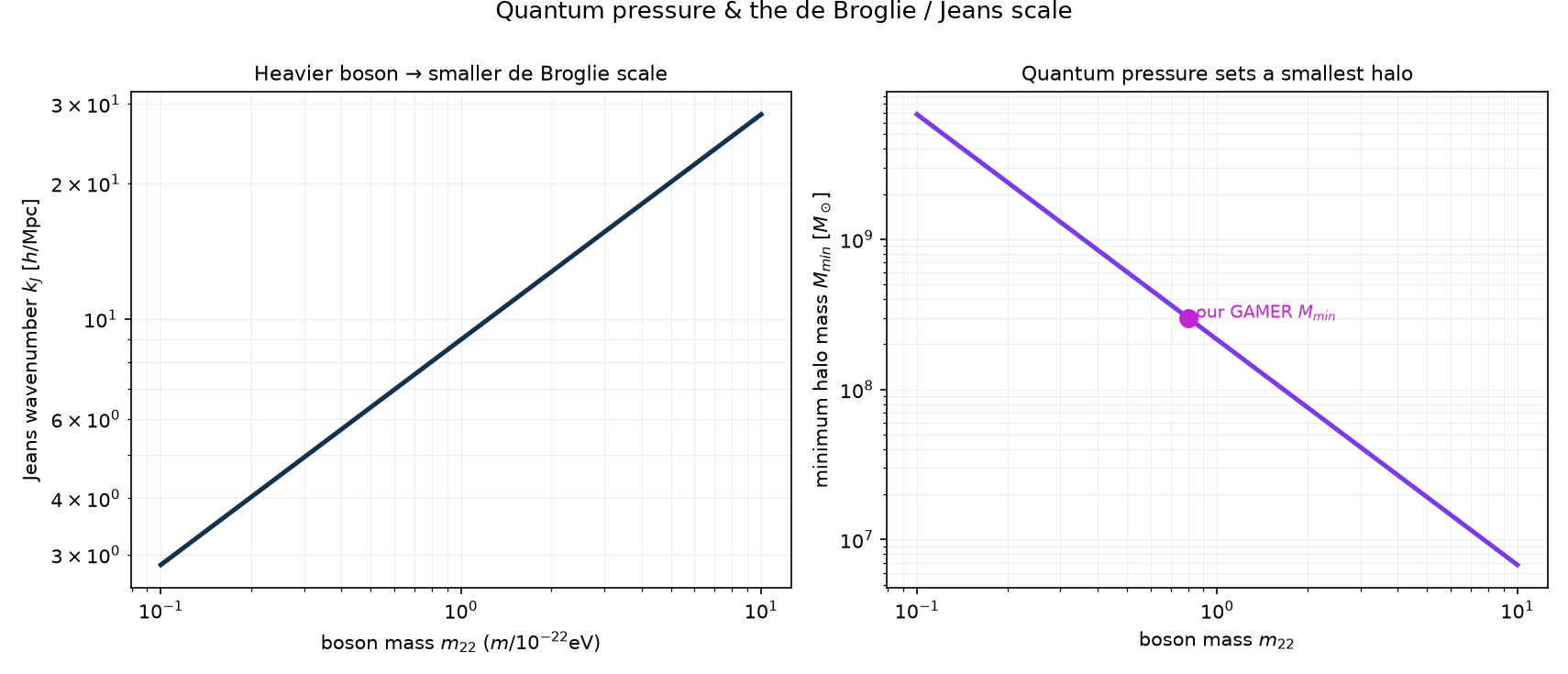
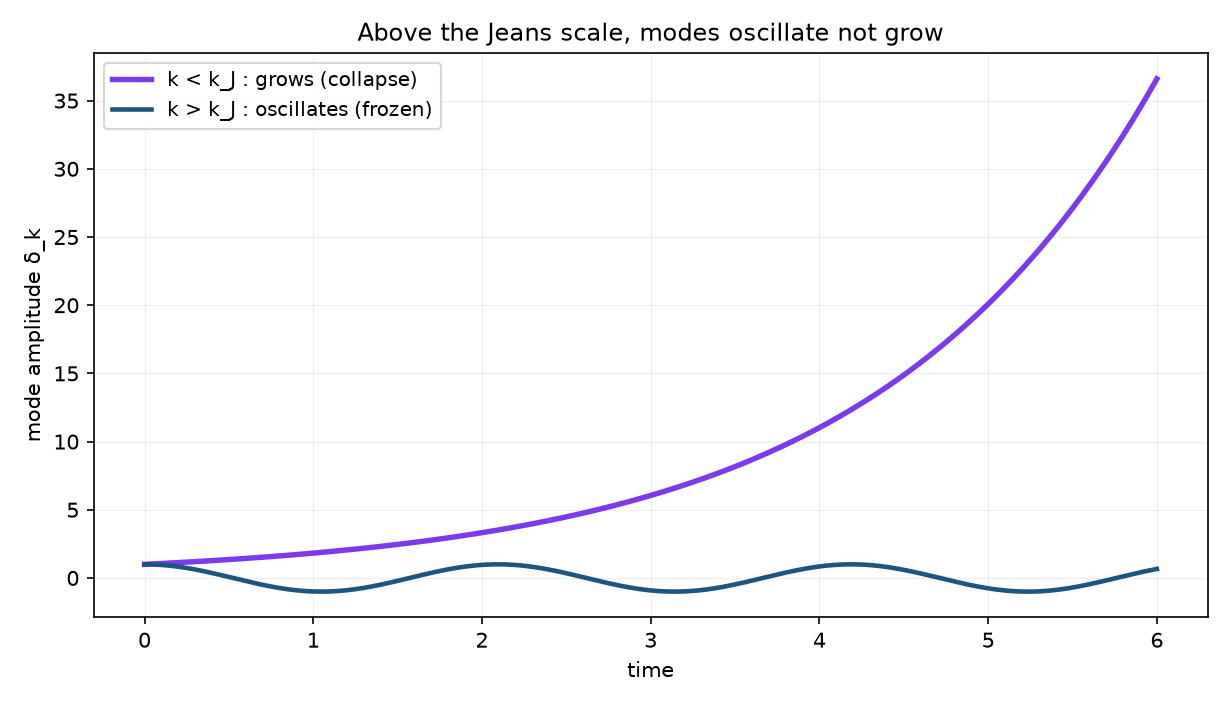
The Madelung picture is how we interpret our wave simulations: the phase gradient gives the FDM velocity field, and the quantum-pressure term is what our analyses isolate as the non-CDM ingredient. The Jeans relation derived here is the physical origin of the Hu–Barkana–Gruzinov cutoff we impose in Task 1 and of the delayed collapse GAMER measures.
- Madelung (1927), Quantentheorie in hydrodynamischer Form, Z. Phys. 40, 322.
- Hui, Ostriker, Tremaine & Witten (2017), Phys. Rev. D 95, 043541 (arXiv:1610.08297).
- Mocz et al. (2018), Schrödinger–Poisson–Vlasov–Poisson correspondence, Phys. Rev. D 97, 083519 (arXiv:1801.03507).