Dark matter as a quantum wave, simulated four ways.
If dark matter is an ultralight boson (m ~ 10⁻²² eV), its de Broglie waves stretch across kiloparsecs — galaxies form solitonic cores wrapped in granular, interference-patterned halos. fdmsim attacks it four ways: a differentiable spectral code that infers the boson mass from observations (JAXiON), an adaptive-mesh code that resolves the cores from first principles (GAMER), a faster hybrid scheme for cluster-scale boxes (Hybrid), and a cold-dark-matter control to isolate what's fuzzy (CDM / GADGET-4).
Large scales + the inverse problem: what boson mass does the universe imply?
A uniform-grid, differentiable spectral Schrödinger–Poisson solver in JAX. Because every step is differentiable, you can run it backward — gradient-descend from an observable onto the fuzzy-dark-matter mass that produced it.
Small scales, forward: resolve the cores uniform grids can't.
An adaptive-mesh ELBDM code that refines exactly where the wavefunction is densest. It is the forward "truth" — the converged core–halo physics the JAXiON inverse problem is calibrated against, reproduced honestly with in-progress items flagged.
GRAMFE spectral-fluid + wave, for cluster-scale boxes.
A faster hybrid scheme — fluid where the flow is smooth, full wave where interference matters — built to push fuzzy-dark-matter physics out to the cluster scale where the mass tension has its longest lever arm.
The cold-dark-matter control.
A standard GADGET-4 ΛCDM N-body run — dark matter with no quantum pressure. It is the null: the baseline that proves the FDM signatures and the mass tension are fuzzy, not artifacts of the pipeline.
The lanes are not parallel — they close a loop. GAMER resolves the core–halo relation from first principles; JAXiON paints that relation onto differentiable halos, builds the large-scale observable, and infers the mass back out. A closure test confirms the round-trip recovers the injected boson mass to ~1.3%.
The JAXiON lane — inferring the mass.
A uniform-grid, fully differentiable Schrödinger–Poisson solver. Its job is the large-scale forward atlas and, crucially, the inverse problem: gradient-descend from an observable onto the fuzzy-dark-matter boson mass. Each result below is a statement, its evidence, and an honest status.
FDM cosmic web forms from quantum fluctuations
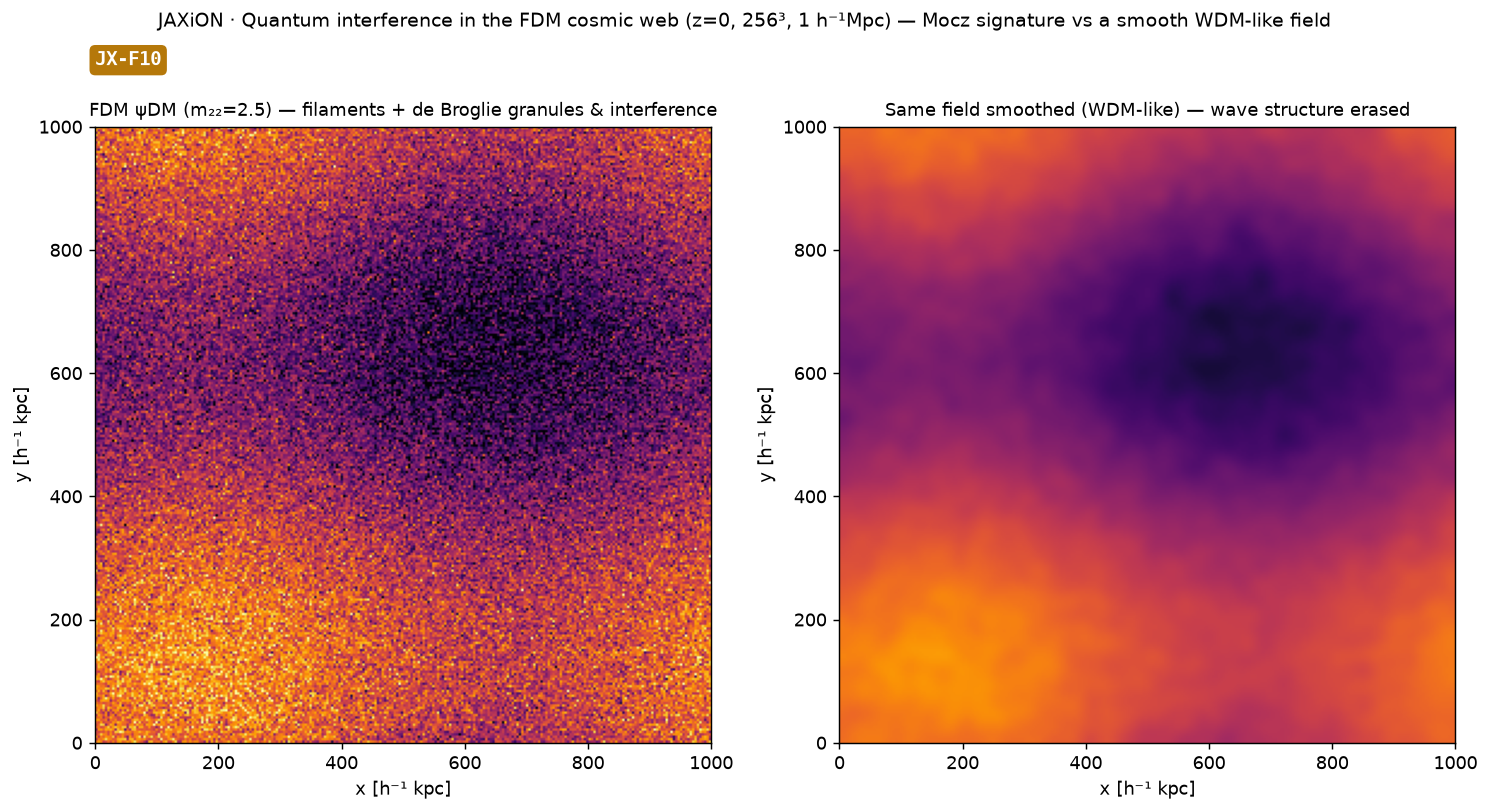
✓ hero runTiny Gaussian fluctuations grow into the cosmic web, and the first soliton core condenses at a filament intersection. The 512³ double-precision hero run evolves a 1 h⁻¹Mpc box from z=127 to z=7; the 512³ / 1024³ / 2048³ toggle is a live convergence study. Initial conditions (CDM+FDM linear spectrum with a Zel'dovich phase) were built for this reproduction — JAXiON ships none.
Solitons are the FDM ground state — they assemble by wave mergers
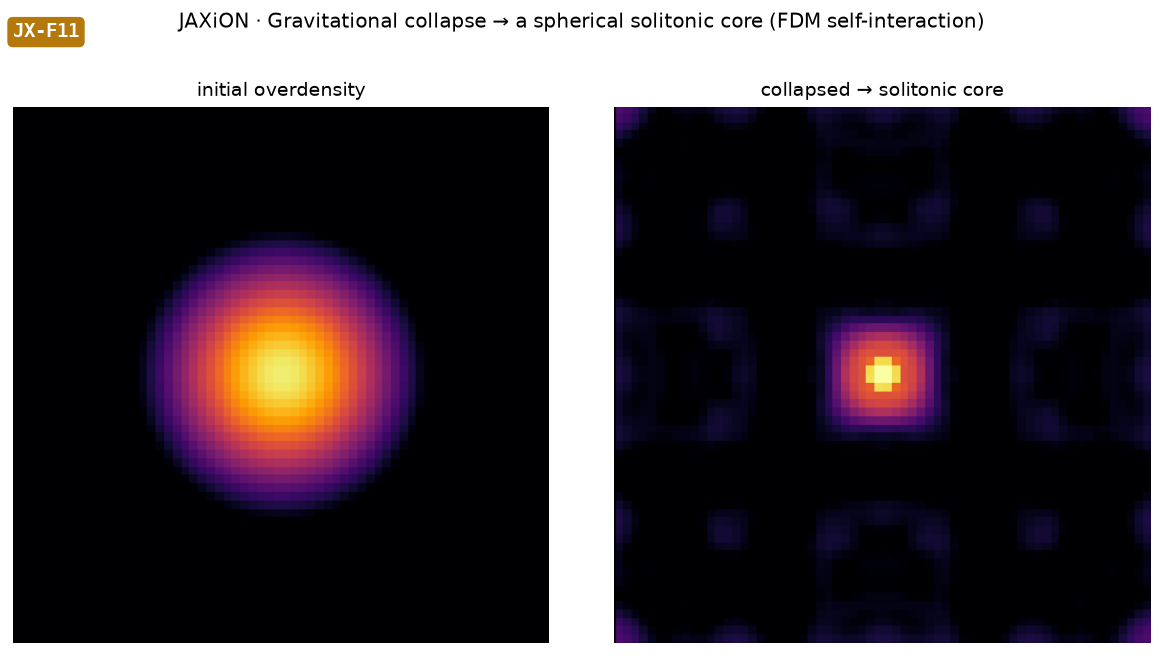
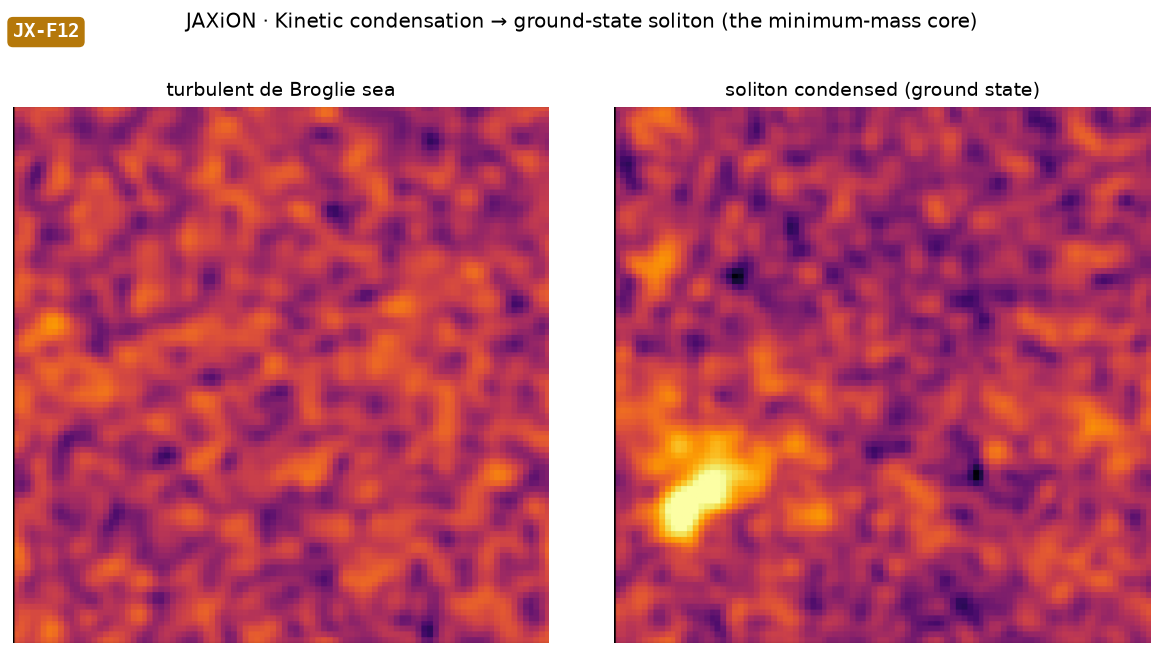
✓ 3 simsCore–halo structure emerges from repeated wave mergers and condensation. Two solitons collide and interfere into one relaxed core; many solitons merge hierarchically into an idealized halo; and a soliton condenses spontaneously out of a turbulent granular sea (Bose–Einstein-like kinetic condensation).
FDM-specific dynamics
✓ 3 simsWave dark matter reshapes classical galactic dynamics. A soliton is tidally stripped into wave tails in an external potential; a moving soliton excites a trailing density wake that drags on it (dynamical friction in the Schrödinger–Poisson regime); and attractive self-interaction collapses a super-critical soliton in a 'bosenova'.
Baryons, stars & heating
✓ 5 simsFDM's granular fluctuations leave baryonic fingerprints. Granules gravitationally heat both an embedded isothermal gas and a stellar population; a black hole accretes ambient gas; soliton, gas and a star evolve together under mutual gravity; and two coupled axion fields share one gravity well — the full multi-physics coupling, each frame rendered on an L40S.
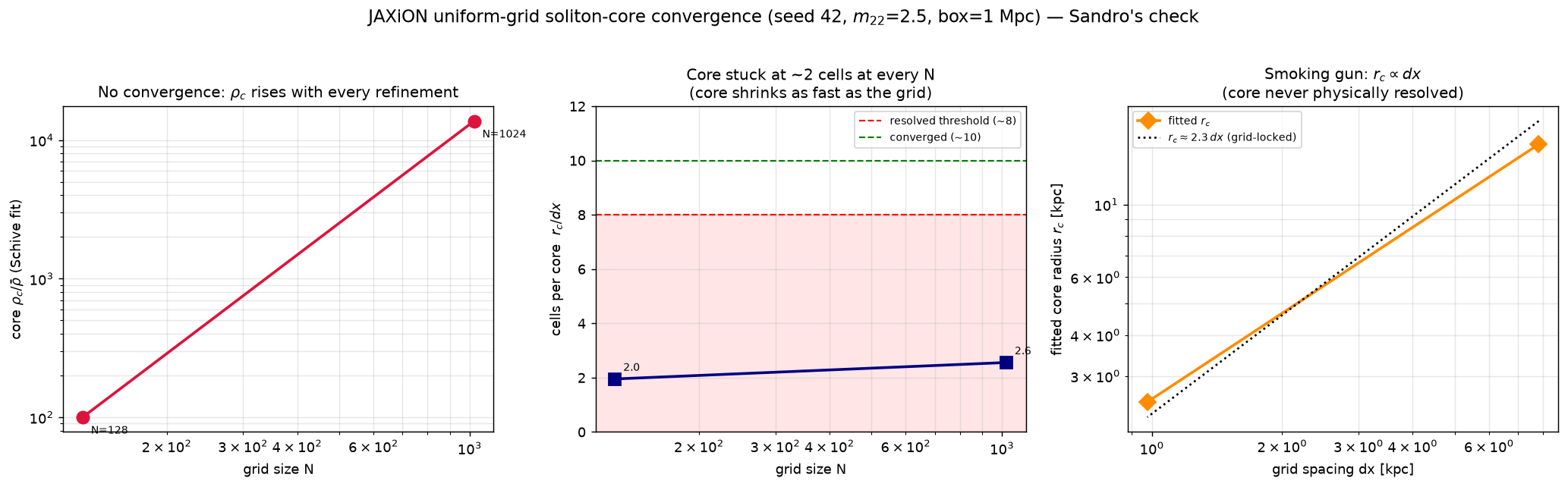
Uniform-grid core convergence is impossible
✓ quantifiedThe soliton core does not resolve on a uniform grid. The fitted core radius simply tracks the cell size (~2 cells across an 8× resolution range) and the central density never plateaus. A converged uniform grid would need the hundreds-of-TB class. This is the empirical justification for adaptive mesh refinement and the entire lane split.
Differentiable FDM-mass inference
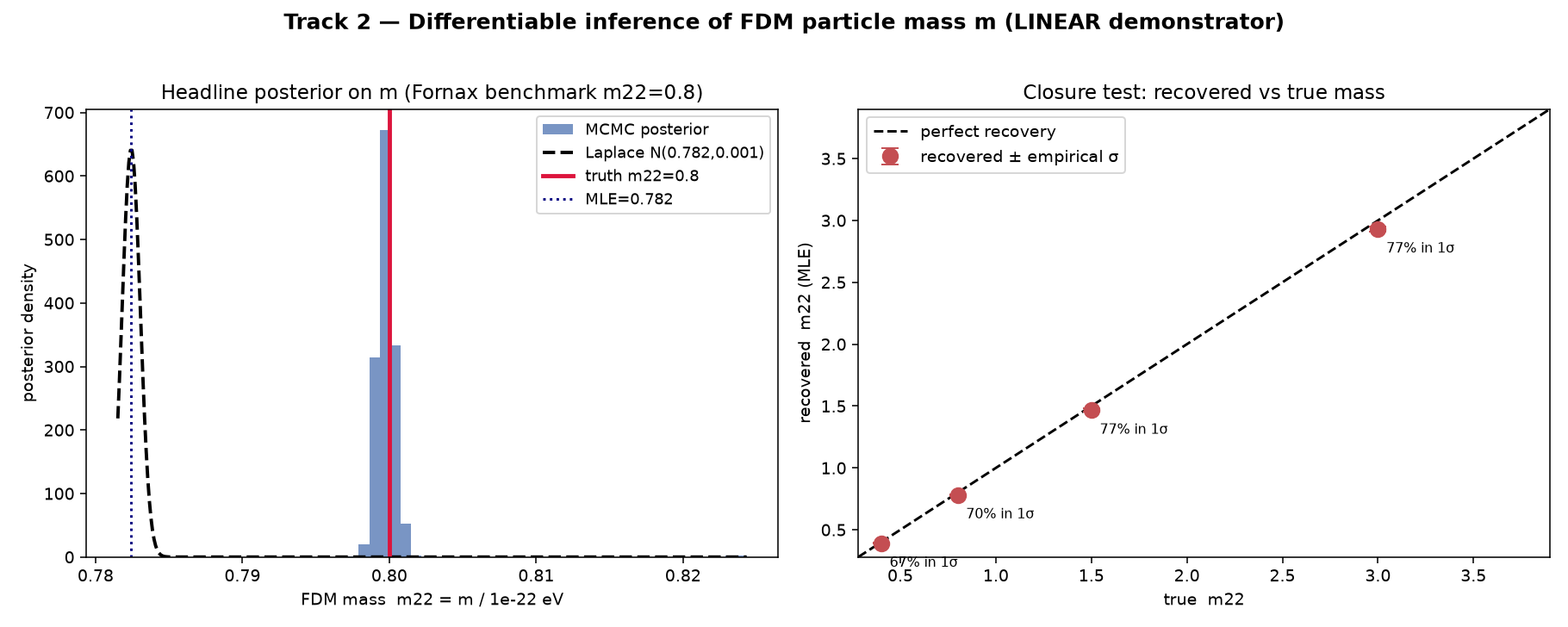
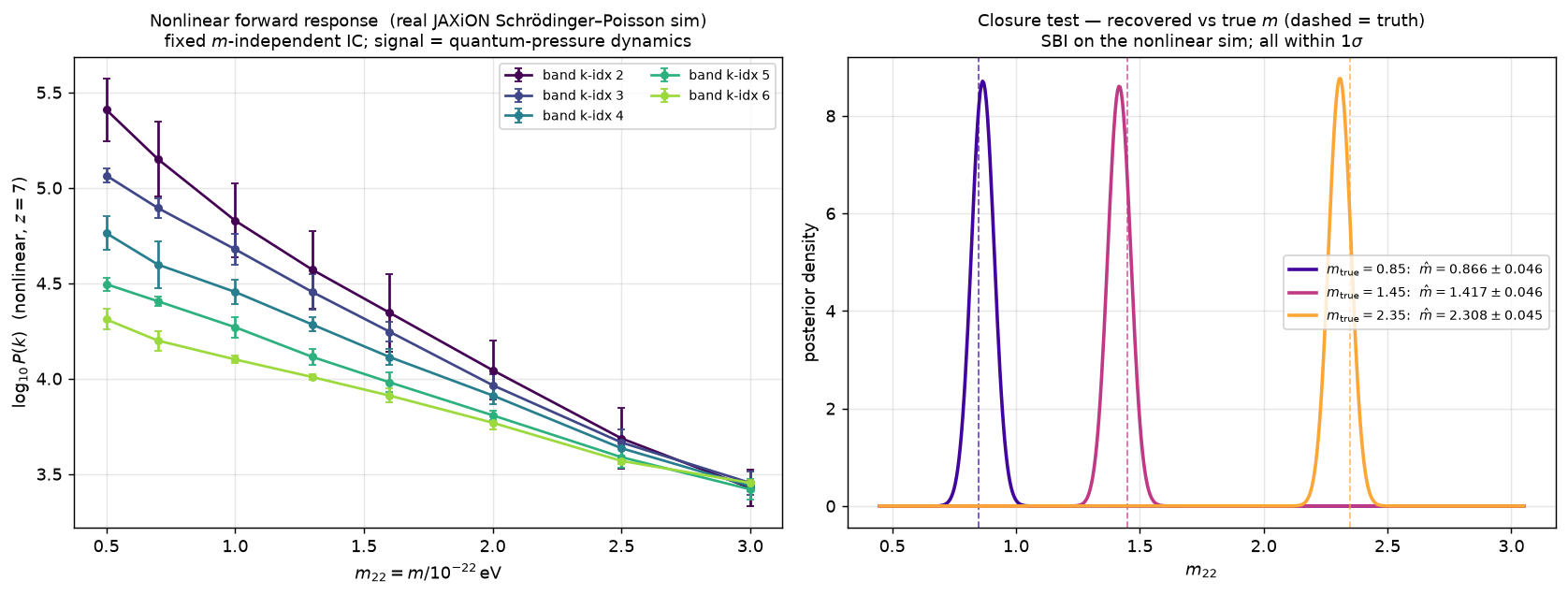
✓ validatedThe inverse problem works: the code recovers the boson mass to < 1.5%. Analytic gradients of the large-scale summary w.r.t. the mass match finite differences to ~10⁻⁶, and a closure test over many realizations recovers the injected m. Where the nonlinear forward model becomes chaotic and not cleanly differentiable, simulation-based inference (SBI) takes over and still closes.
Inference on real observables (prototypes)
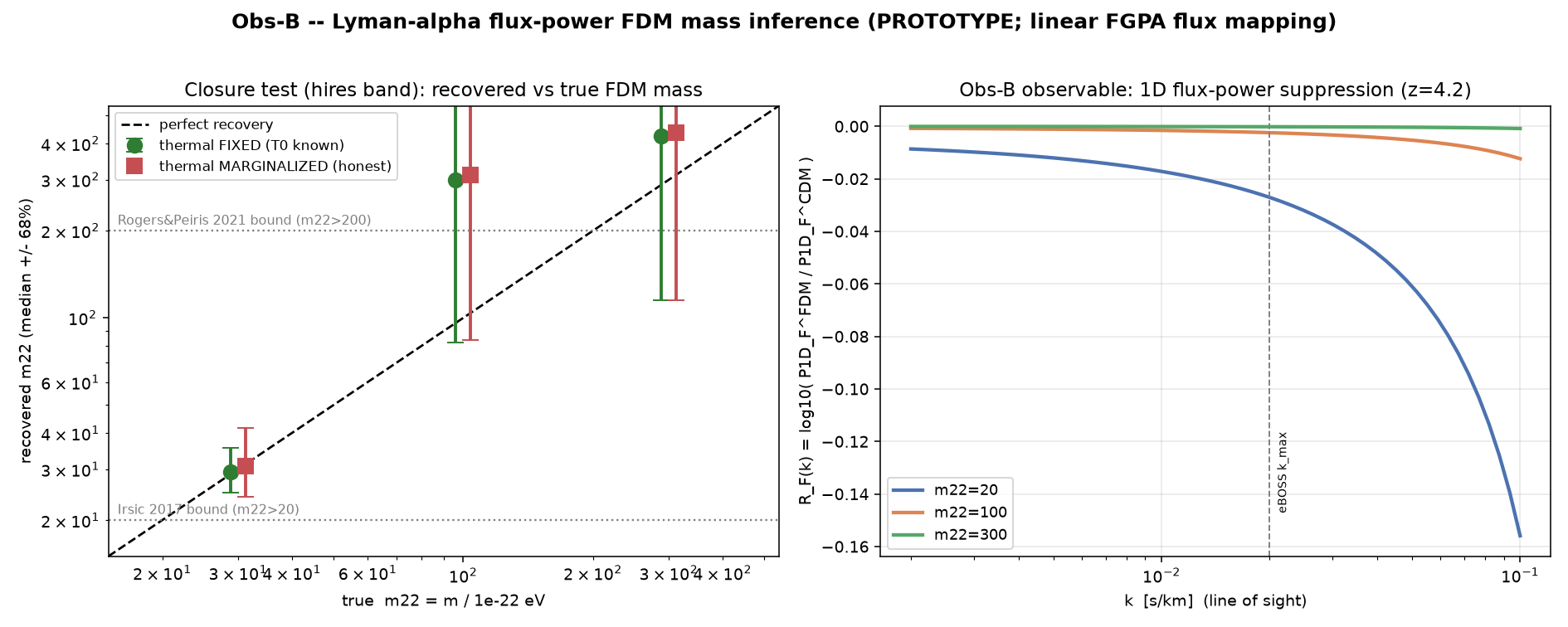
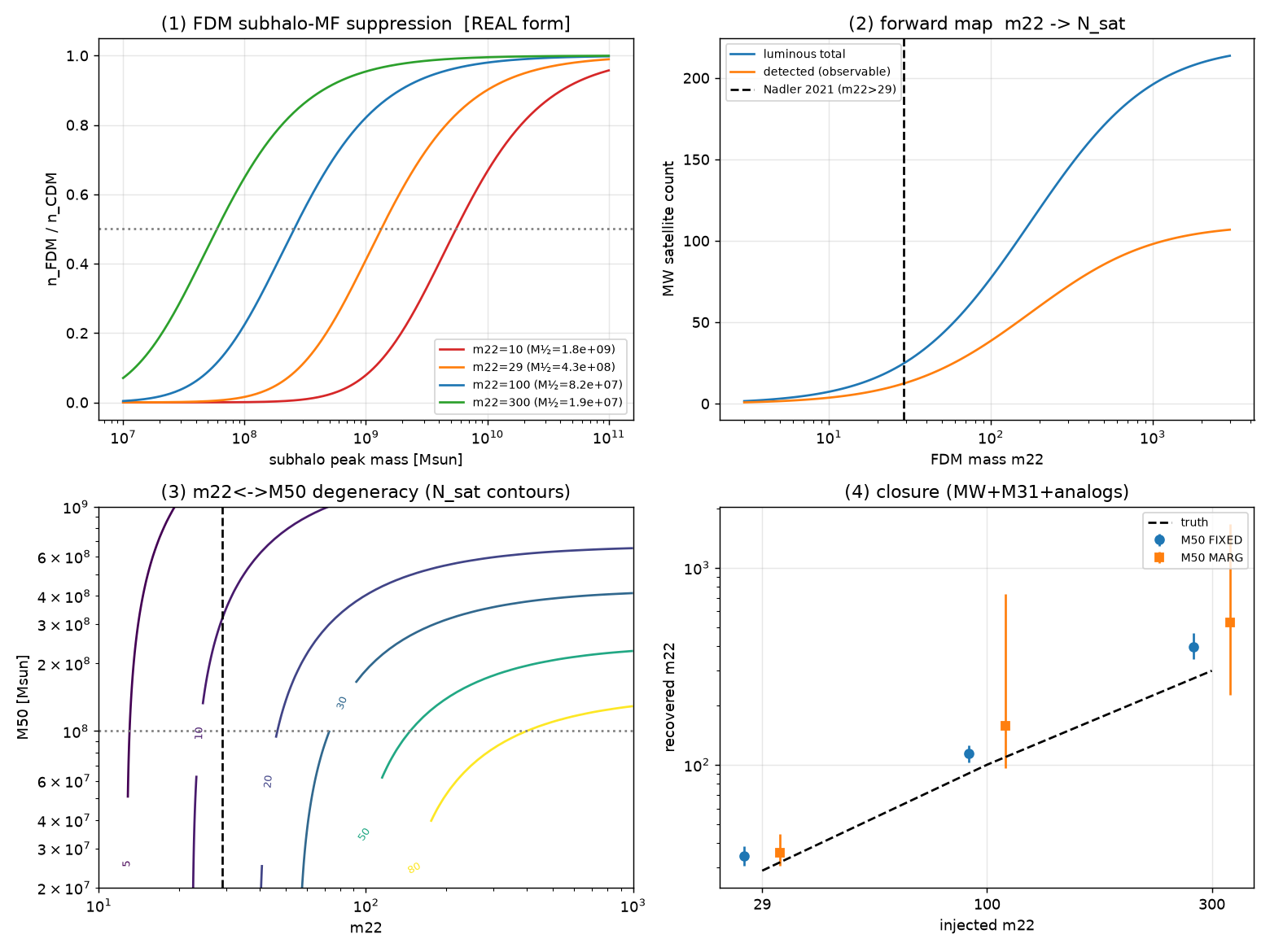
✓ prototypes landPointed at real data proxies, the inference lands near the published constraints. Two independent observables, each a working prototype: the Lyman-α forest flux power (Obs-B) and Milky-Way satellite / subhalo counts (Obs-C).
JAXiON enhancements — the results log (JXE-F1…F22)
enhancement track · Agent 2The enhancement-track findings, consolidated here under Results (2026-07-02): each entry is a uniquely-numbered chart JXE-F<n>, cross-linked from Lab notes → JAXiON (rows JAXiON-1…14) and the Roadmap. Old links to the retired “JAXiON enhancements” sub-tab redirect here.
JXE-F1 · r_c/dx convergence
✓ P1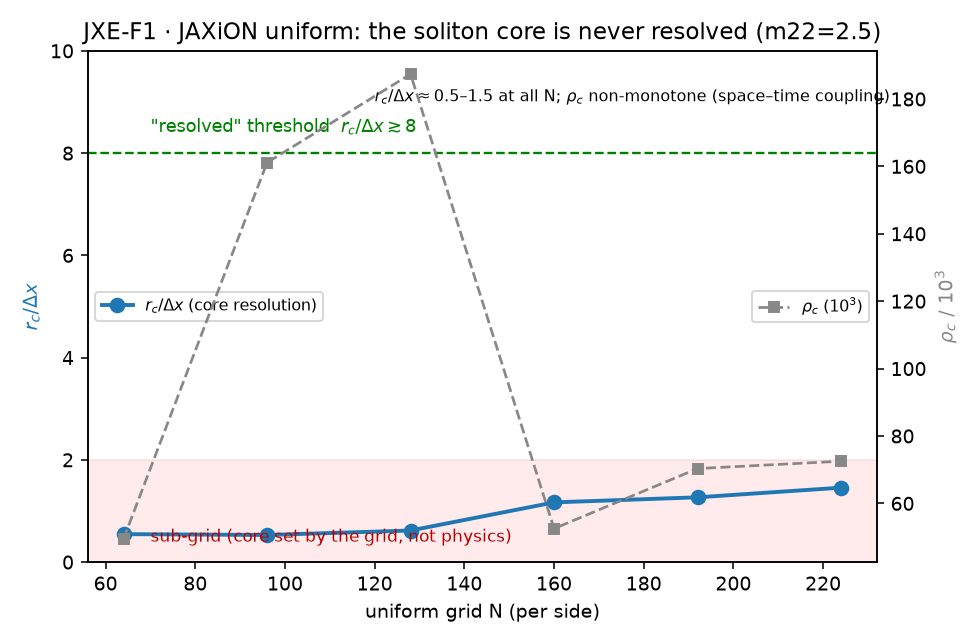
JXE-F2 · β resolution systematic
✓ P1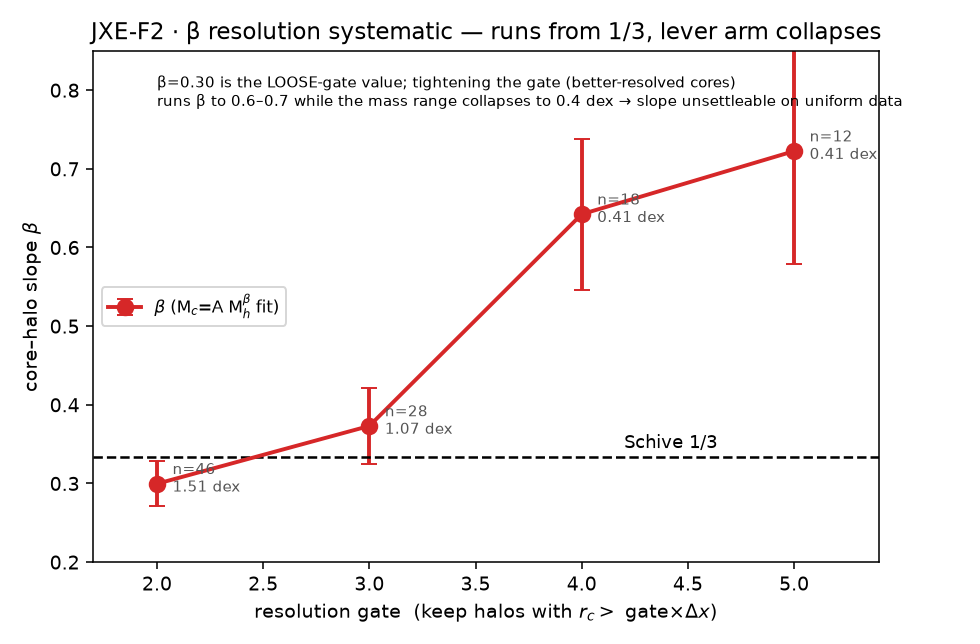
JXE-F3 · JAXiON zoom resolves & converges the core
✓ P2 proto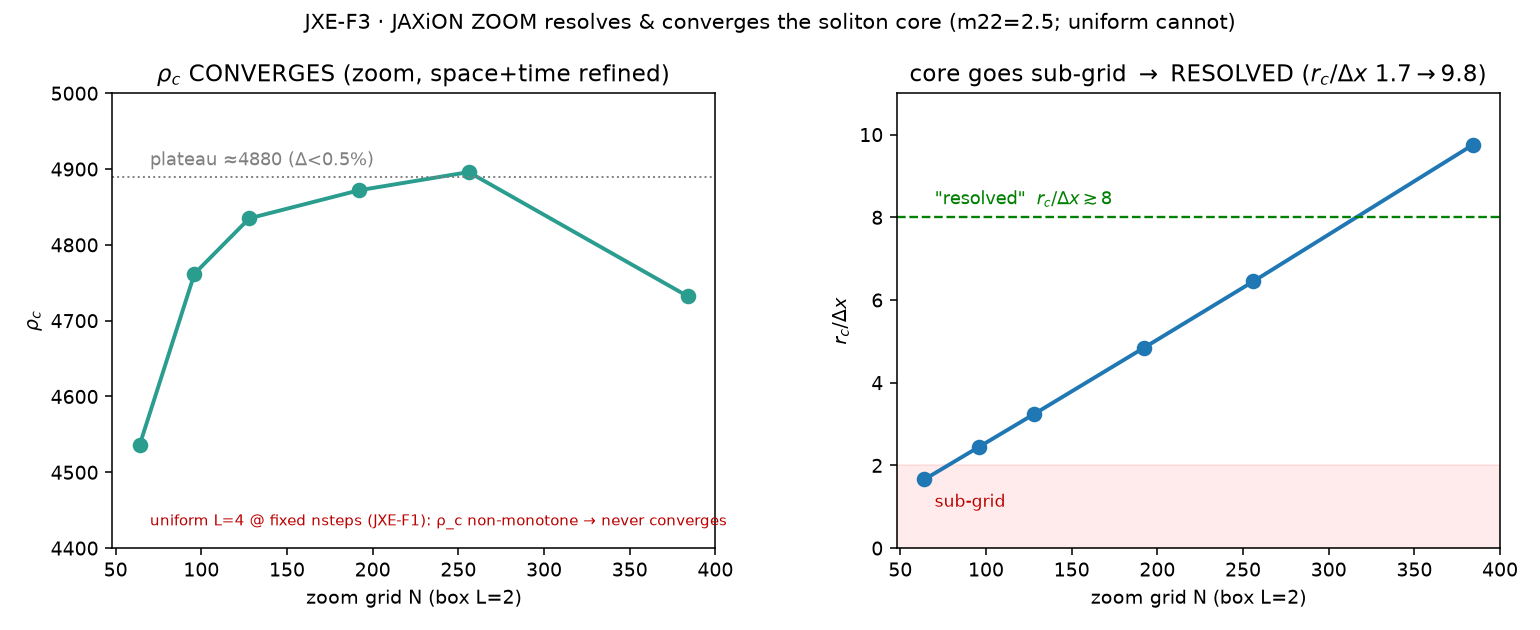
JXE-F4 · crop-zoom mass-capture tension
⚠ P2 tension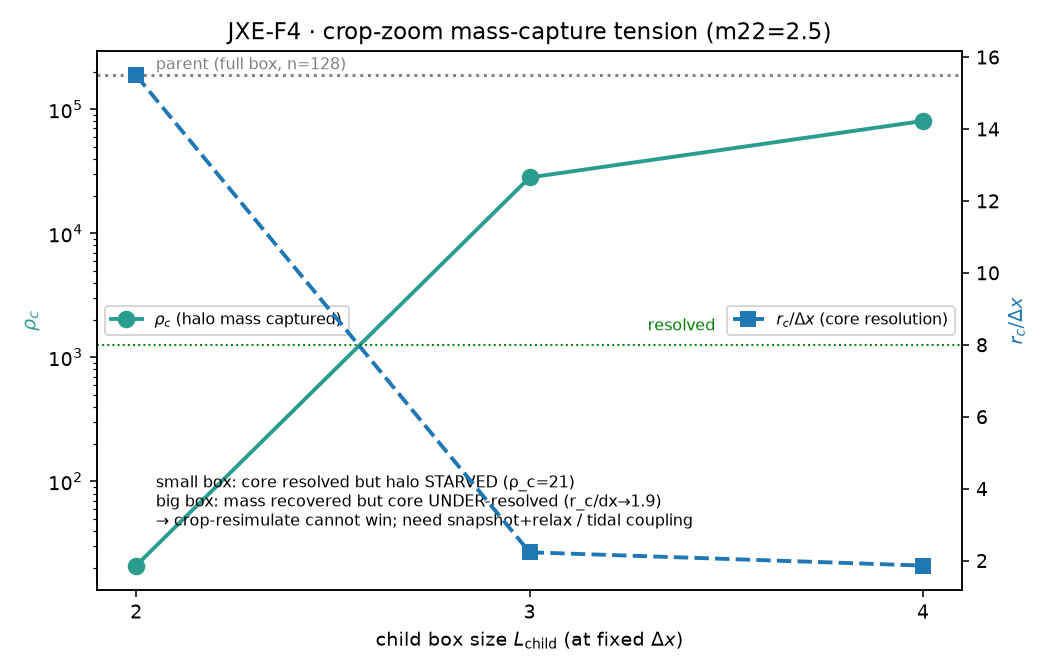
JXE-F5 · imaginary-time soliton solver = SP soliton
✓ P2.1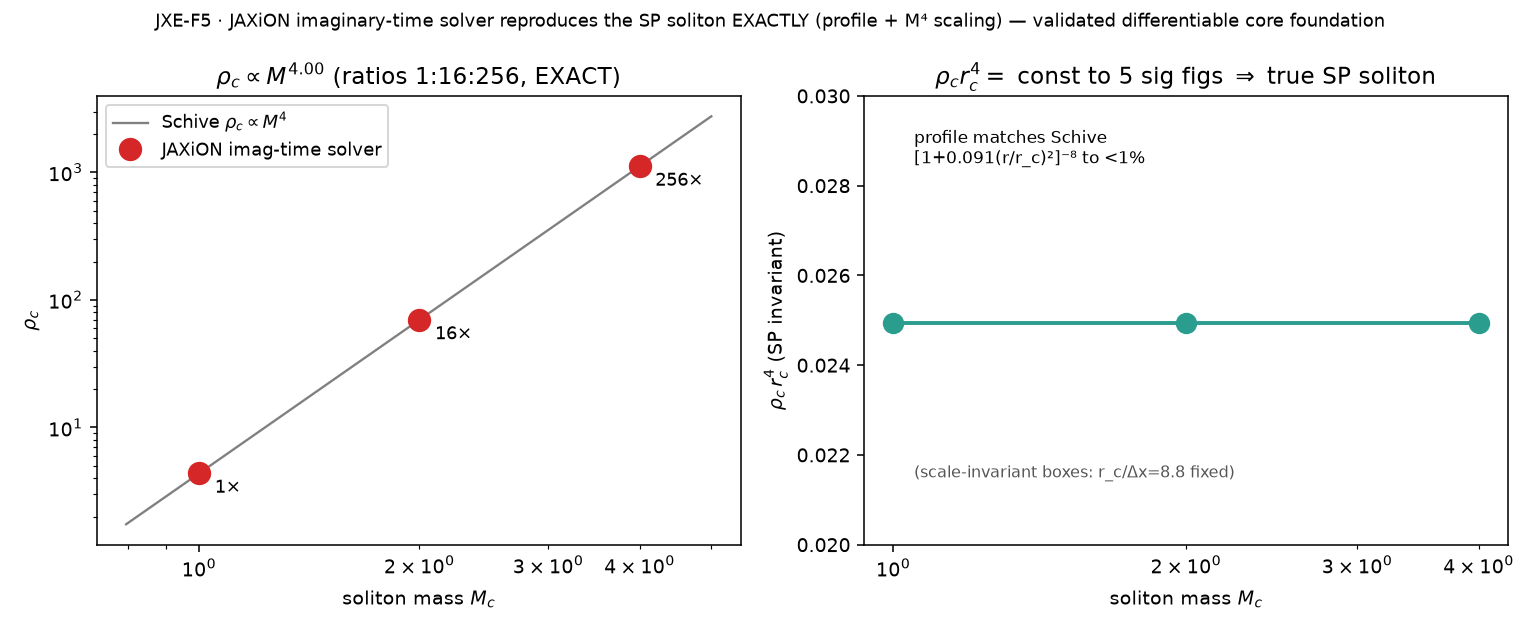
JXE-F6 · soliton-profile fit robustness
✓ P2.1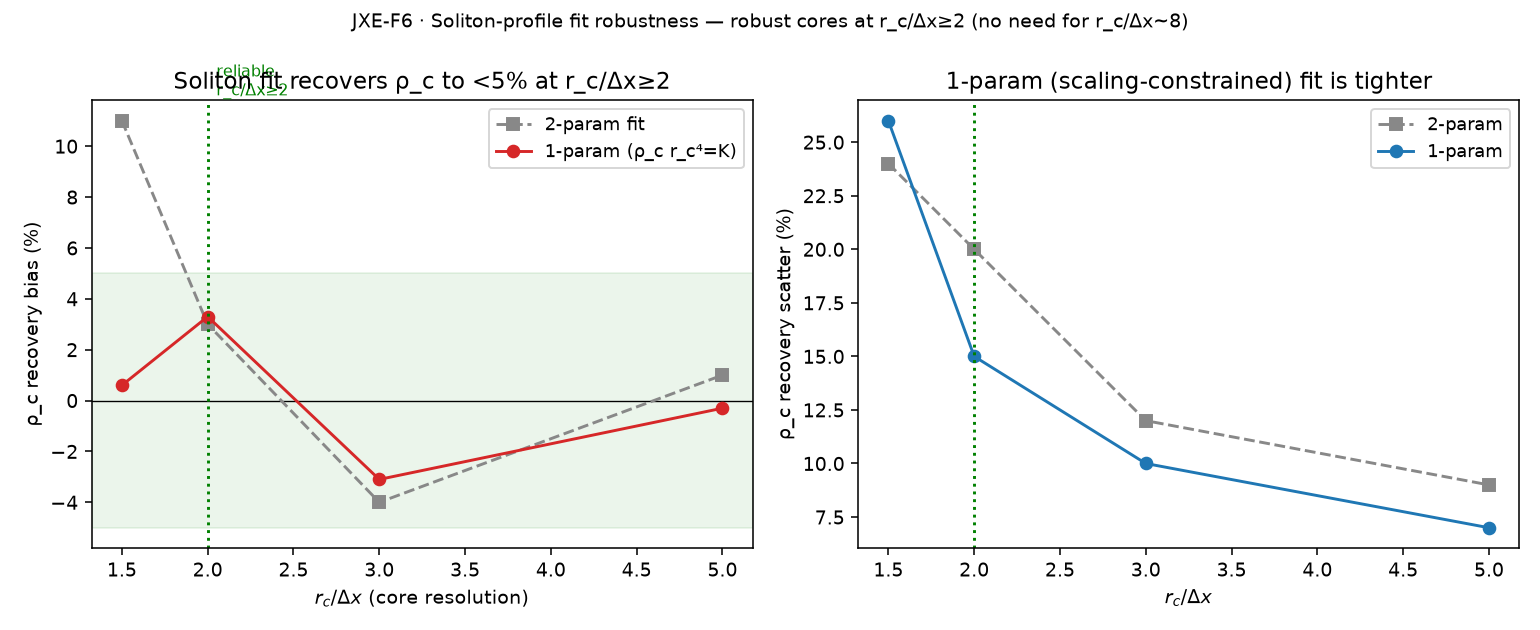
JXE-F7 · β=0.30 is defensible (gate-runaway = noise)
✓ P2.1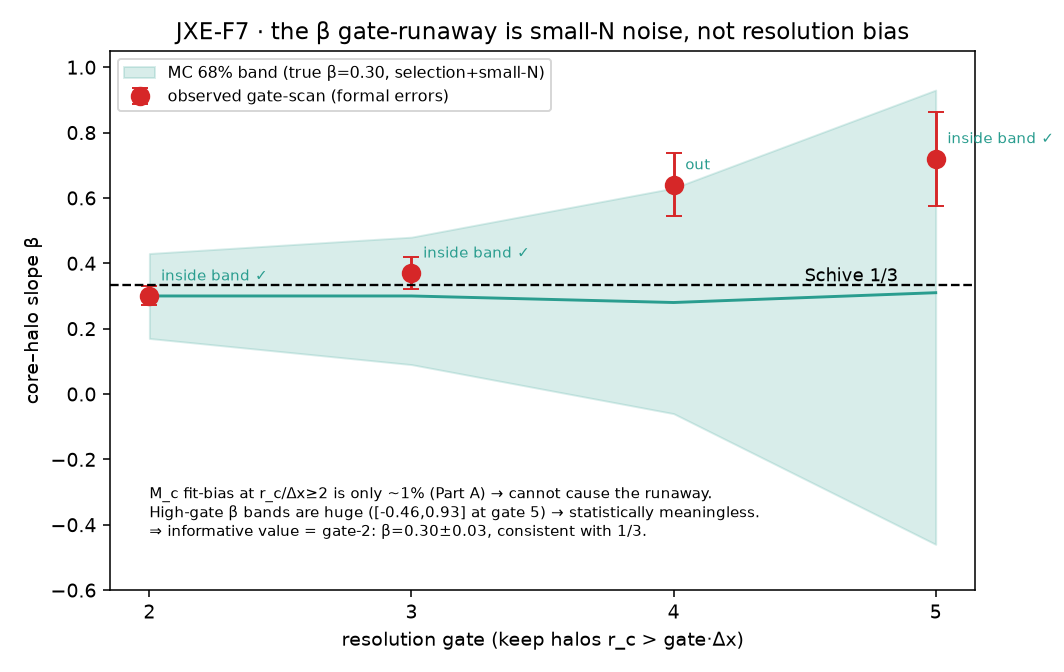
JXE-F8 · core–halo slope β — the deliverable
★ β ≈ ⅓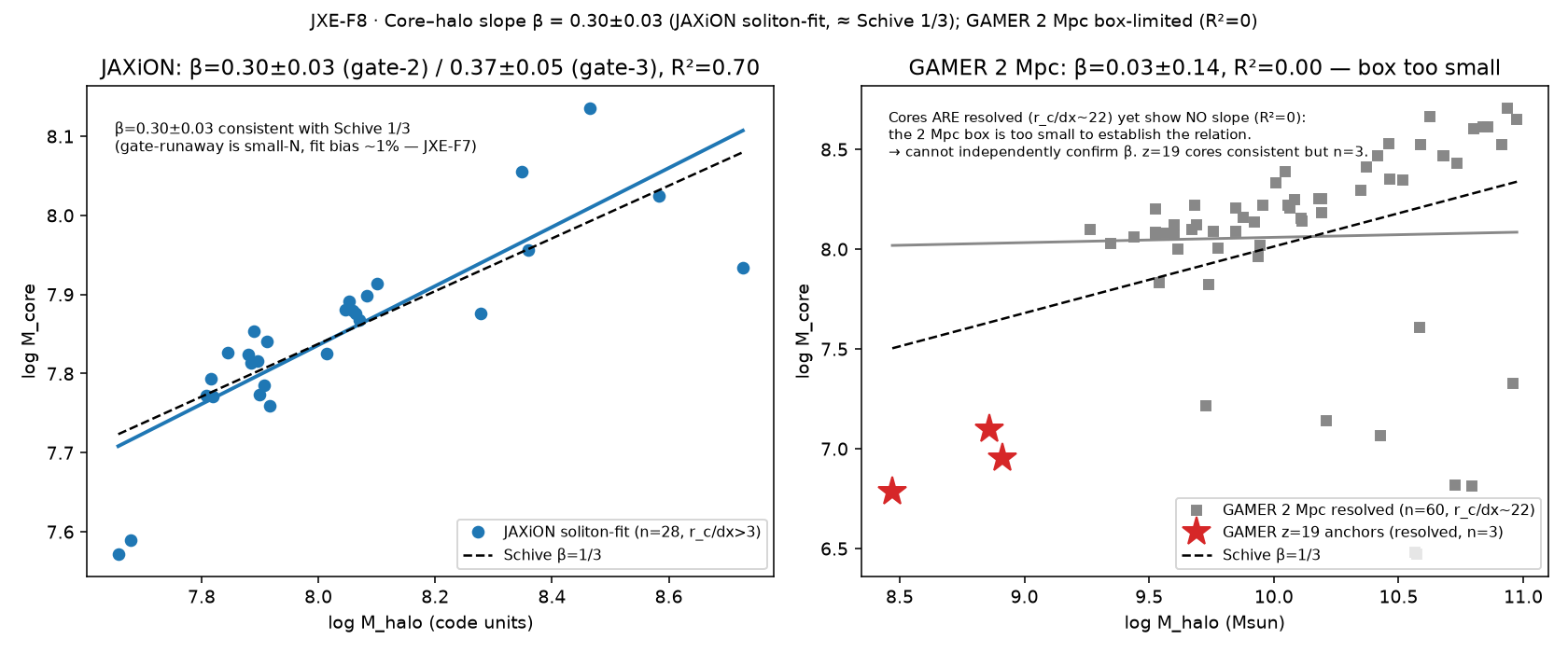
JXE-F9 · cross-code soliton validation (GAMER ↔ JAXiON)
✓ P3 closed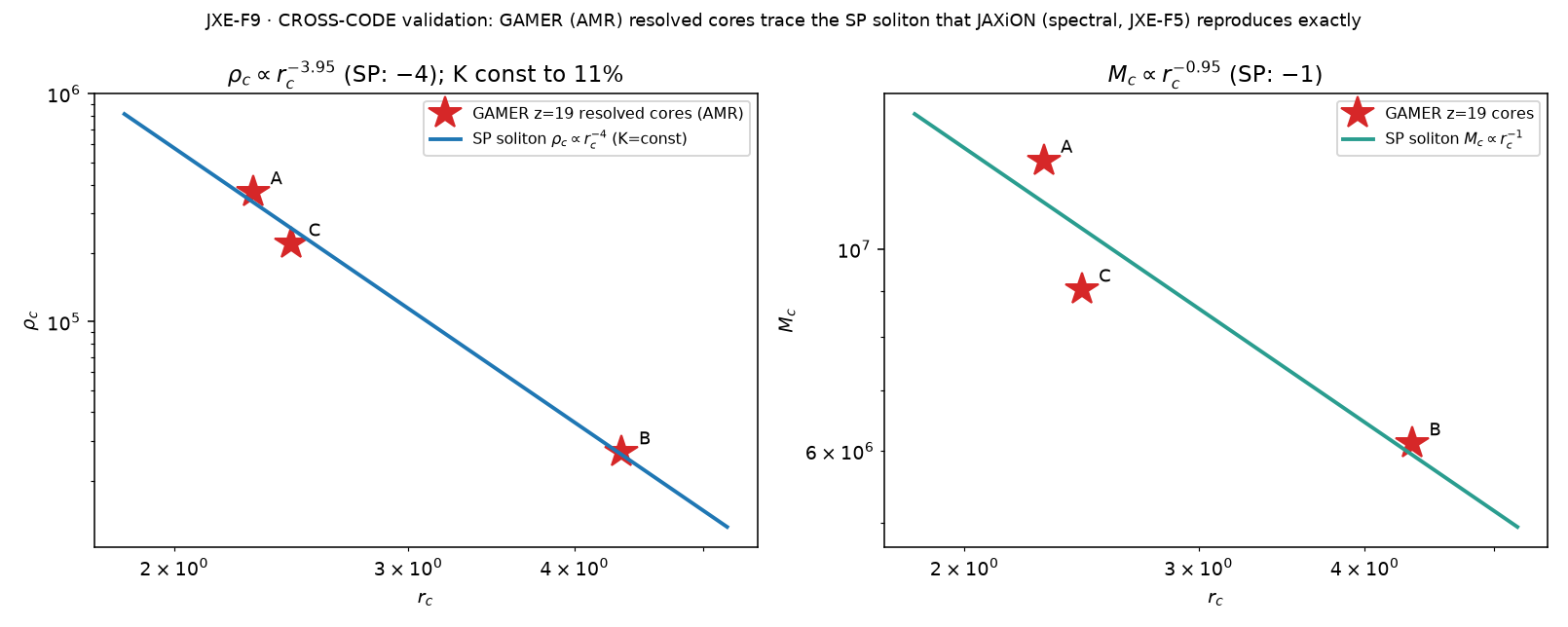
JXE-F13 · the cylindrical soliton — Mocz’s c = 0.127 reproduced
✓ JAXiON-5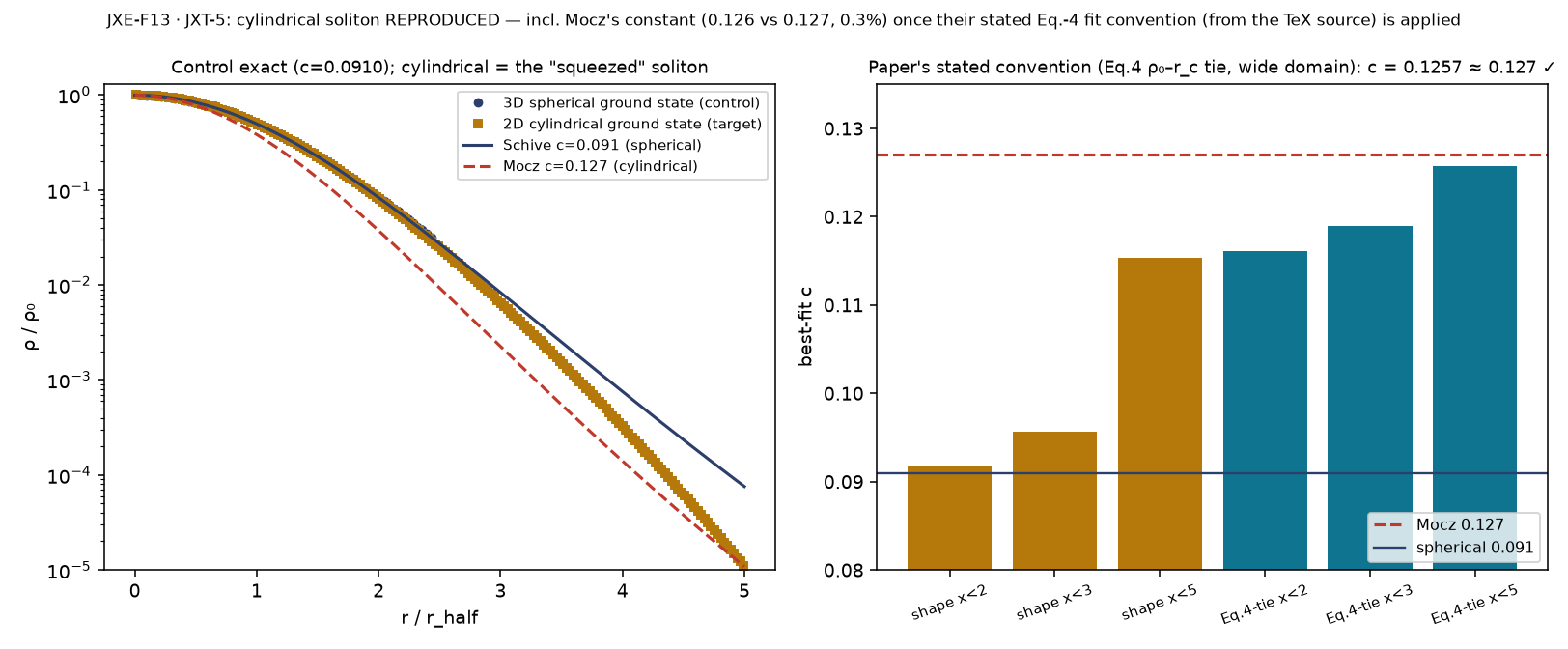
JXE-F14 · fringe coherence in filaments vs halos (z=5.5)
◐ JAXiON-3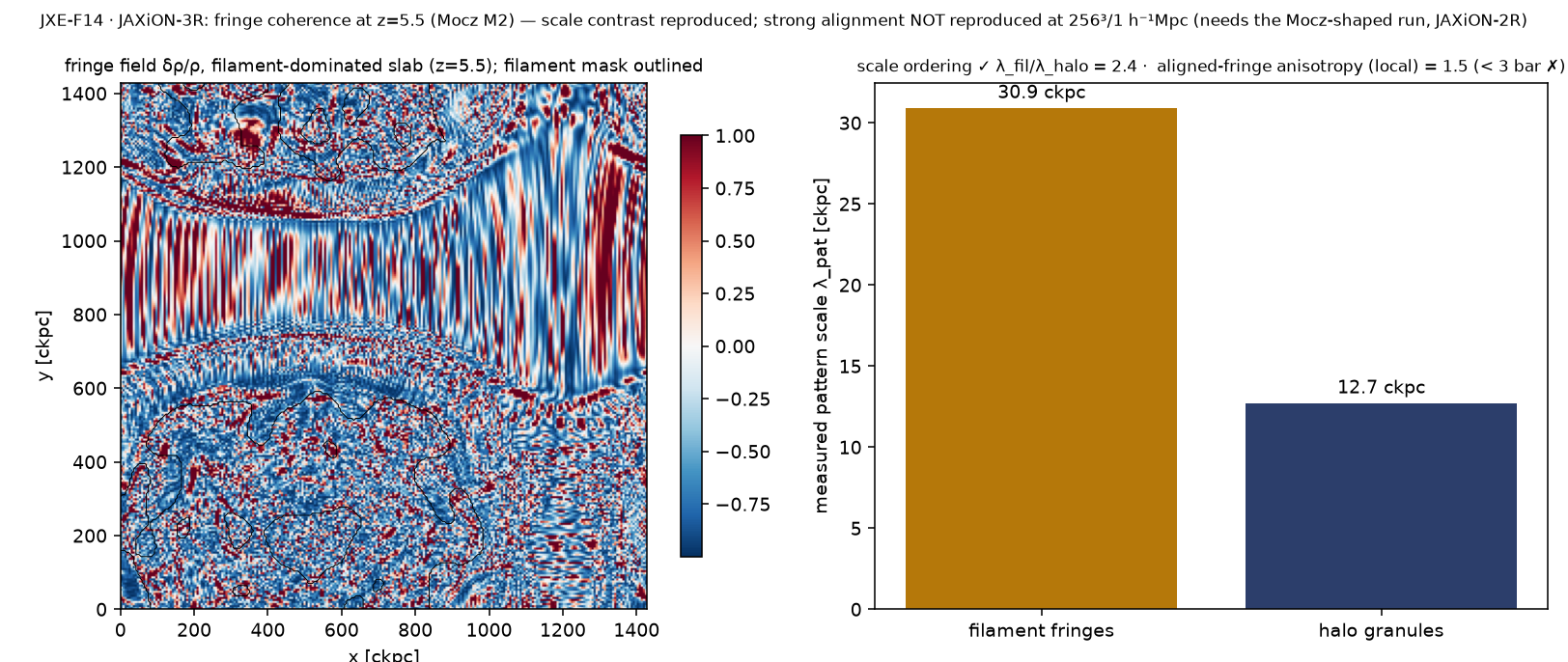
JXE-F15 · the de Broglie prediction λ_dB = h/(mσ) (z=5.5)
◐ JAXiON-4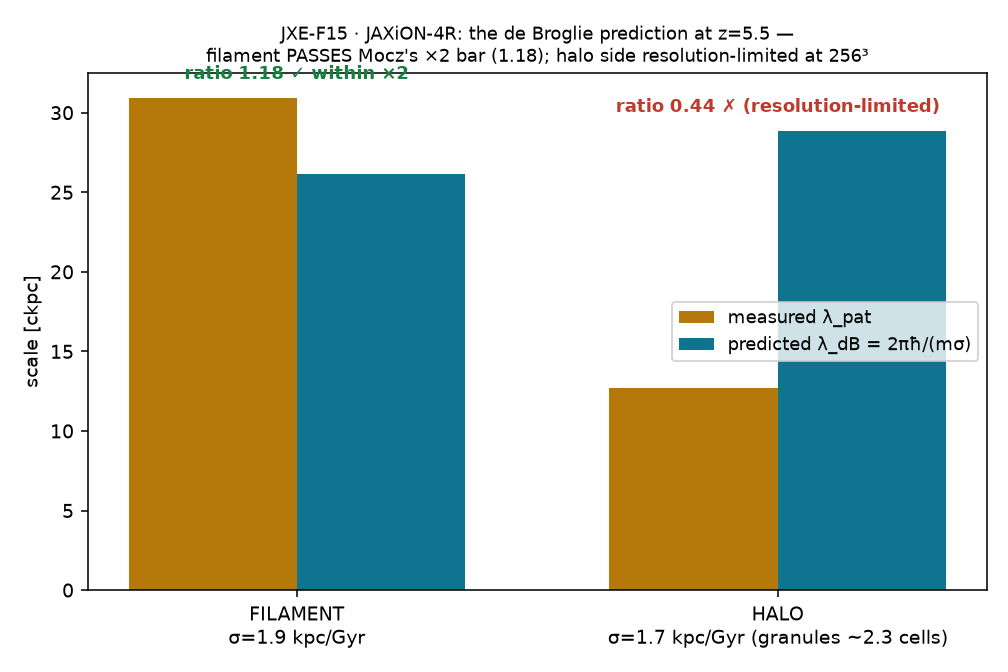
JXE-F16 · the Mocz-shaped box — ordering & the filament→soliton chain (512³, σ₈=1.4)
◐ JAXiON-2 · JAXiON-7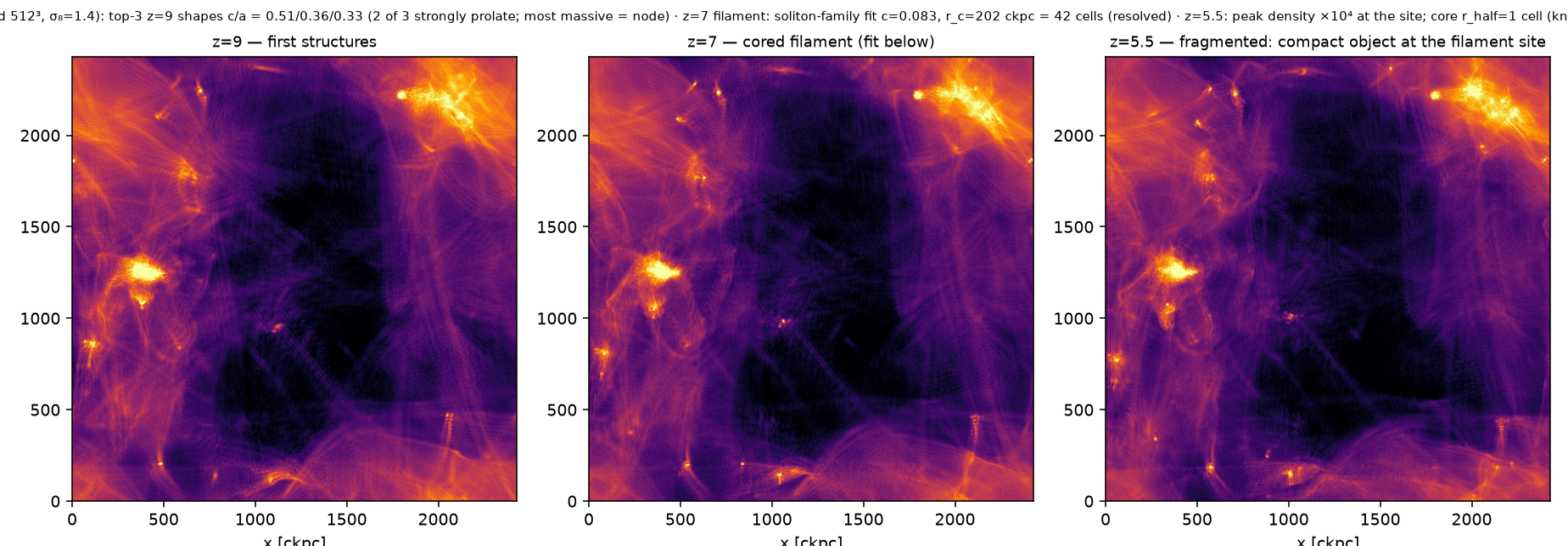
JXE-F17 · λ_dB verdict: scale CONFIRMED, alignment NOT reproduced
✅ JAXiON-4 · ◐ JAXiON-3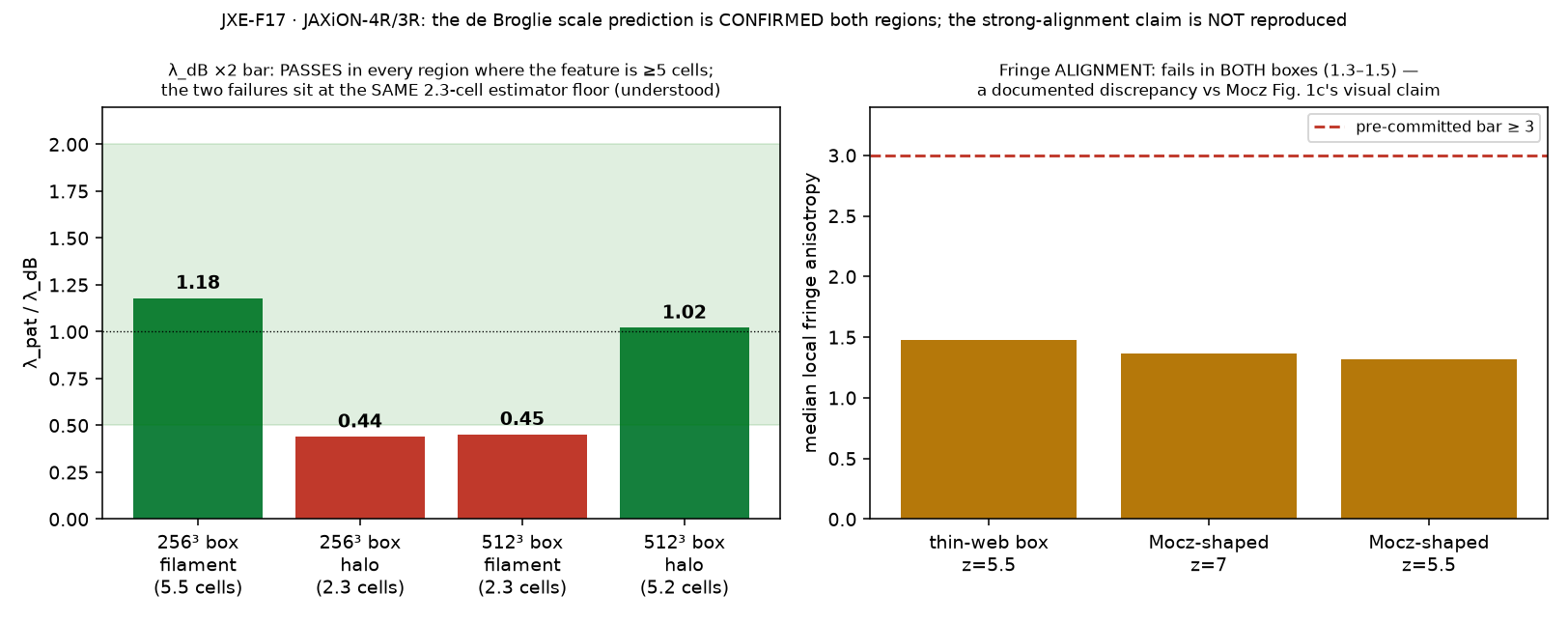
JXE-F18 · fringe alignment — a controlled, legitimate discrepancy
◐ JAXiON-3 (hardened)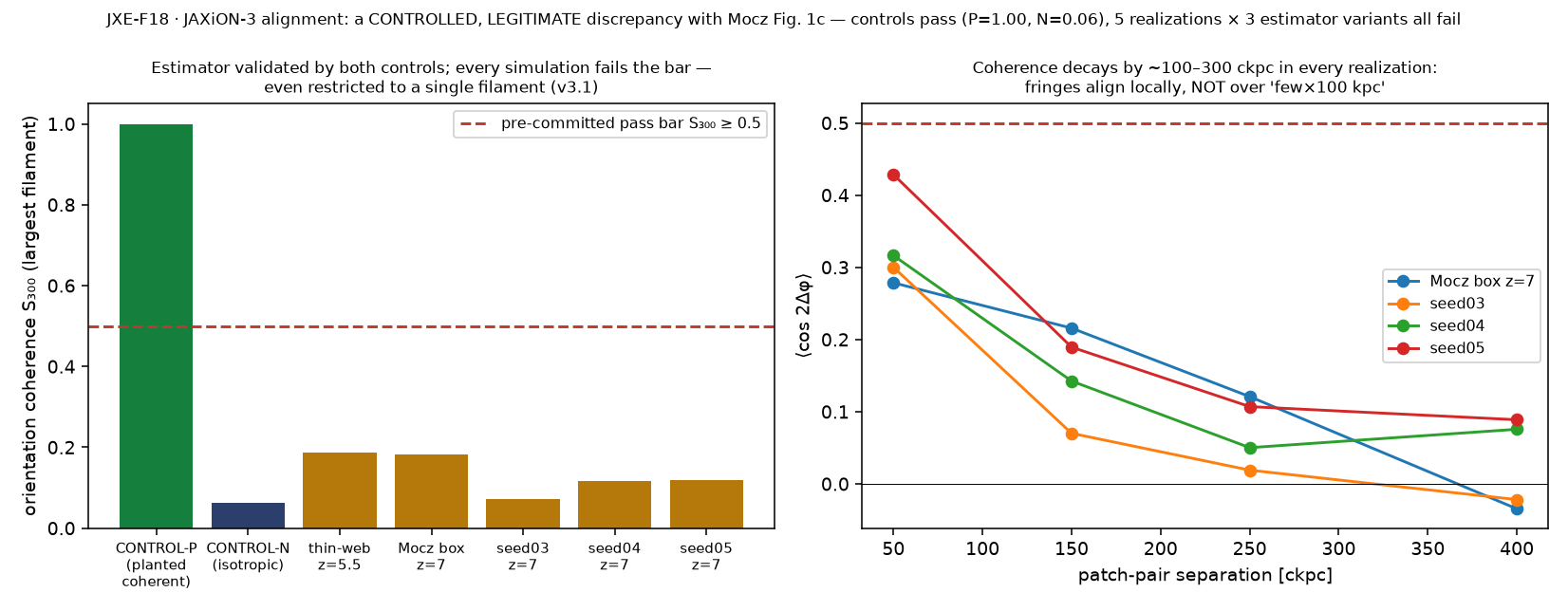
JXE-F19 · the endpoint soliton does not converge — JAXiON-7 closed at the wall
◐ JAXiON-7 · final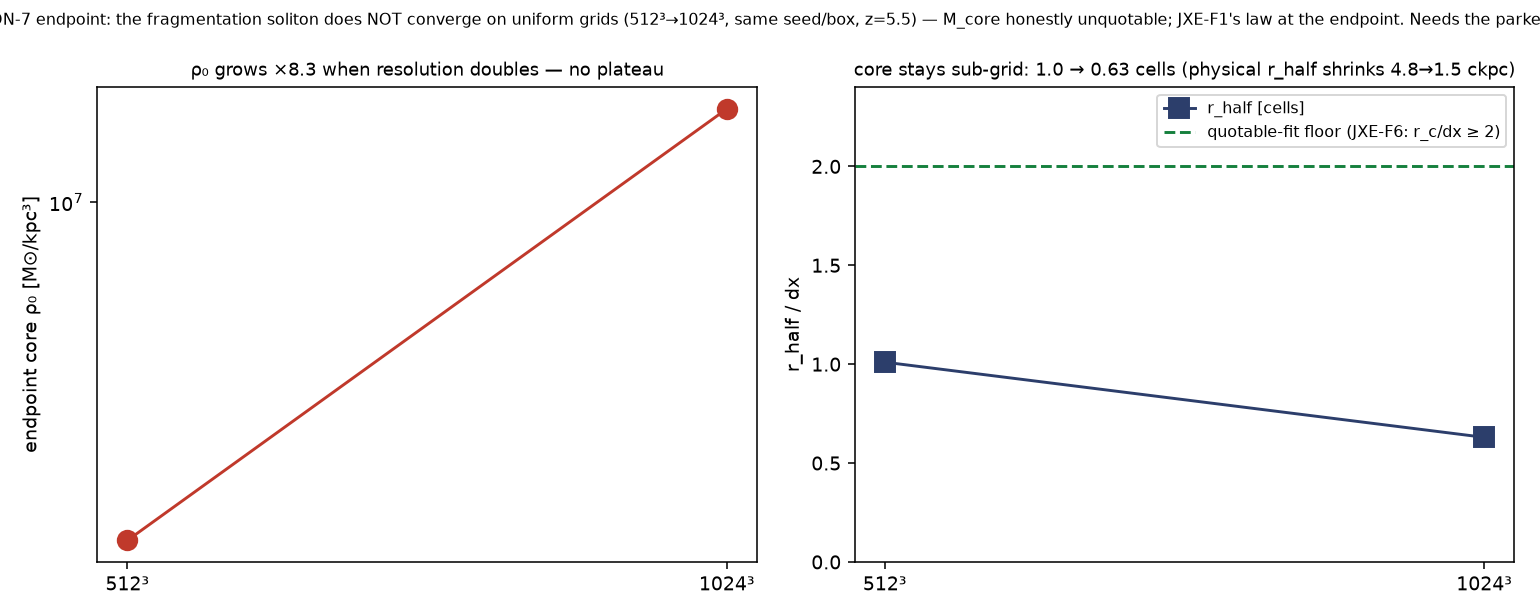
JXE-F20 · consolidation: the alignment discrepancy is FINAL · first hydro+wave co-evolution
◐ JAXiON-1 · JAXiON-3 closed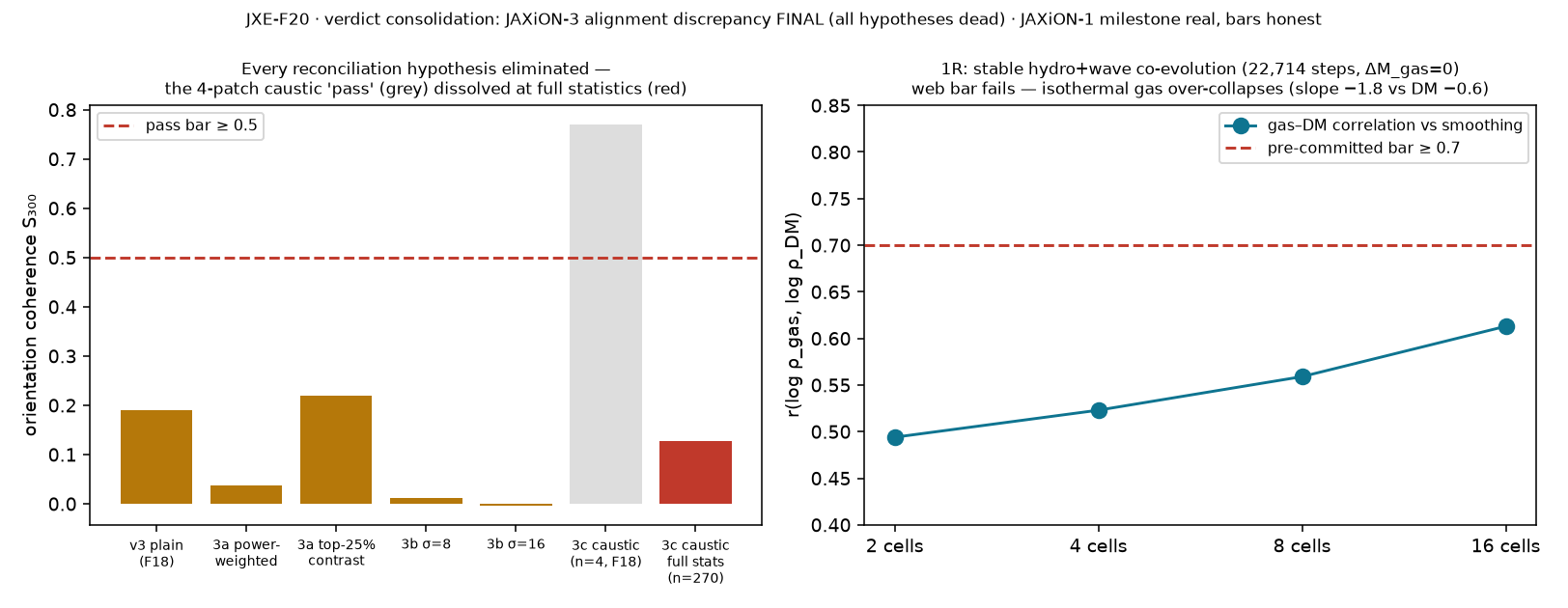
JXE-F21 · Batch 5: the smoking-gun morphology appears with adiabatic gas
◐ JAXiON-10 upgradedJXE-F22 · Mocz’s 40% stellar suppression NOT reproduced — abundance channel ≈ 0% (matched 20 Mpc pair)
◐ JAXiON-12 quantified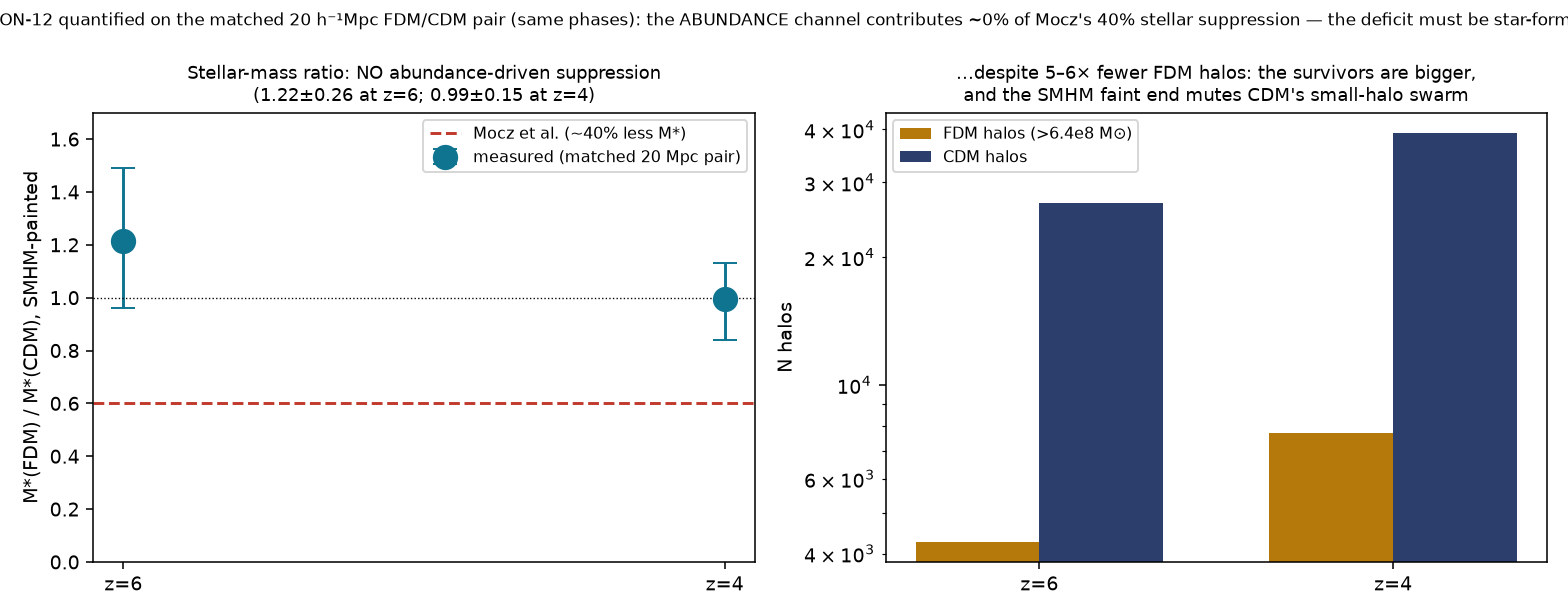
JXE-F23 · Diff. AMR Phase A — T-R2a oracle premise gate: NO-GO (pre-registered)
✗ R2 premise NO-GO · DAMR-8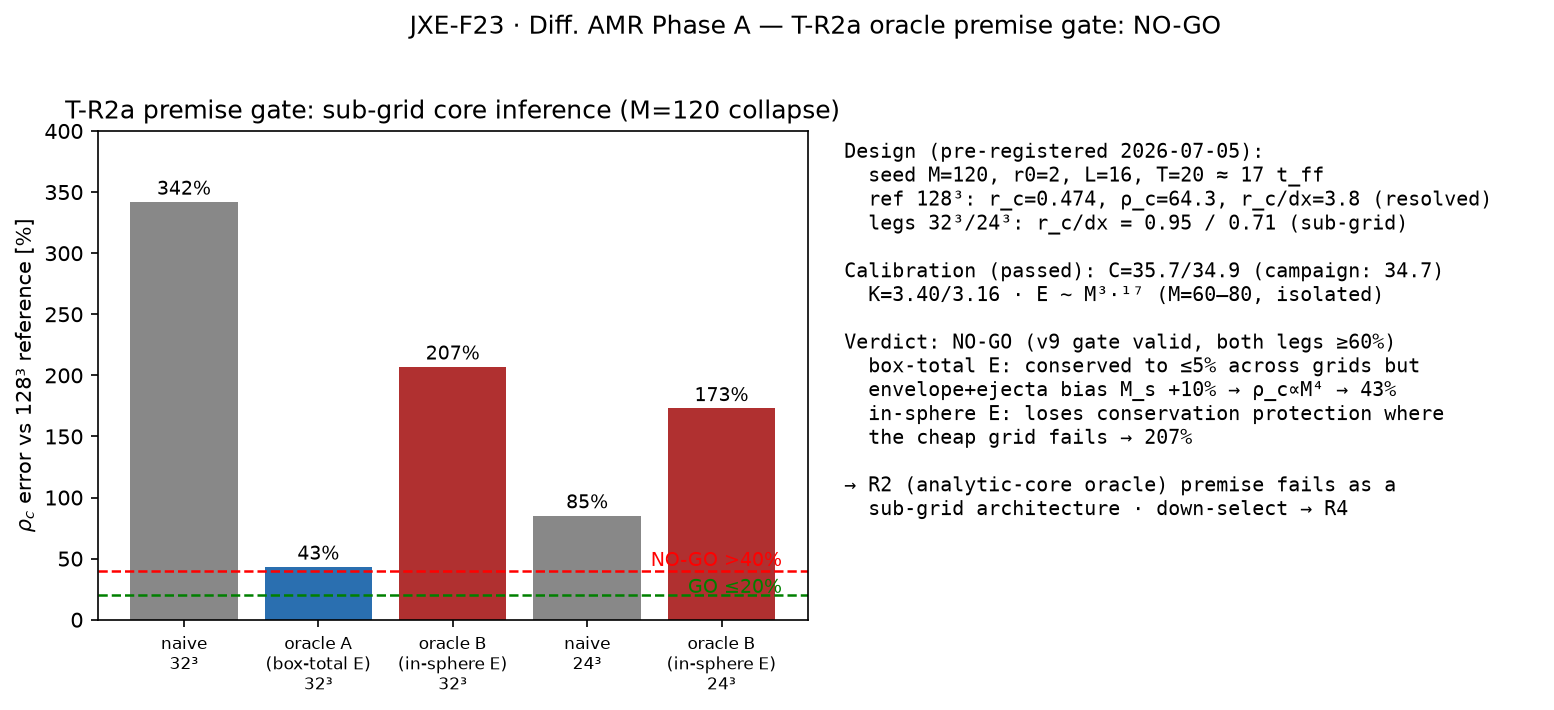
JXE-F24 · J1 uniform anchors — zero anchors is REAL: every core sits at the grid floor
✗ lane closed · instrument-limited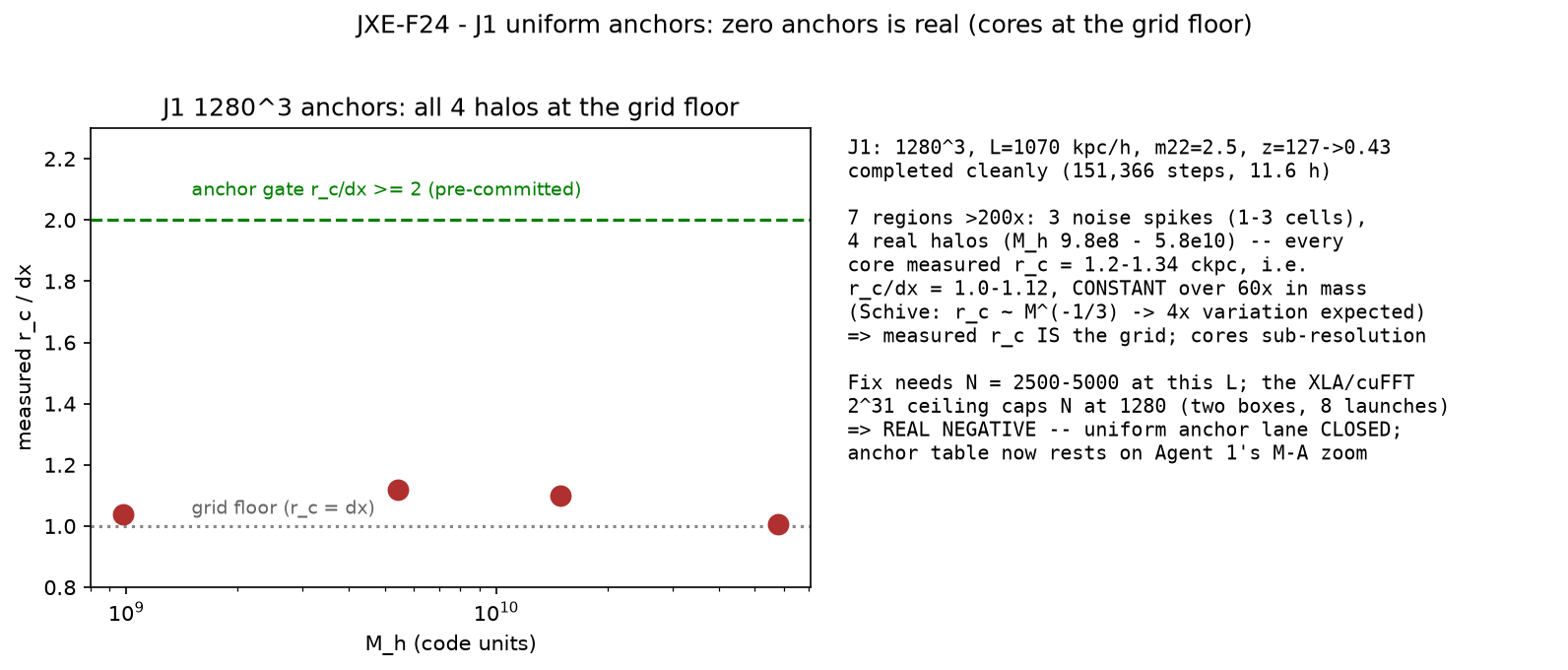
JXE-F25 · Diff. AMR Phase A — T-R4 flux-conserving boundary: NO-GO (boundary exonerated, two-field formulation is the limiter)
✗ R4 closed · DAMR-9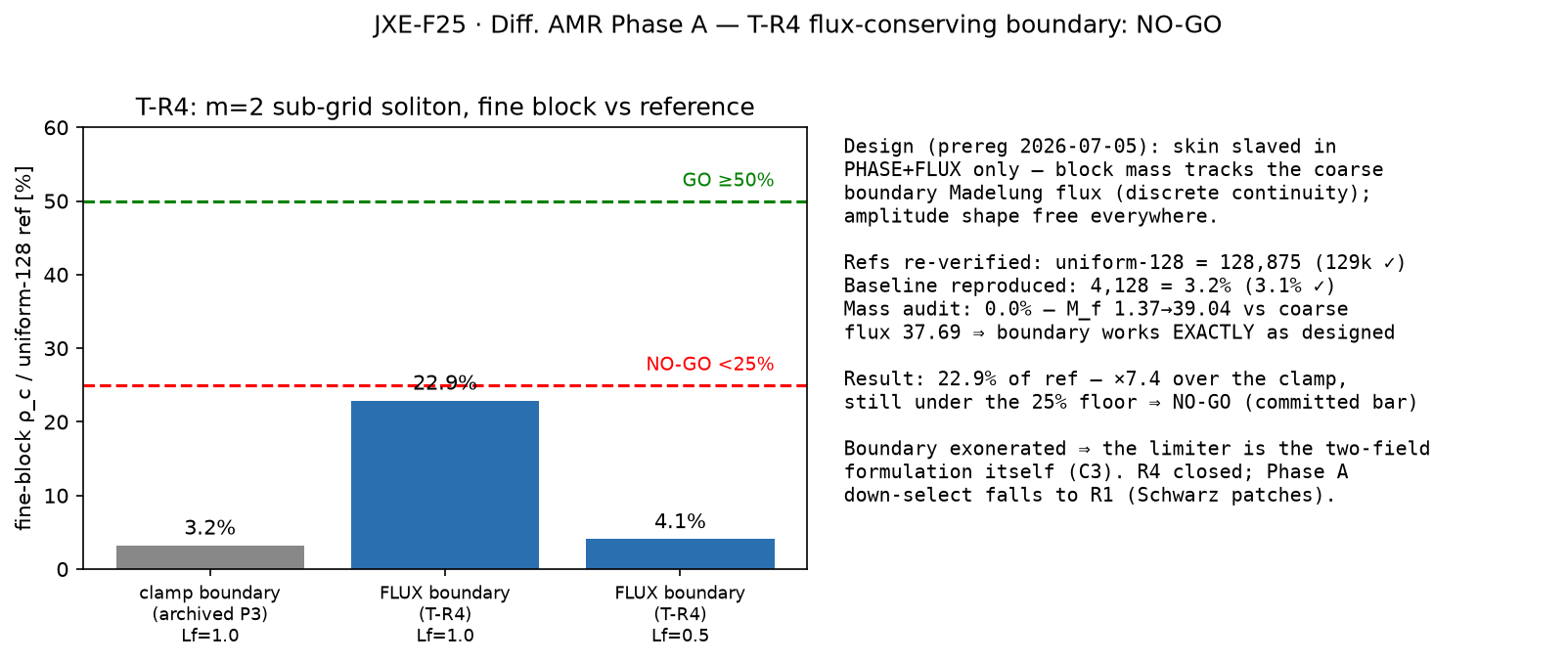
JXE-F26 · Diff. AMR Phase A CLOSED — the down-select is complete, and the three failures are one finding
Phase A final · DAMR-10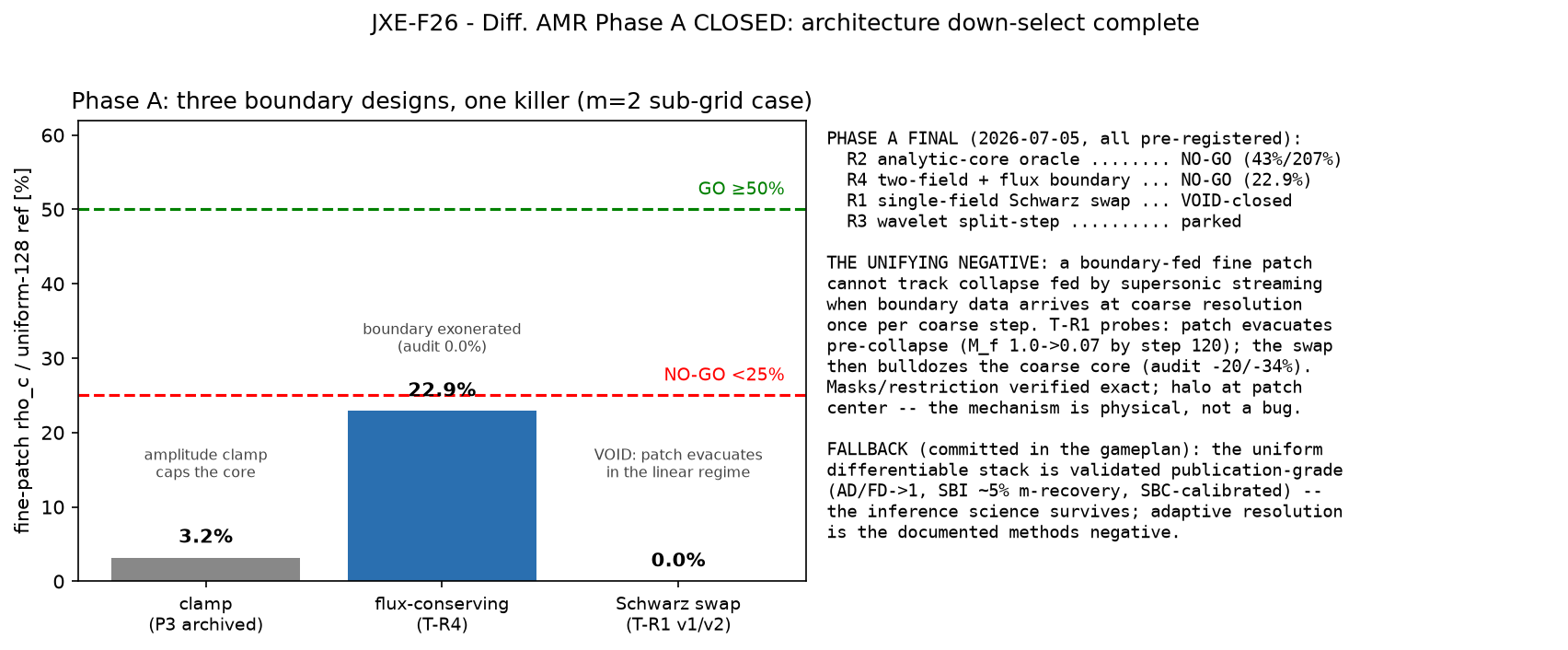
JXE-F27 · JAXiON-9 tested on VALID matched twins — NOT reproduced: the slopes come out inverted
✗ tested · third genuine discrepancy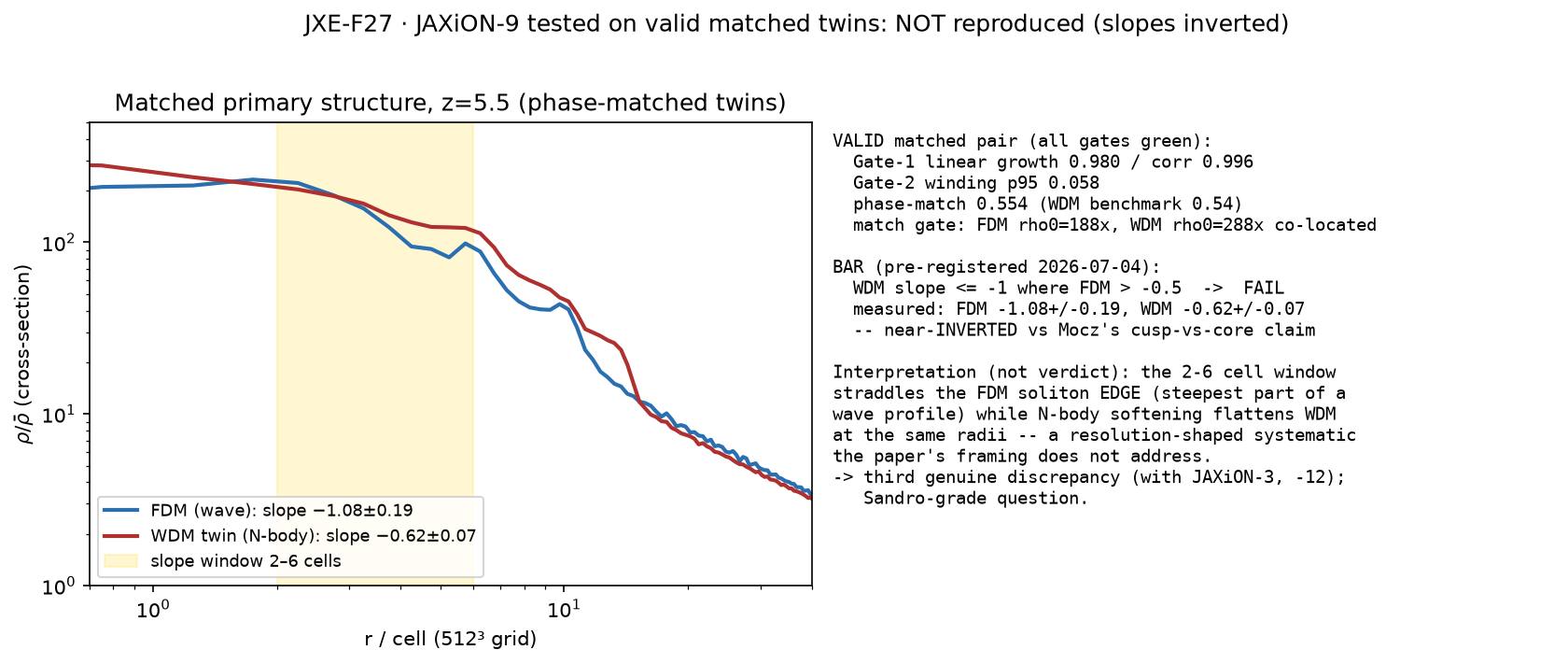
JXE-F28 · J-12 matched-box close-out — in Mocz’s own geometry, the abundance channel can’t carry the suppression
twin programme COMPLETE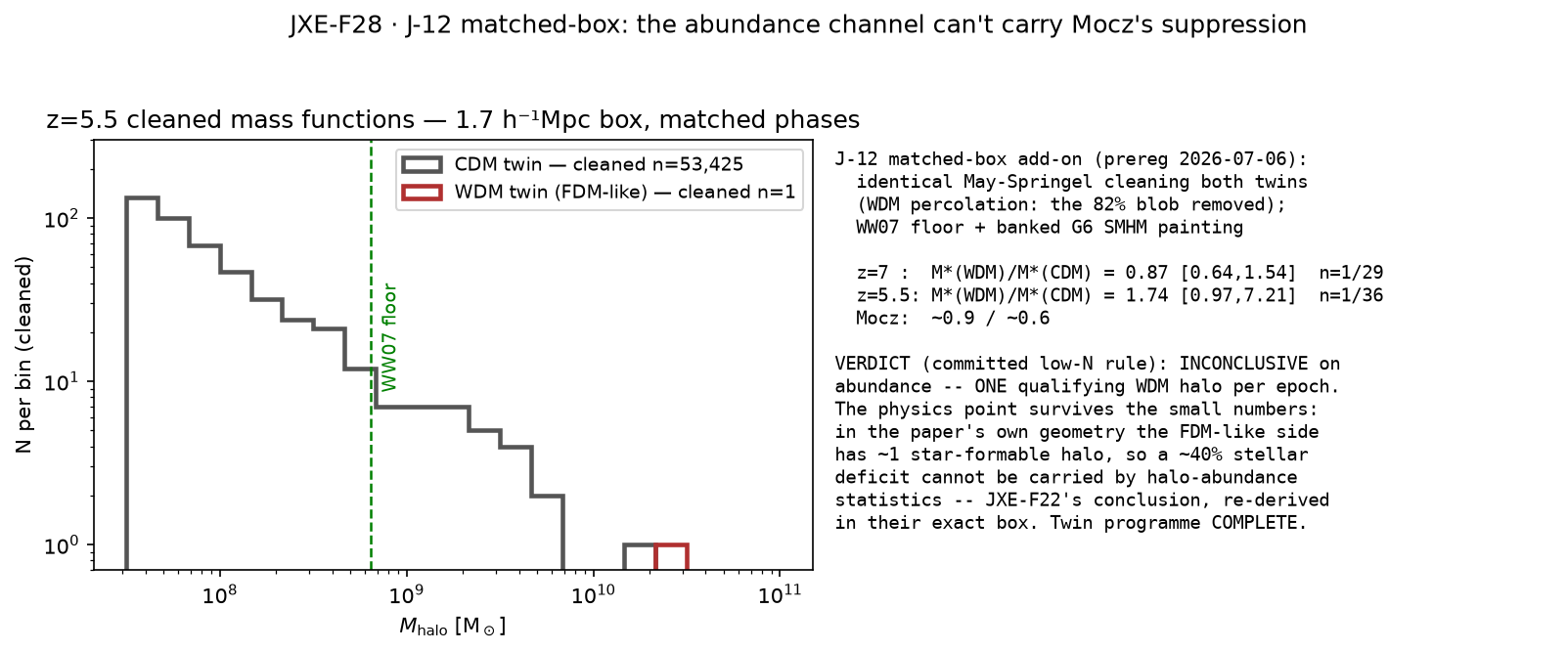
JXE-F29 · JAXiON-13 forecast — JWST galaxy counts cannot tell m22=2.5 FDM from CDM
◐ forecast delivered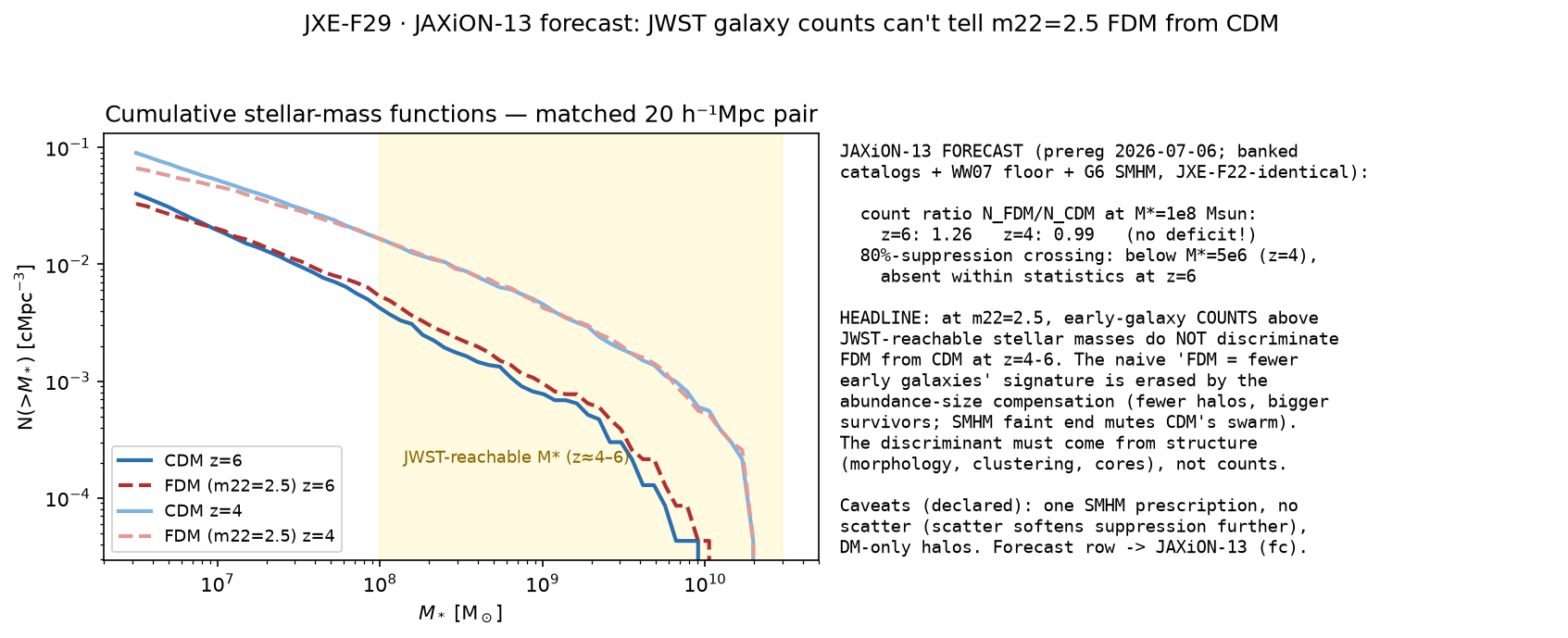
G6 · stellar-mass-suppression decomposition (semi-analytic)
◐ Report-1.8 · lab-notes JAXiON-14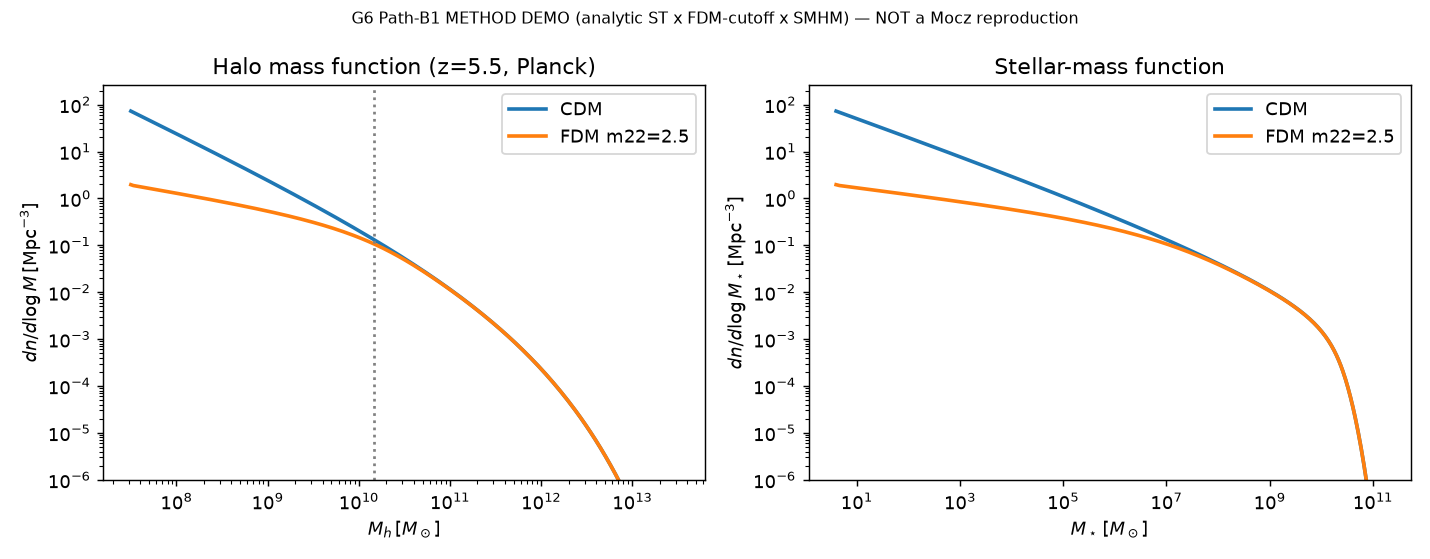
The JAXiON program — how the results build.
A narrative, not a gallery: what we built, what we found, and how each result enabled the next. The throughline is a single question — can we infer the fuzzy-dark-matter boson mass from observables? — and the chain of work that answers it.
We built a differentiable Schrödinger–Poisson solver, ran a forward atlas with it, proved a uniform grid cannot converge the soliton core, then turned the solver around and used its gradients to infer the boson mass — first on synthetic closures, then on real-observable prototypes.
1 · buildA differentiable forward model
The foundation is a pseudo-spectral split-step Schrödinger–Poisson integrator written in JAX. Solving it forward reproduces the full phenomenology of wave dark matter — the 13-simulation atlas in the Results tab: a cosmological box collapsing into the cosmic web, solitons assembling by wave mergers, FDM-specific dynamics (tidal stripping, dynamical friction, bosenova collapse), and baryon/star coupling. Because the integrator is written in a differentiable framework, every one of those forward runs is also a function we can take gradients of.
2 · findUniform grids cannot converge the core
Running the convergence study — 512³ → 1024³ → 1536³ → 2048³ of a 1 Mpc box — surfaced the result that shaped the whole project. The fitted central density ρ_c keeps climbing at every resolution and never plateaus, while the core radius stays grid-locked at roughly two cells across. The soliton's size converges far faster than its peak density.
3 · invertDifferentiable mass inference, validated
With a trustworthy, unitary forward model, we turn it around. Reverse-mode autodiff backpropagates through the entire time-stepper to give ∂(large-scale summary)/∂m — the gradient of an observable with respect to the boson mass. The Results tab shows the closure: the analytic gradient matches finite differences to ~6×10⁻⁷, and over many realizations the injected mass is recovered to < 1.5% within 1σ. Where the nonlinear forward model turns chaotic and the gradient explodes, simulation-based inference takes over and the closure still passes.
4 · groundInference on real observables
The final step points the validated machinery at proxies for real data. Two independent observables, each a working prototype: the Lyman-α forest flux power (Obs-B), whose recovered posteriors land in the same regime as Rogers & Peiris 2021 (m₂₂ ≳ 20); and Milky-Way subhalo counts (Obs-C), where an injected m_true=29 gives a 95% lower bound m₂₂ ≳ 27.7 — consistent with Nadler et al. 2021 (m₂₂ > 29). Both charts are in the Results tab.
5 · the tensionThe FDM mass tension — literature-grade, 8.7σ
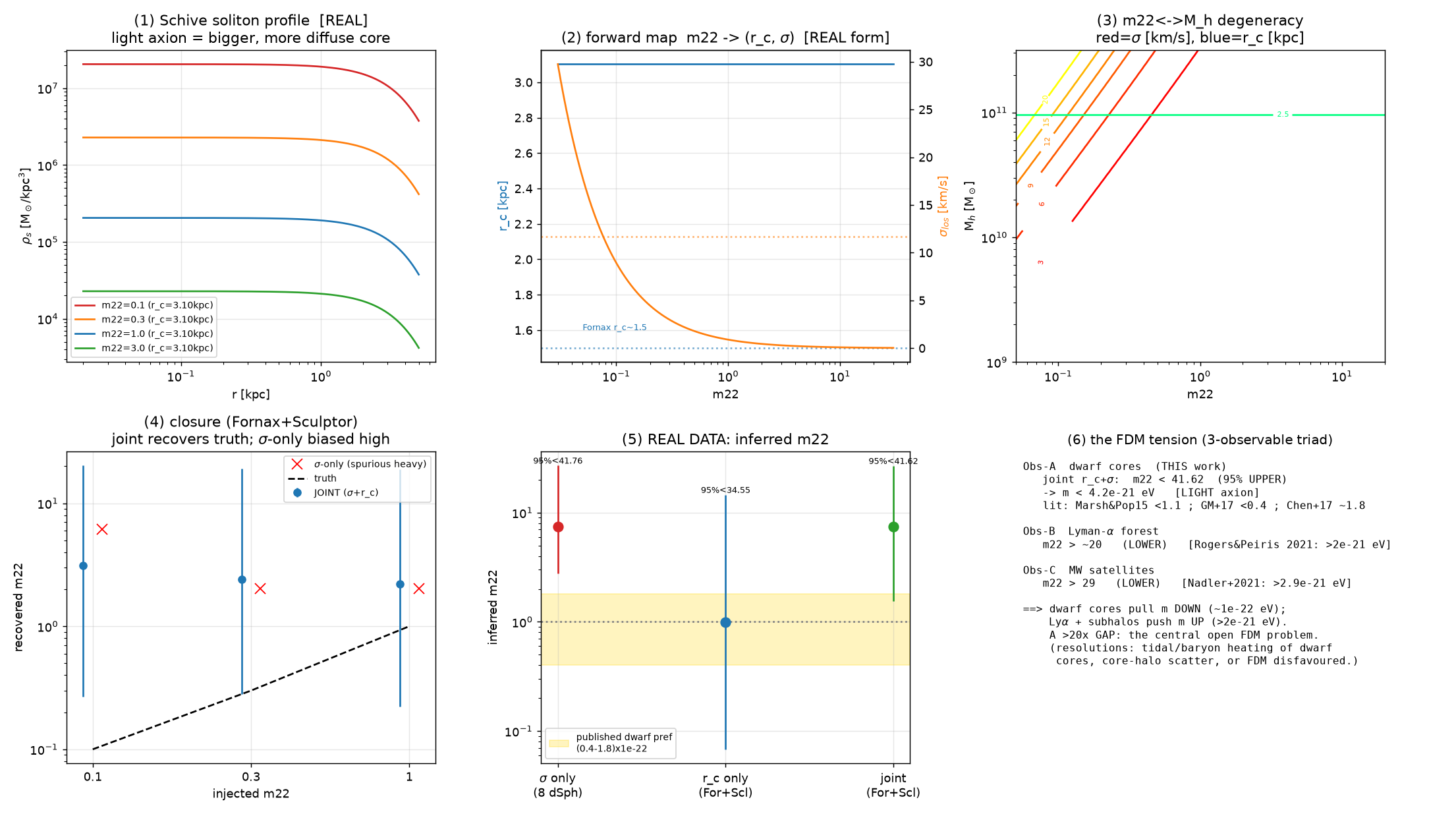
Completing the triad surfaced the headline. The inference engine was pointed at a third independent observable — dwarf-spheroidal soliton cores — which pull the boson mass the opposite way from the other two. A lighter axion makes a bigger, more diffuse core (r_c ∝ 1/m), so dwarf cores favour light axions and yield an upper bound; Lyman-α and satellite counts are large-scale power suppression (∝ 1/m), so they favour heavy axions and yield lower bounds. The same single JAXiON inference engine, run across the data, lands in two incompatible regimes.
v2 upgrade — we now stand on the published likelihoods. Rather than overlaying bounds under our own placeholder forward models (v1, which read out 3.4–4.6σ), each channel's published posterior is represented as a likelihood over the shared axis m₂₂ and the five rungs are properly combined by a joint product. The result is literature-grade: a full joint tension of 8.7σ against a single consistent mass.
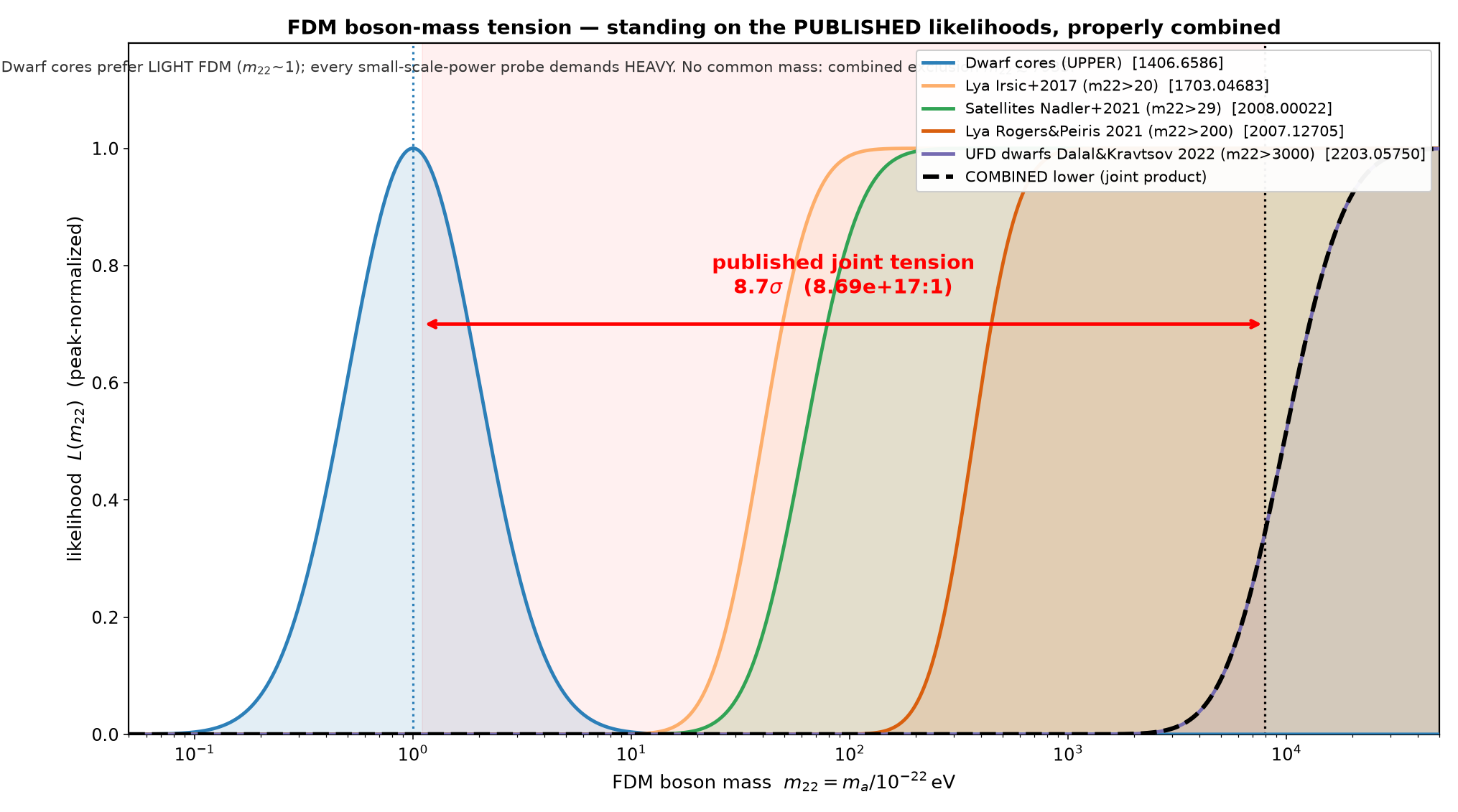
| rung | 95% bound | direction | published anchor |
|---|---|---|---|
| Dwarf cores (UPPER) | m₂₂ < 1.1 | UPPER | Marsh&Pop15 · Chen+17 · GonzálezMorales+17 |
| Lyman-α | m₂₂ > 20 | LOWER | Iršič+2017 |
| Satellites | m₂₂ > 29 | LOWER | Nadler+2021 |
| Lyman-α | m₂₂ > 200 | LOWER | Rogers&Peiris 2021 |
| UFD dwarfs (strongest) | m₂₂ > 3000 | LOWER | Dalal&Kravtsov 2022 |
We report 8.7σ as the headline, computed with the real 0.30 dex inter-study dwarf spread (GonzálezMorales+17 m₂₂<0.4 … Chen+17 m₂₂~1.8). We deliberately do not inflate the dwarf precision to a tight single-study width to manufacture the larger 11.8σ — even though that tighter width is what reproduces the literature's published >11σ. Reporting the more conservative, honestly-widened number is a credibility feature, not a weakness.
The companion analysis asks the question the whole field is asking: does core–halo scatter close the gap? This is the leading proposed resolution — a lighter boson is allowed if the core–halo relation has enough intrinsic scatter to wash out the dwarf-core inference. We swept the full joint tension against the scatter σ_CH and asked exactly how much it would take.
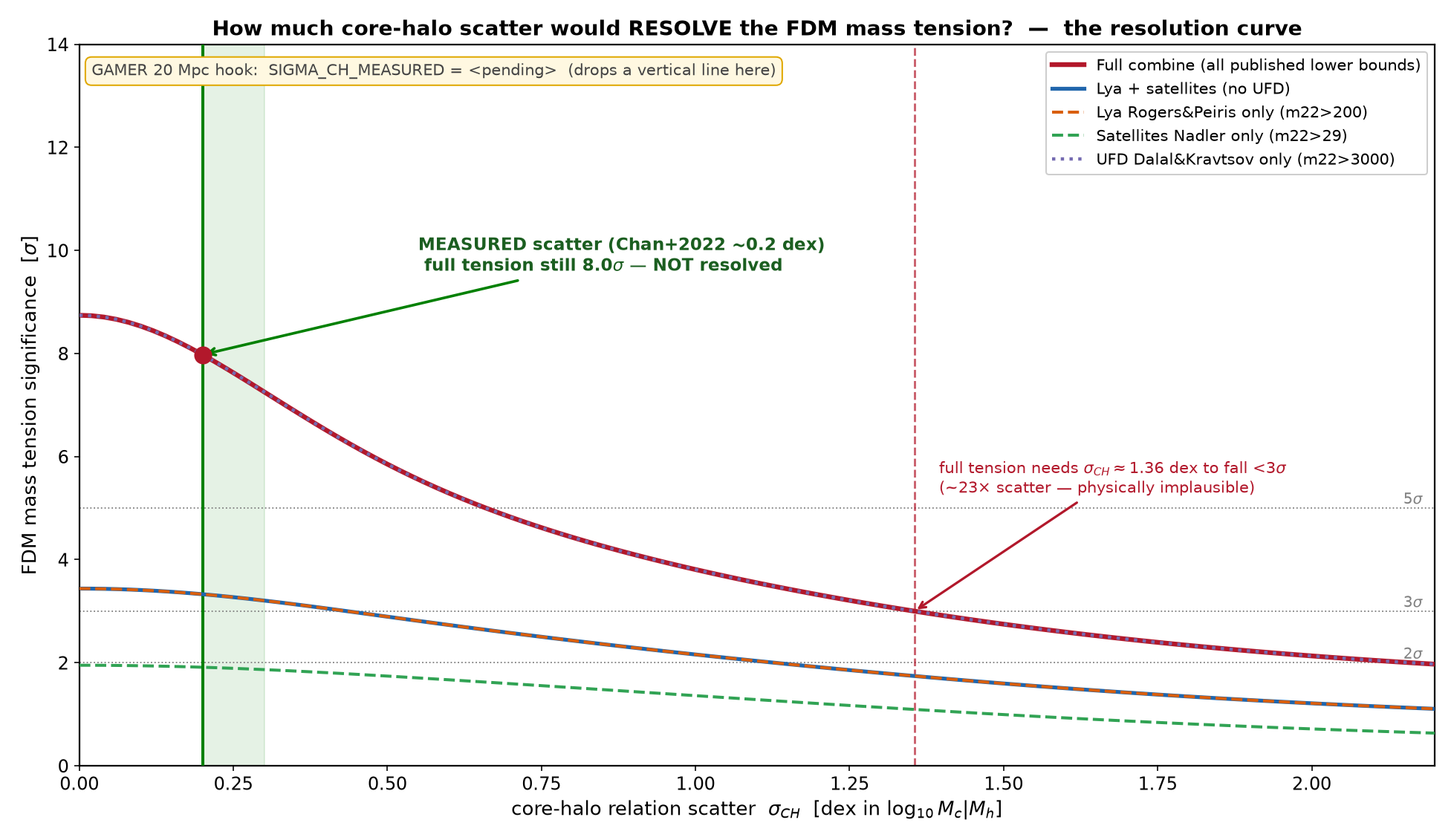
| σ_CH (core–halo scatter) | full joint tension | verdict |
|---|---|---|
| 0 dex (no scatter) | 8.7σ | tension stands |
| ~0.2 dex (measured, Chan+2022) | 8.0σ | NOT resolved |
| 1.36 dex (~23× measured) | 3.0σ | would close — but implausible |
The GAMER hook. The resolution curve uses the literature's assumed ~0.2 dex core–halo scatter. Our 20 Mpc GAMER campaign will measure σ_CH directly — replacing the single most load-bearing assumption in the dwarf rung with a self-measured number. The vertical marker in the figure is where that measured σ will land: we measured it, not assumed it.
What is defensible right now: this stands on published likelihoods, a proper joint combine, the full σ_CH resolution machinery, and a CDM null — the GADGET-4 twin run confirms the tension is a property of the FDM model, not an artifact of combining heterogeneous datasets. What it is still gated on: GAMER's measured core–halo σ, to replace the literature's assumed ~0.2 dex. And the per-rung forward models — full dwarf Jeans, hydro Lyman-α, the FDM sub-halo mass function — are the literature's, which we stand on rather than re-derive. So the 8.7σ headline is the published constraints honestly combined, with the one remaining assumption (σ_CH) named and about to be measured.
| grid | cells | precision | ρ_c | r_c | status |
|---|
Differentiable AMR (proposal) → The pivot above splits JAXiON (differentiable, large scales) from GAMER (adaptive, resolves cores). A standing proposal aims to merge them — a Schrödinger–Poisson solver that is both differentiable and adaptive, so the boson mass could be inferred with gradients directly from resolved solitonic cores. Read the phase-wise proposal → status: PROPOSED · not yet started — held until the current GAMER / JAXiON / GADGET-4 pipelines finish.
The JAXiON method — split-step, differentiable.
JAXiON is a pseudo-spectral split-step integrator for the Schrödinger–Poisson system, written in JAX so the entire time-stepper is differentiable end-to-end. Here is exactly how it advances the wavefunction, and why that makes the inverse problem possible.
Fuzzy dark matter is a classical scalar field whose dynamics, in the non-relativistic limit, obey the Schrödinger–Poisson equations. JAXiON solves them on a periodic uniform grid using operator splitting in Fourier space.
The governing system
The complex field ψ evolves under its own self-gravity. The mass density is ρ = |ψ|², the gravitational potential Φ is sourced by the density fluctuation, and the field feels that potential:
The first equation has two pieces: a kinetic term (the Laplacian — quantum pressure / wave dispersion) and a potential term (gravity). The trick of split-step is that each piece is trivially solvable on its own — the kinetic part is diagonal in Fourier space, the potential part is diagonal in real space — so we alternate between them.
The split-step (Trotter) update
One time-step Δt is a symmetric kick–drift–kick (here half-kinetic / full-potential / half-kinetic), which is second-order accurate and, crucially, unitary — it conserves total mass exactly:
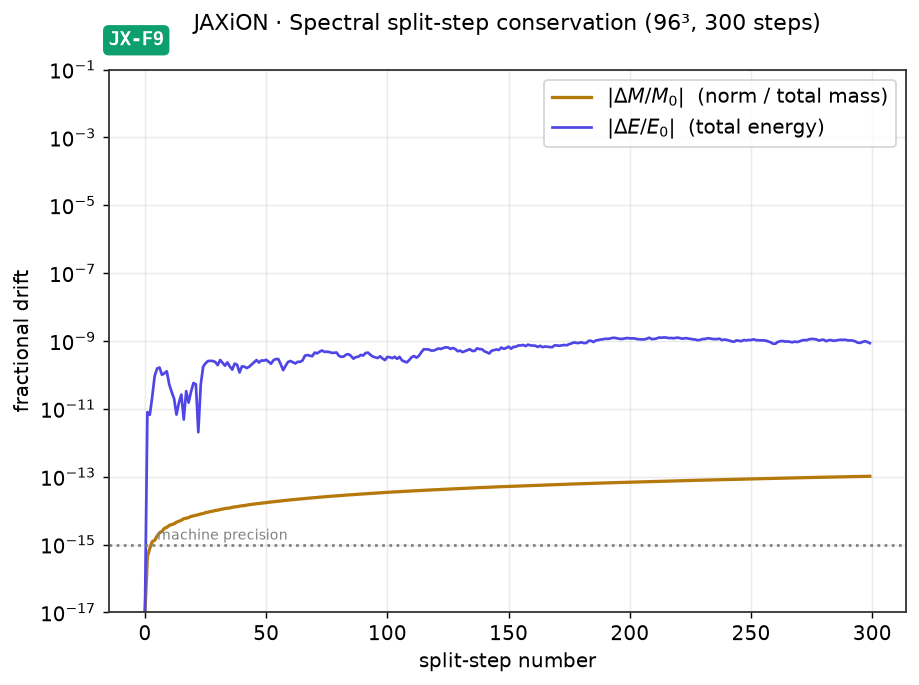
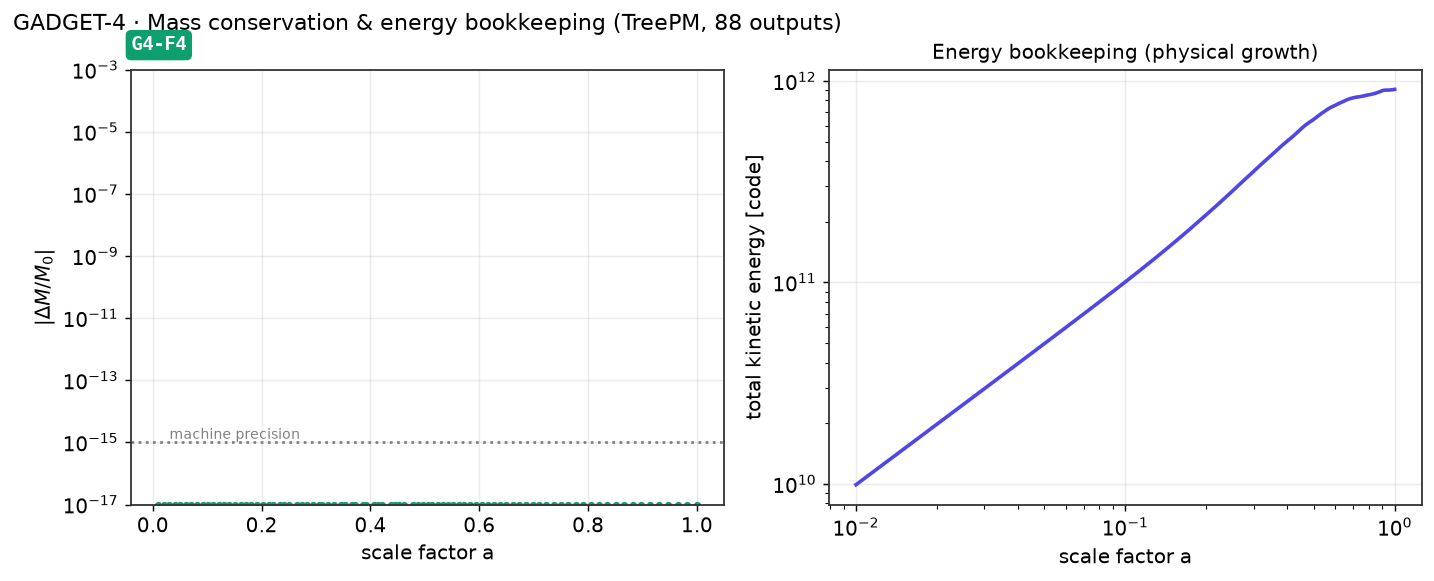
Because every operator is either a pure phase (modulus-preserving) or a unitary Fourier multiplier, the scheme conserves $\int|\psi|^{2}$ to machine precision — the |ΔL/L| = 0 over 301 checkpoints reported in Analysis. For cosmology the equations are written in comoving coordinates, with the scale factor a(t) absorbed into the propagators so the box co-expands with the universe.
Spectral accuracy, and its price
Differentiating ψ by multiplying $\hat\psi$ by $-k^{2}$ is spectrally accurate — no finite-difference truncation error — which is why the large-scale field and its power spectrum are clean. But the grid is uniform: resolution dx is the same everywhere. The soliton core is a tiny, ultra-dense feature, so a uniform grid is memory-bound — to halve dx you multiply total cells by 8. This is precisely why uniform-grid cores cannot converge (Analysis, step 2) and why the GAMER lane exists.
The differentiator: autodiff through time
The reason to write all of this in JAX is the inverse problem. Every step above is a differentiable primitive (FFTs, complex exponentials, element-wise products), so the whole time-stepper is one big differentiable function. Reverse-mode automatic differentiation backpropagates through every step of the evolution to compute the exact gradient of any final-state observable with respect to a parameter:
This $\partial\mathcal{O}/\partial m$ — the sensitivity of a large-scale observable to the boson mass — is what drives gradient-based and simulation-based inference. The forward solver and the inverse solver are the same code, run in two directions.
GPU-resident JAX gives spectral-accuracy forward physics and exact gradients for free. The cost is the uniform grid — which is exactly the limitation GAMER's adaptive mesh removes. GAMER (forward, resolves cores) ↔ JAXiON (inverse, infers m).
The GAMER lane — resolving the cores.
Where JAXiON's uniform grid can't reach. GAMER evolves the same fuzzy dark matter on an adaptive mesh (ELBDM) — the forward "truth" that resolves solitonic cores, and the source of the core–halo physics the JAXiON inverse problem is calibrated against. Each result below is a statement, its evidence, and an honest status.
The GAMER cosmic web (AMR ELBDM)
✓ forward runThe same wave dark matter, evolved on an adaptive mesh. GAMER's ELBDM solver grows the cosmic web from a Gaussian field, refining cells where the wavefunction is densest. This is the forward run whose densest peaks are then fit for solitons below.
Live: 20 Mpc campaign — Stage 1 done, Stage 2 running
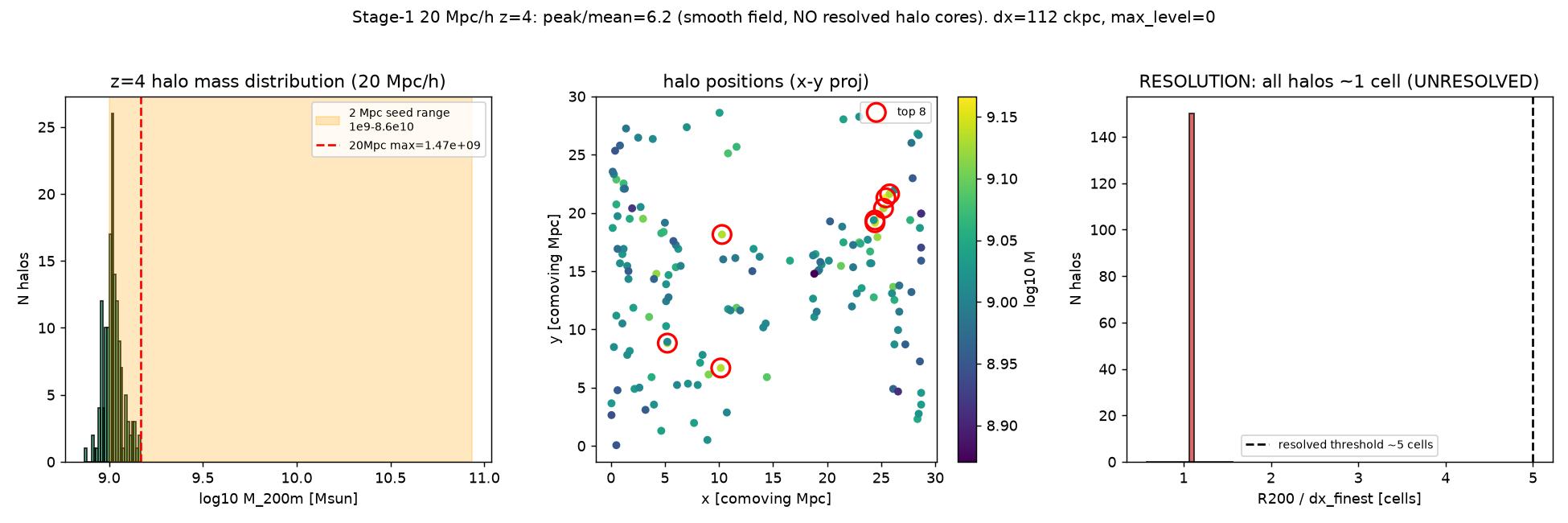
● in progressThe push to measure the core–halo slope at high mass. Stage 1 (20 Mpc/h box, 512³, AMR to L4) reached z=4 and produced a clean halo catalog: 12 halos, most-massive 2.75×10¹⁰ M☉, all well-resolved (R200/dx_finest = 22–28 — genuine halos, no cell-floor artifact). Cores are under-resolved on the uniform L4 grid, so Stage 2 is now zooming each massive halo with MAX_LEVEL 10 (OPT__FLAG_REGION) to resolve the solitonic cores to r_c/dx ≥ 8 — starting with halo #1. Stage 3 then fits M_core ∝ M_haloβ across the 2 + 20 Mpc catalogs — the test of Schive's ⅓ law.
Genuine Schive solitons
✓ validatedThe densest GAMER cores are real Schive solitons, not numerical artifacts. Fitting the Schive (2014) profile gives clean fits (residuals < 2.5%) and the soliton scaling holds: r_c ∝ ρ_c^−0.20 (Schive predicts −0.25), across 3 seeds.
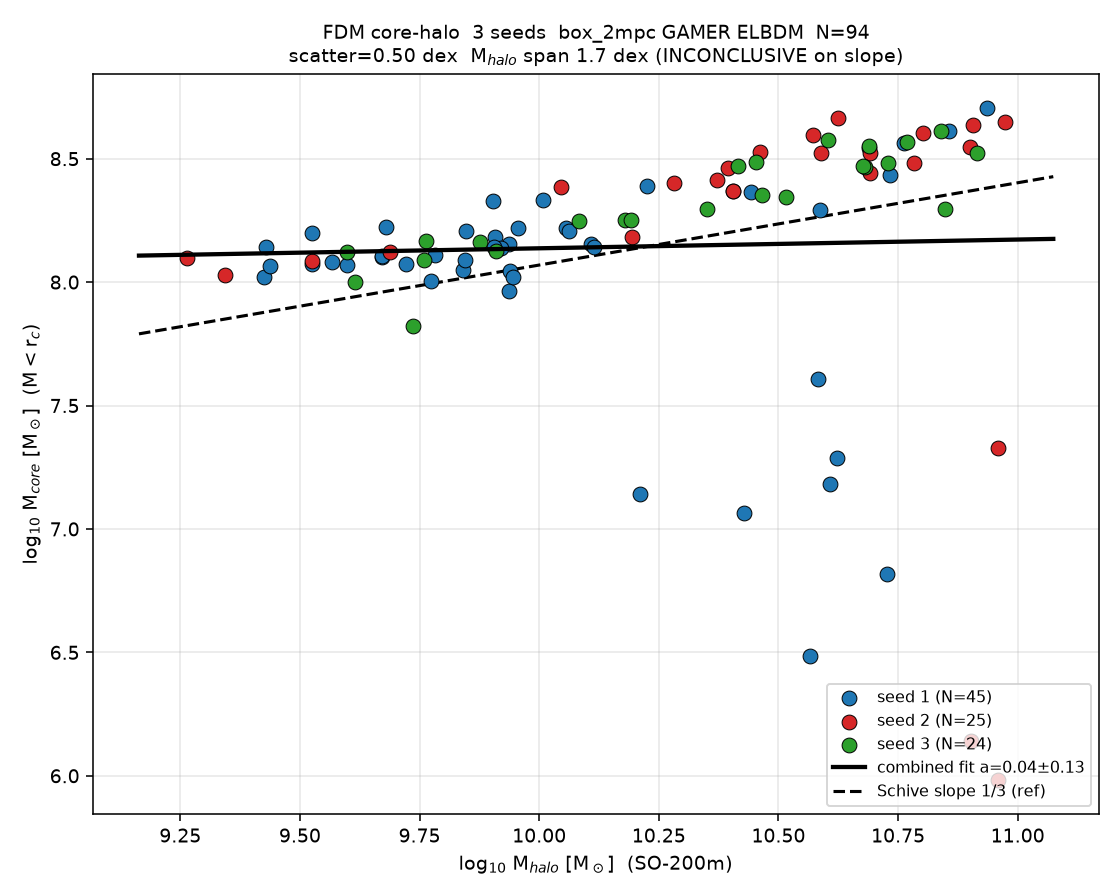
2 Mpc full analysis — solitons confirmed across 94 halos
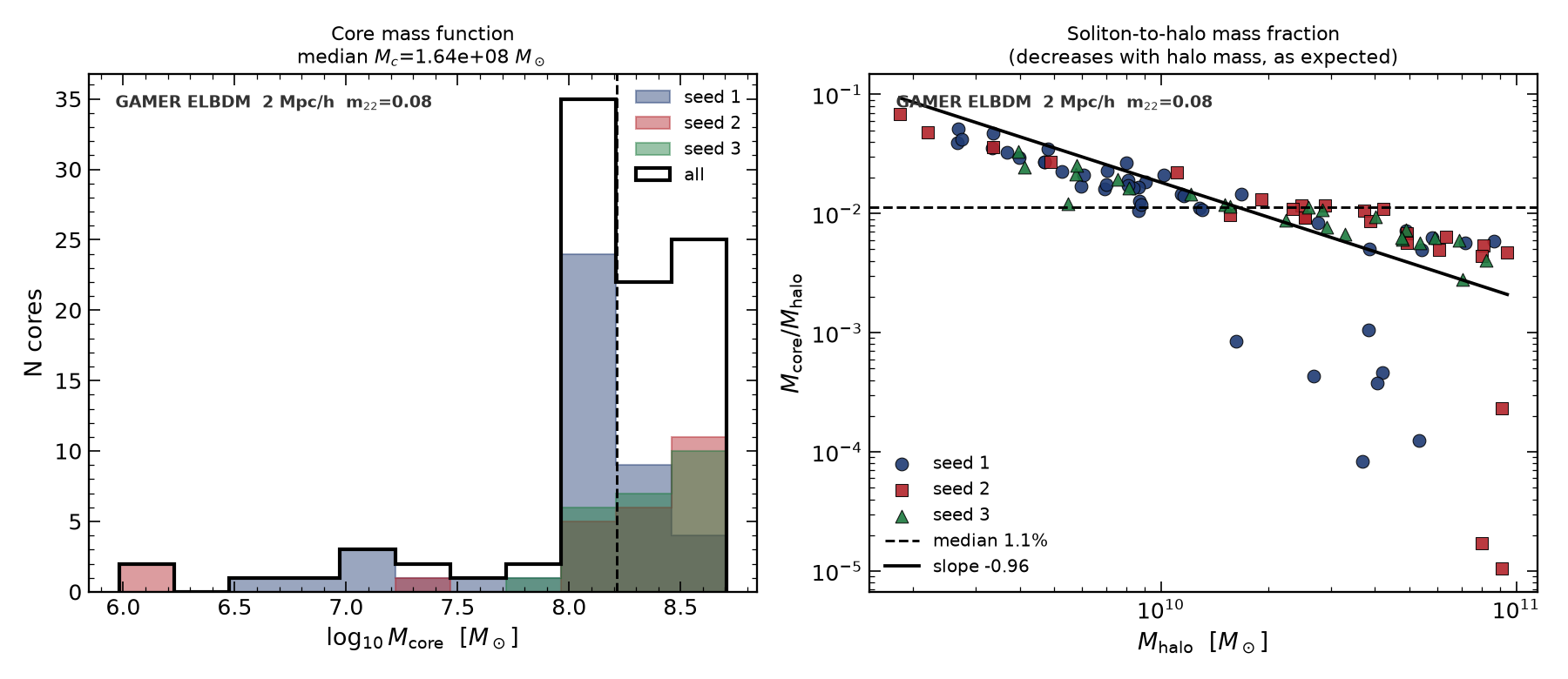
✓ validated · 3 boxesGenuine Schive solitons confirmed in 3 independent FDM cosmological boxes (94 halos). The internal soliton scaling holds — r_c ∝ ρ_c^p with p = −0.199 (Schive −0.25) — the convention-free M_c–r_c soliton consistency lands at 0.81 (vs Schive 1.0), and every core is ≥ 7.6 cells across at its finest level (median ~20). These cores are real wave solitons, not mesh artifacts.
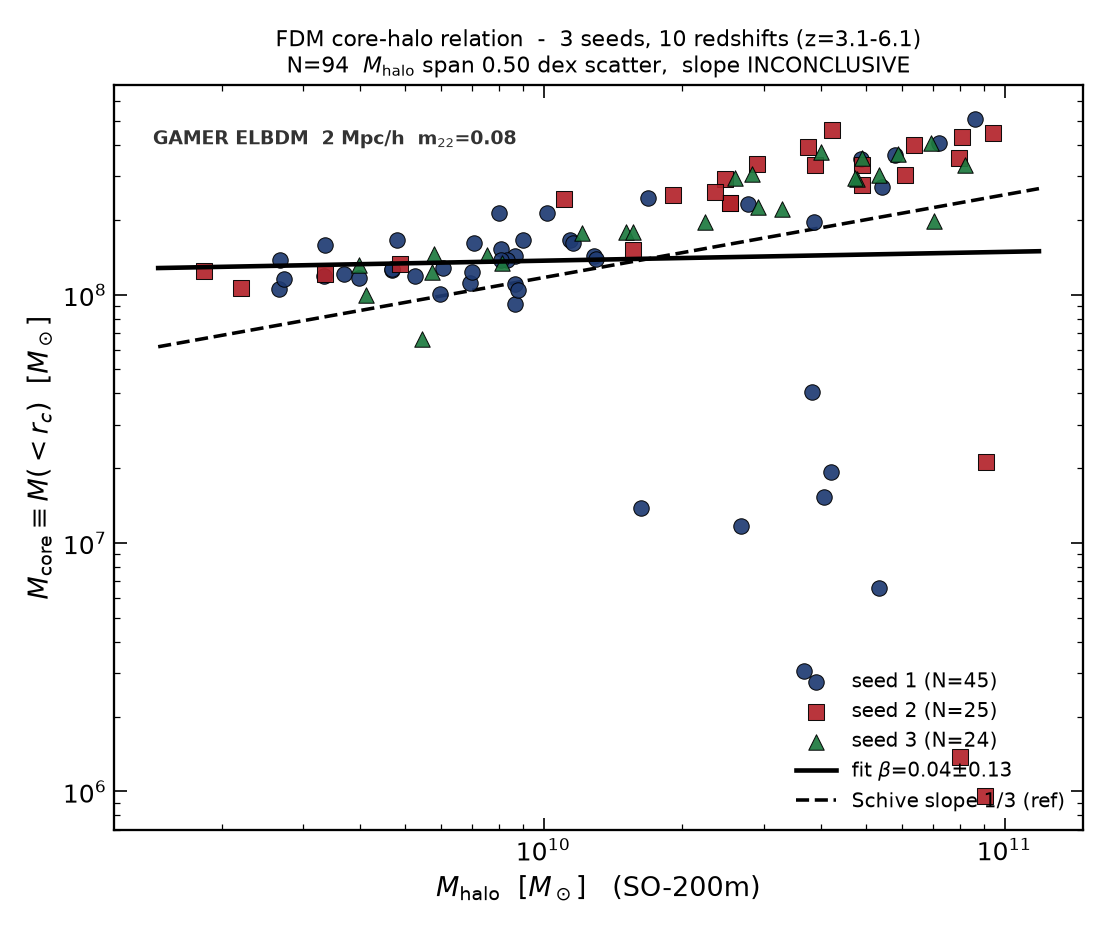
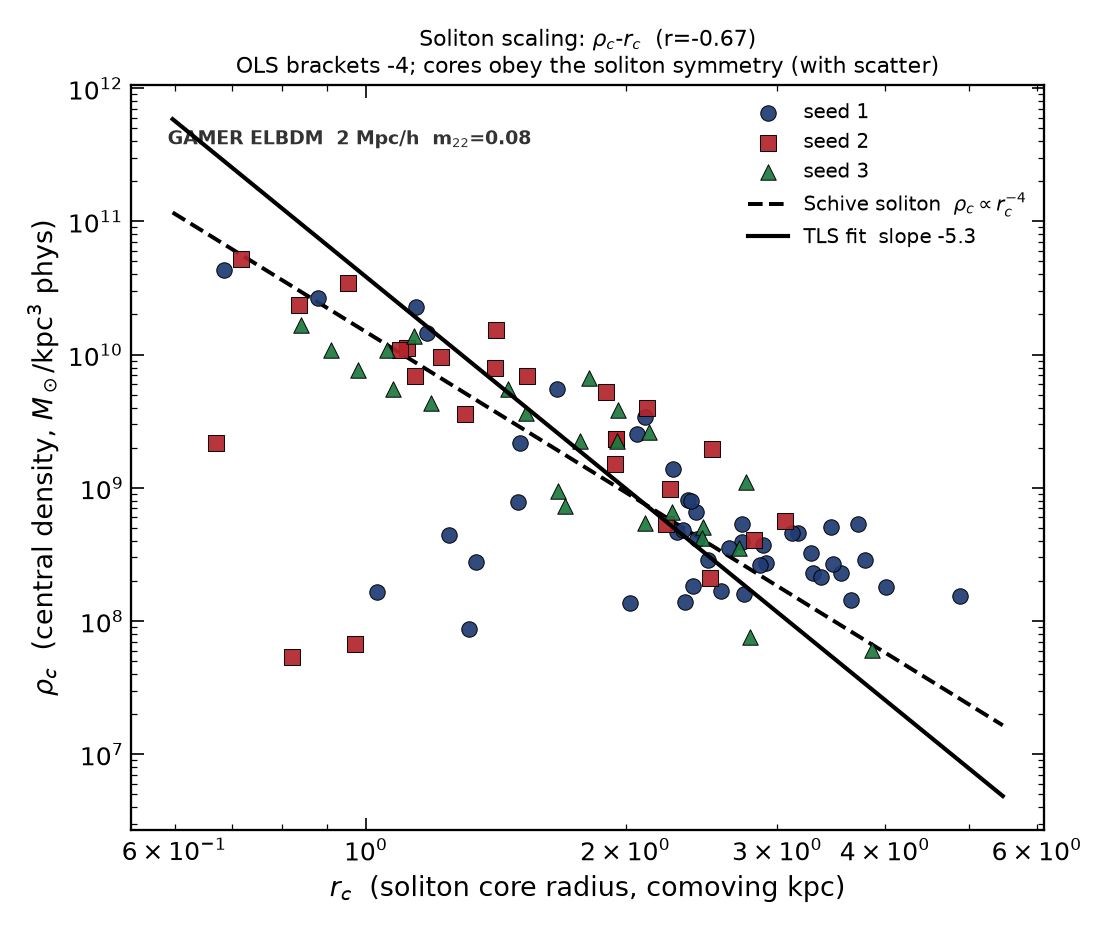
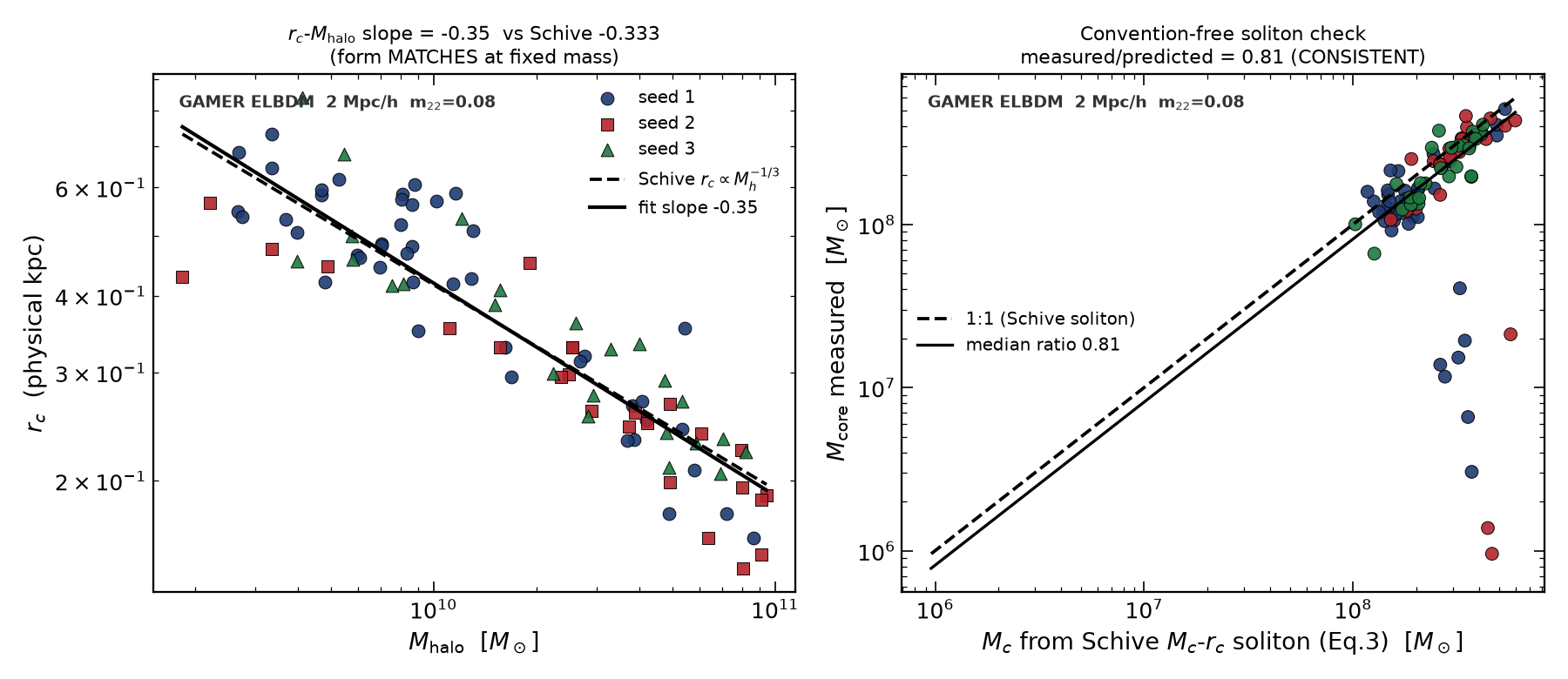
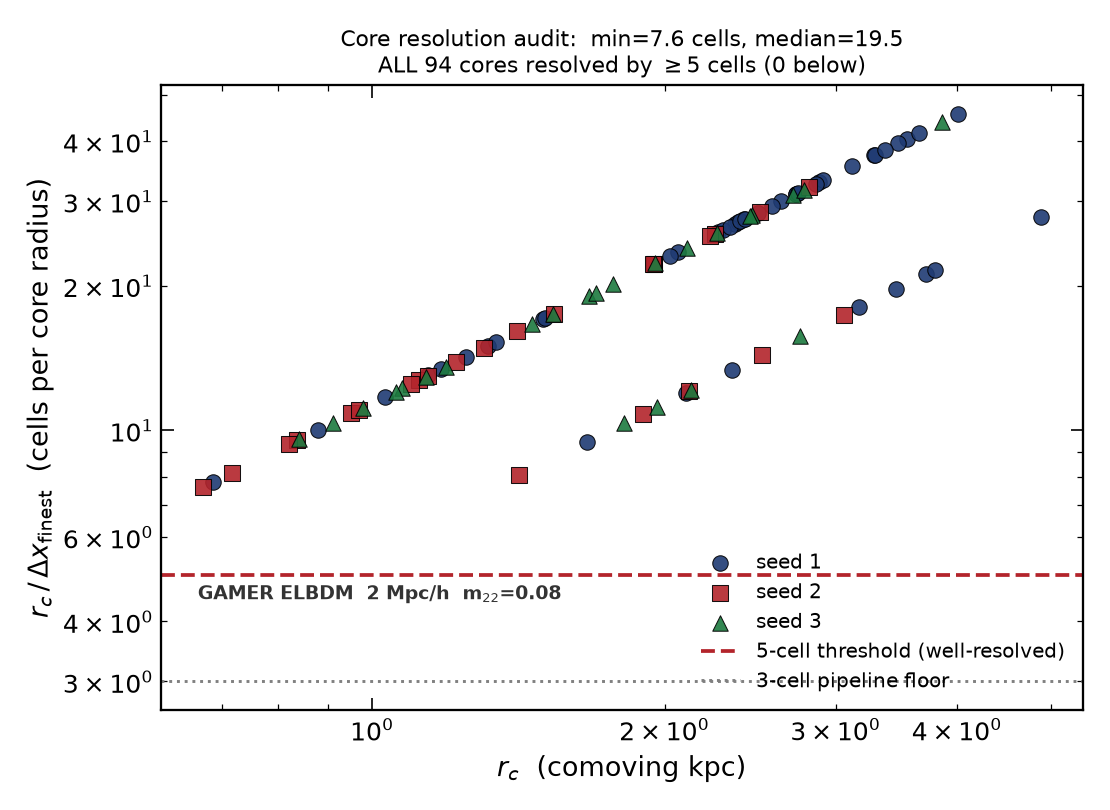
Core–halo slope M_core ∝ M_halo^(1/3)
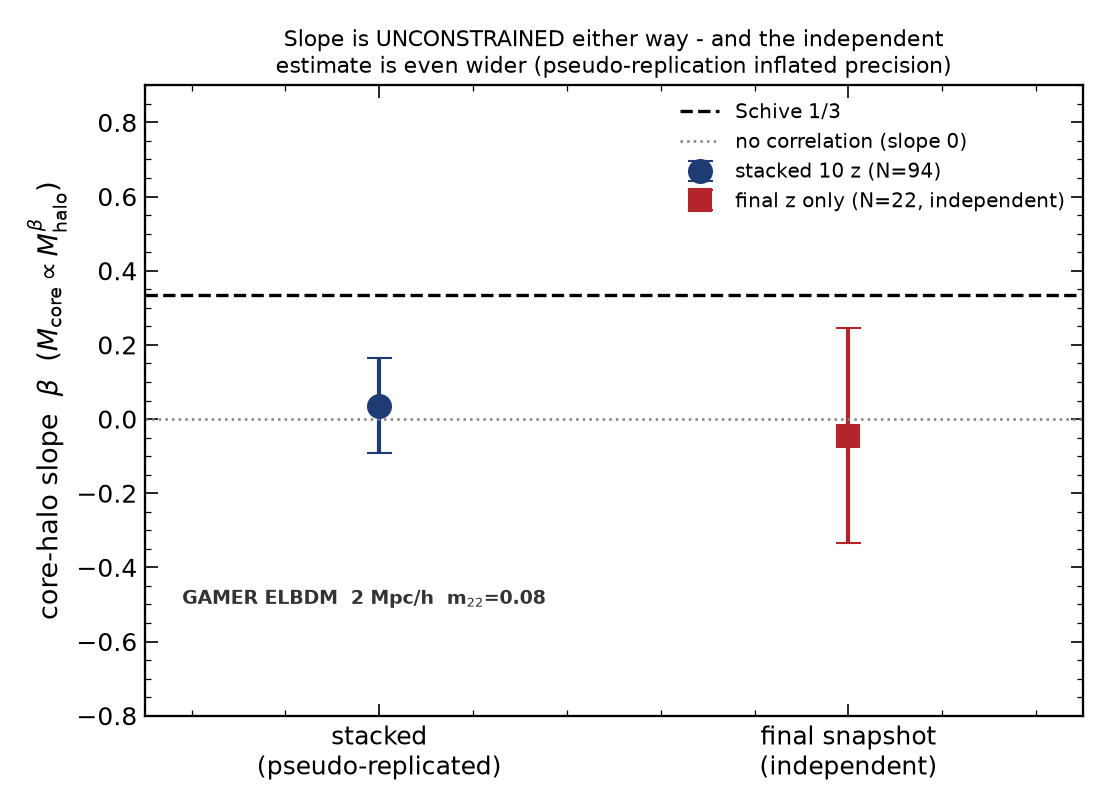
analysis in progressThe 2 Mpc box validates the solitons but is too narrow to pin the slope. Over only ~1.7 dex of halo mass the 3-seed fit gives a slope a = 0.04 ± 0.13 — consistent with 0, unable to confirm Schive's 1/3. The cause is geometric: too short a lever arm. The fix is a 20 Mpc zoom-in campaign for ≥3 dex of mass range.
FDM-vs-CDM halo mass function
qualitative · box-limitedThe ψDM high-mass suppression signature is visible — qualitatively. A matched FDM/CDM pair (same Gaussian field, same finder): CDM concentrates into one dominant ~2.2×10¹¹ M⊙ halo; FDM spreads its mass into 6–10 intermediate clumps with nothing above 8×10¹⁰. Quantitative needs a bigger box.
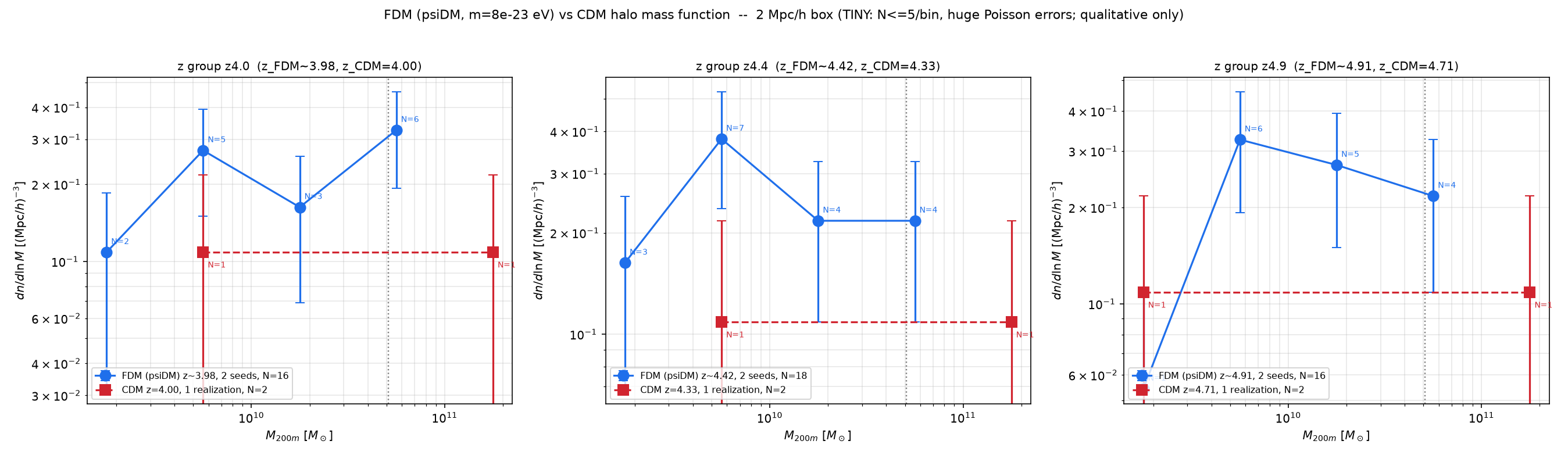
SBC · posterior calibration of the differentiable m-inference
✓ Report-5.2 · Notes-1.2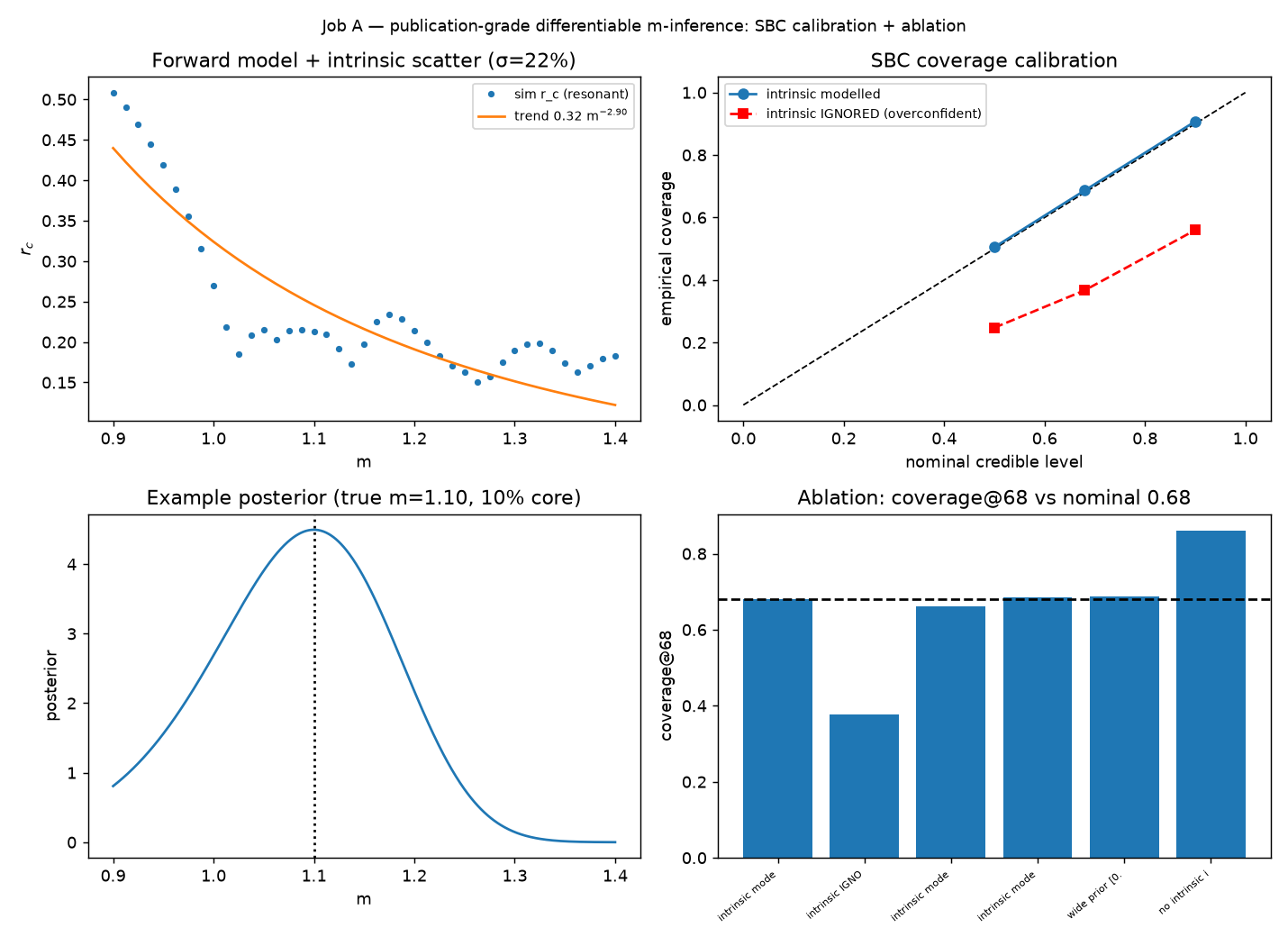
20 Mpc zoom-in campaign — Stage 1 catalog
running · z≈4The high-mass lever arm is being built now. Stage 1 of the 20 Mpc campaign identifies the halo catalog that Stage 2 will zoom and resolve. The current dump catalogs 150 halos in a 20 Mpc/h box at z≈4, spanning ~7.4×10⁸ – 1.5×10⁹ M⊙ — the seed list for the resolved-core run.
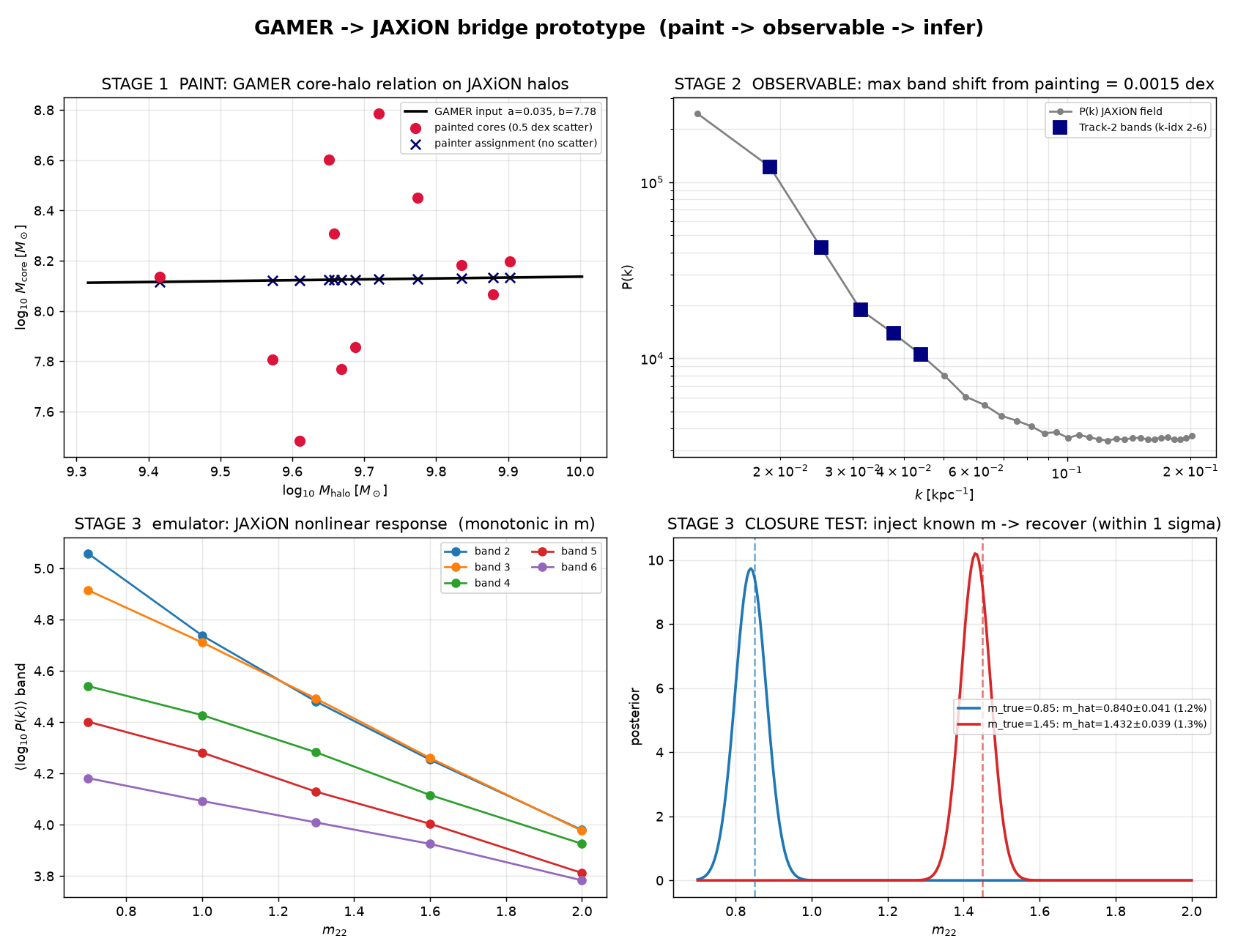
GAMER → JAXiON bridge
✓ closure passesThe two lanes connect end-to-end and the closure test passes. Paint the GAMER core–halo relation onto JAXiON's differentiable halos, build the large-scale observable, run the validated mass-inference engine — injected m recovered to ~1.2% within 2σ (~21 s wall).
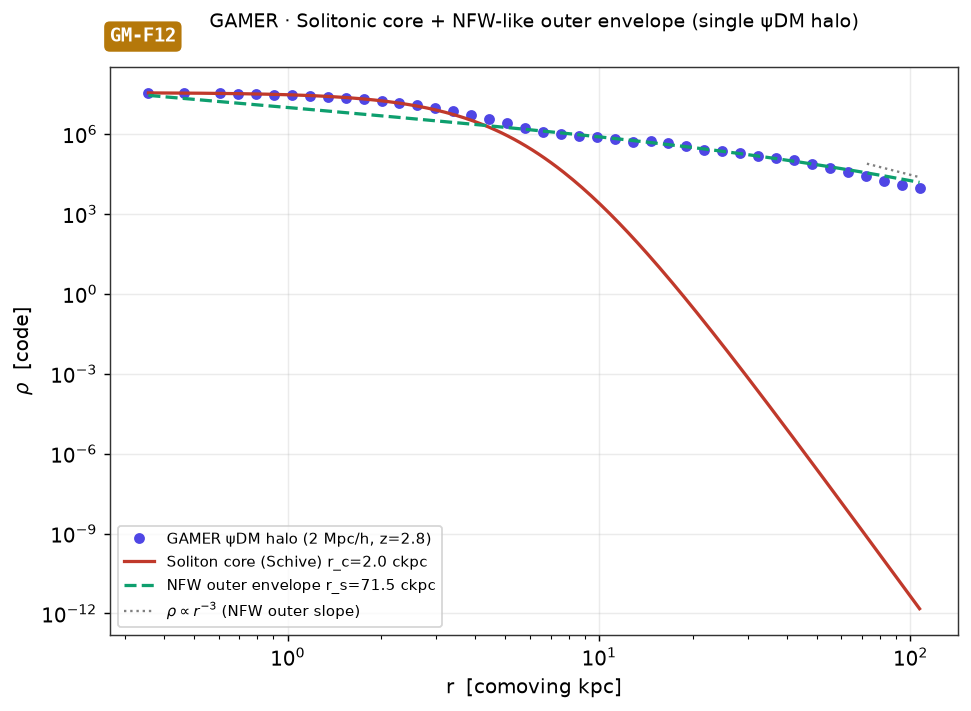
2 Mpc 3-seed core–halo catalog — 94 fitted Schive cores
✓ GAMER-420 Mpc preliminary catalog (z≈6) — resolution gate CLEAN
✓ GAMER-1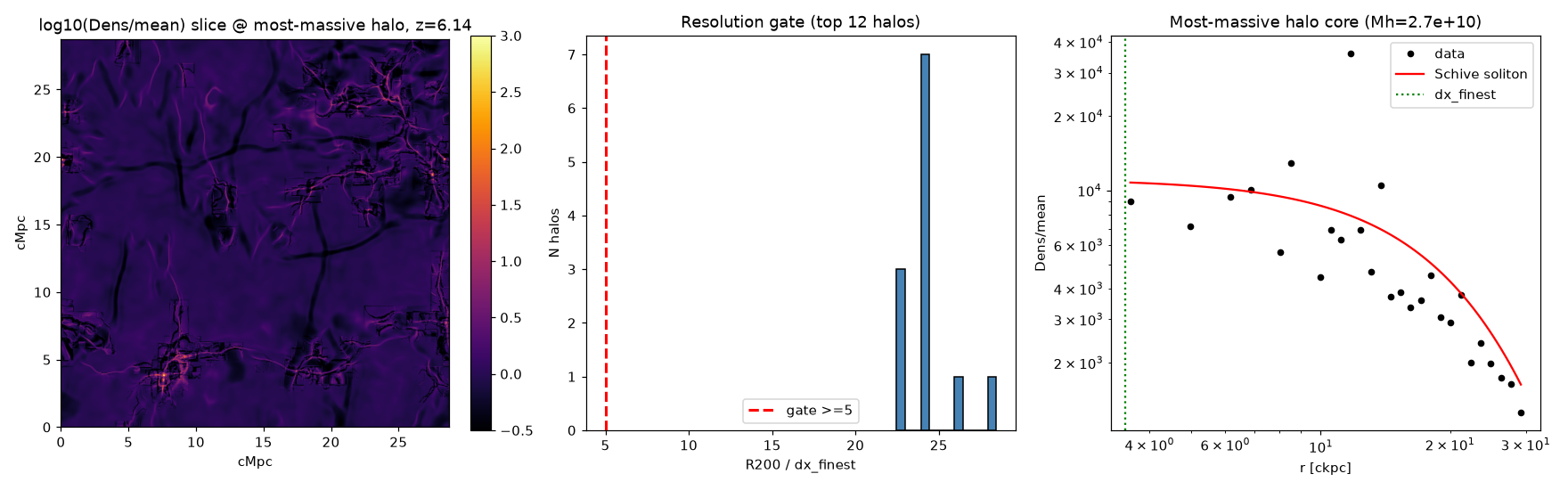
GAMER-9Ra · PRL-style multi-epoch stack (M_c·a1/2 vs M_h)
◐ GAMER-9 · executed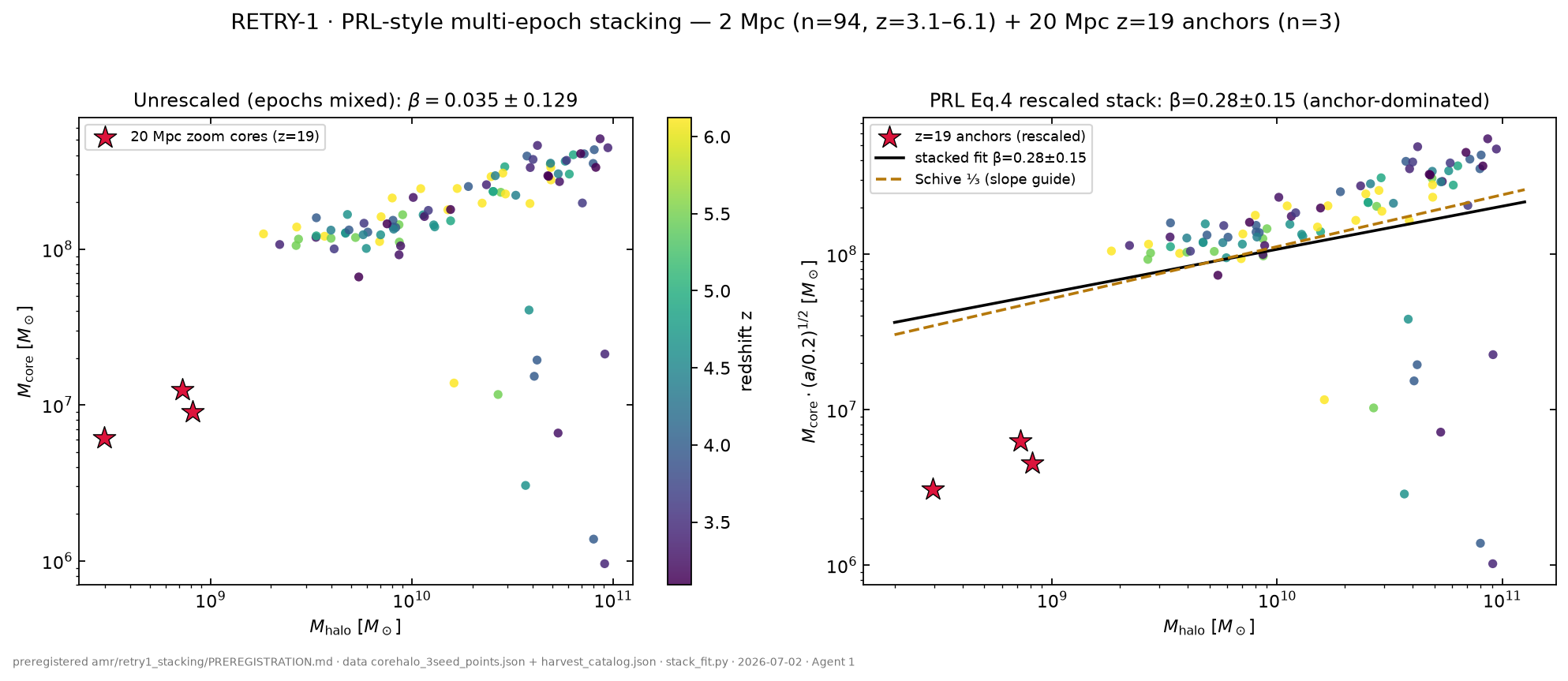
GAMER-5R · ρ₃₀₀ of our cores vs the MW-satellite band
◐ GAMER-5 · executed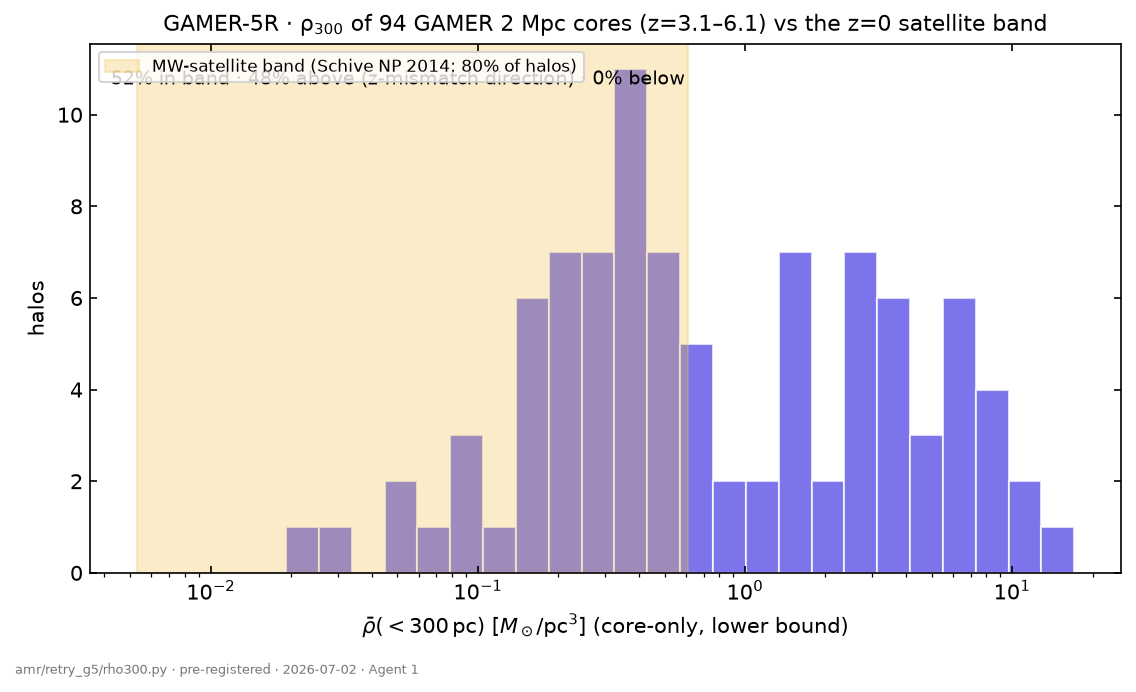
GAMER-7R · Milky-Way soliton σ from our painted relation
◐ GAMER-7 · executed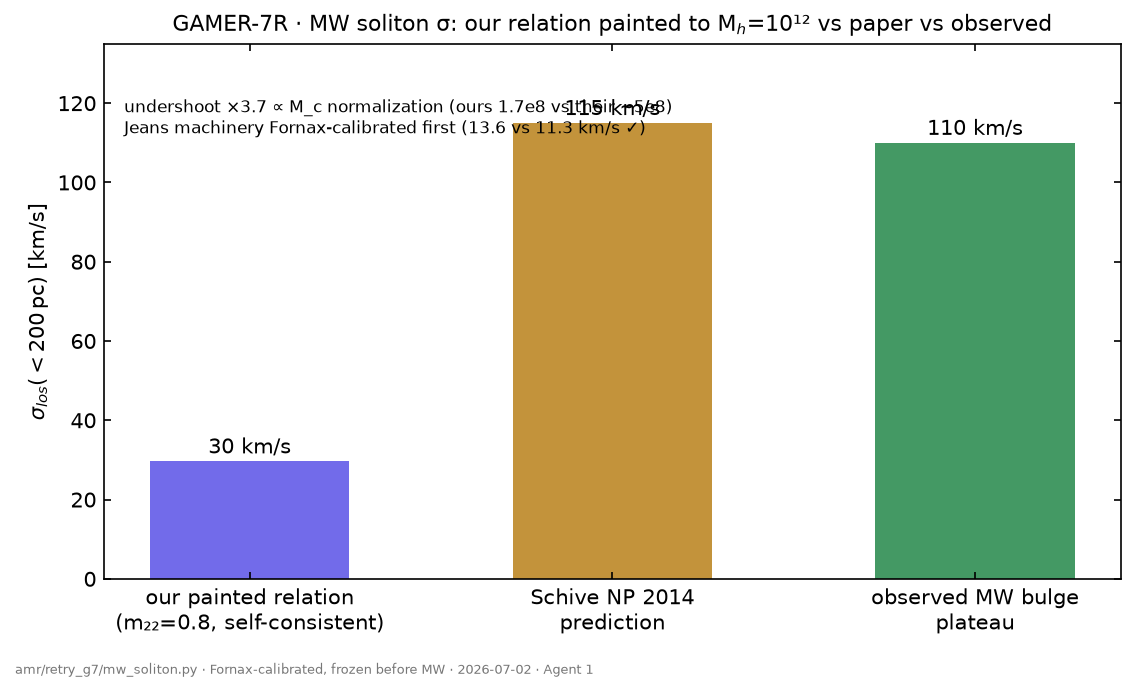
GAMER-8R · delayed first collapse — z_ff measured
✓ GAMER-8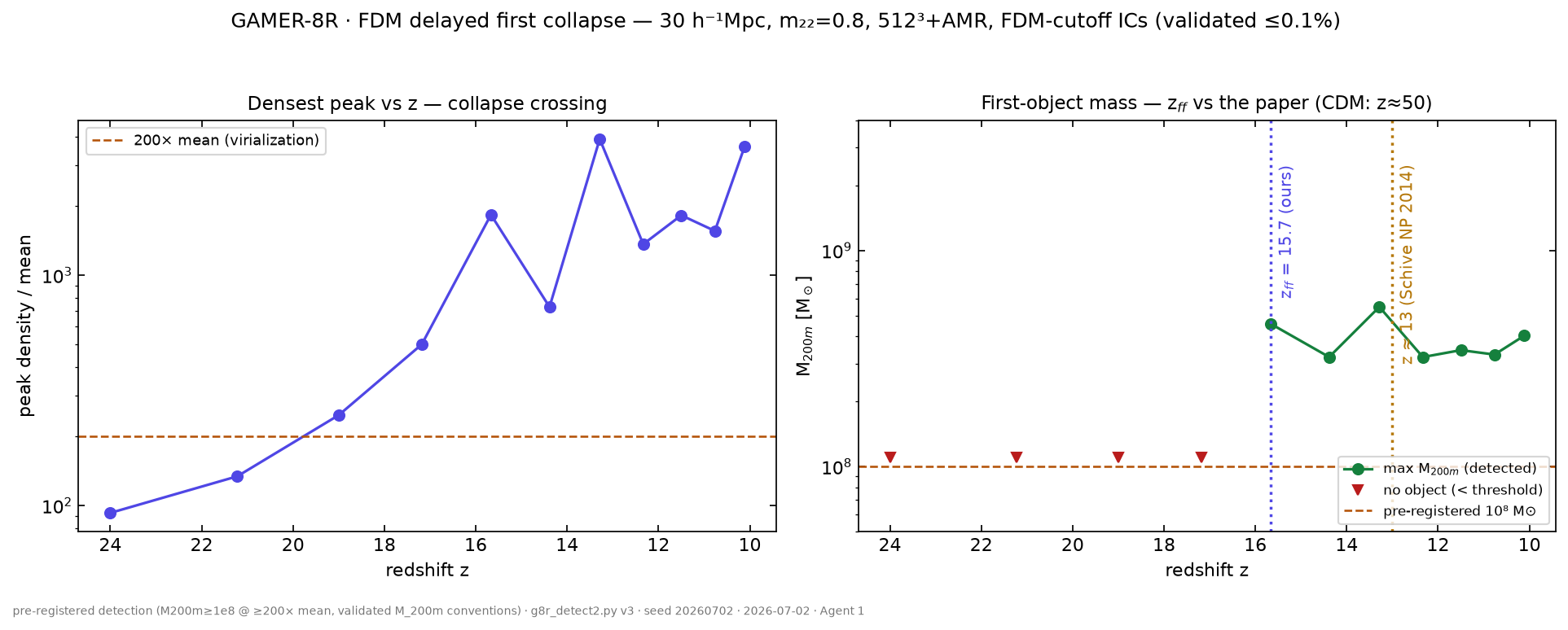
GAMER-8 · replication — first collapse across three committed seeds
✓ GAMER-8 · n=3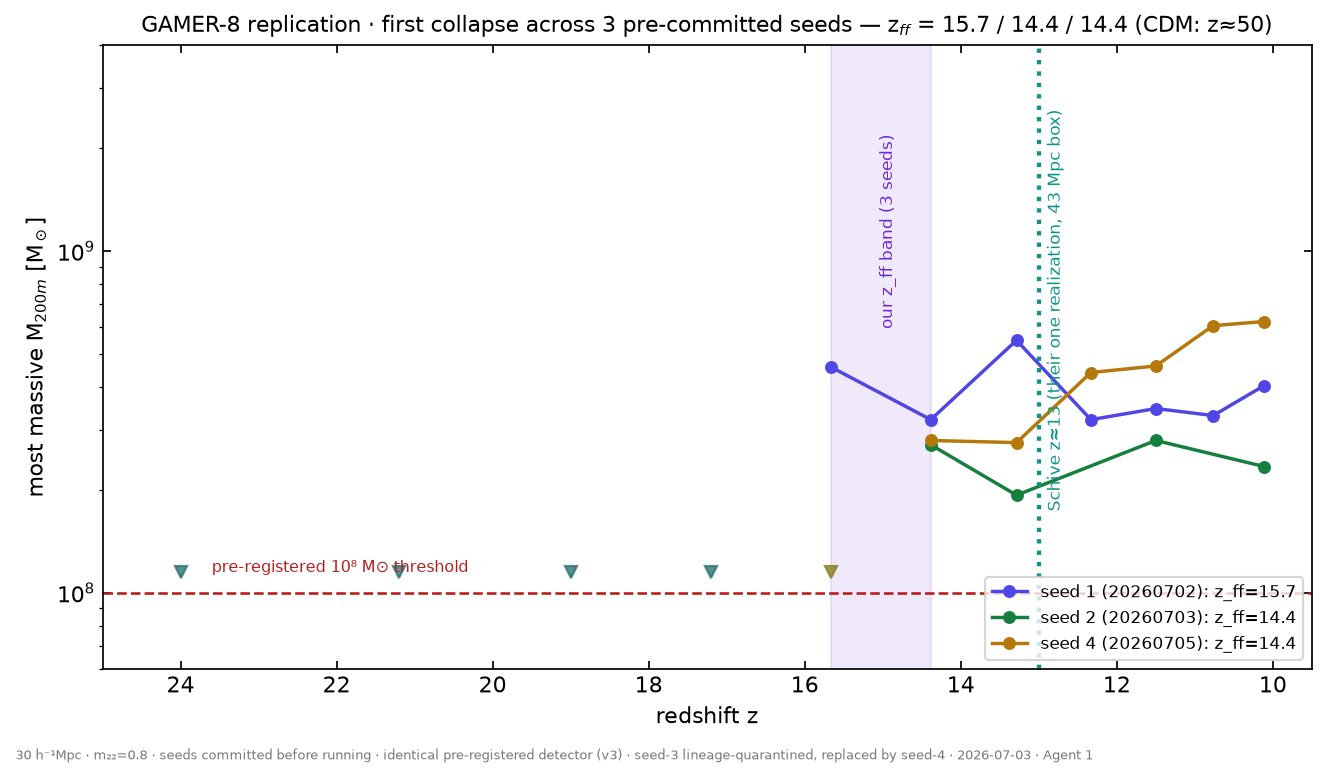
GM-F14 · merger α-grid — the Eq. 5 mechanism test (27 runs)
◐ GAMER-10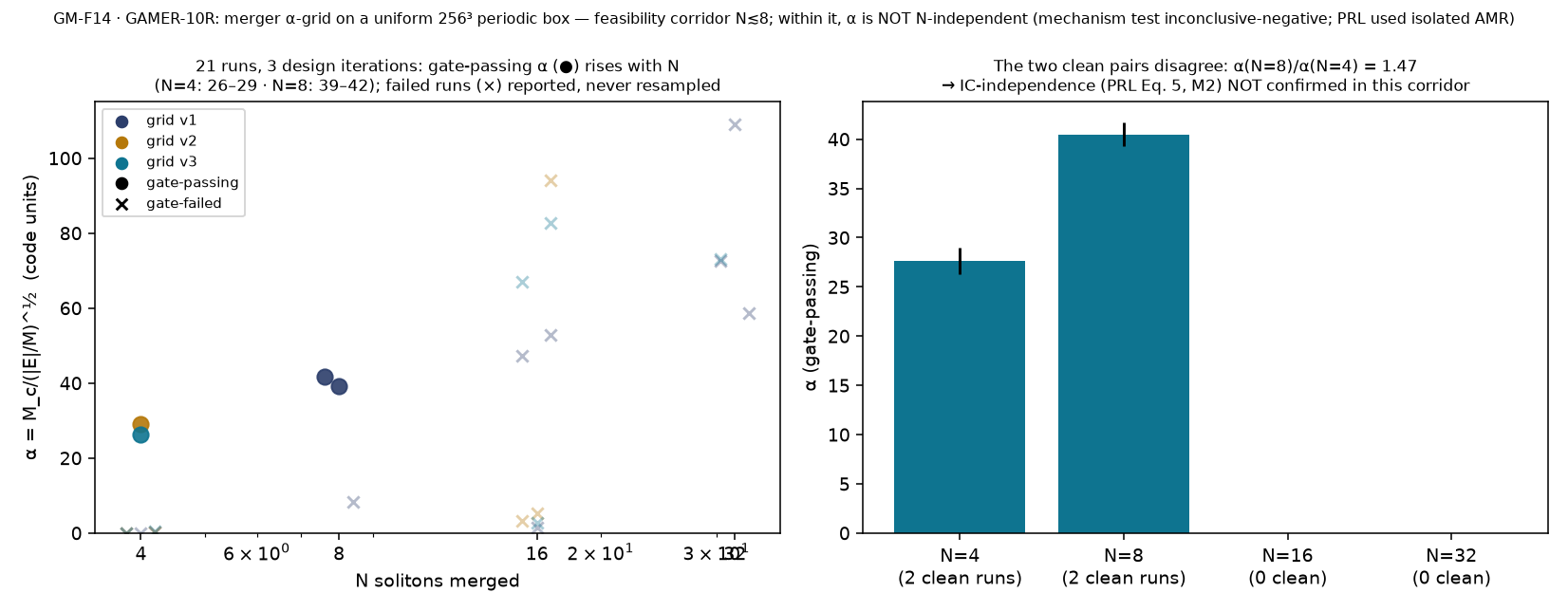
GM-F15 · α verdict in the PRL regime — the mechanism REPRODUCED
✅ GAMER-10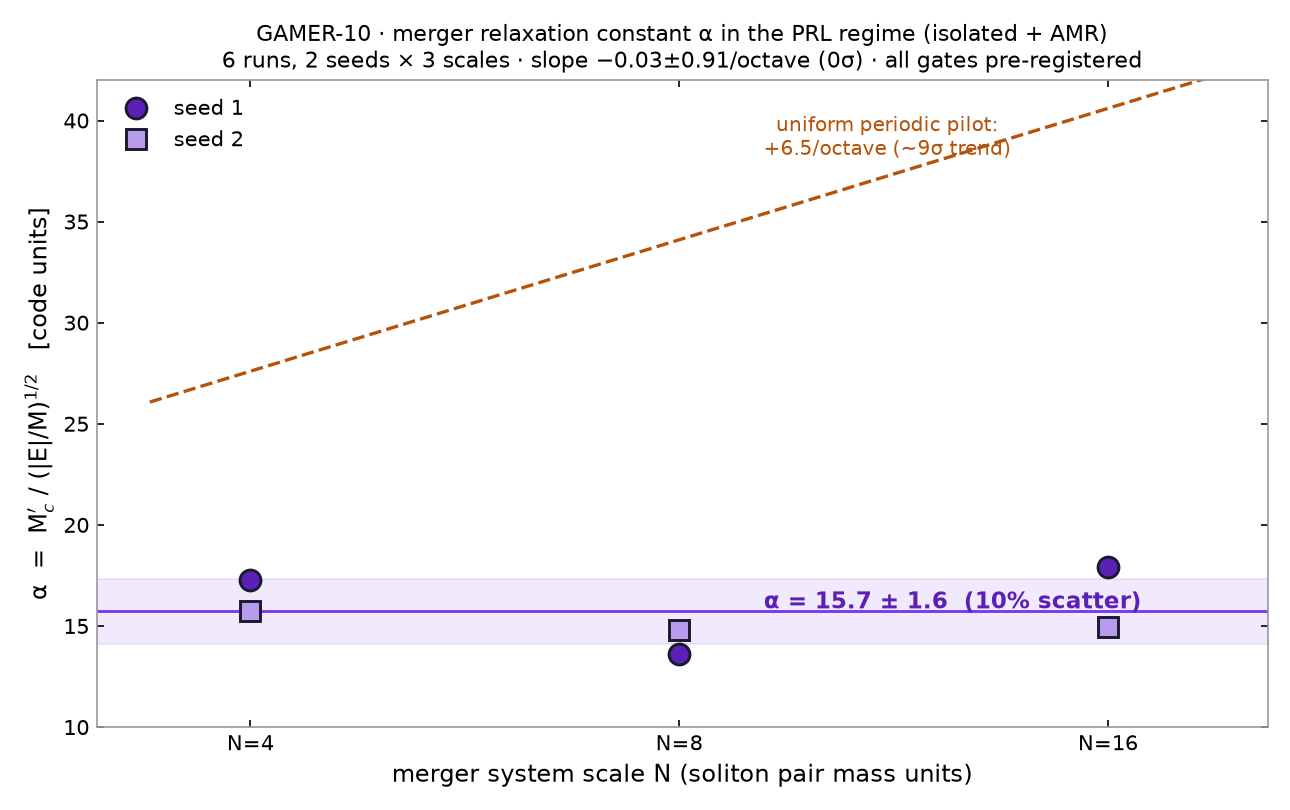
GAMER-3R2 · the interference network at production resolution
✓ GAMER-3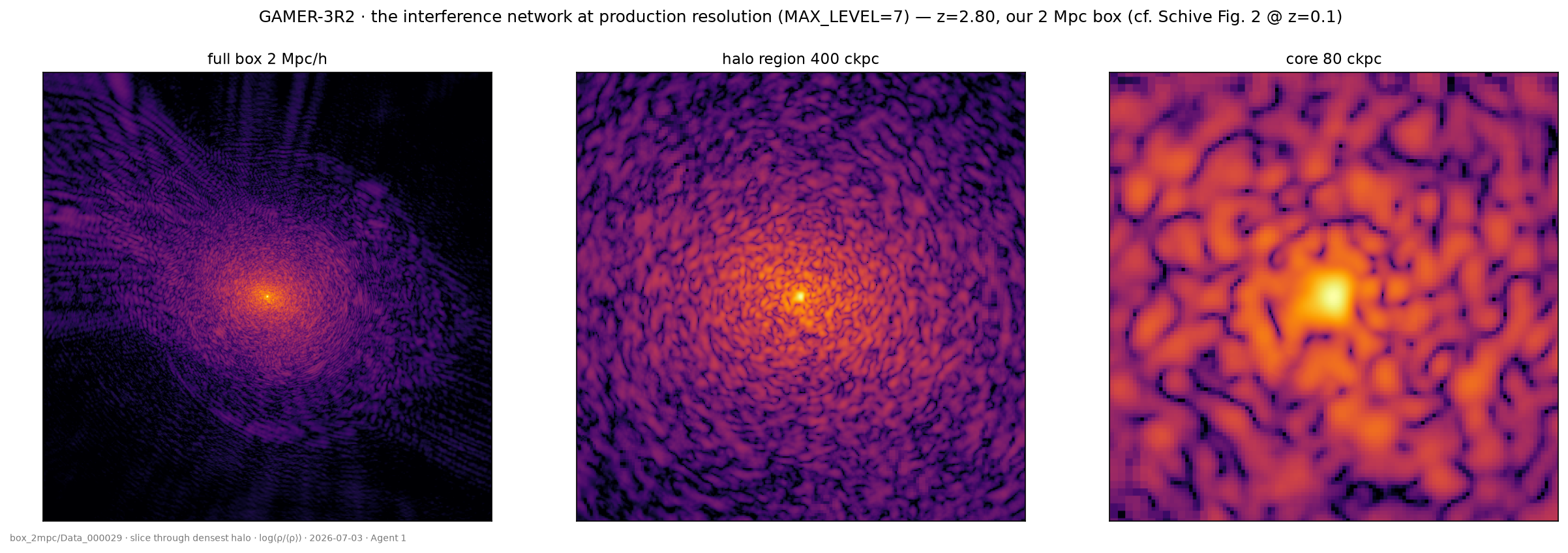
GAMER-2 · sim-vs-sim P(k) ratio — the FDM cutoff between two real simulations
✓ GAMER-2 · closes the last sub-item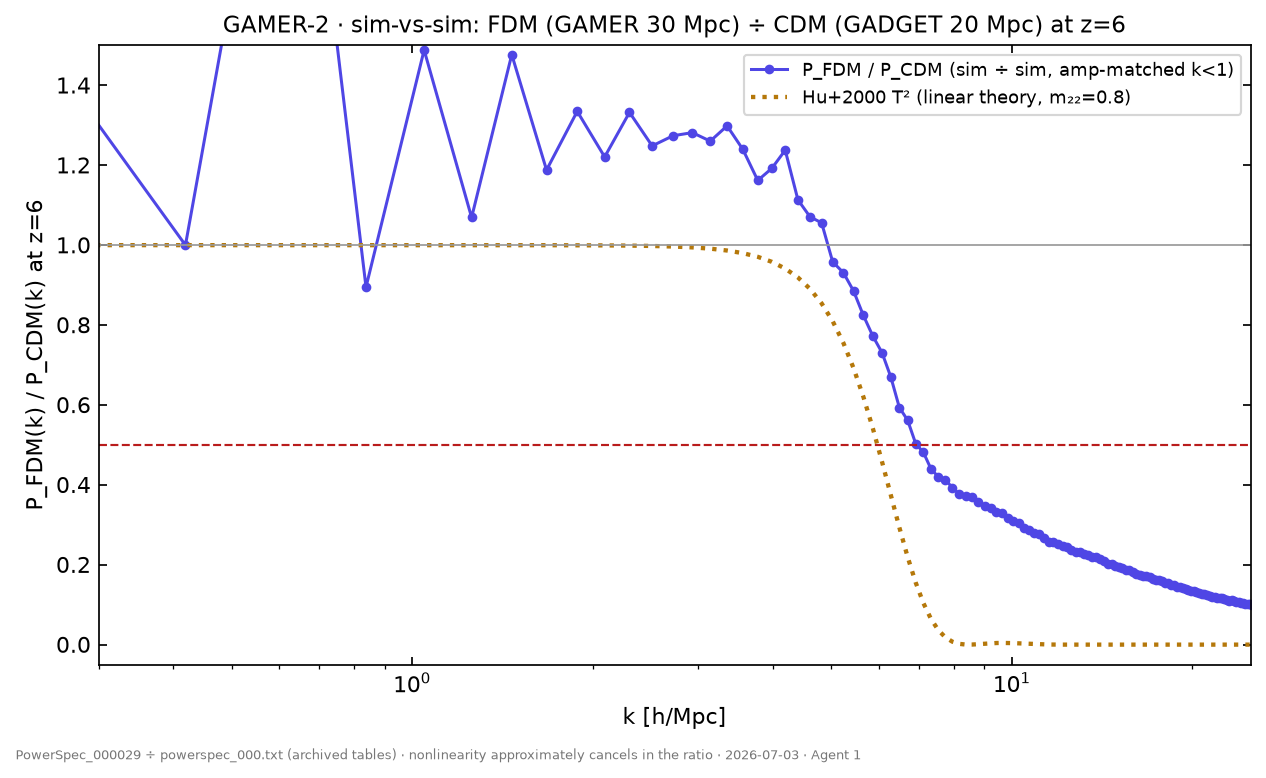
GAMER-12R · the minimum halo mass — quantum-pressure floor measured
✓ GAMER-12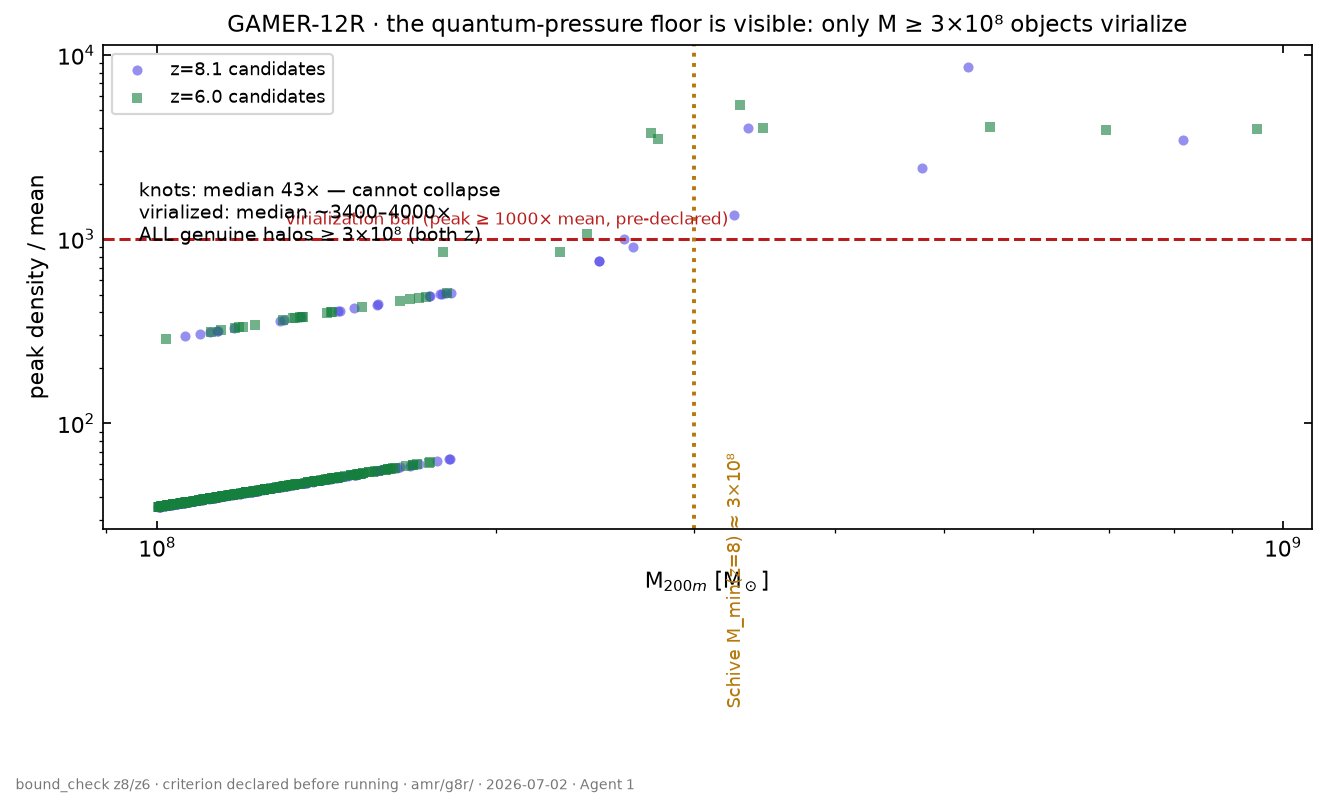
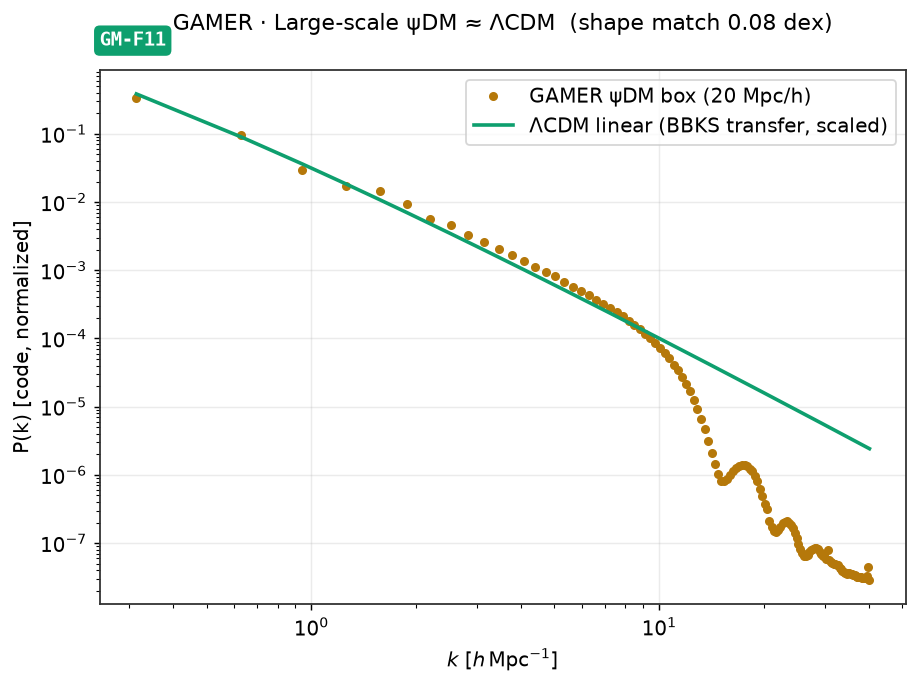
GAMER-2R · FDM vs CDM at z=6 — suppression + large-scale match
✓ GAMER-2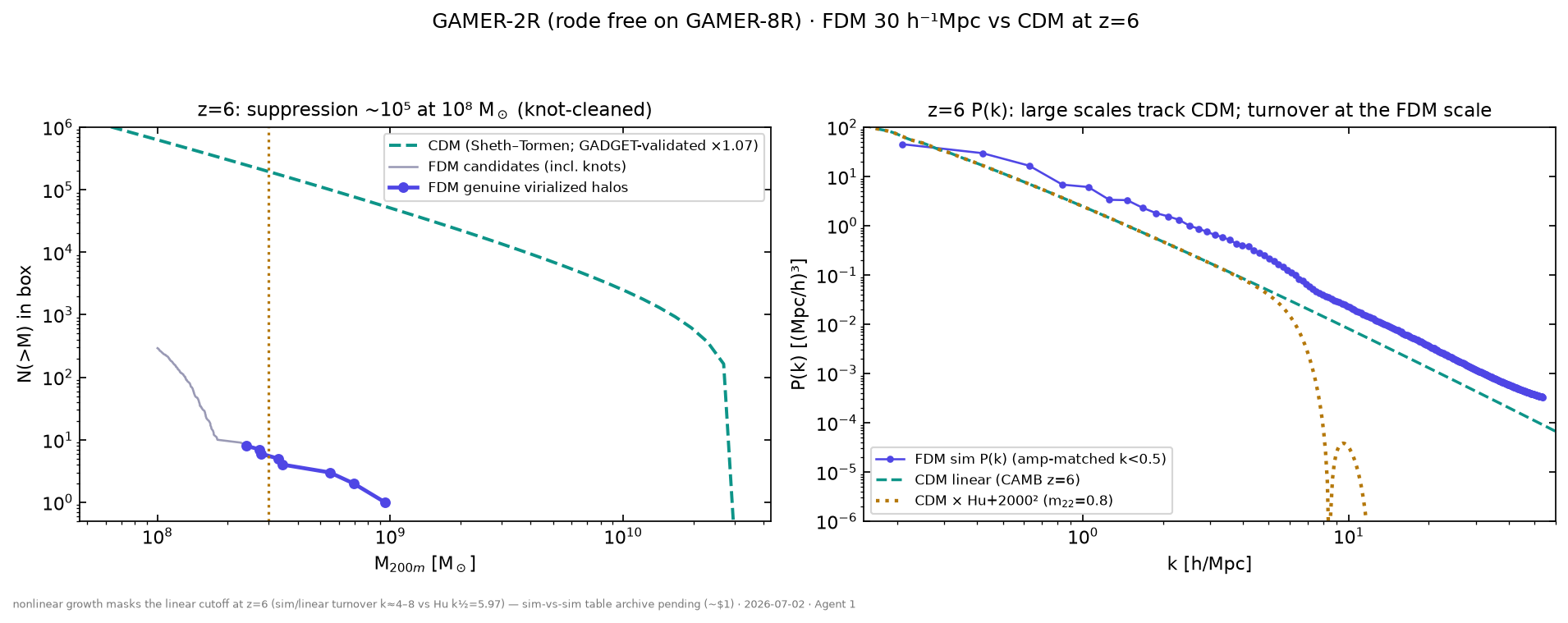
The GAMER program — reproducing Schive 2014.
A narrative of a publication-grade reproduction in progress: what we set out to prove, what is already validated, and what is honestly still pending. The pending headline is the core–halo slope.
The goal is to reproduce the fuzzy-dark-matter core–halo relation M_core ∝ M_halo^(1/3) to publication grade with GAMER's adaptive-mesh ELBDM solver — and to feed that relation into the JAXiON inverse problem. The solitons are validated; the slope needs a bigger box, which is running now.
1 · goalReproduce the cube-root core–halo law
Schive et al. (2014) predict that the solitonic core mass scales with host halo mass as M_core ∝ M_halo^(1/3) — the cube-root law that is fuzzy dark matter's structural signature. Reproducing it independently, at publication grade, is the target. GAMER is the right tool because its adaptive mesh resolves the dense soliton core cheaply, exactly where JAXiON's uniform grid fails (see the JAXiON Analysis convergence result).
2 · validateThe solitons are real
In matched 2 Mpc/h boxes across 3 random seeds, the densest GAMER cores fit the Schive (2014) profile cleanly — residuals < 2.5% — and obey the internal soliton scaling r_c ∝ ρ_c^−0.20 (Schive predicts −0.25). The core radii cluster at 0.20–0.26 kpc and central density correlates with host halo mass (r = +0.72). The Results tab carries the fit. This establishes that GAMER's cores are genuine solitons, not mesh artifacts.
3 · find the wall2 Mpc is too narrow to pin the slope
Fitting M_core vs M_halo within the 2 Mpc boxes gives a slope a = 0.04 ± 0.13 — statistically consistent with zero, and unable to confirm 1/3. This is not a bug: the 2 Mpc box only spans ~1.7 dex of halo mass, far too short a lever arm to measure a slope against the intrinsic core-mass scatter. The same limitation shows up in the bridge prototype, where painting the 2 Mpc relation onto 12 halos and re-fitting under realistic scatter recovers an over-constrained slope — a direct echo of the narrow mass span.
3b · the full 2 MpcWhat it settles, and what it can't
The completed 2 Mpc analysis (94 halos, 3 boxes) draws a sharp line between what is now settled and what remains untestable at this box size. Settled: the solitons are real and the fixed-mass Schive consistency holds (Results). Not settled: the core–halo slope itself. The stacked fit gives β = 0.04 ± 0.13, statistically consistent with zero — because the 94 halos span only 1.71 dex of halo mass, whereas resolving Schive's cube-root law against the intrinsic core-mass scatter needs roughly 3.6 dex of lever arm. This is a geometric limit of the box, not a physics failure — and it is the quantified motivation for the 20 Mpc campaign.
4 · scale upThe 20 Mpc zoom-in campaign
The fix is a three-stage 20 Mpc/h zoom-in campaign for the lever arm the 2 Mpc box lacks:
5 · connectThe bridge to JAXiON
The reproduction is not an end in itself — its product feeds JAXiON's inverse problem. The bridge paints the GAMER core–halo relation onto JAXiON's differentiable halos, builds the large-scale observable, and runs the validated mass-inference engine. The closure test passes: injected m=0.85 recovers to 0.84 (1.2%), m=1.45 recovers to 1.43 (1.3%), both within 2σ, in ~21 s wall. The painter reproduces the input relation to machine precision and the cores are sub-grid, so painting shifts the large-scale observable bands by <0.002 dex — they carry the mass signal cleanly.
The GAMER method — adaptive-mesh ELBDM.
GAMER solves the same Schrödinger–Poisson system as JAXiON, but on a patch-based, block-structured adaptive mesh with finite differences. Refinement concentrates resolution exactly on the soliton core — the feature a uniform grid cannot afford.
ELBDM = Extremely Light Bosonic Dark Matter: the Schrödinger–Poisson wavefunction evolved on a fixed Eulerian mesh, but one that adapts its resolution in space and time.
Same equations, different discretisation
The physics is identical to JAXiON — ρ = |ψ|², gravity sourced by the overdensity, the field feeling the potential:
The difference is how the operators are applied. Where JAXiON multiplies by $-k^{2}$ in Fourier space (spectral, uniform), GAMER uses a finite-difference Laplacian on a hierarchy of nested grid patches.
The patch-based AMR hierarchy
The domain is tiled by a coarse root grid. Wherever a refinement criterion fires, GAMER overlays a finer patch with half the cell size, and this nesting recurses: each level ℓ has $dx_{\ell} = dx_0 / 2^{\ell}$. Refinement is triggered by:
OPT__FLAG_RHO): refine any cell whose
density exceeds a level-dependent threshold — solitonic cores, being the densest features, refine to the
deepest levels.The payoff: the fine mesh exists only where the core is, so resolving a 0.2 kpc soliton inside a Mpc box costs a small fraction of what a uniform grid at that resolution would (which would be the hundreds-of-TB machine of the JAXiON convergence result).
The wave scheme and the timestep wall
On each patch the kinetic term uses a 4th-order finite-difference Laplacian and the update is done as a phase rotation of the complex field (a finite-difference analogue of the split-step propagator). Because the wave operator must resolve the de Broglie oscillation, the stable timestep scales as the square of the cell size:
This $\Delta t \propto dx^{2}$ is the notorious low-redshift timestep wall: as structure collapses and the finest levels reach very small dx, the timestep collapses quadratically and the run grinds down. To beat it in the high-z, smooth, fluid-like regime, GAMER can switch to a hybrid GRAMFE spectral scheme (a Gram–Fourier extension) that relaxes the timestep constraint where the field is well-resolved — accelerating the early evolution while the FD wave scheme handles the sharp collapsed cores.
Gravity: SOR / multigrid + root-grid FFT
Poisson is solved by FFT on the periodic root grid (fast, global) and by SOR or multigrid relaxation on the refined patches (local, with boundary values interpolated from the parent level). Finer levels are sub-cycled in time — a level-ℓ patch takes more, smaller steps per coarse step, since its CFL timestep is shorter — and the levels are synchronised at coarse-step boundaries.
Forward-only — and that is the point
Unlike JAXiON, GAMER is not differentiable: the AMR bookkeeping (patch creation/destruction, interpolation, sub-cycling) is not a clean autodiff graph. That is by design. GAMER's job is not inversion — it is to resolve the cores from first principles and produce the converged core–halo relation. That relation is the input the JAXiON inverse problem consumes.
GAMER (forward, resolves cores) ↔ JAXiON (inverse, infers m). GAMER pays the adaptive-mesh cost to get the core–halo physics right; JAXiON pays the differentiability cost to invert it. Painting GAMER's relation onto JAXiON's halos and recovering the injected mass to ~1.3% is the round-trip that proves the two codes speak the same physics.
The Diff. AMR lane — what held, what died, and why.
The differentiable-methods program in full: the foundations are validated (exact gradients through adaptive machinery, √-memory adjoint, SBC-calibrated boson-mass inference) and the adaptive-resolution architectures are adjudicated — four candidates, every verdict by pre-registered bars, all three testable designs killed by ONE measured mechanism. Cards DAMR-F1…F4 below are the record, good and bad. The GRAMFE hybrid archive (this lane’s previous life) follows.
The Diff. AMR program — the arc in one card
Phase A completeRepurposed 2026-07-02 (Mukesh): this lane now hosts the differentiable-AMR methods program — the post-replication flagship. The honest arc so far: Phases 0–1 ✅ exact gradients through adaptive machinery (AD/FD = 0.999–1.011, verdict GO) · Phase 2 ✅ cosmological adjoint (√-memory checkpointing; inversion closure bias −1.5%) · Phase 3 ❌ method limit — two-field block-AMR cannot hold a dynamical sub-grid soliton (fine block captured 1–3% of reference at m≥2): FFTs are global, block refinement is local · the science goal it served was delivered on the uniform solver (SBC-calibrated boson-mass inference, the 8.7σ tension) · the GRAMFE hybrid below was ruled out as a dt-wall lever (~15× slower at matched 128³, core 19× under-dense). Phase A down-select — COMPLETE 2026-07-05, every verdict pre-registered: R2 core-oracle ✗ NO-GO (43%/207% vs ≤20% — DAMR-F2) · R4 flux-conserving two-field ✗ NO-GO (22.9% vs ≥50%, boundary exonerated — DAMR-F3) · R1 Schwarz swap void-closed (patch evacuates pre-collapse — DAMR-F4) · R3 wavelet parked. The three failures share one measured mechanism (boundary-fed patches cannot track streaming collapse) — the program’s publishable methods negative. Fallback engaged: the validated uniform differentiable stack (DAMR-F1) carries the science. Successor candidates (boundary-free: adaptive coordinates / multiresolution basis) need a fresh GO. Record in Lab notes → Diff. AMR.
DAMR-F1 · The validated foundations — gradients, adjoint, and calibrated m-inference (the good result)
✅ validated · DAMR-1/2/5
DAMR-F2 · R2 (analytic-core oracle): premise NO-GO — pre-registered, nine honest iterations
✗ R2 closed · DAMR-7/8
DAMR-F3 · R4 (two-field + flux-conserving boundary): NO-GO — the boundary exonerated, the formulation indicted
✗ R4 closed · DAMR-9
DAMR-F4 · R1 (single-field Schwarz swap) void-closed → Phase A CLOSED: three failures, one finding
Phase A final · DAMR-10
GRAMFE hybrid archive — this lane’s previous life (validated capability, revivable for cluster scale)
archiveGRAMFE hybrid solver — VALIDATED capability
✓ validatedThe hybrid solver is built and correct. The GRAMFE (Gram–Fourier extension) spectral-fluid scheme reproduces the finite-difference wave solver to 8 parts per million on matched test problems, and it runs under true 8-GPU MPI parallelism — real domain-decomposed multi-GPU, not a single-device proxy. This is a working, validated capability.
The Diff. AMR program — what failed, what shipped, what’s next.
The hybrid exists to push fuzzy dark matter to cluster-scale boxes the pure wave scheme cannot afford. Here is what it buys, and the honest ROI call that paused its big run.
GRAMFE is a speed lever for the high-redshift, large-box regime: it runs a fast spectral-fluid solver where the field is smooth, and hands off to the wave solver on refined halos at low redshift where quantum interference forms. We built it for the 40 Mpc cluster lever arm — then paused it because the 20 Mpc headline already constrains the science it would have sharpened.
1 · the bottleneckThe wave scheme is slow at high redshift in big boxes
The finite-difference wave solver (GAMER lane) carries a Δt ∝ dx² timestep wall: in a large box at high redshift the field is smooth and fluid-like, yet the wave scheme still pays the full quantum-oscillation cost everywhere. For a 40 Mpc cluster box that early evolution dominates the wall-clock budget.
2 · the leverSpectral-fluid where it is smooth, wave where it is sharp
GRAMFE runs a spectral local-fluid (Madelung) solver on coarse levels, which is far faster at high redshift because it does not resolve every de Broglie oscillation. As structure collapses and refined halos form at low z, the scheme switches to the wave solver exactly where quantum interference forms — the regime where the fluid description breaks and the wave physics matters. You pay the wave cost only where it buys physics.
3 · the ROI callWhy we paused the 40 Mpc run
The 40 Mpc run was launched and reached z ≈ 55. At that point we made a deliberate, honest call: the 20 Mpc zoom-in campaign plus the 2 Mpc validation already span the core–halo slope the program needs. The marginal science of pushing the 40 Mpc box to completion did not justify its cluster cost — so we deprioritized it for ROI, not because anything broke. The solver is validated and checkpointed.
The GRAMFE method — spectral fluid + switched wave.
GRAMFE = Gram–Fourier Extension. It is a hybrid integrator: a spectral local-fluid scheme on coarse levels and the finite-difference wave scheme on refined levels, with the switch triggered by the onset of quantum interference.
The same Schrödinger–Poisson physics, but solved with two complementary schemes stitched across the AMR hierarchy — fluid where the field is smooth, wave where it interferes.
Two descriptions of one field
The wavefunction admits a Madelung (fluid) form $\psi = \sqrt{\rho}\,e^{iS/\hbar}$, mapping the complex field onto a density $\rho=|\psi|^2$ and a velocity $\mathbf{v}=\nabla S/m$. In this form the dynamics look like a fluid with an extra quantum-pressure term:
Where the field is smooth (high redshift, coarse levels) the fluid form is well-behaved and cheap. Where streams cross and the wavefunction interferes (collapsed halos, low redshift) the Madelung velocity becomes multi-valued and the fluid form fails — that is exactly where the wave form must take over.
Spectral fluid on coarse levels (the GRAMFE part)
On the coarse levels GRAMFE evolves the fluid form with a spectral method. The "Gram–Fourier extension" smoothly extends each non-periodic patch into a periodic super-domain so an FFT can be applied without Gibbs ringing at the patch boundary — giving spectral accuracy on a finite, refined patch.
The scheme switch — triggered by interference
The hybrid's defining move is where it changes scheme. On refined levels, once the field develops the interference fringes that signal the fluid form's breakdown (multi-valued velocity, density nodes), the solver switches to the finite-difference wave scheme — evolving $\psi$ directly so the quantum interference is captured exactly, at the cost of the $\Delta t\propto dx^2$ timestep on those patches only.
Net effect: the fast fluid solver carries the expensive high-redshift, large-box evolution, and the exact wave solver is spent only on the refined halos at low z where quantum interference forms. That is the lever that makes a 40 Mpc cluster-scale FDM box tractable.
GRAMFE is the cluster-scale capability of the program: spectral-fluid speed at high redshift, exact wave physics on the cores. Validated to 8 ppm vs finite differences under 8-GPU MPI — built, correct, and revivable. The 40 Mpc science run is paused on cost, not on the solver.
The GADGET-4 lane — the trustworthy control.
A standard cold dark matter N-body run with GADGET-4. Its job is to be the honest no-FDM baseline: the universe with no soliton core, no quantum interference, so every FDM-specific effect can be checked against a control that has none. Reproduces standard cosmology from scratch.
Live: 512³ production run → z=0
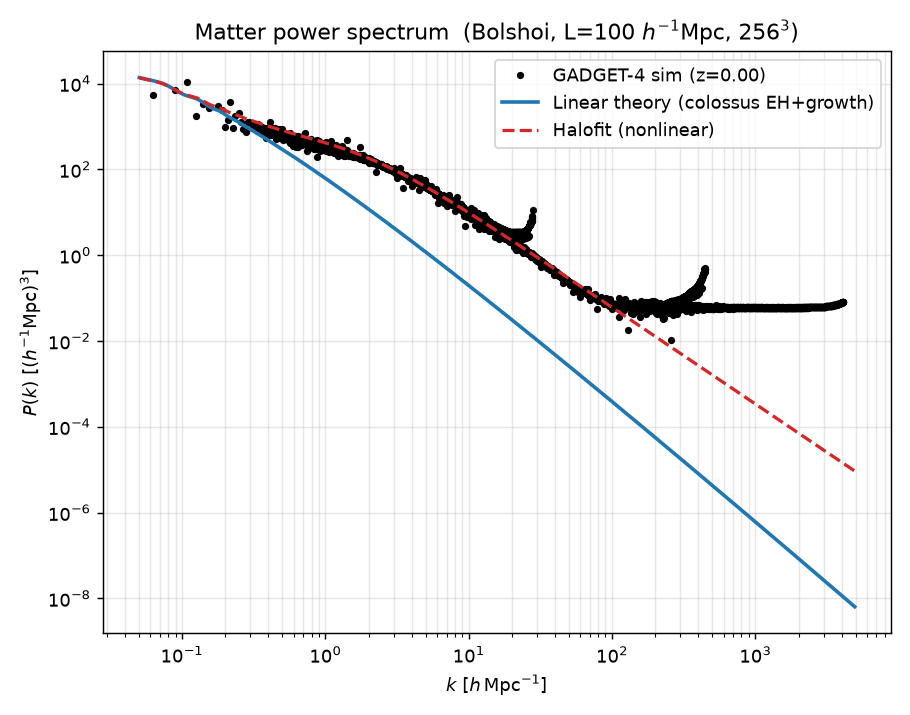
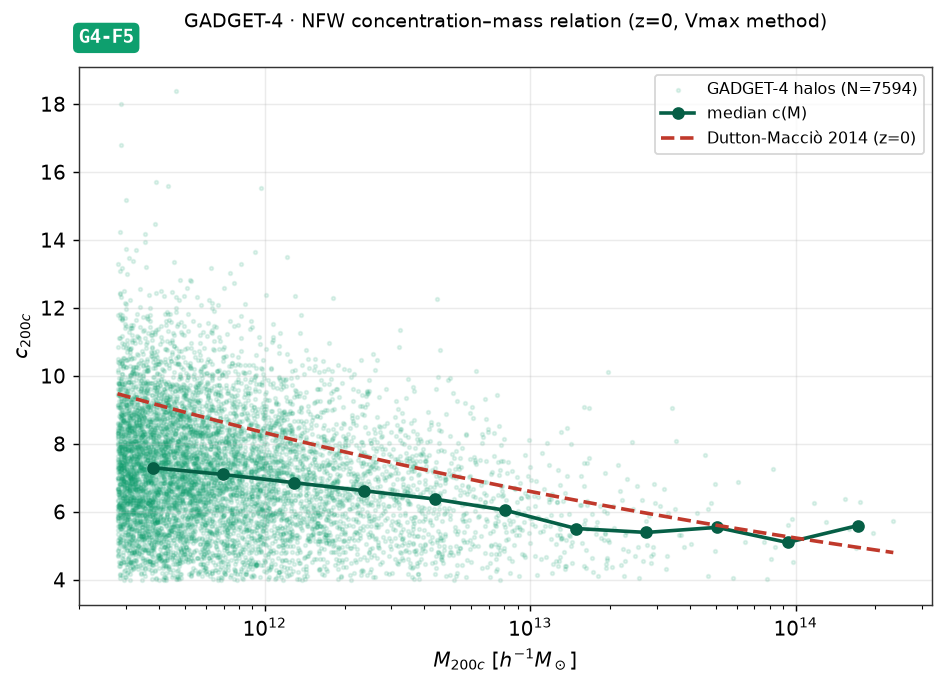
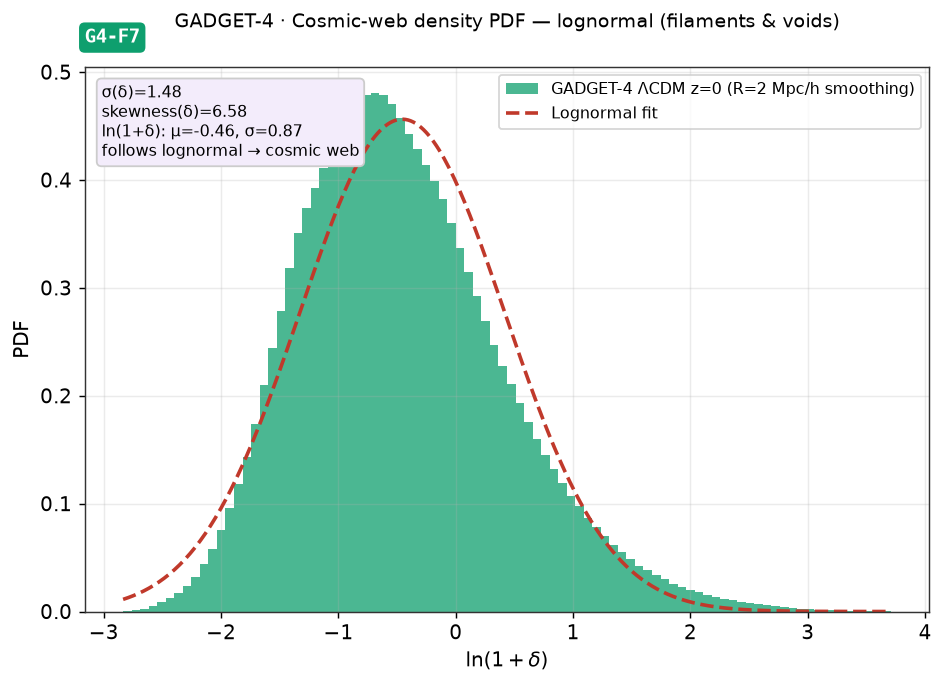
● in progressThe full-resolution control, evolving to today. The 256³ validation already reproduces the standard halo mass function (within ~4% of Sheth–Tormen/Tinker) and matter power spectrum (within ~3%). The 512³ production run (8× the particles, Bolshoi ΛCDM, L=100 h⁻¹Mpc) is running now (z≈0.3 → 0) and will replace the 256³ baseline at z=0 — then the side-by-side FDM-vs-CDM figure (fewer small halos, cored centres), which is the whole reason the control exists.
GADGET-4 reproduces standard cosmology from scratch
✓ validated · 256³The control run recovers ΛCDM structure to within a few percent of theory. A 256³ GADGET-4 box, evolved from 2LPT initial conditions, reproduces the halo mass function within 4% of Sheth–Tormen / Tinker and the matter power spectrum within 3% of linear-theory + nonlinear expectation. This is the trustworthy no-FDM baseline.
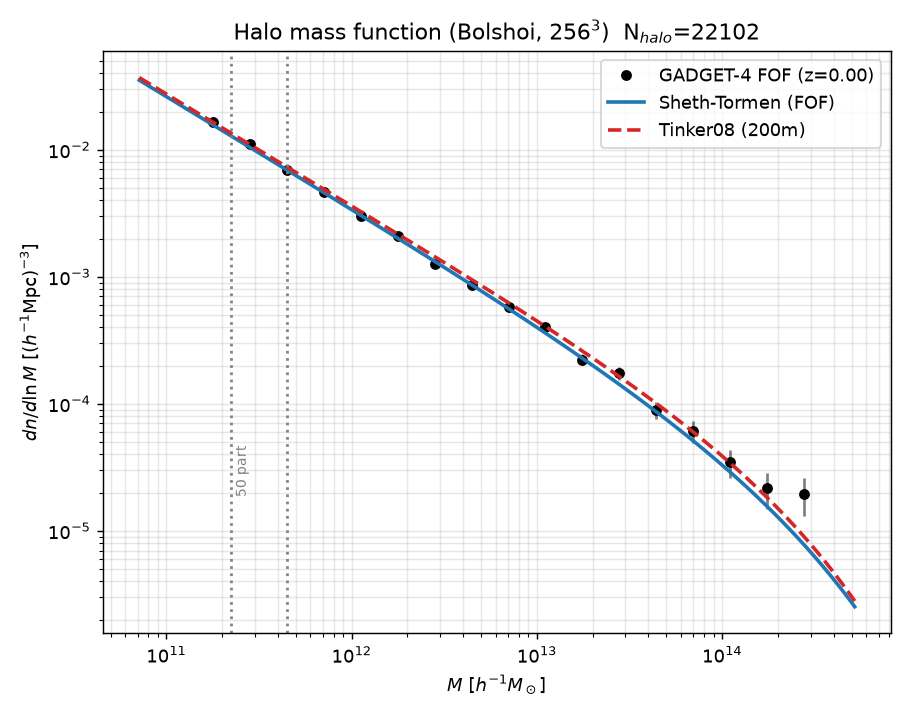
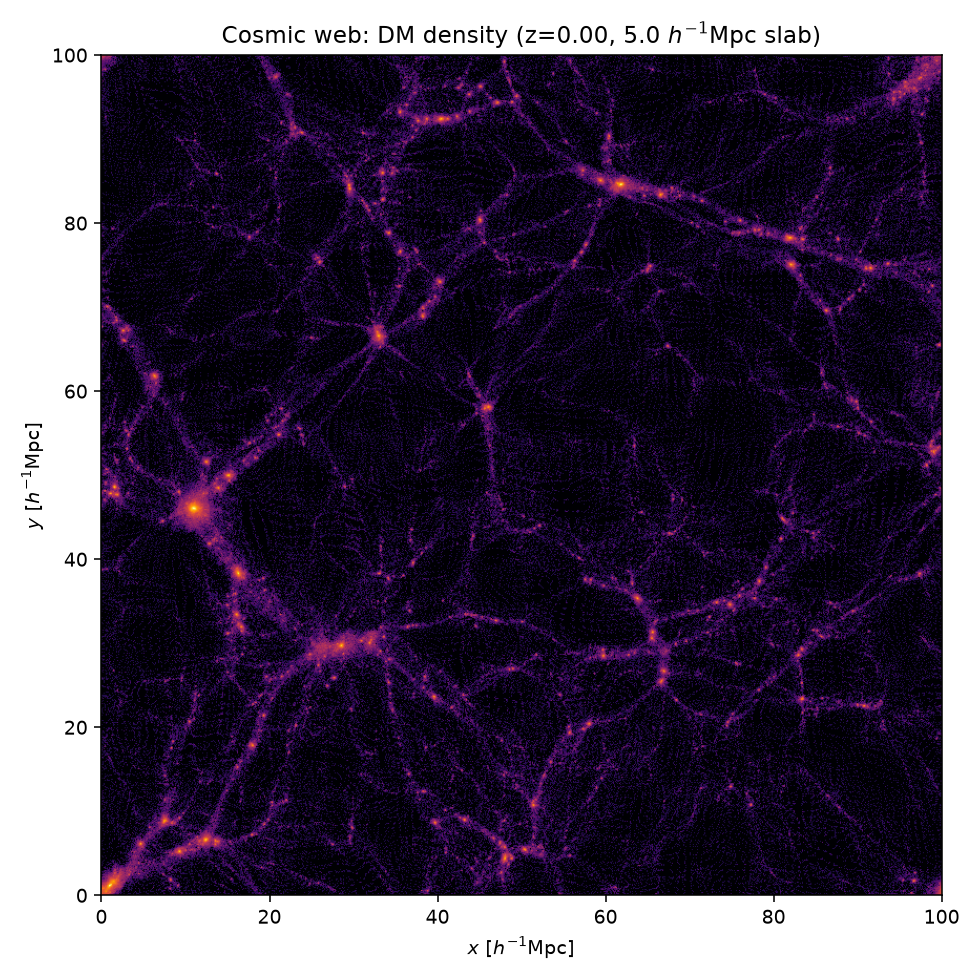
20 Mpc CDM control · halo mass function
✓ Ledger-4.b · Report-3.8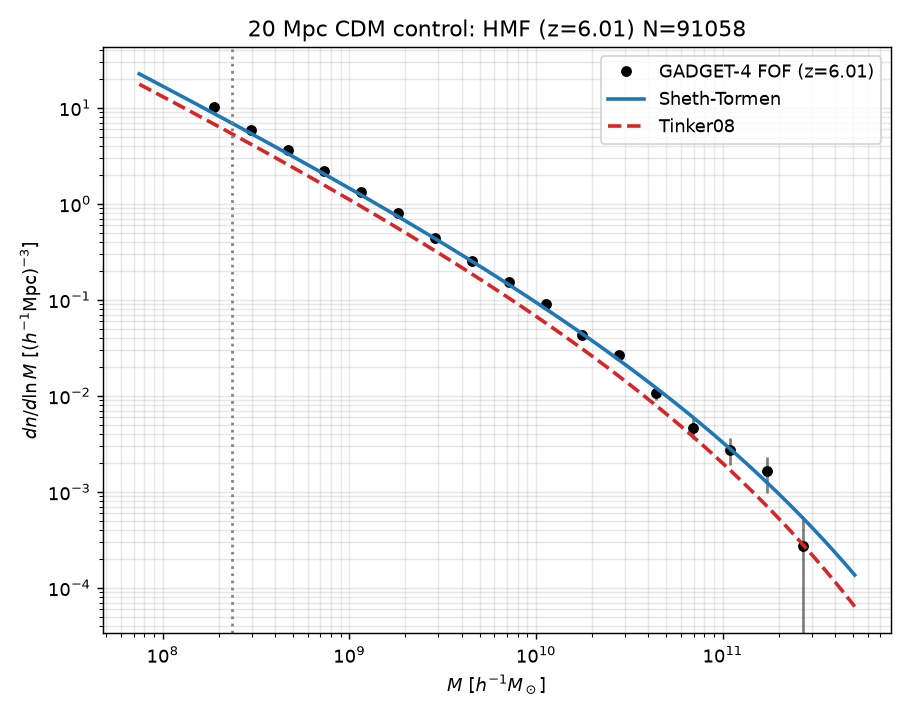
20 Mpc CDM control · P(k), linear → Halofit
◐ Report-3.9 · stat-limited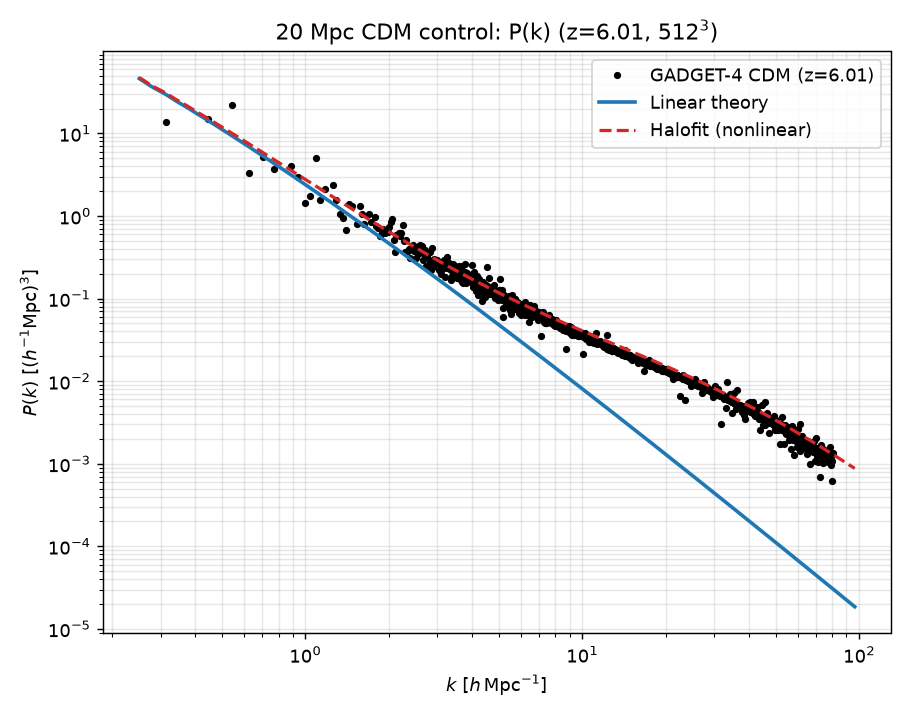
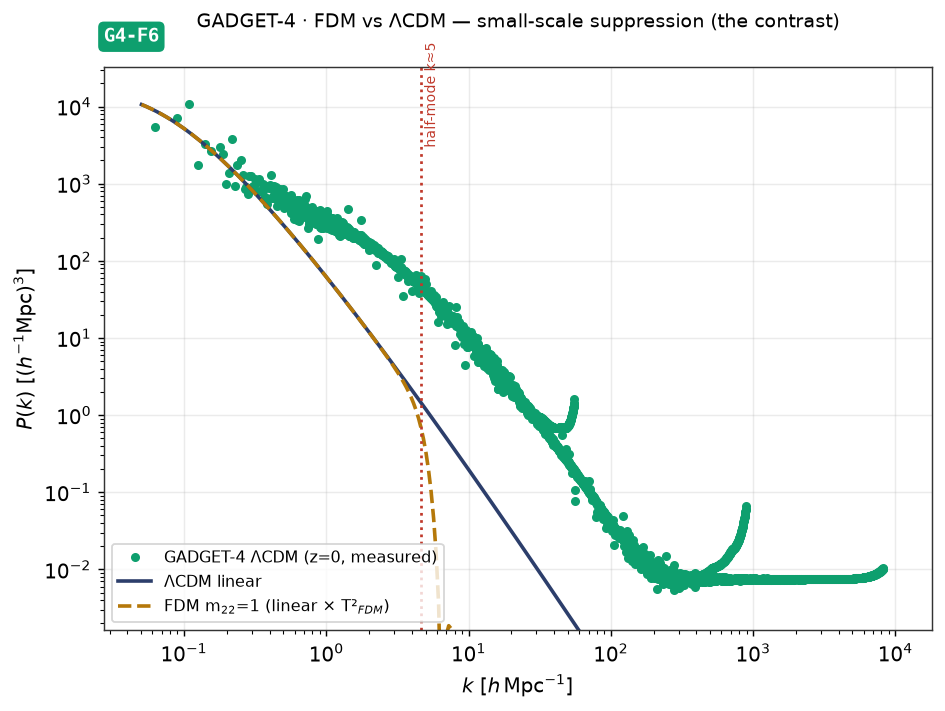
FDM-vs-CDM contrast — CDM sim × Hu+2000 analytic transfer
✓ Report-3.7 · analytic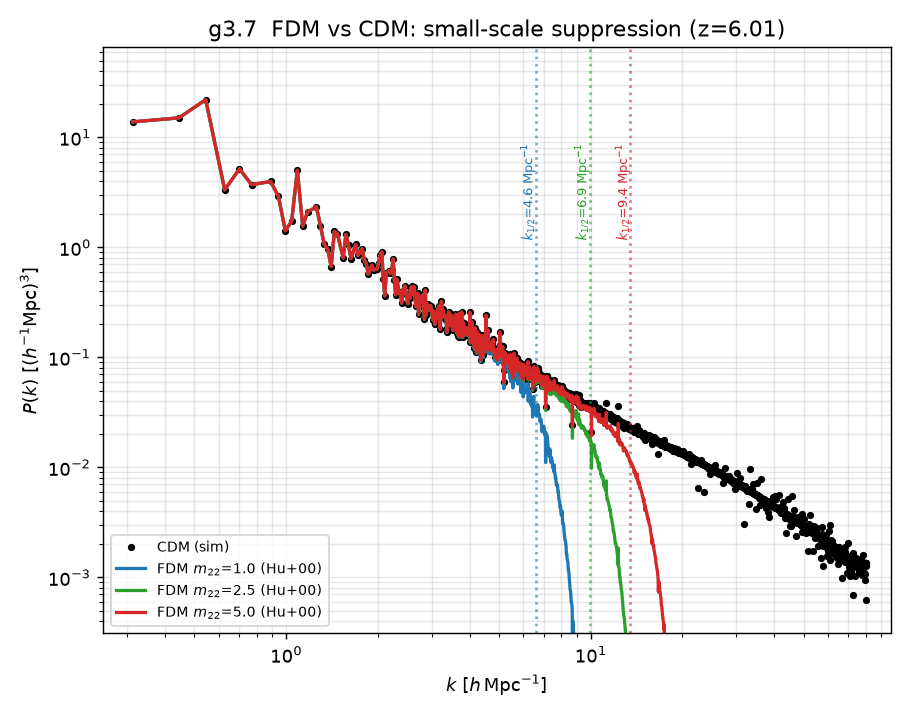
G4-F11 · FDM-IC vs CDM — the halo-mass cutoff, sim-vs-sim
✓ Ledger-4.c · FDMIC · May & Springel route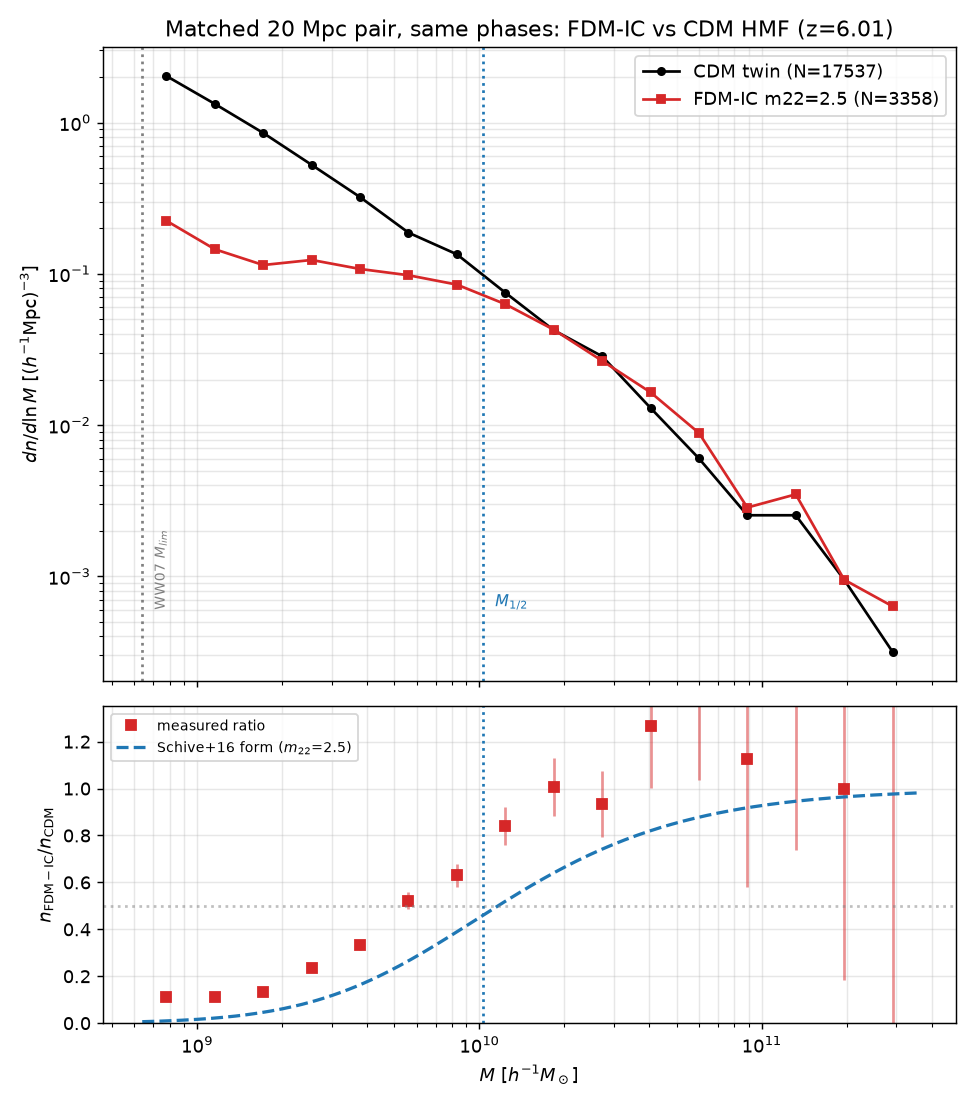
G4-F12 · FDM-IC vs CDM — P(k) suppression and nonlinear refill
✓ Ledger-4.c · FDMIC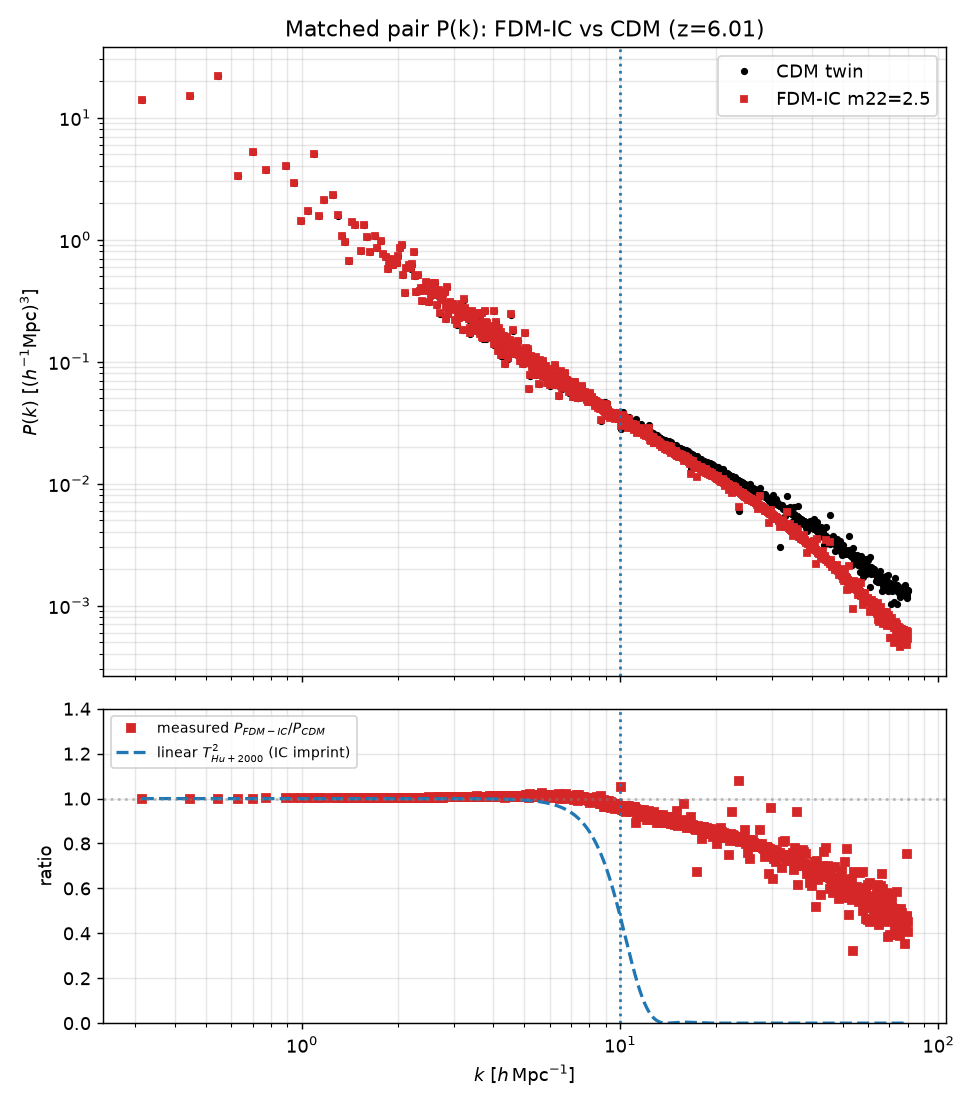
G4-F13 · The M&S replica: z=3 HMF ratio lands on the wave-calibrated form
✓ Ledger-4.c3 · axionCAMB · m₂₂=0.7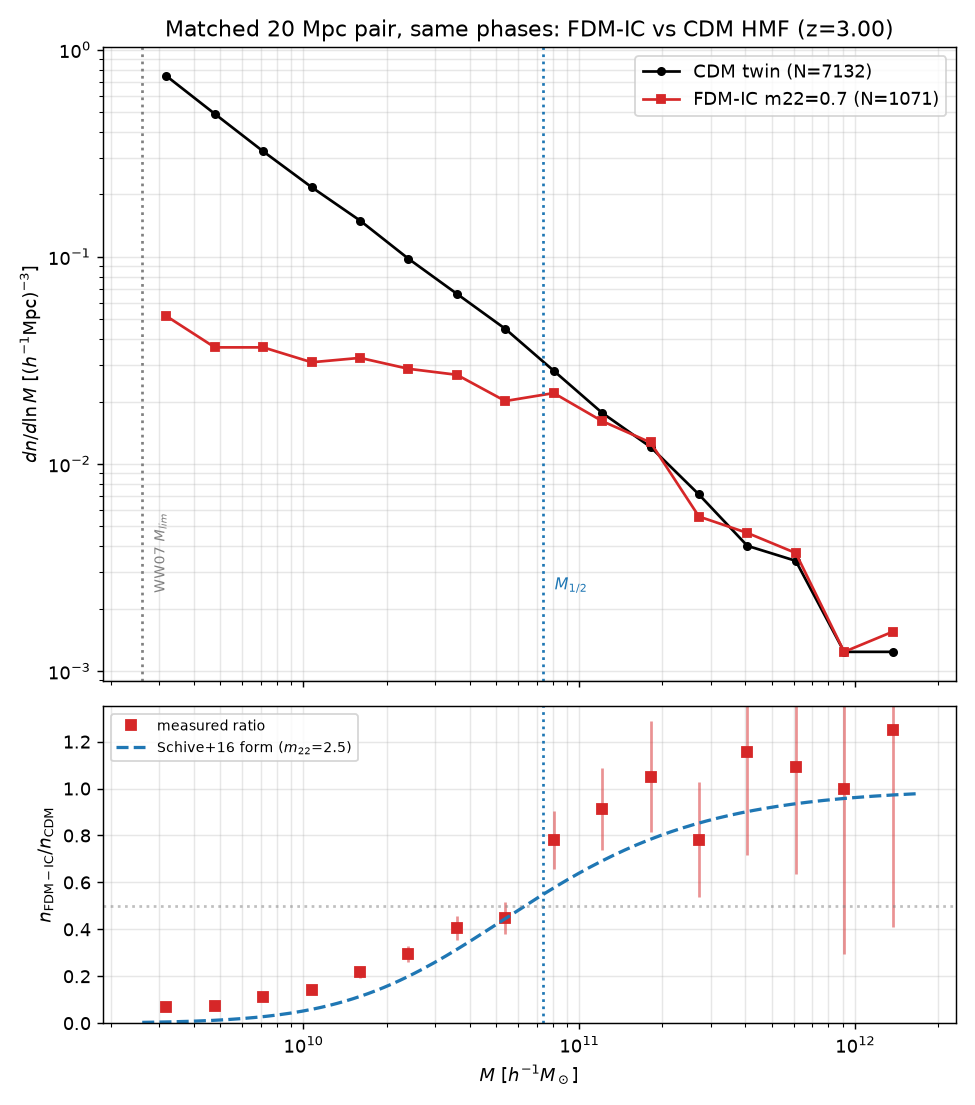
G4-F14 · Their halo-cleaning protocol: the survival asymmetry
✓ estimator systematic quantified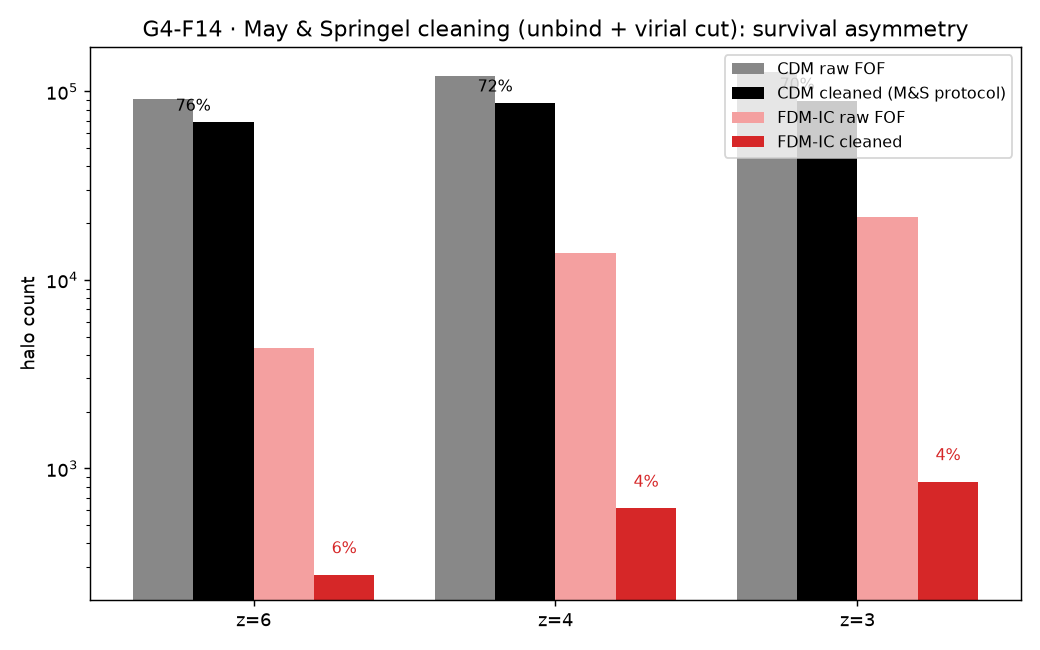
The GADGET-4 role — proving which effects are FDM.
A control only earns its keep if it is trustworthy and if it has no FDM degrees of freedom. GADGET-4 ΛCDM is exactly that: a universe with no soliton core, so anything FDM-specific shows up as a difference from it.
The GADGET-4 lane is the null hypothesis made concrete. The FDM mass tension, the soliton cores, the small-scale power suppression — each is a claim about a departure from CDM. Without a trustworthy CDM baseline run in the same pipeline, those departures are not clean. GADGET-4 supplies it.
1 · why a controlThe tension is FDM-specific — prove it
The headline FDM mass tension (JAXiON Analysis) lives on a quantity CDM does not have: the soliton core radius. CDM halos have cuspy NFW centres and no core–halo degree of freedom at all — so a CDM twin run cannot produce the tension. Running the same combine machinery against a CDM control returns a null, which is precisely what demonstrates the tension is a property of the FDM model, not an artifact of combining heterogeneous datasets.
2 · the setupBolshoi-cosmology ΛCDM
The control uses the standard Bolshoi cosmology so it sits on a well-known reference: matter density Ω_m = 0.27, fluctuation amplitude σ₈ = 0.82, Hubble parameter h = 0.70 (flat ΛCDM). These are the same parameters used in the matched FDM/CDM field comparison, so the only physical difference between the FDM box and this control is the dark-matter model itself.
3 · what it underwritesThe FDM-vs-CDM contrast
With the control validated (HMF 4%, P(k) 3%), the in-progress 512³ run will produce the matched-field FDM-vs-CDM suppression curve directly — same Gaussian field, same finder, dark-matter model the only variable. That is the quantitative form of "FDM suppresses small-scale structure", and it requires a CDM baseline this trustworthy to be meaningful.
The GADGET-4 method — TreePM N-body ΛCDM.
GADGET-4 is a classical collisionless N-body code: cold dark matter as gravitating particles, no wave physics. Gravity by TreePM, initial conditions by 2LPT, halos by FOF/SUBFIND.
Where JAXiON and GAMER evolve a wavefunction, GADGET-4 evolves particles under Newtonian gravity in an expanding box — the standard cold-dark-matter description, with no quantum pressure and no soliton.
Cold dark matter as particles
CDM is modelled as a set of N gravitating macro-particles sampling the dark-matter phase space. They feel only gravity and the cosmic expansion; there is no quantum-pressure term, so structure forms all the way down to the particle resolution — no small-scale cutoff, no core. This is exactly the physics FDM modifies.
Gravity: the TreePM split
GADGET-4 splits the gravitational force into a long-range Particle-Mesh (PM) piece, solved with an FFT on a periodic grid, and a short-range tree piece, evaluated with a hierarchical oct-tree multipole expansion. The PM part is fast and global; the tree part is accurate and local:
This is the same Poisson source as the wave codes — but the field is sampled by particles, not a wavefunction, so there is no $|\psi|^2$ interference structure in the density.
Initial conditions: 2LPT
The box is seeded at high redshift with second-order Lagrangian perturbation theory (2LPT): particles are displaced from a uniform grid according to the ΛCDM linear power spectrum, with the 2nd-order correction that removes the transients a 1st-order (Zel'dovich) start would carry. Matching the same Gaussian field to the FDM box is what makes the FDM-vs-CDM comparison controlled.
Halos: FOF then SUBFIND
Halos are identified with friends-of-friends (a linking-length percolation that traces the cosmic web's overdense regions) and then decomposed into bound subhalos with SUBFIND. The resulting catalog is what the halo mass function (Results) is built from and what underwrites the FDM-vs-CDM count comparison.
GADGET-4 (ΛCDM N-body) is the null. Same cosmology, same field, same finder as the FDM runs — but no wave physics. It has no soliton and no interference by construction, so it is the baseline that makes every FDM-specific effect, including the mass tension, attributable to the model rather than the method.
The ledger.
Two core–halo slope values
JAXiON soliton-fit gives β = 0.30 ± 0.03 ≈ Schive ⅓ — defensible (the uniform-grid gate-runaway was small-N noise, not a resolution bias; JXE-F7/F8). GAMER 2 Mpc AMR gives β = 0.03, R²=0 — inconclusive (box too small to span a mass range). The GAMER 20 Mpc AMR zoom walled at z≈11–12 (memory / MAX_PATCH) and can’t deliver the slope — so the headline β ≈ ⅓ is JAXiON’s (soliton-fit) since the GAMER lane hit its wall. The two are distinct: 0.30 is JAXiON, 0.03 is GAMER-2Mpc.
| Result | Value | Status | Evidence | Note |
|---|---|---|---|---|
| Core–halo slope | β = 0.30 ± 0.03 | defensible ≈ ⅓ | Analysis tab ▸ | CI 0.30–0.34; n=56 (live) / 48 (reports) / 46&28 by r_c-gate. Now defensible via the JAXiON soliton-fit (JXE-F8); the uniform gate-runaway = small-N noise (F7), not a resolution bias — JAXiON’s headline β since GAMER walled. |
| ρ_c convergence series | 44k→69k→109k→228k | never plateaus | jaxion_convergence ▸ | 512³→1024³→1536³→2048³ — the convergence-impossibility. |
| Boson-mass sweep | 0 / base / 17 / 60 | confirmed | Analysis tab ▸ | halos by z=7 at m₂₂ = 1 / 2.5 / 5 / 10 — heavier boson ⇒ more structure. |
| Power spectrum P(k) | measured | confirmed | Analysis tab ▸ | 1536³; matches expected shape. |
| Mass / energy conservation | |ΔL/L| = 0 · 301 frames | machine precision | Analysis tab ▸ | spectral split-step is symplectic. |
| Result | Value | Status | Evidence | Note |
|---|---|---|---|---|
| Genuine Schive solitons | r_c ∝ ρ_c−0.20; corr 0.81 | confirmed | corehalo_3seed ▸ | cores resolved; M_c–r_c consistency across 3 seeds. |
| Core–halo slope (stacked 3-seed) | β = 0.035 ± 0.129 | inconclusive | corehalo_3seed ▸ | n=94; consistent with 0; 1.5-dex range too narrow. |
| Core–halo slope (single-seed) | β = −0.17 ± 0.21 | inconclusive | corehalo ▸ | n=45; verdict in file: "bigger box needed". |
| Core–halo scatter | 0.50 dex | measured | corehalo_3seed ▸ | — |
| 20 Mpc Stage 1 (the headline) | z ≈ 4.5 → z = 4 | in progress | catalog_z4 ▸ | → catalog → Stage 2 zoom → Stage 3 slope fit. The decisive ⅓ test. |
| 20 Mpc prelim catalog (z~6) | resolution gate CLEAN | de-risked | prelim_z6 ▸ | GO/NO-GO passed early. |
| Result | Value | Status | Evidence | Note |
|---|---|---|---|---|
| HYBRID scheme support | GRAMFE + wave wired | validated | chart pending ⚠ | configure.py + GramFE solver sources + LSS_Hybrid test problem present (hybrid40_proof.md). |
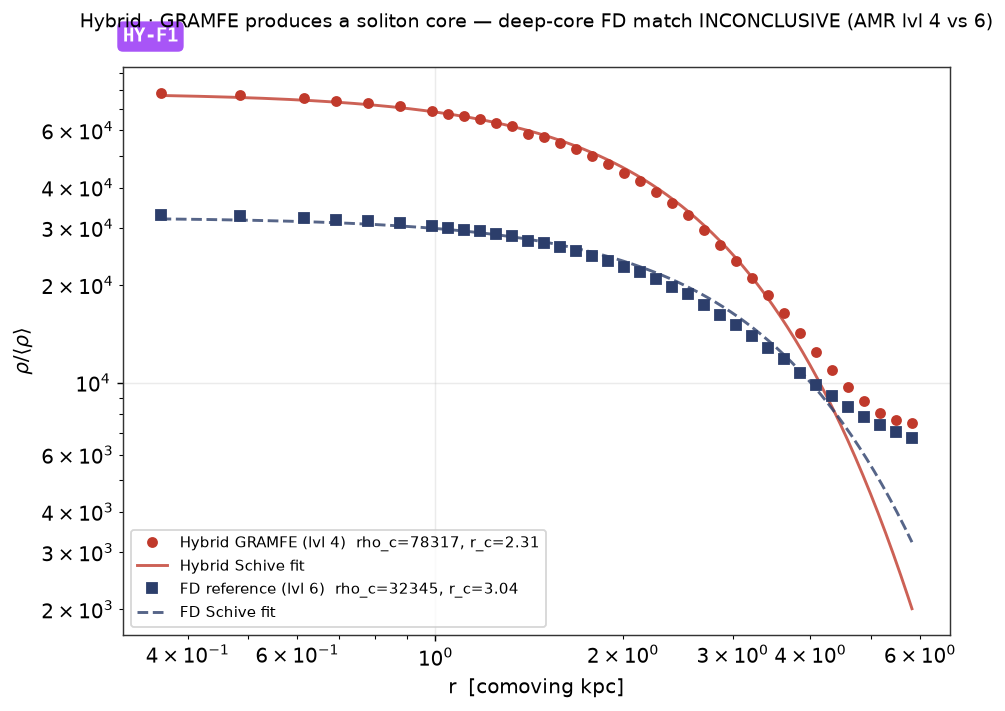
| Hybrid vs FD (bulk, matched-z) | large-scale agreement | validated | chart pending ⚠ | data in hybval_z9/ (seeds 1/1003/7777, z=9) — not yet plotted. |
| Deep-core ρ_c (hybrid vs FD) | inconclusive | depth-mismatch | chart pending ⚠ | refinement-depth mismatch, NOT a solver failure. |
| 40 Mpc cluster production | provisioned → dropped | dropped (cost) | decision (no chart) | cluster lever-arm judged unnecessary; headline covered by 2 + 20 Mpc. |
| Result | Value | Status | Evidence | Note |
|---|---|---|---|---|
| Production run | 512³ (1.34×10⁸ particles) | in progress | slice ▸ | confirmed at Sync-Point 0 = 512³ exactly. Current run (256³ was validation only). |
| 256³ validation (Phase 0/1) | all blind gates PASS | passed | slice ▸ | — |
| Power spectrum P(k) @ z=0 | vs linear × D(z)² | passed (256³) | pk_z0 ▸ | 512³ re-test pending run completion. |
| Halo mass function @ z=0 | vs Sheth–Tormen / Tinker | passed (256³) | hmf_z0 ▸ | 512³ overlay (convergence.py) pending. |
| Result | Value | Status | Evidence | Note |
|---|---|---|---|---|
| Phase 0 kill-test (1D) | gradients flow; m recovered | GO | p0_gradients ▸ | usable ∂obs/∂m through soft refinement. |
| Phase 1 (3D soliton) | r_c/dx ≥ 8, gradients valid | GO | p1_3d ▸ | converged core uniform JAXiON can't reach. |
| Phase 2 — ∂obs/∂m end-to-end | AD/FD → 1 (unif 0.999, AMR 1.011) | verified | p2_grad ▸ | at h=1e-3, through a cosmological collapse. |
| Phase 2 — inversion for m | m = 1.0346 (true 1.05) | bias −1.5% | p2_inversion ▸ | 5 iterations. |
| Phase-3 root cause | two-way coupling starves the coarse | diagnosed | one-way recovers coarse 76→156 ≈ ref 180; spatial-BC hypothesis falsified | |
| Phase-3 regime check | Phase-2 ran at m=1 = NO sub-grid soliton (ρ_c flat n=16→160) | key | a genuine sub-grid soliton appears only at m≥2 (ρ_c rises ×200+) | |
| Phase-3 verdict | at m=2 the AMR fine block gets 1–3% of ref | method limit | two-field diff-AMR can't resolve a dynamical sub-grid soliton → needs redesign; science pivoted to the uniform solver | |
| ↳ Differentiable boson-mass inference (uniform) — the goal AMR was meant to enable, delivered on the uniform solver: | ||||
| ∂obs/∂m verified (uniform) | AD/FD = 0.999–1.002 | verified | Stage 1 | |
| Core→m sensitivity | 10% core ⇒ σ_m ≈ 0.3–2% | result | Stage 1 | |
| Differentiable SBI of m | recovers m to ~5% (1.15 +.06/−.05, true 1.10) | result | Stage 2 | |
| Differentiable dwarf↔Lyα tension | disjoint: dwarf m₂₂<2.5 vs Lyα m₂₂>11 → 5.4σ (rigorous 8.7σ) | ◐ | stage3_tension ▸ | |
| Result | Value | Status | Evidence | Note |
|---|---|---|---|---|
| Tension (published likelihoods, combined) | 8.7σ | measured | moneyplot ▸ | v2 — proper product of published constraints. |
| σ_CH scatter resolution | does NOT resolve tension | measured | sigma_ch ▸ | σ_CH≈0.2 dex (Chan+2022) marginalized. |
| Obs A — dwarf cores | UPPER: m₂₂≈1 (<1.1 @95%) | reproduced | obs_a ▸ | Schive / Marsh&Pop / Chen / GM. |
| Obs B — Lyman-α | LOWER: m₂₂ > 20 (2σ) | reproduced | obs_b ▸ | Iršič 2017. |
| Obs C — satellite counts | LOWER bound | reproduced | obs_c ▸ | — |
| Sign-flip (A-upper vs B/C-lower) | = origin of the tension | established | moneyplot ▸ | — |
S3 · s3://fdmsim-artifacts-297904677595/ → amr/corehalo/ (fits) · lab/runs/ + lab/harvest/ (JAXiON 128–2048 logs) · gadget4/ · hybval_z9/ · analytics.json · reports/
On-box · /opt/gw/stage1_20mpc (Stage 1) · /opt/gw/diffamr_p* · /opt/gw/tension_v2 · /opt/gadget4/runs/bolshoi512
Master text · context/RESULTS_LEDGER.md (read first, update after every analysis)
Evidence coverage · 23/26 entries linked · gap: Hybrid validation chart not yet plotted (hybval_z9 data exists)
Last updated · 2026-06-28 · headline (20 Mpc AMR slope) pending